Exploring Scotland, A Journey Through Its Rich History and Scenic Beauty

Introduction

There’s something about Scotland that grabs you by the soul. It’s a country where every turn reveals another dramatic vista, where history seeps from ancient stones, and where the landscape whispers tales of the past.

While I’m Scottish, my wife Josanne is a New Zealander who’d seen relatively little of my homeland beyond Edinburgh, Glasgow and Aberdeen. After work in Paris and trips to Rome and Venice, we were heading back to take the high road home in June 2024. It’s taken me ages to write this up, but I’ve finally done it!

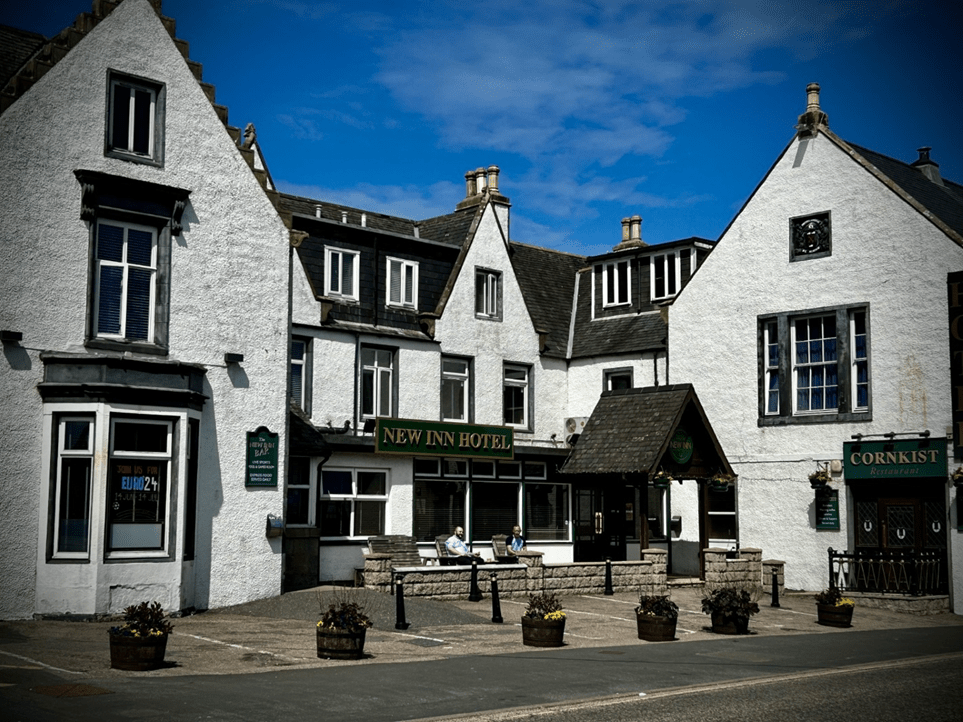
We started our 11-day journey in Ellon, Aberdeenshire, where I lived from 1978-1985 when my dad worked on the oil rigs. Josanne and I returned there to marry in 1992 at St Mary’s on the Rock Church, with our reception at the New Inn Hotel.

Having visited Edinburgh several times before, we deliberately bypassed Scotland’s capital.

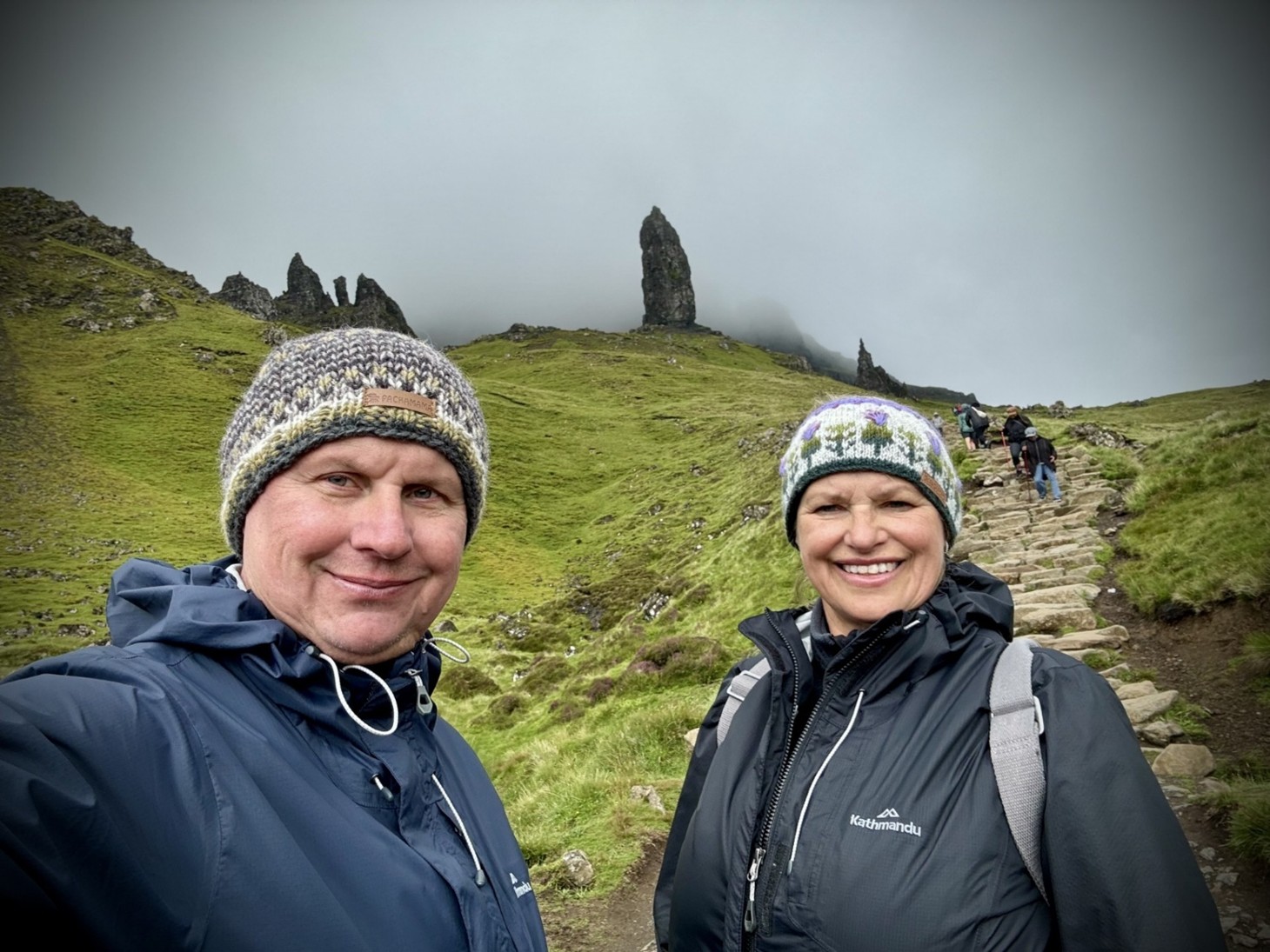
We’d brought warm, wet weather clothing. Even in summer, we expected rain. I didn’t reckon on buying a beanie on Skye because the wind was so cold on my ears though!

DAY 1-2: ELLON, ABERDEENSHIRE (22-23 JUNE)

Our stay here was mainly catching up with old friends (including the odd beer at the Brew Dog pub). Despite having lived here, I was still surprised at how long it remains light in Scotland. We left the pub after 11pm and it still wasn’t dark. I’m not difficult to keep amused!

St Mary-on-the-Rock was designed by George Edmund Street and built in 1871, based on the medieval parish church destroyed in 1776. It’s a Grade A listed building with floor tiles by Minton and excellent stained glass.

The New Inn Hotel is a historic coaching inn built in 1704, overlooking the River Ythan.  It was a changeover point for horses between Aberdeen and Peterhead. It has been part of the Ellon history for over 320 years.

The historic New Inn Hotel in Ellon, Aberdeenshire, built in 1704, stands as a charming coaching inn with a rich history.

DAY 3: BALLATER (24 JUNE)

We set off early for Ballater, working out travel times and what we wanted to see along the way, our modus operandi throughout Scotland. We said goodbye to my best man Kevin and his wife Wendy, hoping to return their hospitality when they visit New Zealand.

Ballater is “The Royal Village” in Royal Deeside, about 40 miles from Aberdeen, most famous for Balmoral Castle. Many shops display “By Royal Appointment” warrants, I suspect an advantage of having the Royals as neighbours!

Our reason for starting here was to visit Balmoral Castle. While I’d never been, it was what I expected, though Josanne said it was smaller than she thought. Prince Albert purchased it for Queen Victoria in 1852. She called it “my dear paradise in the Highlands.”

It has extensive, tidy gardens, including vegetable gardens to feed the Royal Family when in residence (we were there before they arrived, so no chance of bumping into a King, Queen, Prince or Princess)!

This was probably the last day of good weather until we had another sunny day in Mull. Thankfully, having been brought up in Scotland, I wasn’t expecting days of warm sunshine like a New Zealand summer.

We also stopped at Crathie Kirk, where the Royal Family worships when at Balmoral. Unfortunately closed to visitors while we were there, we could only walk around outside. While built in 1895 during Queen Victoria’s reign, there had been previous churches dating back to the 9th century.

Exterior view of Crathie Kirk, a church built in 1895 during Queen Victoria’s reign

We stayed at the Balmoral Arms, a traditional Scottish hotel in the heart of Ballater, built in the Victorian era.  They did a lovely breakfast where Josanne experienced haggis as part of a traditional Scottish breakfast for the first time! She enjoyed it, though unlike me, her breakfasts tended to be healthier.

A view of Ballater’s main street, showcasing its historic buildings and the iconic church spire under a clear blue sky.
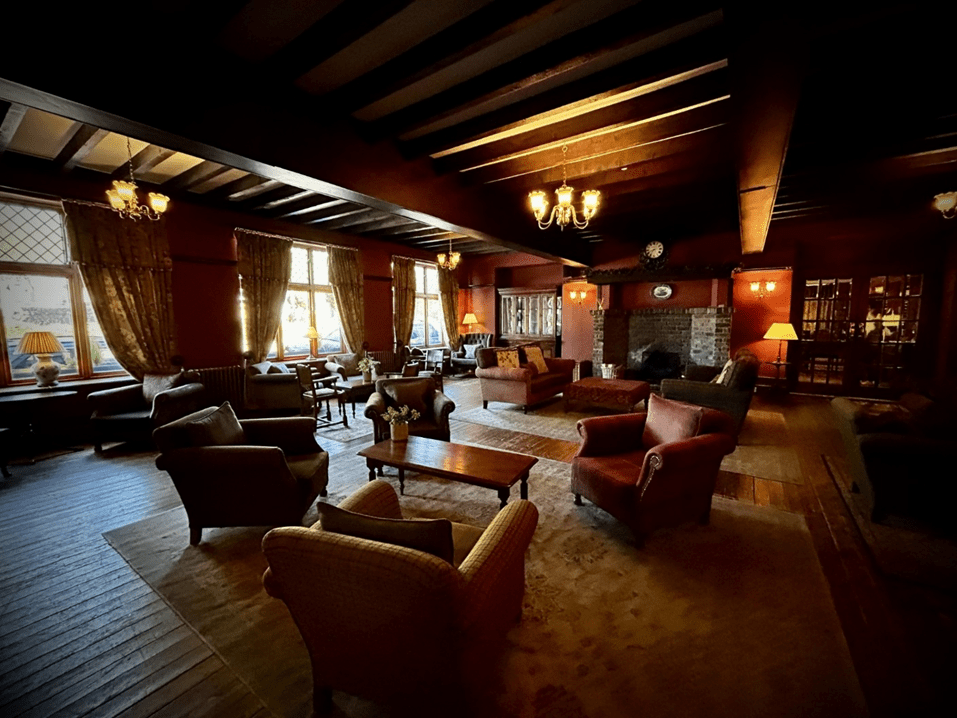
The cozy interior of the Balmoral Arms hotel featuring comfortable seating, warm lighting, and a welcoming atmosphere perfect for relaxation.

DAY 4: INVERNESS (25 JUNE)

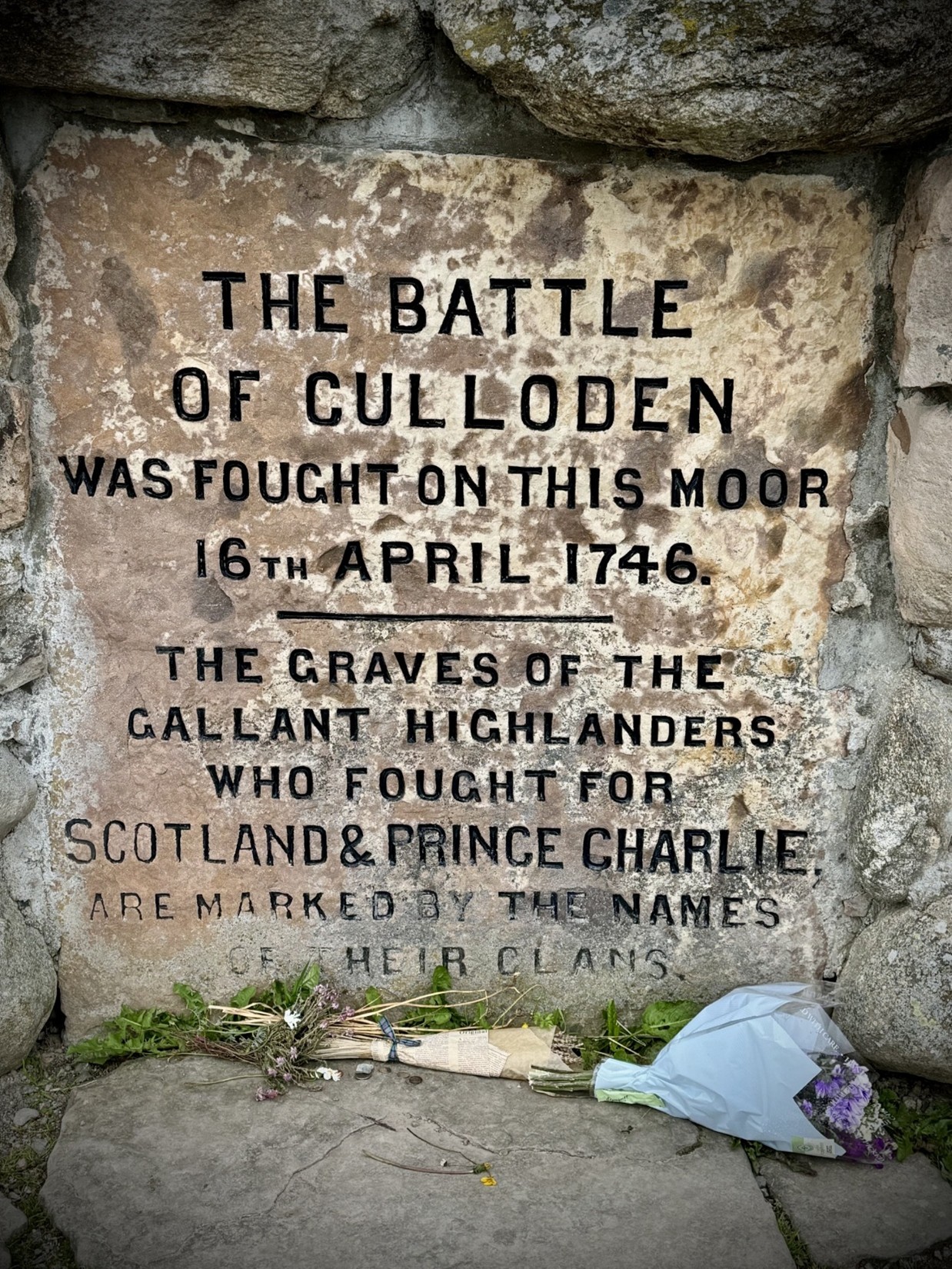
We headed to Inverness to see the Battle of Culloden site, the famous 1745 battle from the Jacobite Rising. At a very high level, the battle lasted less than an hour but around 1,500-2,000 Jacobites were killed versus approximately 50 government troops. It marked the end of the Jacobite uprising and the Highland clan system.

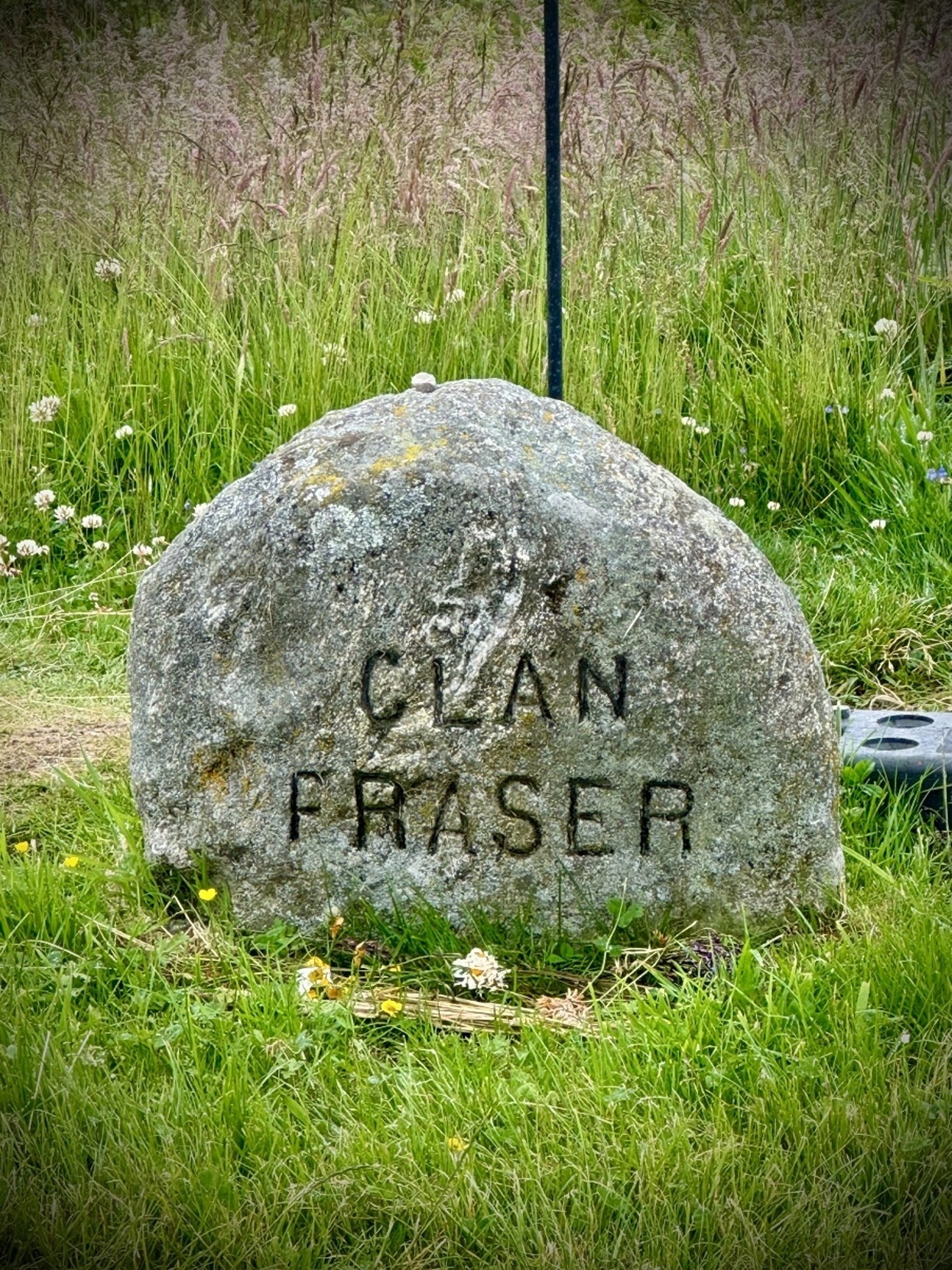
The battlefield is well-preserved and you can walk the actual ground where clansmen charged. Seeing the undulating and stony ground and understanding their weapons versus government troops, you can only tip your hat at the bravery of those men. The visitor centre excellently explains what took place with lots of clan markers to show who was located where at the time the battle commenced.  It was moving, and everyone seemed sombre and respectful.

By the time we left Culloden, that most famous of Scottish weathers (drizzle) had kicked off! From here, we headed to Cawdor Castle, which I recall from studying Macbeth at high school!

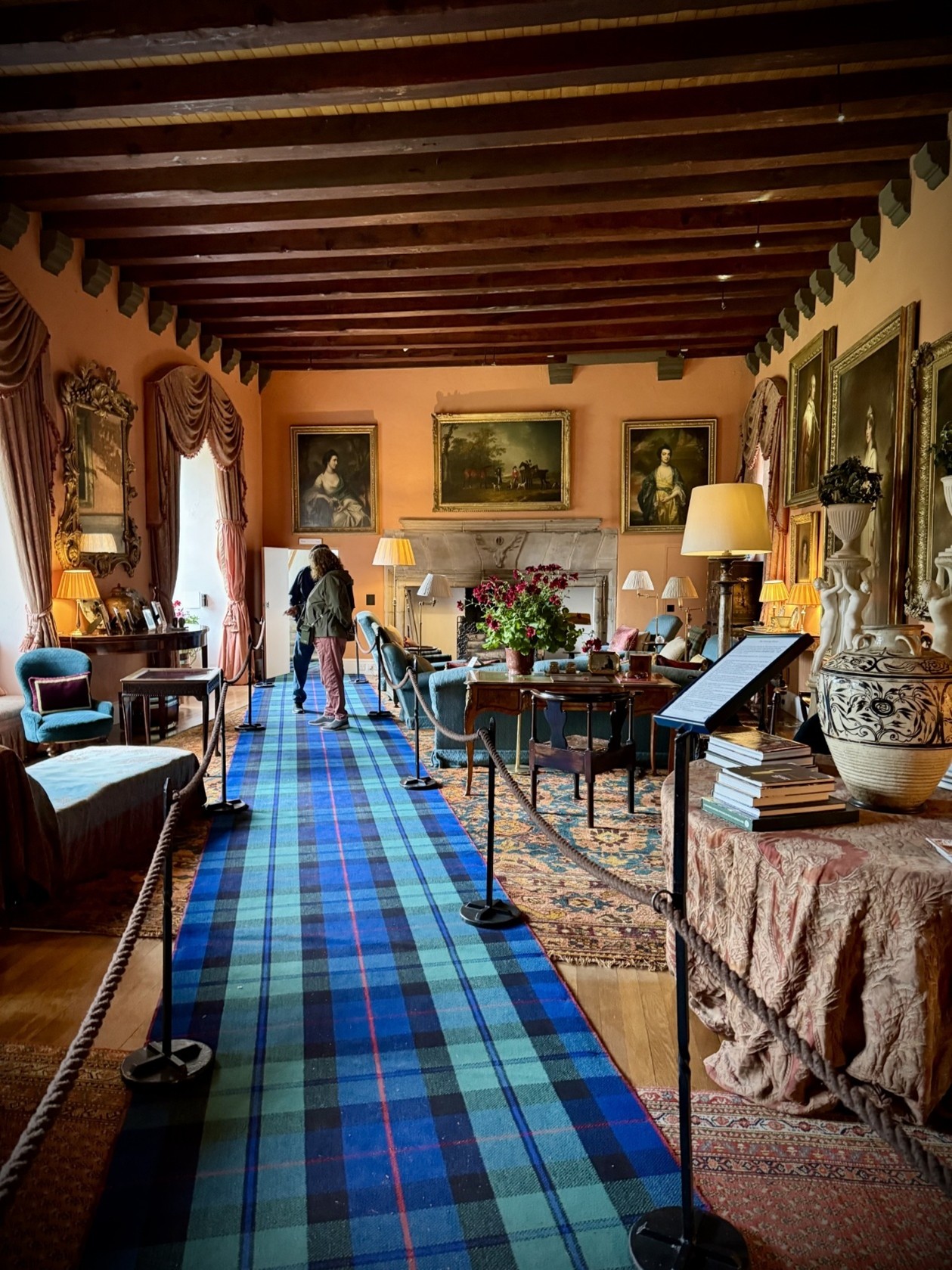
Cawdor Castle is still a family home, built in the 14th Century, most famous for its Shakespearean connection where Macbeth, the Thane of Cawdor, allegedly lived. The castle is built around an ancient holly tree still visible in the basement. Legend says the original Thane was told in a dream to build where a donkey rested.

It’s very well-preserved with beautifully kept gardens.

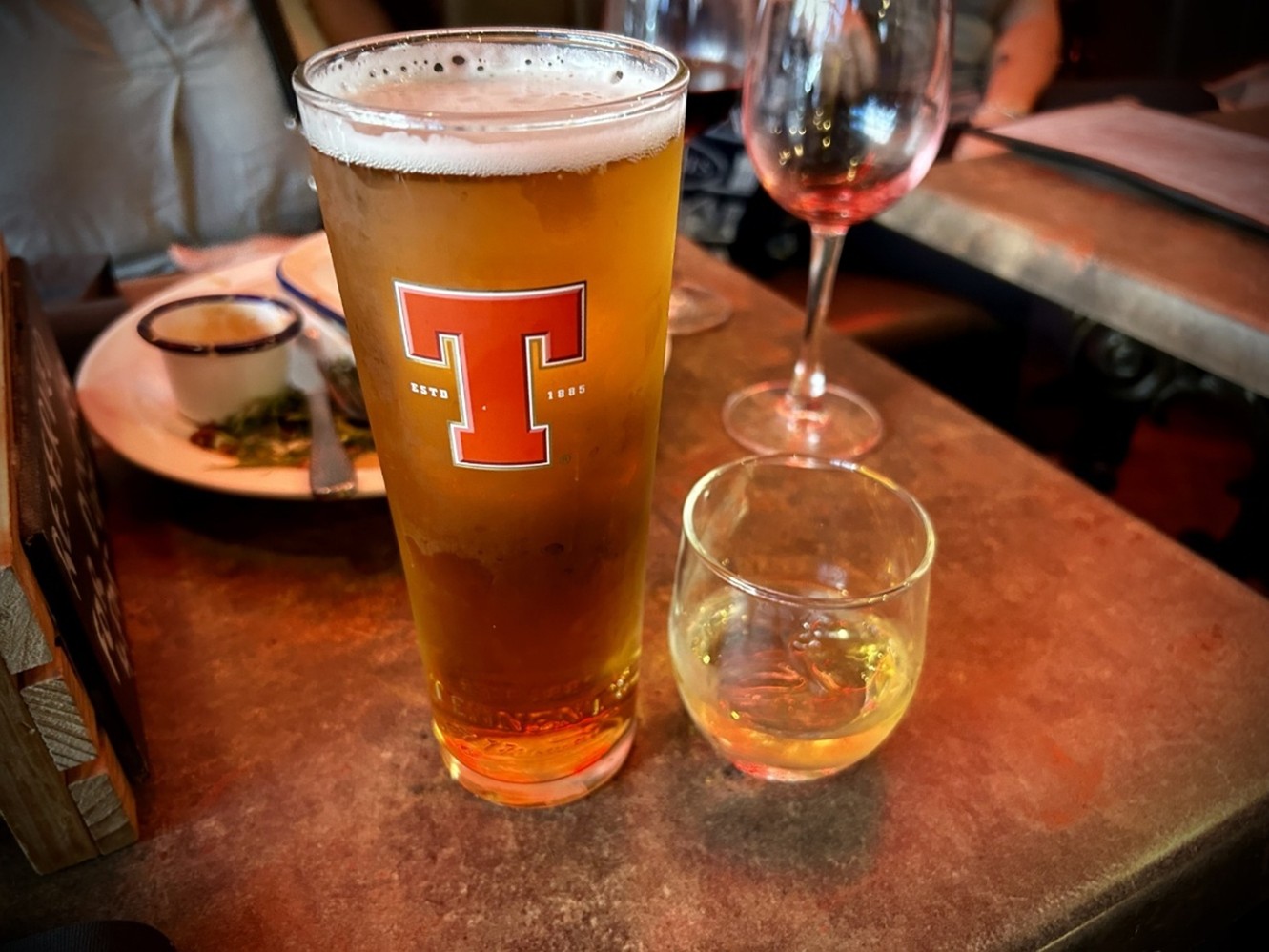
We spent that night in Inverness at the Ballifeary Guest House with traditional Highland hospitality in a handy location. We went into town for dinner, came across a pipe band playing in the city centre, and I went traditional with a pint of Tennents and a whisky chaser!

The next day before setting off, I made time for a quick Scotch pie. It was delicious and took me straight back to my youth where school lunch was invariably a Scotch pie and a custard slice

DAY 5: INVERNESS TO BROADFORD, ISLE OF SKYE (26 JUNE)

From Inverness, we headed to Skye, something that Josanne had been most excited about (though it was also where we had the worst weather).

First stop was Urquhart Castle. We arrived so early it wasn’t open yet, so had to wait around 30 minutes. We could have carried on, but it seemed a shame to waste the opportunity, and while Josanne said it was fine to carry on, I knew there was a hidden subtext that said “don’t even think about it“!

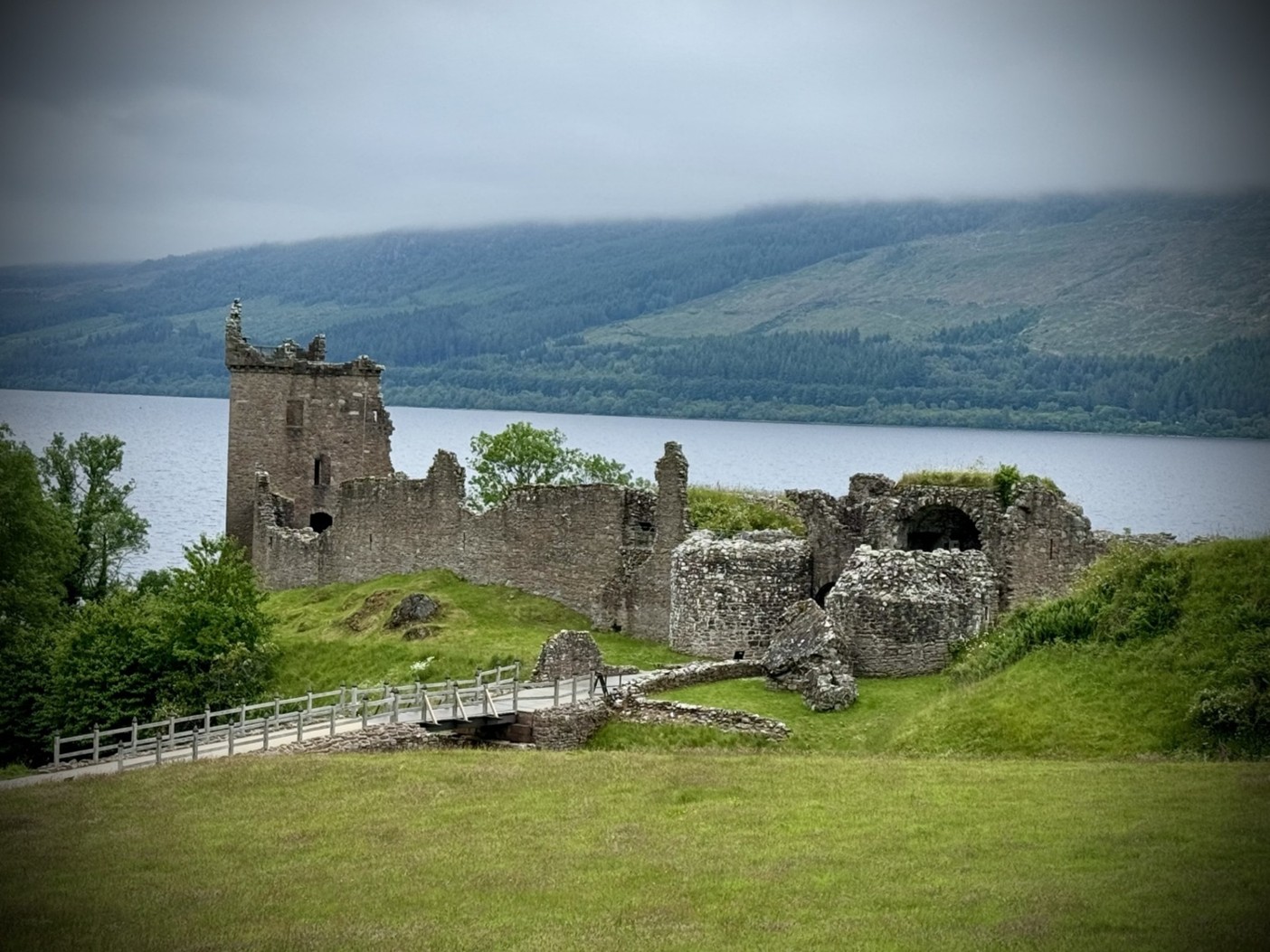
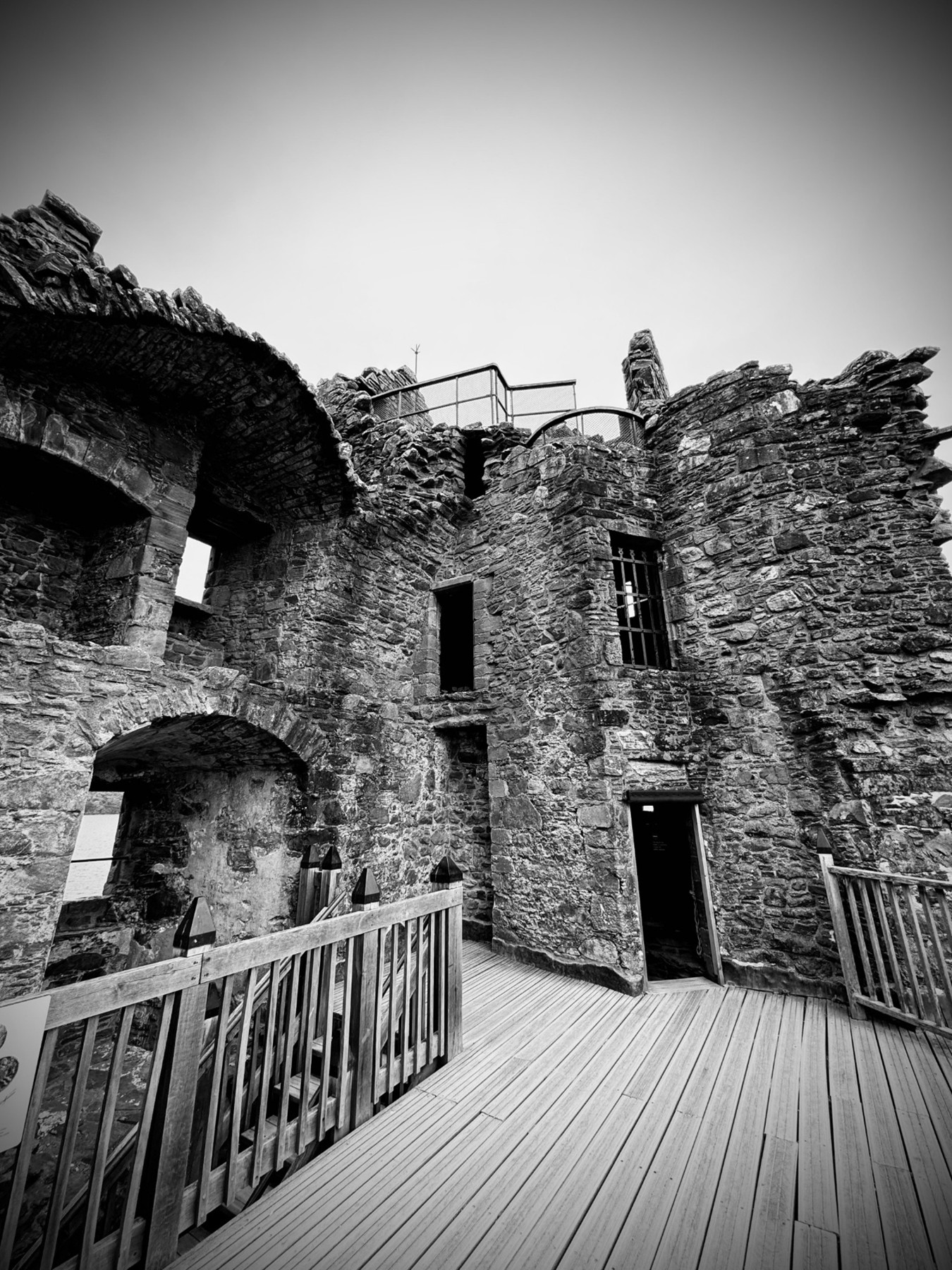
Urquhart Castle is about 20 miles from Inverness on the banks of Loch Ness. Once one of Scotland’s largest castles, it was destroyed in 1692 to prevent Jacobites from occupying it. It has over 1,000 years of history, occupied since the 6th century. You can see the impressive Grant Tower, offering stunning views across Loch Ness.

Most Nessie sightings are allegedly near this location. I can’t profess to having seen even a ripple. Maybe Nessie doesn’t like tourists. Or maybe it was too early.

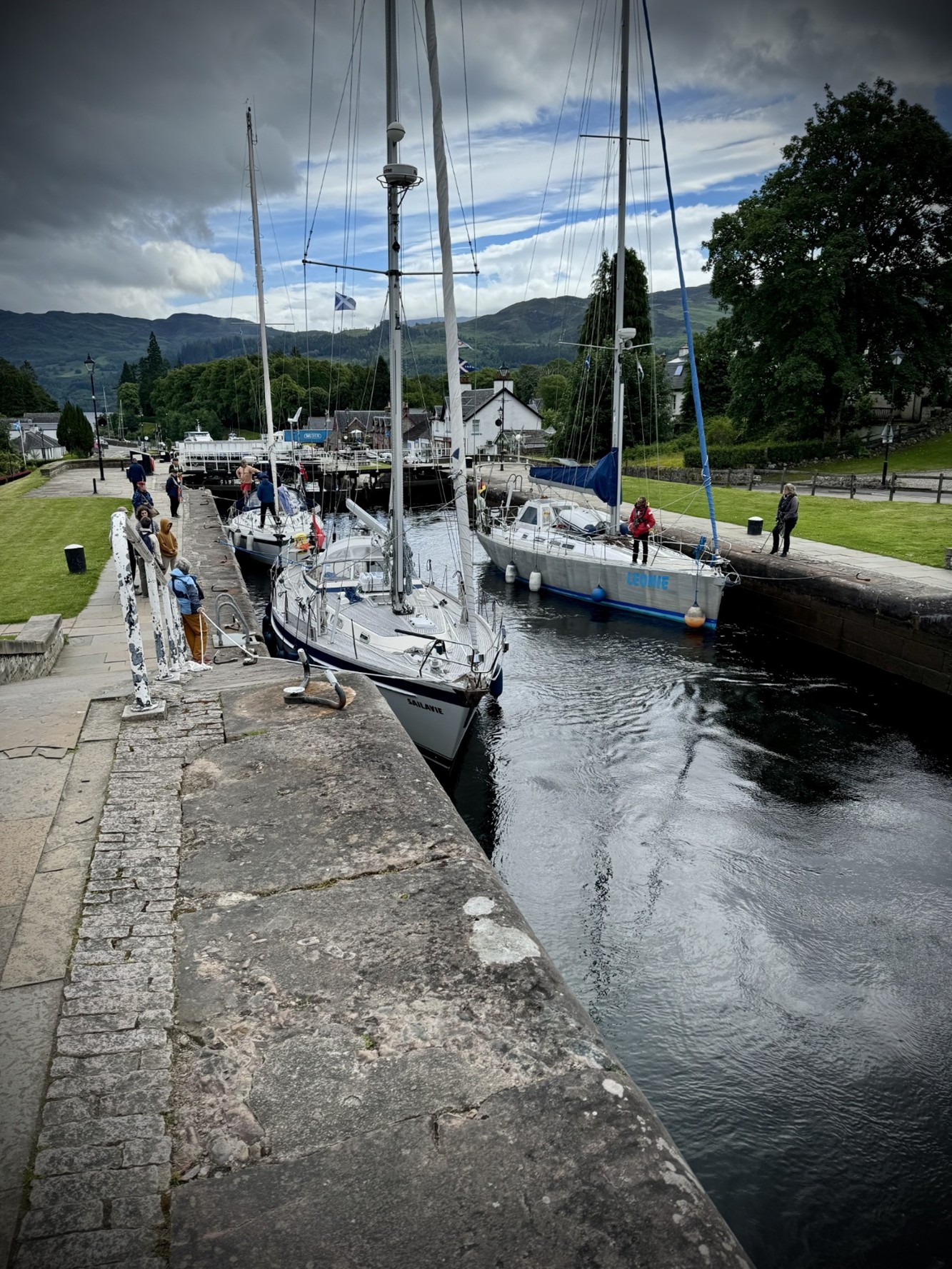
Being chilly, we grabbed tea and cake in the café before heading towards the Caledonian Canal at Fort Augustus.

The Caledonian Canal is a 60-mile engineering marvel connecting Scotland’s east and west coasts. Designed by Thomas Telford and opened in 1822, it links four lochs, Ness, Oich, Lochy, and Linnhe.

There are 29 locks, including Neptune’s Staircase (8 locks) at Banavie—the longest staircase lock in Britain. The Fort Augustus section features 5 locks descending into Loch Ness.

Next was Eilean Donan Castle, which was a highlight for me. Supposedly Scotland’s most iconic castle, it is situated on a small island where three lochs meet. Originally dating from the 13th century as defence against Viking raids, it was destroyed in 1719 by government ships during the Jacobite uprisings.

The castle lay in ruins until restored between 1919-1932. It’s featured in numerous films including “Highlander” and James Bond’s “The World Is Not Enough“.  It is named after Saint Donan who came to Scotland in the 7th century.

It is spectacular inside with rooms furnished to show castle life. It’s one of those castles you can quite happily just sit and look at, especially on the outside. Enchanting, enigmatic, evocative. Don’t miss this if travelling near Skye!

Someone told us the drive to Plockton was very picturesque. This small village on the shores of Loch Carron was only about 6 miles from Kyle of Lochalsh (where the Skye Bridge connects). Due to the Gulf Stream, it actually has Cabbage Trees which are common in New Zealand. It’s most famous as the filming location for Hamish McBeth (the fictitious town of “Lochdubh“). We visited a small gin distillery, though as I was driving, Josanne did the tasting.  We grabbed a couple of small bottles for our travels. The locals here were incredibly friendly.

Scenic view of boats anchored at Plockton.
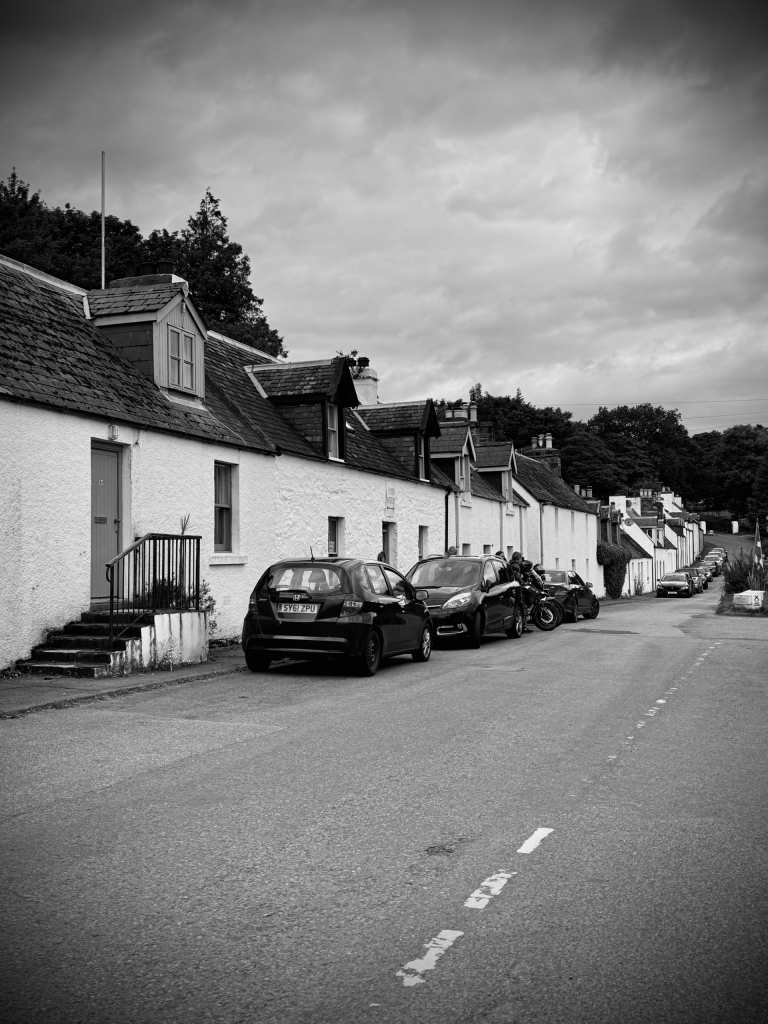
Plockton’s main thoroughfare

By the time we’d reached Skye, the weather had turned very Scottish—cold, windy and rainy. Our first night was at the Broadford House, very basic but with friendly, helpful staff. We grabbed fish and chips and sat at the water’s edge eating them during a brief respite from the rain.

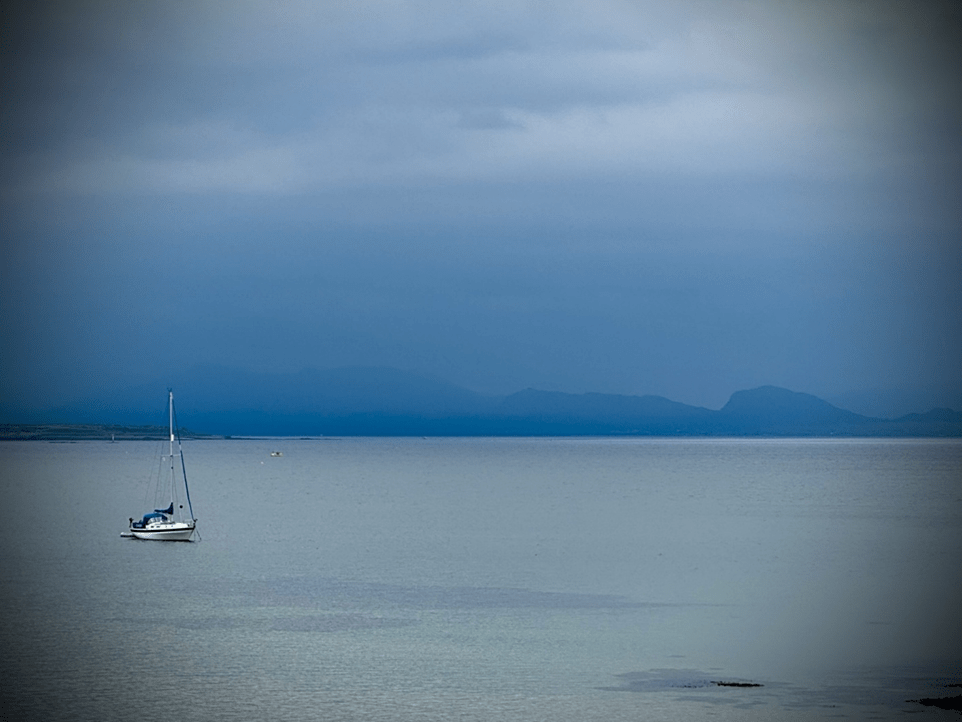
A solitary sailboat gliding on the calm waters of Broadford, Isle of Skye, against a backdrop of dramatic, moody skies.

On awakening next morning, it was as if we’d stepped back into winter, howling wind, horizontal rain and definitely not summer temperatures. On the bonus scale though, at least there were still no midges!

Not letting weather put us off, we jumped in the car with wet weather kit and headed for Sligachan Bridge. Built in the early 1800s by Thomas Telford, we definitely got to see it at its wettest! You normally have good views of the Cuillin mountains in the background.

Legend says if you dip your face in the pools beneath the bridge, you’ll receive eternal beauty. I’d challenge that by suggesting if we’d dipped our faces in the pools, we’d have caught hypothermia!

DAY 6-7: PORTREE, ISLE OF SKYE (27-28 JUNE)

Next stop was Portree, where we’d spend a couple of nights to tour around.

Portree is Skye’s capital and largest town. The name means “King’s Port” in Gaelic, received following James V’s 1540 visit. It’s famous for its colourful harbour houses and is the main hub for exploring Skye’s attractions.

The rain hadn’t stopped, so we looked around shops. There were lovely colourful houses on the waterfront, so we walked up the hill to see them before returning to the car.

Things weren’t drying out, so we thought visiting Talisker Whisky Distillery would be excellent. Alas, the wet weather meant we weren’t the only ones with this idea and it was packed with no tour places available all day.

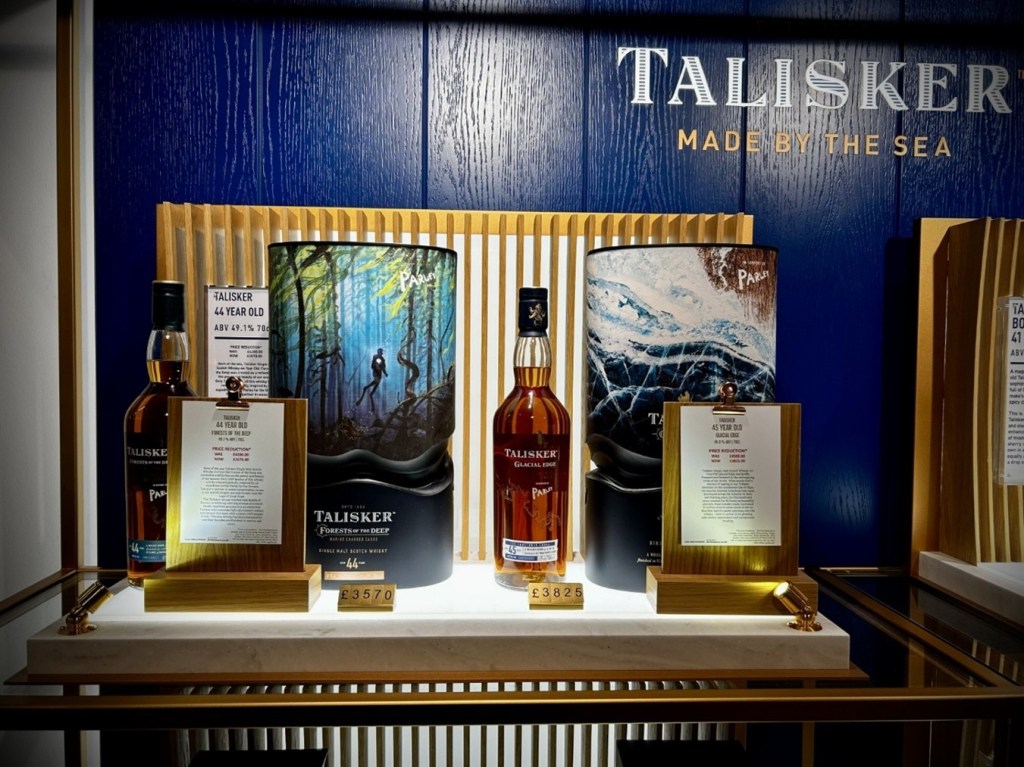
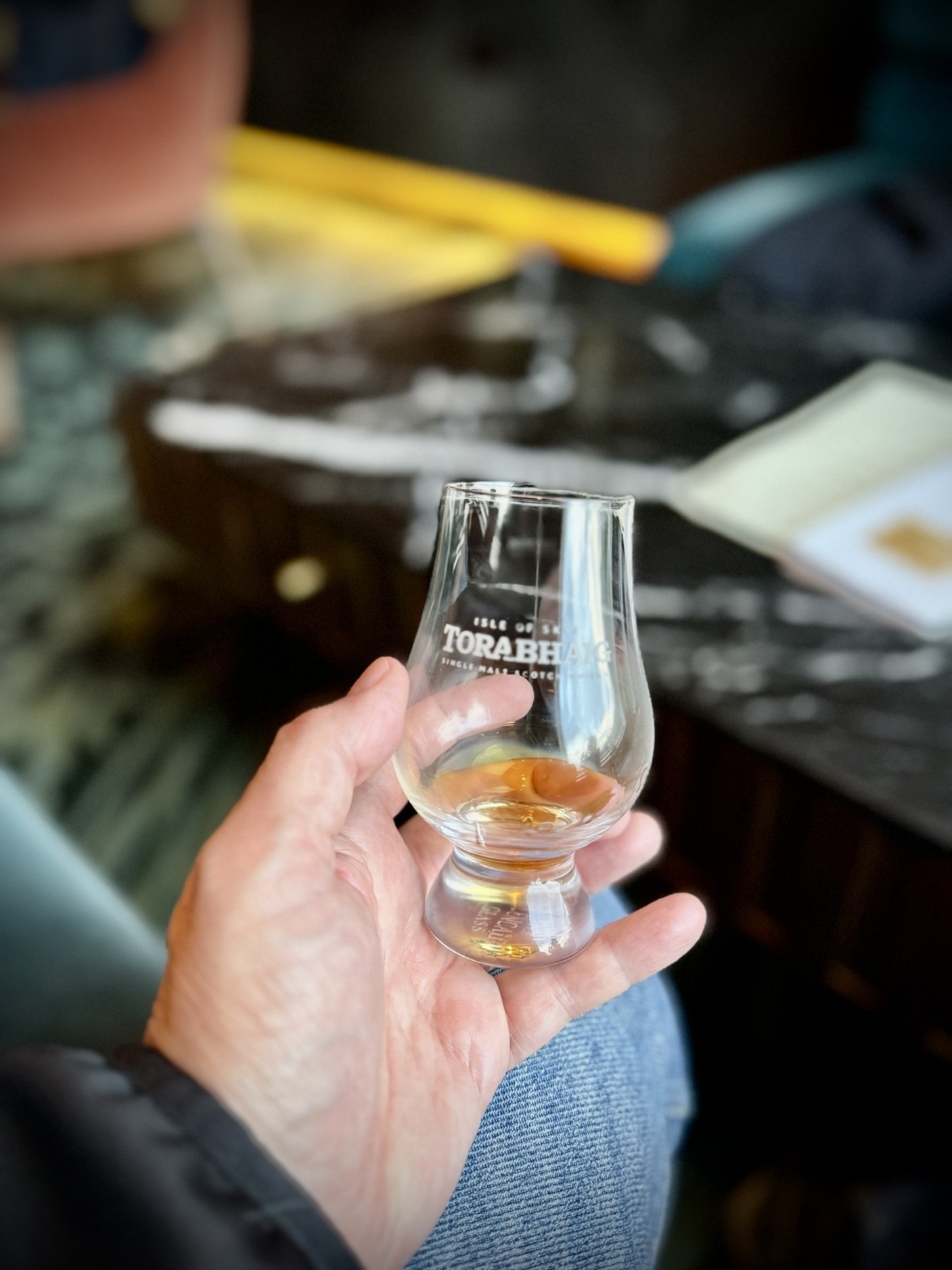
We tried a couple of whiskies and were given the great advice of purchasing some Talisker Dark Storm at duty free. You can only buy it there (it’s not even available at the distillery) and it’s now one of my firm favourites!

There were lots of bottles to choose from, including a 45-year-old finished in the arctic circle. At £3,825, it was an absolute snip, reduced from £4,500!

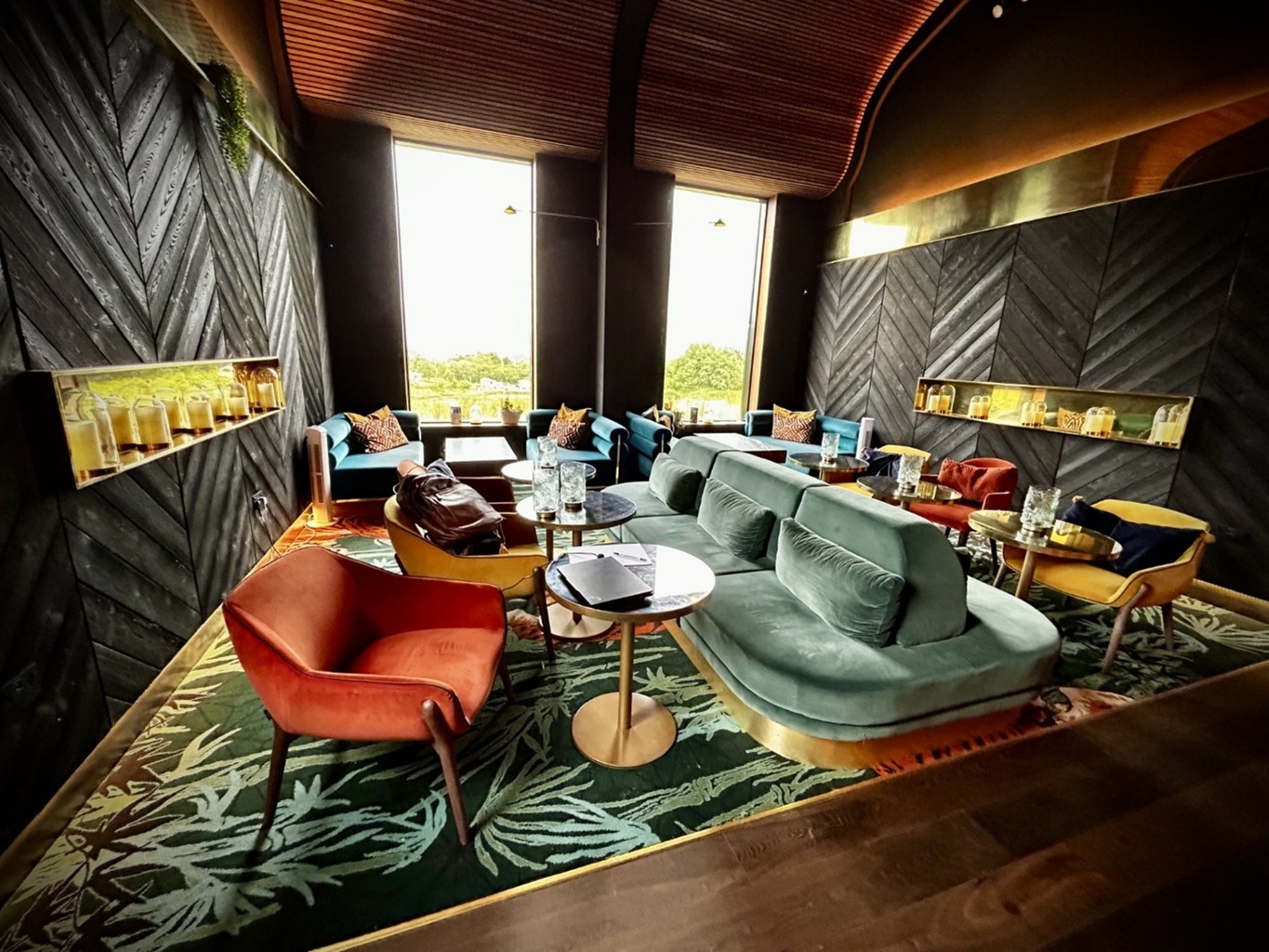
We stayed at the Bracken Hide hotel in self-contained Nissan style huts, with the restaurant and bar a short walk away in the main building. The first night we heard about a man in a van making pizzas (I drove down and waited in the car as it was still raining). The second night we ate in the restaurant which was excellent. We had the best breakfasts of the whole week here. They had an incredibly well-stocked bar with just about every whisky you could think of.

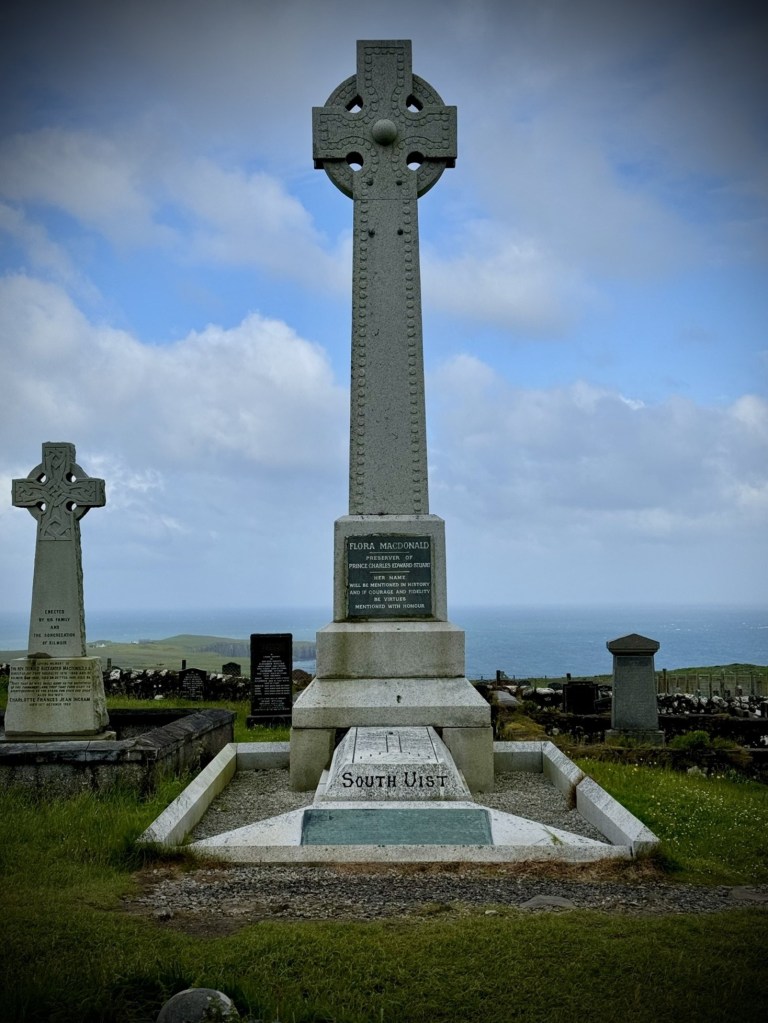
On the 28th, we did quite a bit of driving. We drove from Portree to Uig and onto Kilmuir to see Flora MacDonald’s resting place. My mum’s side are MacDonalds, so we wanted to visit Flora’s grave. Flora is renowned in Scottish history for helping Bonnie Prince Charlie escape after losing at Culloden. She smuggled him from South Uist to Skye. This story is immortalised in the Skye Boat Song.

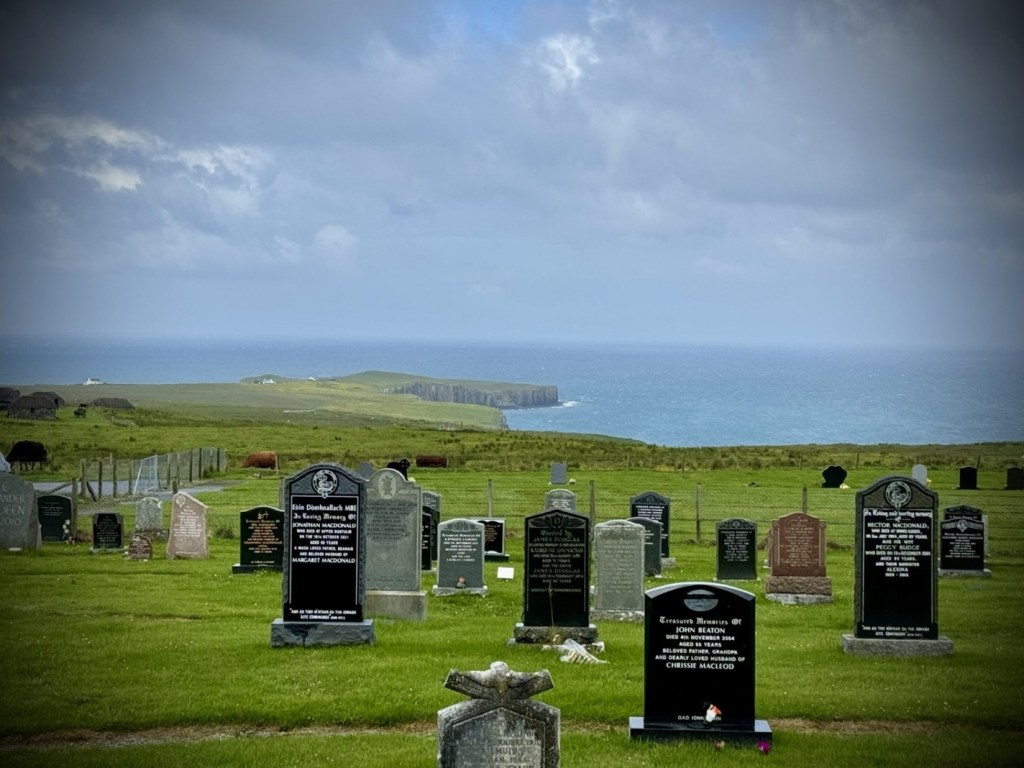
Flora MacDonald died on 5th March 1790 and is buried at Kilmuir Cemetery. Her body was allegedly wrapped in a sheet in which Bonnie Prince Charlie had slept. The words engraved on her memorial come from Samuel Johnson.

Flora isn’t the only famous person buried here. There’s a magnificent grave marker with a carved effigy of a knight in armour marking Angus Martin’s grave (Aonghas na Geoithe, or “Angus of the Wind”).

Local legend claims Angus stole this tomb slab from an early Scottish king’s grave on Iona and carried it here himself. Though historians doubt this, it’s a great story!

Up at the graveyard was stark and open landscape—beautiful yet basic. The wind was howling in from the sea with no warmth in it at all. It was at the gift shop where I succumbed and bought a woollen beanie! Josanne did likewise.

There was also a small museum showing how people lived in years gone by. They were far hardier than me!

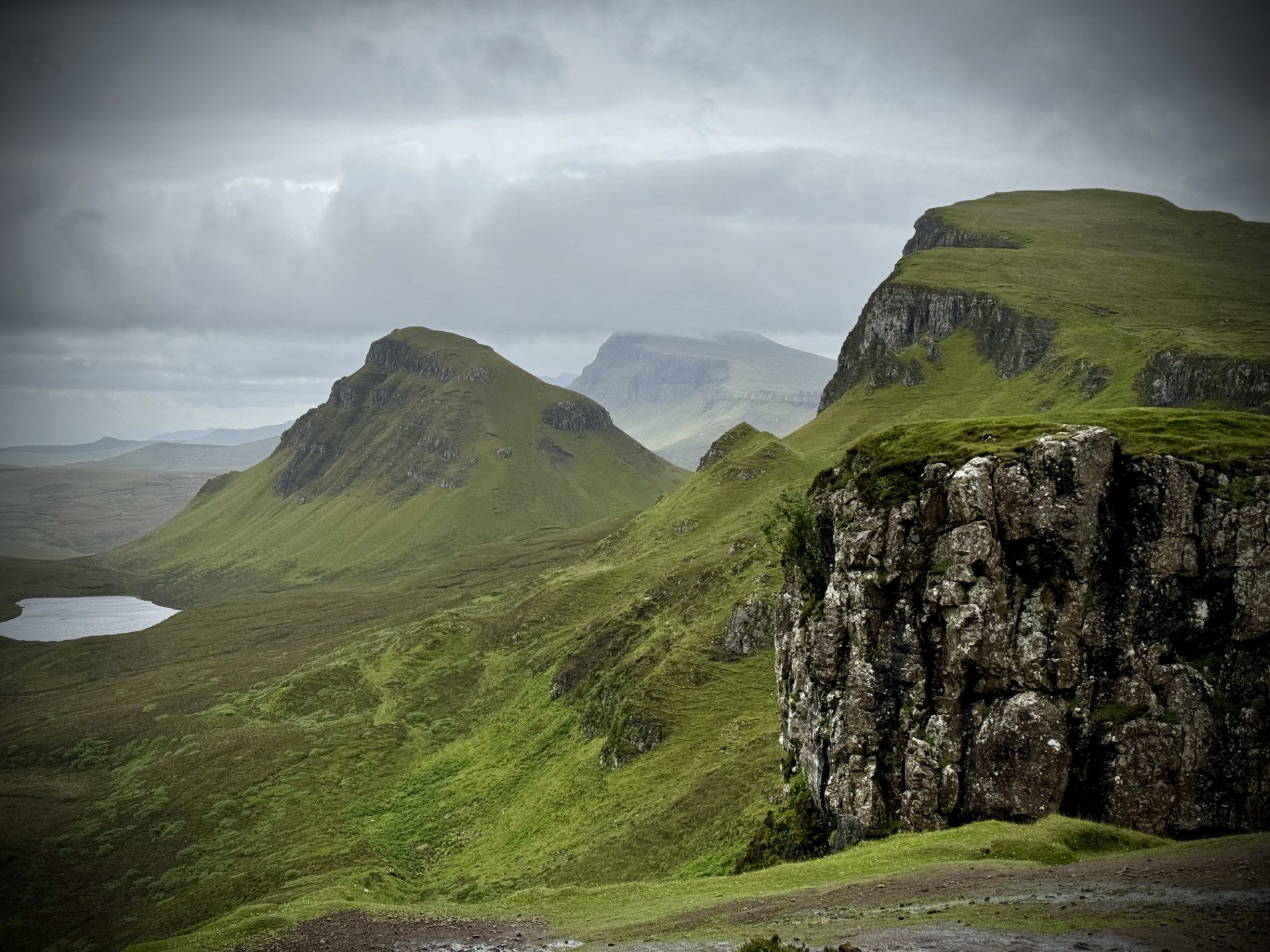
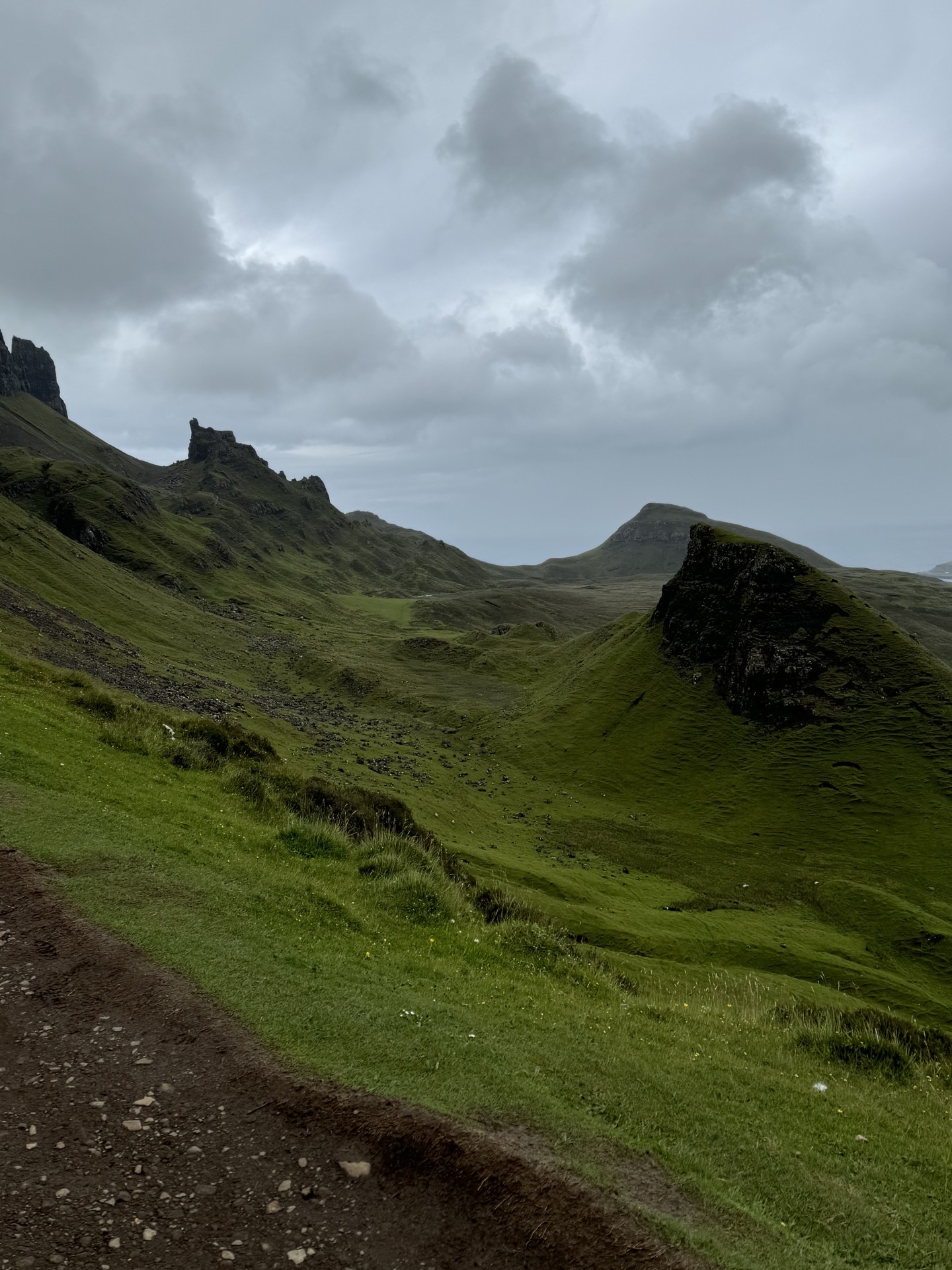
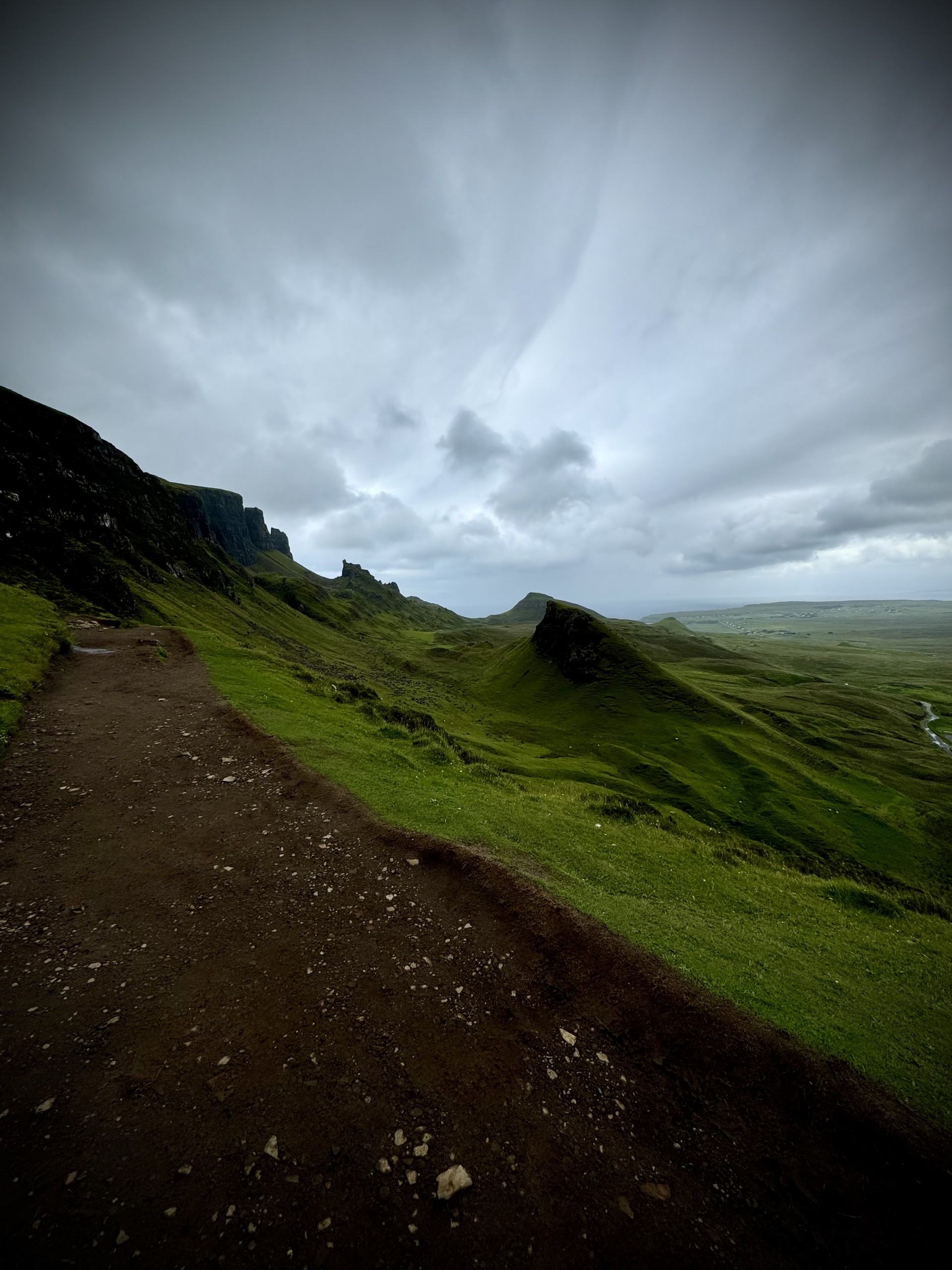
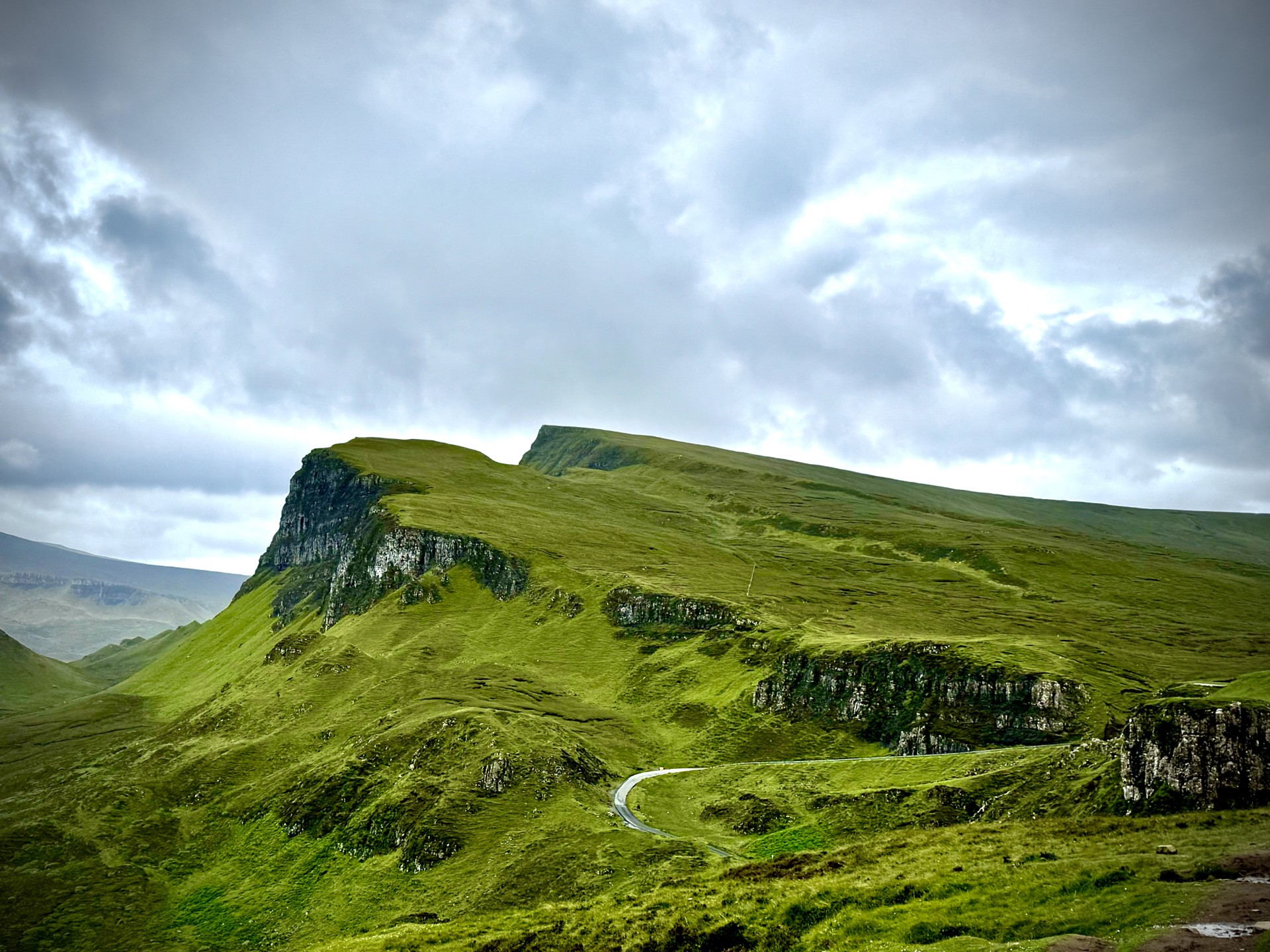
From here we headed to the Trotternish Peninsula, the northernmost stretch of Skye, its name and landscape both shaped by Viking times. Formed by a massive ancient landslip, the area is known for its dramatic cliffs and surreal rock formations, none more striking than the Quiraing, which means “round fold” in Old Norse and is said to still be slowly shifting.

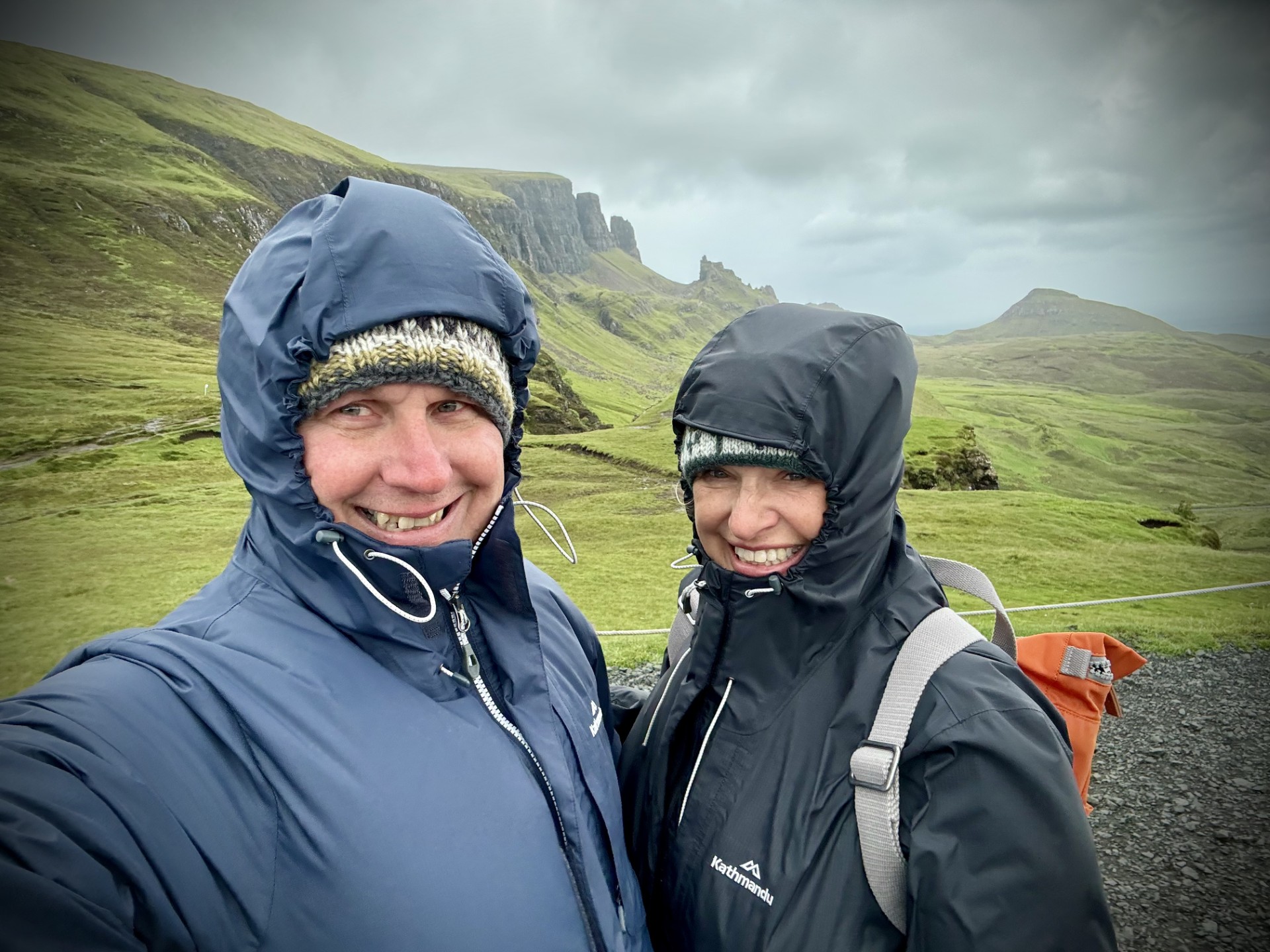
We’d planned a longer walk, but the cold and relentless wind had other ideas. Even so, we managed a one-hour trip and made it back to the car just before the heavens opened. The beauty of the Quiraing was unbelievable—raw, sculptural, and enthralling. Had the weather been kinder, we’d have walked further, but it was enough to stand and take in the majesty.

There’s a nice view of the Quiraing that you can see here.  It shows how windy it was that day, as does the short clip here.  You couldn’t hear me speaking, it was so windy!

Getting out of the wind seemed like a good idea, so we headed down to the waterfront to see both the Kilt Rocks and Mealt Falls as well as dinosaur footprints on the beach.

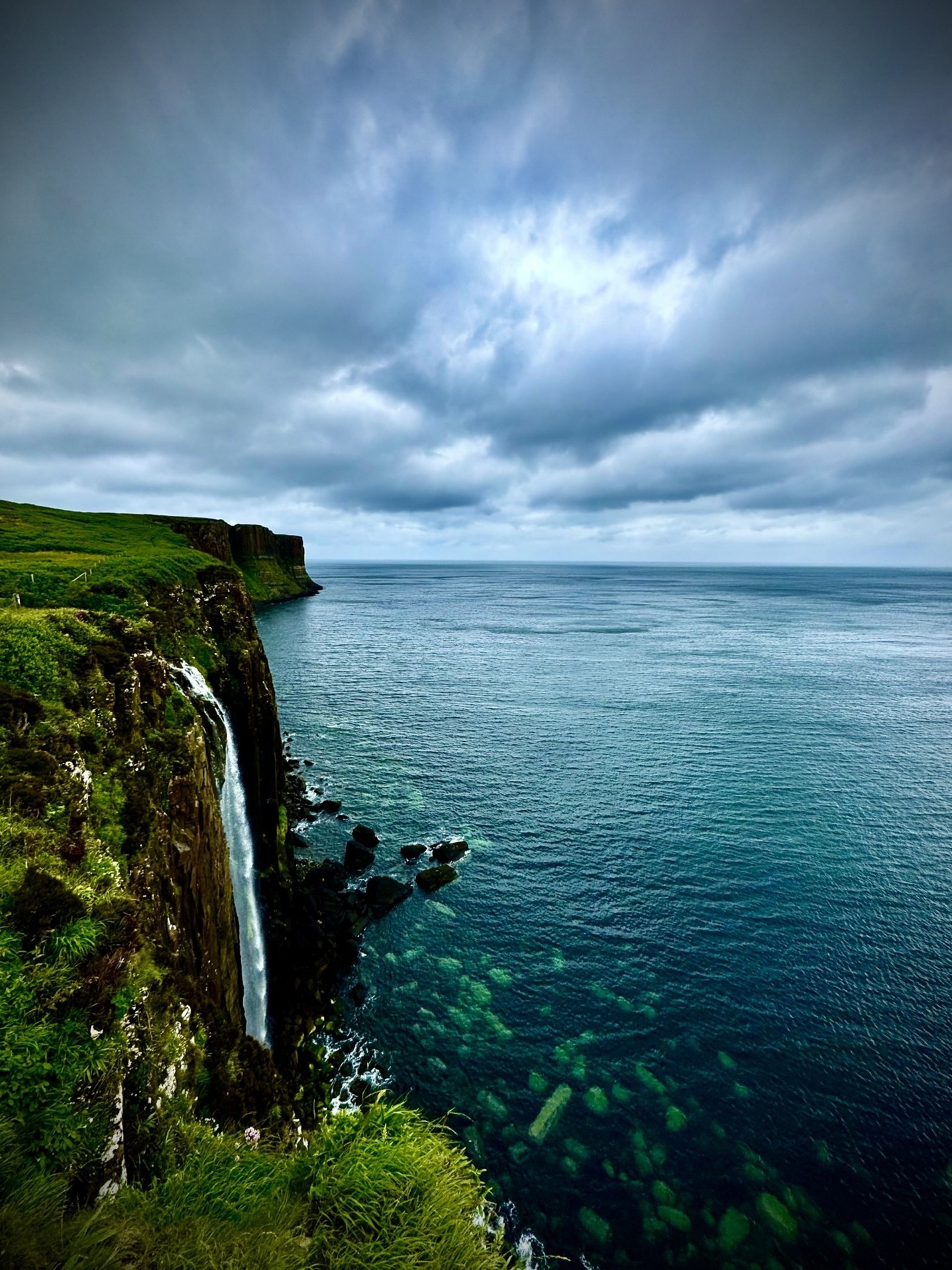
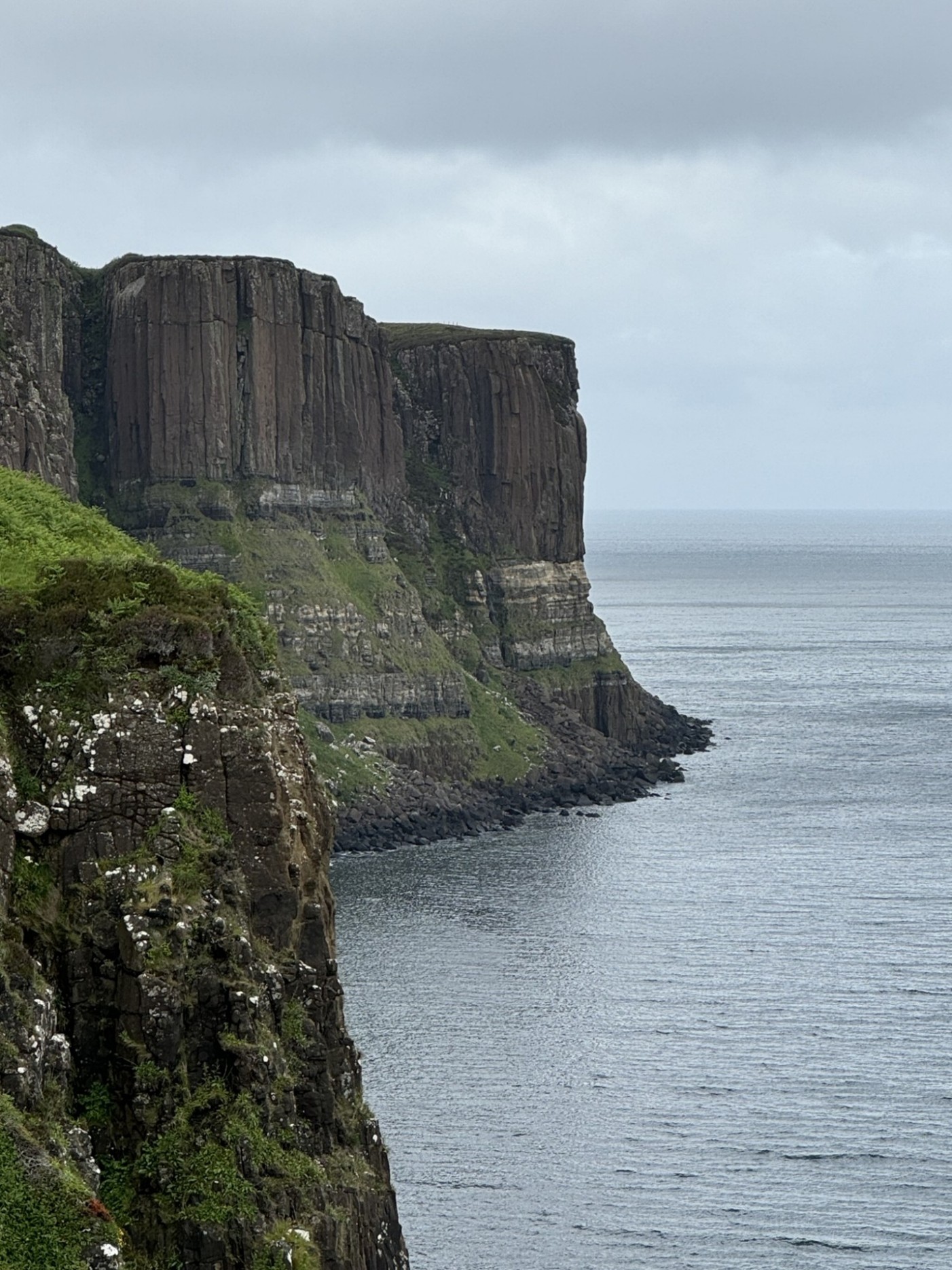
Mealt Falls is a magnificent waterfall cascading down cliffs and plunging into the sea at the Sound of Raasay, coming directly from Loch Mealt. Kilt Rock gets its name from steep basalt columns resembling kilt pleats. There’s a carpark with good views.

You can see a short video of it here.

We were getting cocky with the weather and decided to chance our luck looking for dinosaur footprints at Staffin Beach. The footprints date back approximately 170 million years to the Middle Jurassic period, made by long-necked sauropods and three-toed theropods. We managed to see at least one print, however, the skies then opened and climbing back over rocks to the car took an eternity.  We were absolutely soaked!  I must admit, it’s hard to imagine Skye being subtropical though.

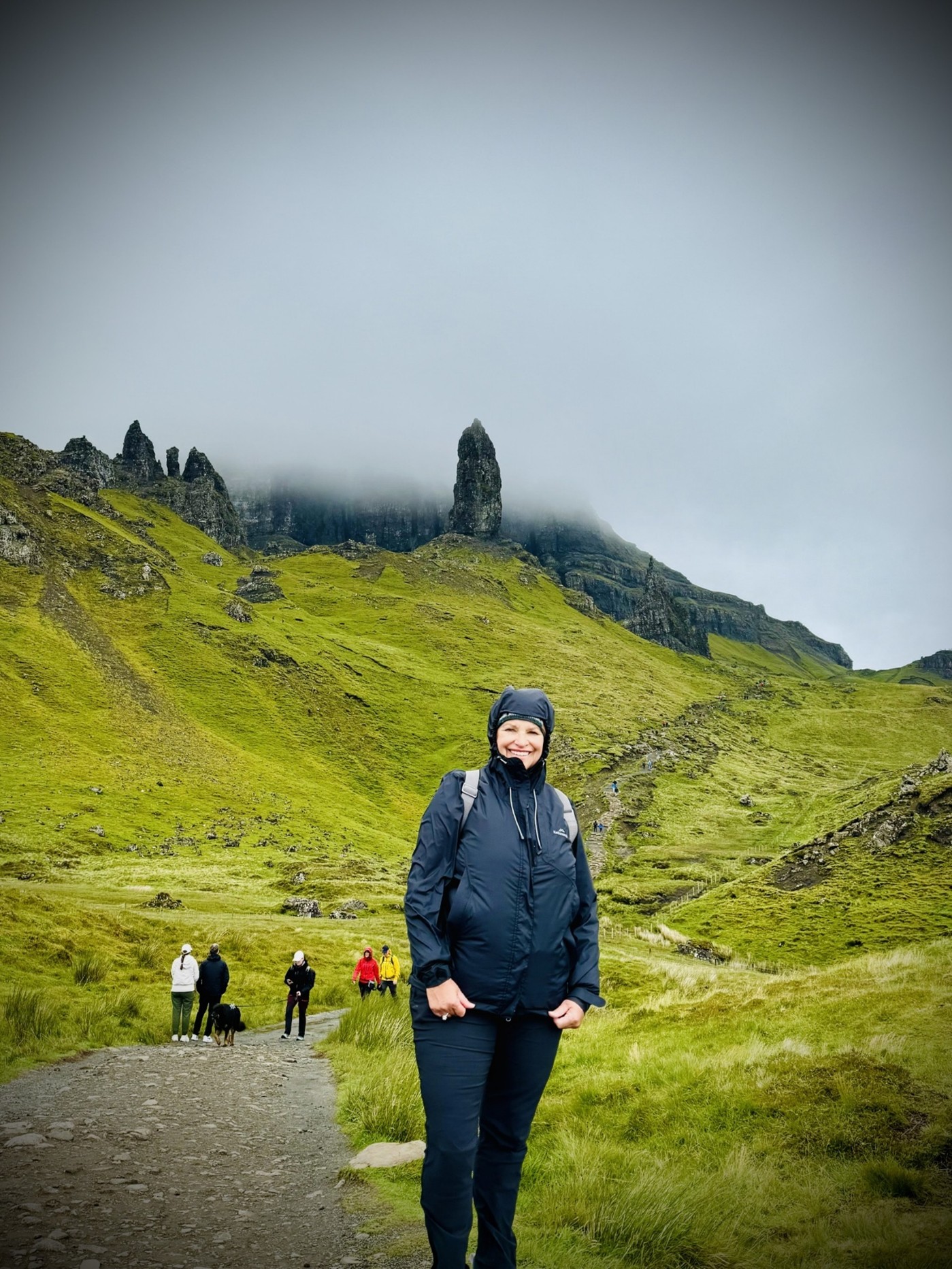
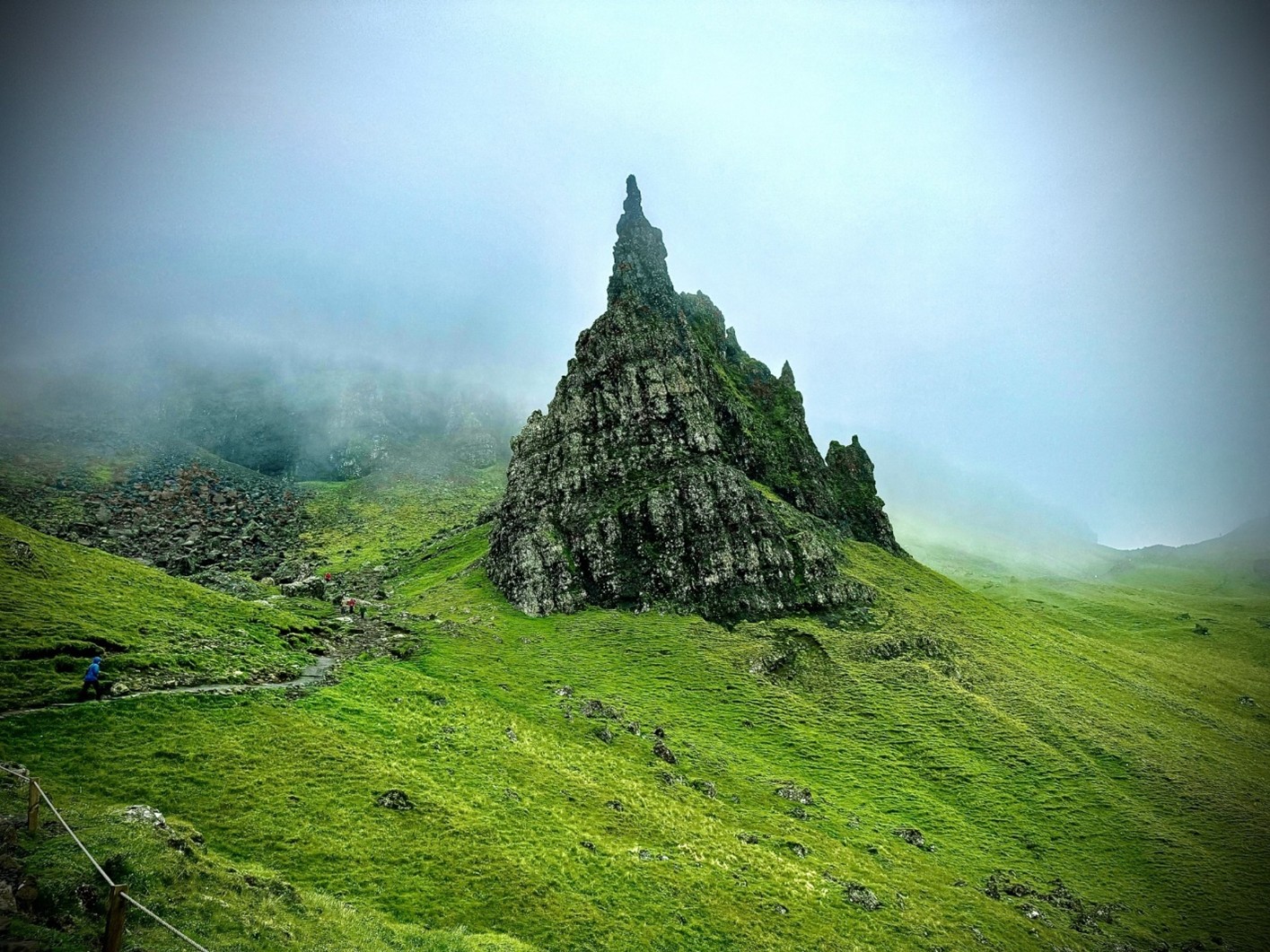
We hadn’t finished for the day as we were determined to walk up to the Old Man of Storr, a 50m tall rock pinnacle. Local legends claim it’s a giant’s grave, but I suspect it’s really part of the land slip (though the giant story is far more interesting!).

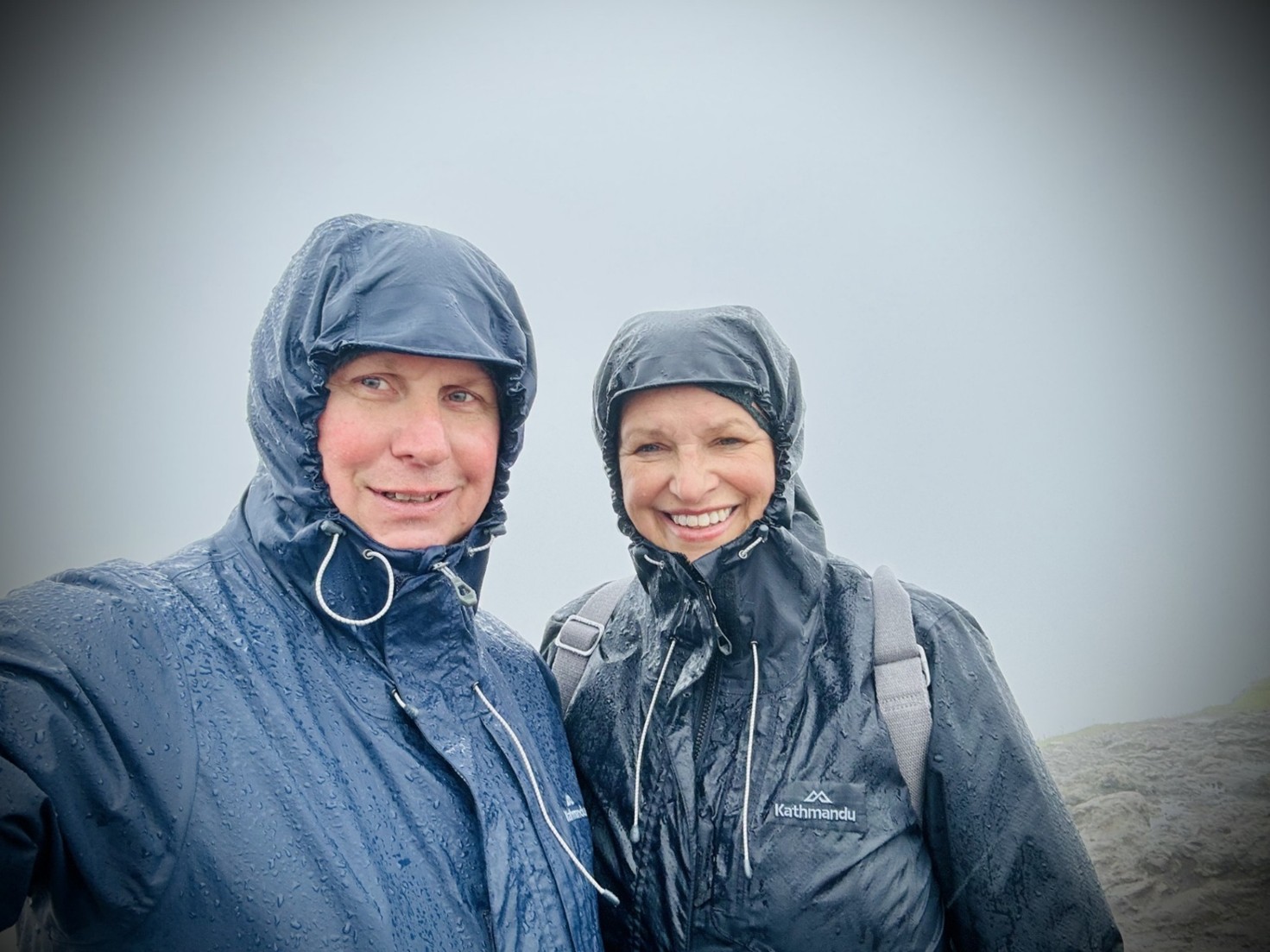
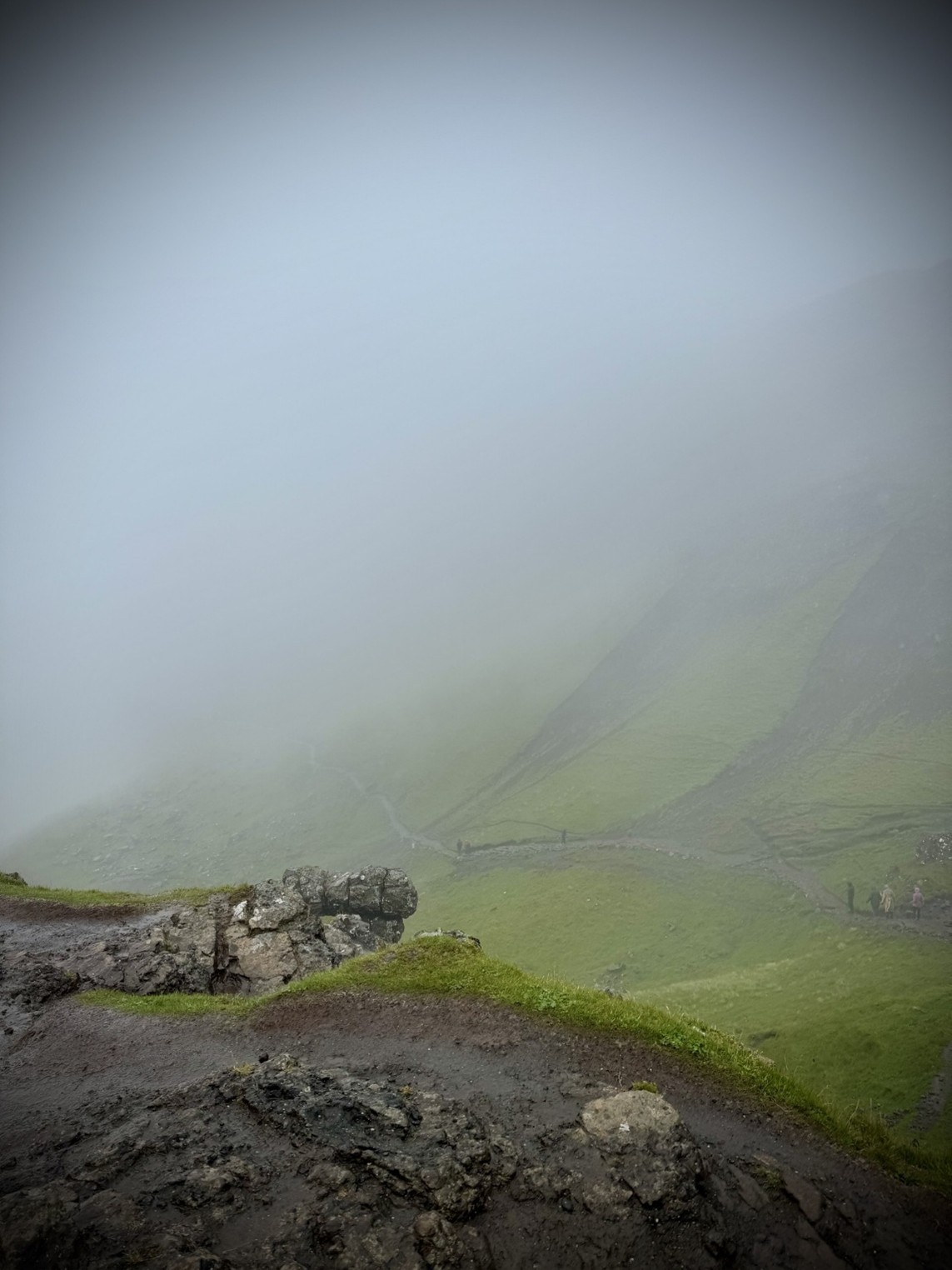
It’s only a 3.8km round trip and while there are slippy areas over rocks in the wet, we were soaked anyway so decided we may as well do it. We started walking and while the cloud was low, it wasn’t too bad. Part-way up, however, the rain started again and visibility dropped significantly. We made it to the top, but by then we were in the clouds with heavy rain. My weather app suggested it would clear in around 20 minutes, and I was keen to stay for photos. Josanne sensibly said we should head back down as it wasn’t going to clear (for once, my weather app was right, but we were halfway down by the time it cleared).

The photos were still stunning—I’d love to have gone up when the weather and views were better! By the time we got to the top, views were non-existent and we were soaked. Again. But still smiling!

Back at the car, we got most of the wet clothes off and headed back to the hotel for dinner and a well-earned dram for me and a G&T for Josanne. Our clothes hadn’t dried out by next morning when we checked out and headed to Armadale Bay.

With so many happy memories (most of them wet) from Skye, early on 29 June, we headed for the ferry back to Mallaig for the next part of the adventure. Although I’d never been to Mallaig, I’ve always been aware of it due to it being the title in one of my favourite bagpipe pieces, Steam Train to Mallaig.

DAY 8: ARMADALE TO MALLAIG, GLENFINNAN, AND GLENCOE (29 JUNE)

Ferry trips between the Islands were always quick and efficient. We set off early to drive from Portree to Armadale for the ferry to Mallaig. We chose this option as it’s only a short crossing and got us much closer for the next stint.

First stop was Glenfinnan. While there are two things of significance there, one is more famous to most of the world, though perhaps not to native Scots.

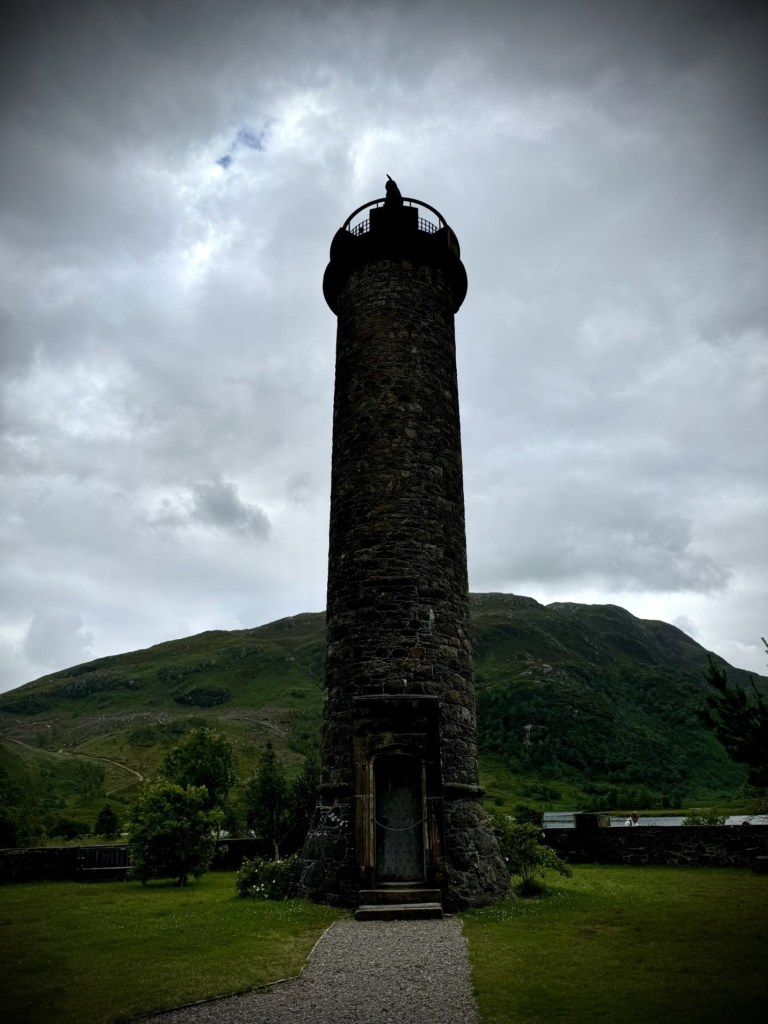
Glenfinnan was where Bonnie Prince Charlie raised his standard in August 1745, marking the start of the final Jacobite Rebellion (leading to Culloden in April the following year). On the banks of Loch Shiel, there’s a 60-foot monument commemorating the clansmen who fought and died. We first headed to the Glenfinnan Monument before the second attraction.

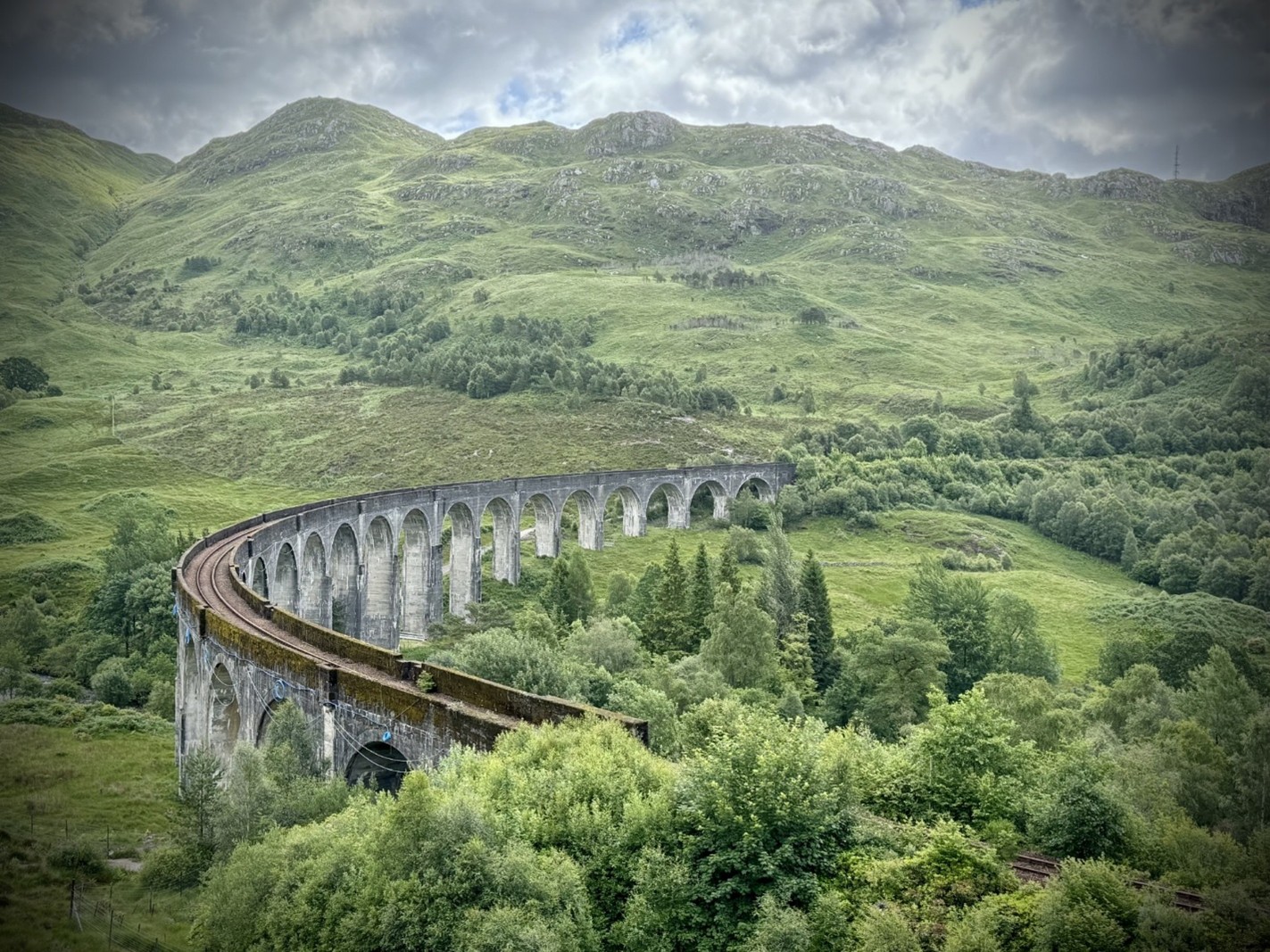
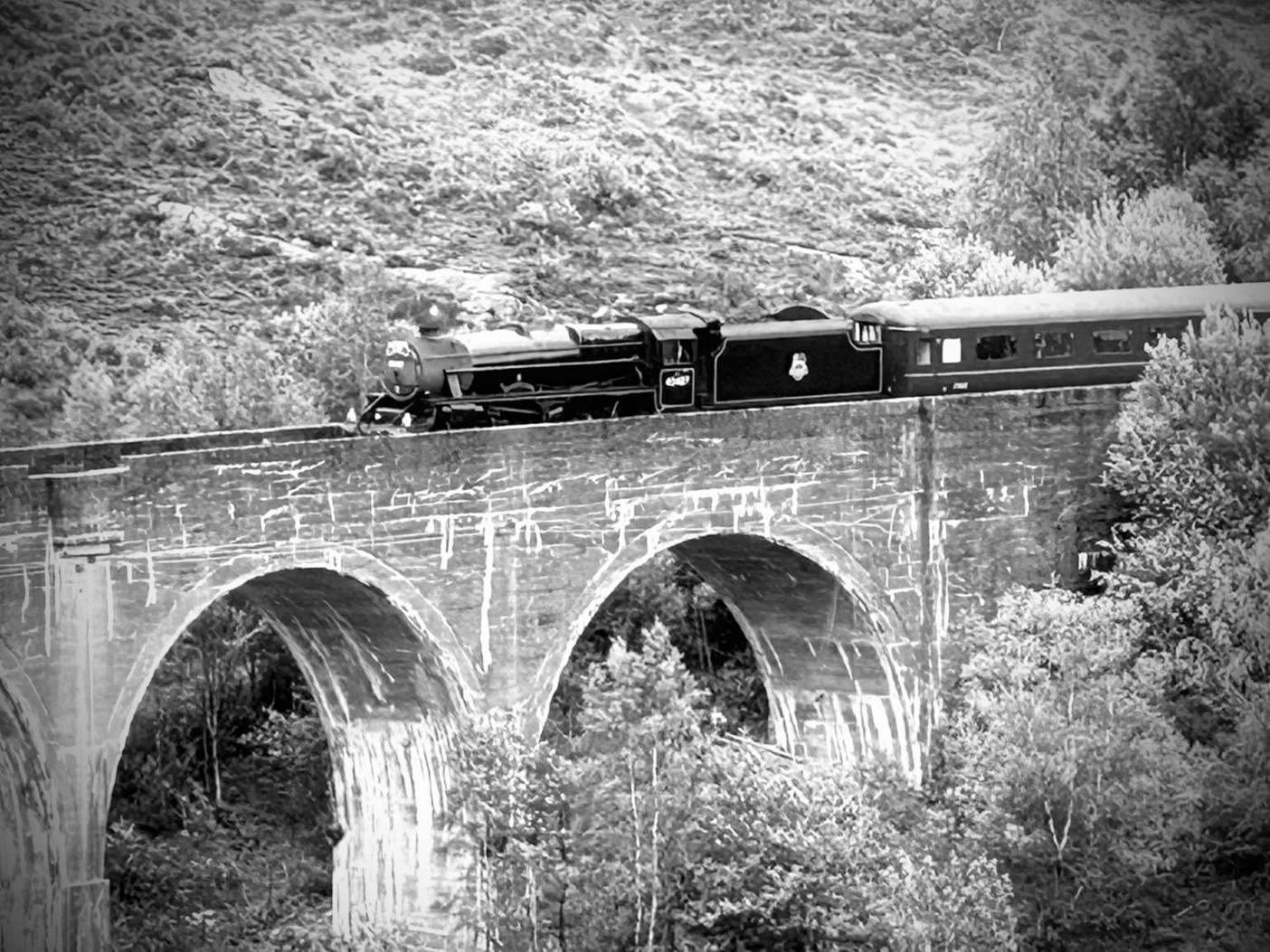
Glenfinnan is also home to the Glenfinnan Railway Viaduct. Completed in 1901 and built entirely of concrete, the 21-arched railway viaduct is undoubtedly one of Scotland’s most iconic railway structures. It’s where you can see the Jacobite Steam Train making its twice daily crossings between Fort William and Mallaig.

We got to our vantage point and waited with around 300 others for the train. It stopped as it got to the far side of the viaduct, gave a long, mournful steam whistle and started forward across the single-track viaduct, gaining speed. While we were there to see the Jacobite Steam Train, I think we may have been outnumbered by those coming to see the Hogwarts Express!

You can see the video that I took of it here.

As we headed back to the car, the grey skies turned rainy, but we’d ticked another thing off the list, so we didn’t really care.

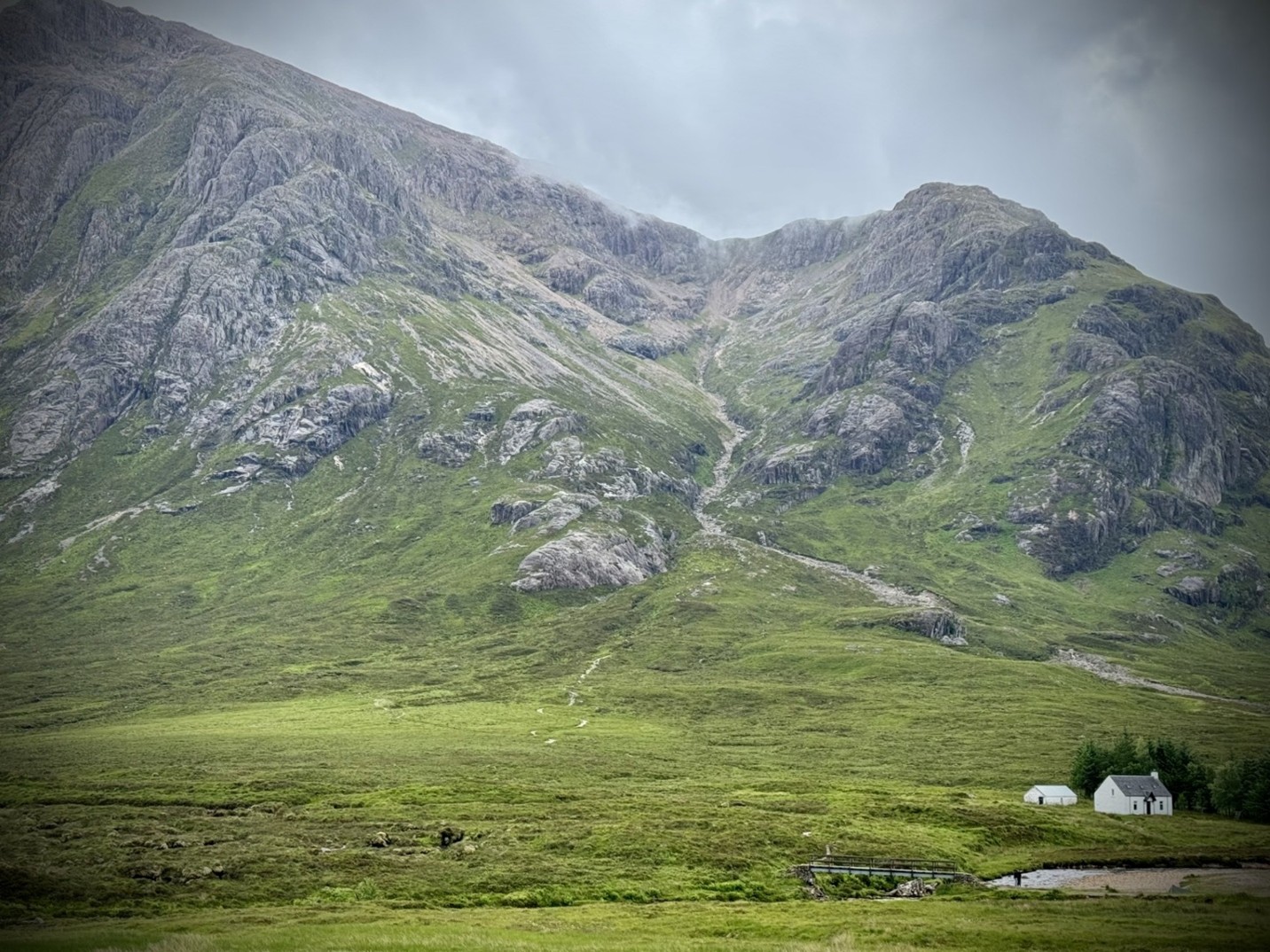
The next activity required a detour as Josanne really wanted to see Glencoe. It is, without doubt, both a famous and a dramatic glen. Moreover, it’s the site of the 1692 Massacre of Glencoe where 38 MacDonalds were murdered by Campbells.

The glen was once an ancient super volcano, but Ice Age glaciers and millennia of weather have reshaped it. The A82 road takes you right through the middle with a few places to stop for photos.

Josanne was mesmerised by Glencoe’s beauty, and we spent an hour chatting and taking photos. It being Scotland, in the short time we were there it was both sunny and misty and atmospheric. It did not disappoint.

We stopped briefly in the Glencoe Museum where you see traditional thatched houses and learn about farming. The story of the 1692 massacre was shared in detail.

From here, it was off to Oban where we’d spend one night.

DAY 9: OBAN (30 JUNE)

Oban is known as the “Gateway to the Isles” as you can get ferries to both the Inner and Outer Hebrides. It has a working fishing port and draws tourists from all around Scotland and beyond. Our primary reason was catching a ferry to the Isle of Mull, but we both wanted to explore the town.

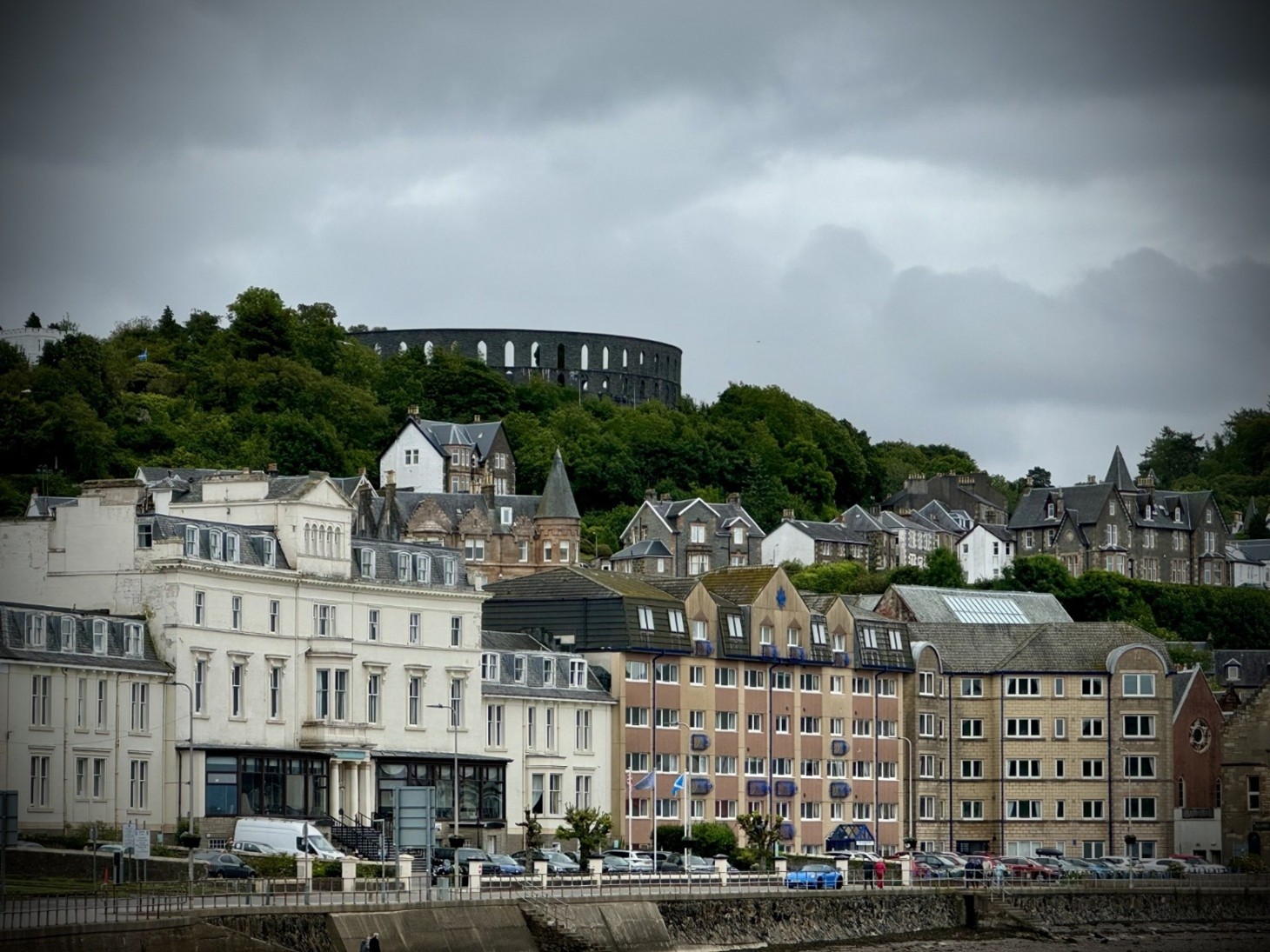
Having been in Rome two weeks prior, it was interesting to see Oban had its very own Coliseum (though slightly less spectacular than Rome’s version)! McCaig’s Tower dominates the skyline, built between 1897-1900 to provide work for locals and as a family memorial. It was never finished.

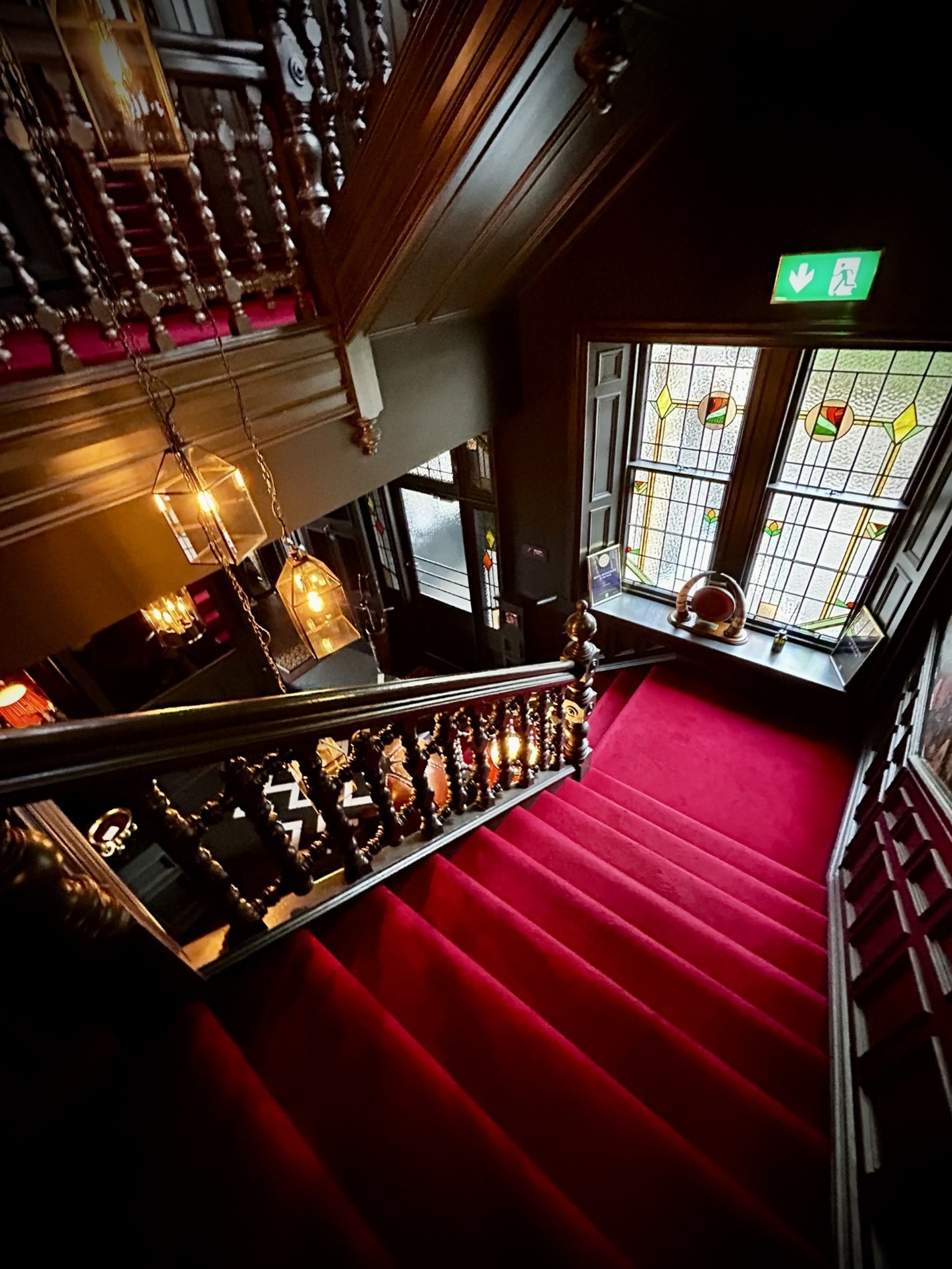
Oban is home to one of Scotland’s oldest distilleries (founded in 1794) and, perhaps not surprisingly, some excellent seafood thanks to the local fishing fleet. We spent the day exploring the town and decided to eat in the hotel restaurant that evening as we were quite tired. It was a beautifully restored Victorian era hotel (No 17 The Promenade), sitting on the waterfront. The owners had done a great job blending historic charm with modern luxury, with lovely views over the Sound of Mull.

DAY 10: ISLE OF MULL (1 JULY)

The Isle of Mull hadn’t initially been on Josanne’s “must do” list, but I wanted to see more than one Island and had heard lots of positives about Mull. We caught the 9.30am ferry for the 45-minute crossing from Oban to Craignure. The journey takes in views of many other islands like Kerrera, Lismore, and Jura.

We left early to use most of this day exploring on the way to Tobermory, knowing we’d have to drive straight back down next day. It was a good call and the sun was out. I was very pleased we’d chosen to visit Mull as it truly is diverse by terrain, history and sights.

We’d earmarked two “must do” items, to visit Duart Castle and the Distillery in Tobermory. As it was such a beautiful day and the driving (most on single track roads with passing bays) was a joy, we took yet another detour to visit the Standing Stones at Kinlochspelve.

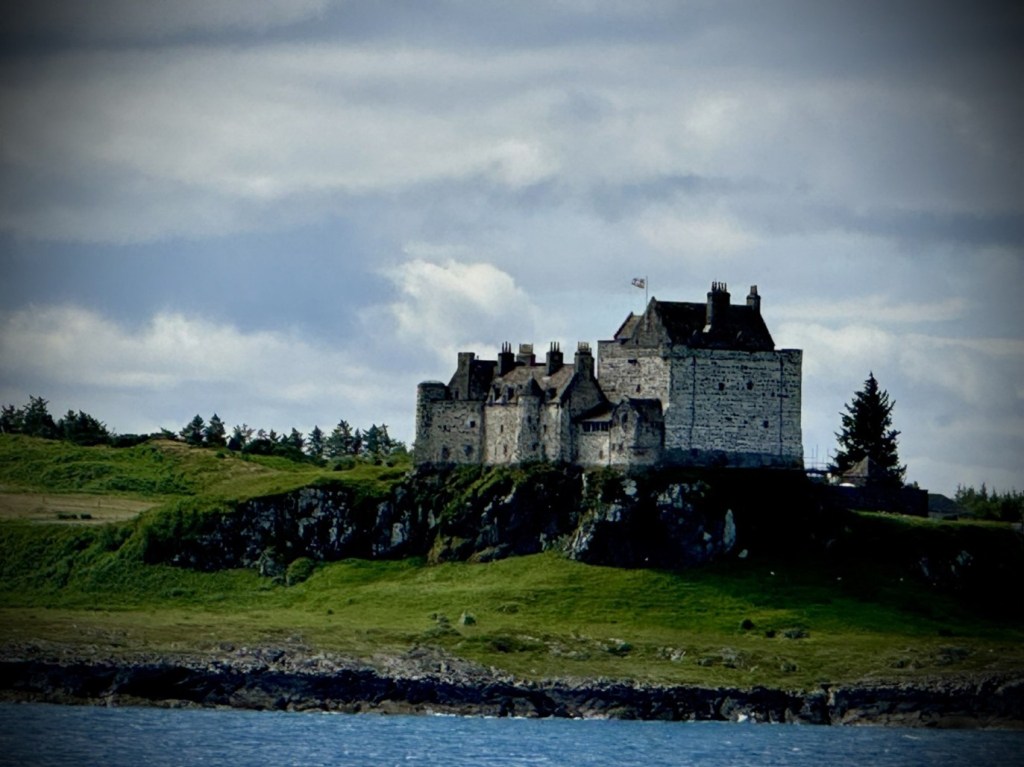
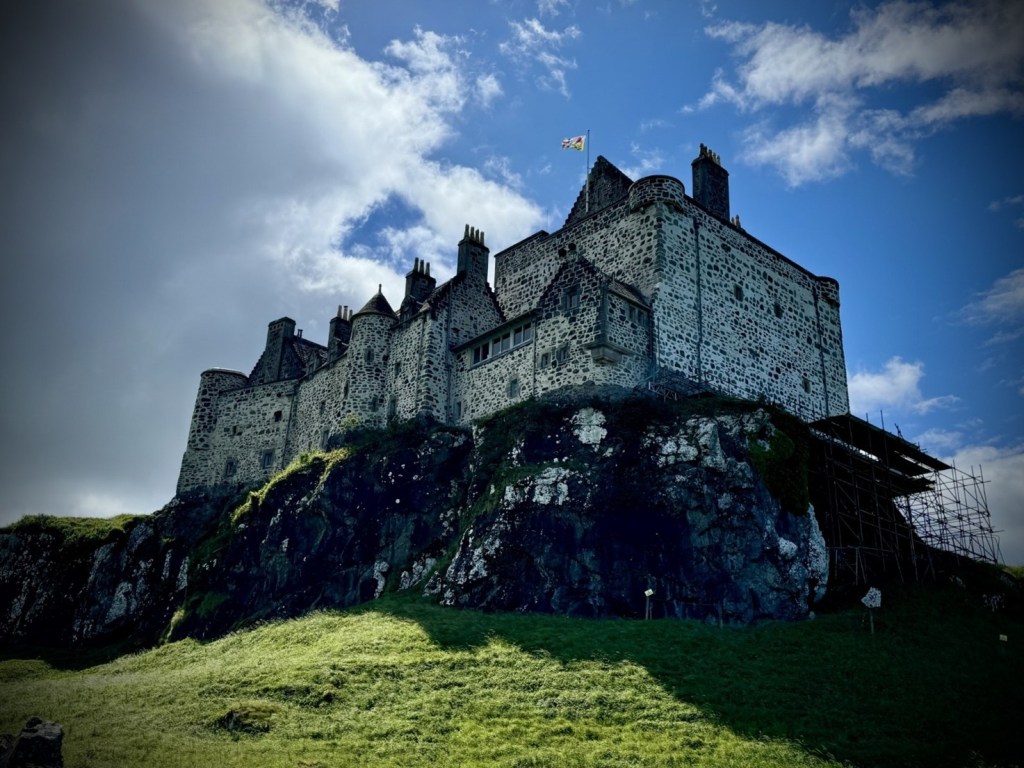
We’d sailed past Duart Castle on the CalMac ferry so that cemented our decision to head there first.

The castle has been the ancestral seat of Clan Maclean since the 1200s. It looks very dramatic, sitting on a hill overlooking the Sound of Mull. While abandoned for a long time, Sir Fitzroy Maclean refurbished it in 1911, and the Maclean family still owns and lives in it now.

Those who’ve watched Outlander will know all about Standing Stones. I made Josanne hand me the car keys before she touched one. Just in case!

It was only around 12 minutes from Duart Castle to Kinlochspelve, a small settlement at the head of Loch Spelve. The ancient standing stones allegedly date back to the Bronze Age (approximately 3,000-4,000 years old). Their purpose remains contentious—they could have been astronomical, ceremonial, or territorial markers. We’ll never know for sure! To reach them, there’s a small parking area (only accommodating three or four cars) and then you walk across farmland.

It’s a very atmospheric setting. I found myself quietly contemplating what it could have been like here 3 or 4 thousand years ago. How did the people live? What did they do here? I did have the eerie feeling we were being watched…

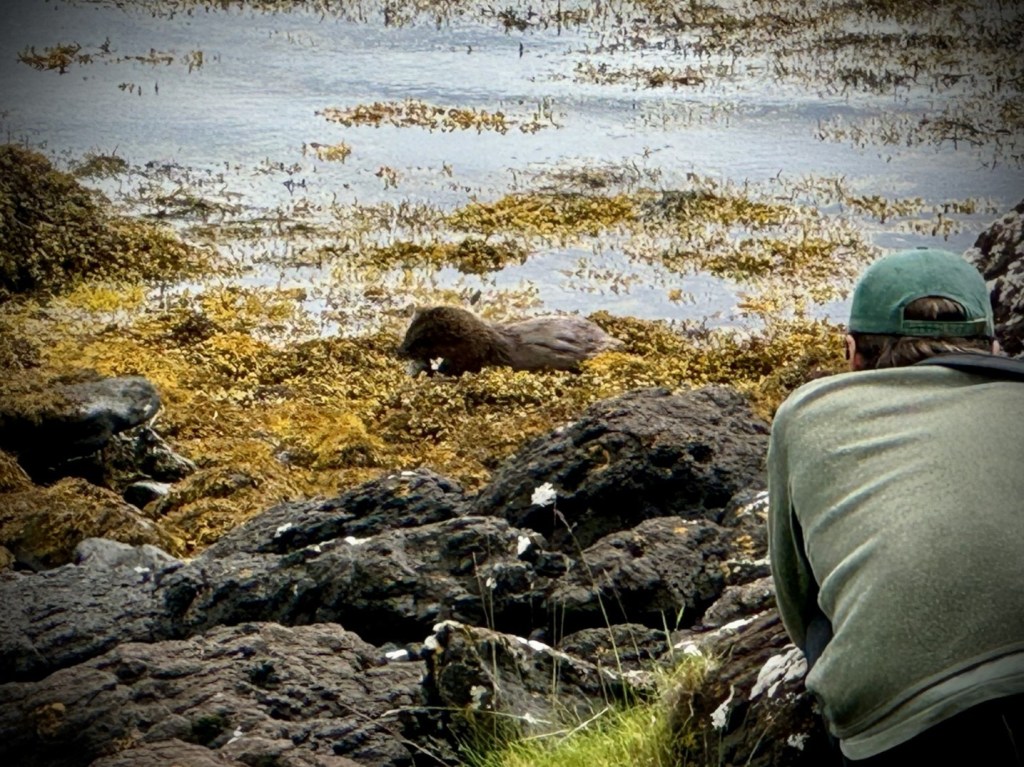
The drive from Kinlochspelve to Tobermory was another you couldn’t get bored of. So much to see, from mountains (where we did see soaring eagles, though I didn’t get a photo). The route we took let us explore some of Mull’s most evocative landscapes—a fantastic blend of coastal views, forested glens, and open moorland. We even came around one corner to find 4 or 5 cars stopped with their inhabitants watching a sea otter eating an eel. If we’d been 5 minutes earlier, we’d have seen the fight for survival the eel eventually lost.

As I only had my iPhone, these photos were as good as I could get.  You can see a brief video of it here.

Tobermory is the main town on Mull, most famous for its brightly coloured buildings. It’s allegedly one of Scotland’s most photographed harbours and I can see why. Although only a small town, it has shops, galleries, restaurants, pubs and even a distillery established in 1798. It’s also a working fishing port with plenty of good seafood.

We got lucky with the weather as the sun shining certainly added to the feel-good factor. The colours brightened under the sun’s gaze, as if Tobermory had dressed for the occasion. There’s allegedly a sunken Spanish galleon from the Armada that sank in the bay in 1588. More importantly, the gold supposedly on board has never been found. Maybe next trip…

We again ate in the hotel this evening as they had a nice menu and it meant we could both have a drink with dinner.

DAY 11: MULL TO GLASGOW VIA LOCH LOMOND (1 JULY)

Next morning it was raining, but we’d explored all we needed on the way up to Tobermory. All we had to do was head back to Craignure for the 9.55am sailing back to Oban, arriving around 11am.

The plan was heading to Glasgow via Loch Lomond. I may have taken a slightly more circuitous route than planned, but we eventually got back on track without too much shouting!

While you drive along the length of the Loch, there isn’t necessarily that much to see other than water. We’d decided to stop at Luss for late lunch and a look around.

Loch Lomond is obviously well known for the song “The Bonnie Banks o’ Loch Lomond.” In the song, widely associated with the Jacobite rebellion, the “High Road” is interpreted as the physical route taken by the living successfully returning to Scotland after battle. The “Low Road” refers to the spiritual path of the dead. It was believed a deceased person’s soul could return to Scotland quicker than the living, hence the singer being in Scotland via the Low Road before his companion taking the High Road. Hence the song is about someone not returning home, having died. Runrig (a band from Skye) have a fantastic live version of this song that you can watch here.

We stopped at Luss for a look around and lunch. For some reason, I didn’t take any pictures of Loch Lomond. It was a typically grey day, so maybe it wasn’t looking its best! From there, we were in Glasgow in under an hour. I’d chosen the Sherbrooke Hotel for this overnighter.

The hotel (as it is now) was built in 1896 of red sandstone as a private residence during the industrial boom. During World War 2, it was used as a radar training centre for naval officers and is now a Grade B listed, 14-room luxury hotel.

However, none of those was the reason I booked it. It was primarily booked as it was close to Ibrox, where my beloved Rangers play, and I was booked in for a Stadium Tour the next day!  That, however, is another story for another day!

POST TRIP REFLECTIONS

As I drove south from Glasgow toward Newcastle, leaving behind the mountains, lochs, and islands that had shaped the past nine days, I felt a quiet, contemplative smile settle in. Josanne had been eager to see more of Scotland, but I enjoyed it just as much as she had.

This journey connected deeply with both of us. We travelled from the granite respectability of Aberdeenshire to the otherworldly beauty of Skye and Mull, from battlefields where history was created and changed, to remote beaches where dinosaurs once walked. We took ferries, navigated single-track roads, and stood before castles that have witnessed centuries of often bloody Scottish history.

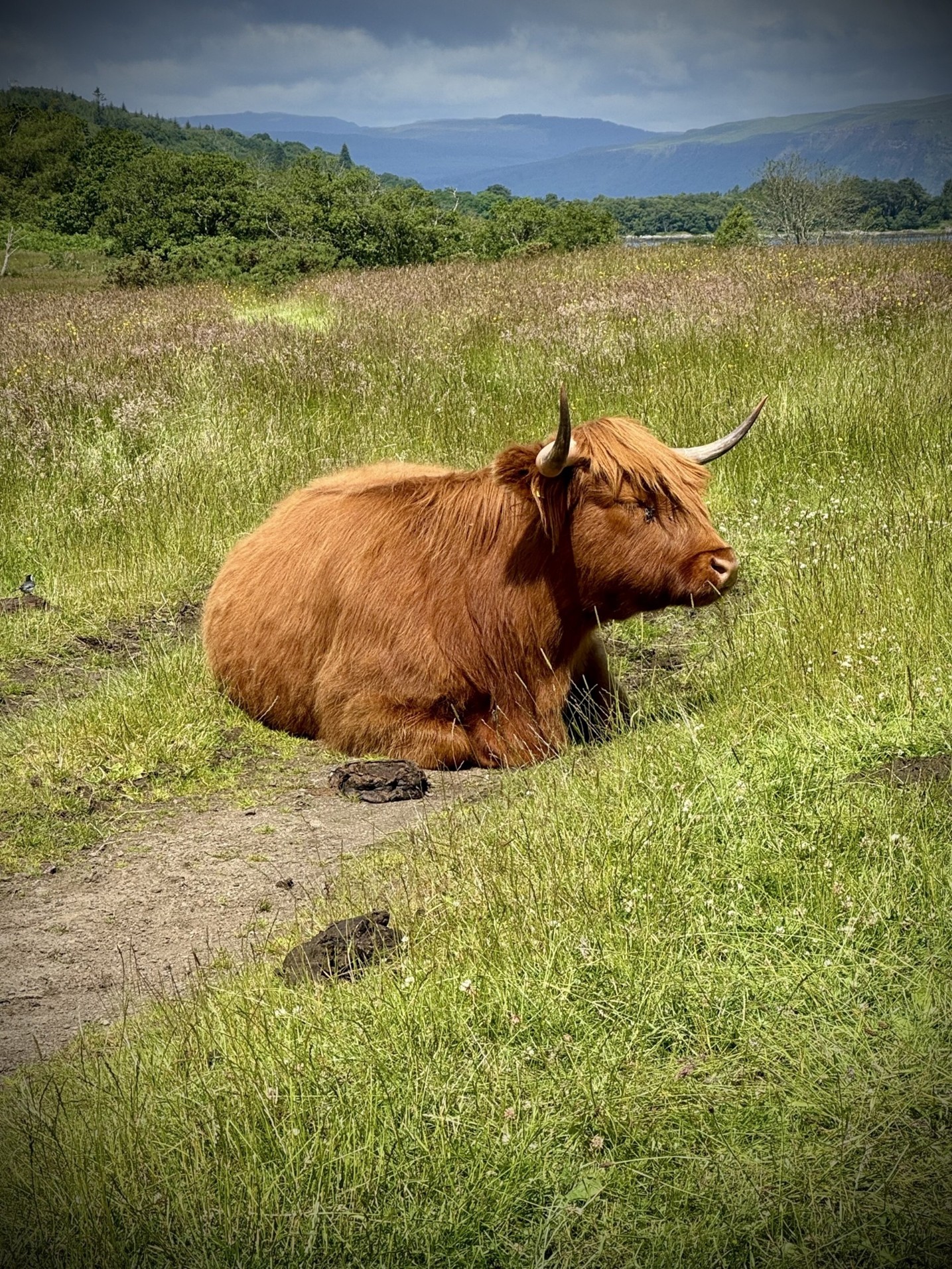
As I smiled, I reminded myself why we travel in the first place. It’s not to tick boxes on an itinerary (though ironically, I’d certainly created a spreadsheet to do just that), but to embrace the possibility of wonder. To stand before the Old Man of Storr as mist swirls around ancient rock. To watch Highland cattle amble across the road as if they own it (which, in a sense, they do). To trace the footsteps of Jacobites and clan chiefs, Vikings and alleged prehistoric giants created memories for both of us that hopefully stay with us forever.

Scotland is a land where every mile reveals another breathtaking view, where history isn’t confined to museums but lives in every ruin, ridge and castle. The landscape tells stories of prehistoric volcanic fury, glacial carving, and human endurance, sometimes against all odds. While New Zealand offers its own raw beauty, it doesn’t carry the ancient weight Scotland does.

Scotland is redolent of ancient ballads and battlefield winds, where standing stones whisper of forgotten rites, harbour towns glow brighter under the sun’s gaze, and every glen carries the scent of memory, rebellion, and belonging. I’d forgotten how much I missed her!

PRACTICAL INFORMATION FOR TRAVELERS

Best Time to Visit:

  • June offers long daylight hours (sunset after 10pm) and relatively mild weather. Don’t expect too much of Scottish weather though—it can disappoint!
  • Midges (tiny biting insects) are less prevalent in June than July-August. That was a godsend for us as insects love biting me.
  • Summer is peak season. Book accommodation well in advance as if you just turn up, you may not get in.
  • Weather is changeable year-round, so always pack layers and waterproofs (and if you have a beanie, take it. Just in case!)

Driving in the Highlands and Islands:

  • Many roads are single-track with passing places. Pull over to let faster traffic pass. Be nice; it doesn’t cost anything.
  • Watch for sheep, Highland cattle, and deer on roads and be ready to stop for photos if the opportunity arises.

What to Pack:

  • Waterproof jacket and trousers (essential)
  • Layers for changeable weather
  • Good walking boots or shoes
  • Midge repellent (in summer at least)
  • Camera with good zoom for wildlife (though all my photos were from an iPhone 15 Pro)
  • Binoculars for wildlife spotting if you plan on doing any of that

Costs:

  • Scotland can be expensive, especially in peak season
  • Ferry bookings should be made in advance (CalMac). These are, surprisingly,  not expensive.
  • Many castles and attractions have entry fees
  • Accommodation varies widely.  We found many expensive on the Kiwi Dollar

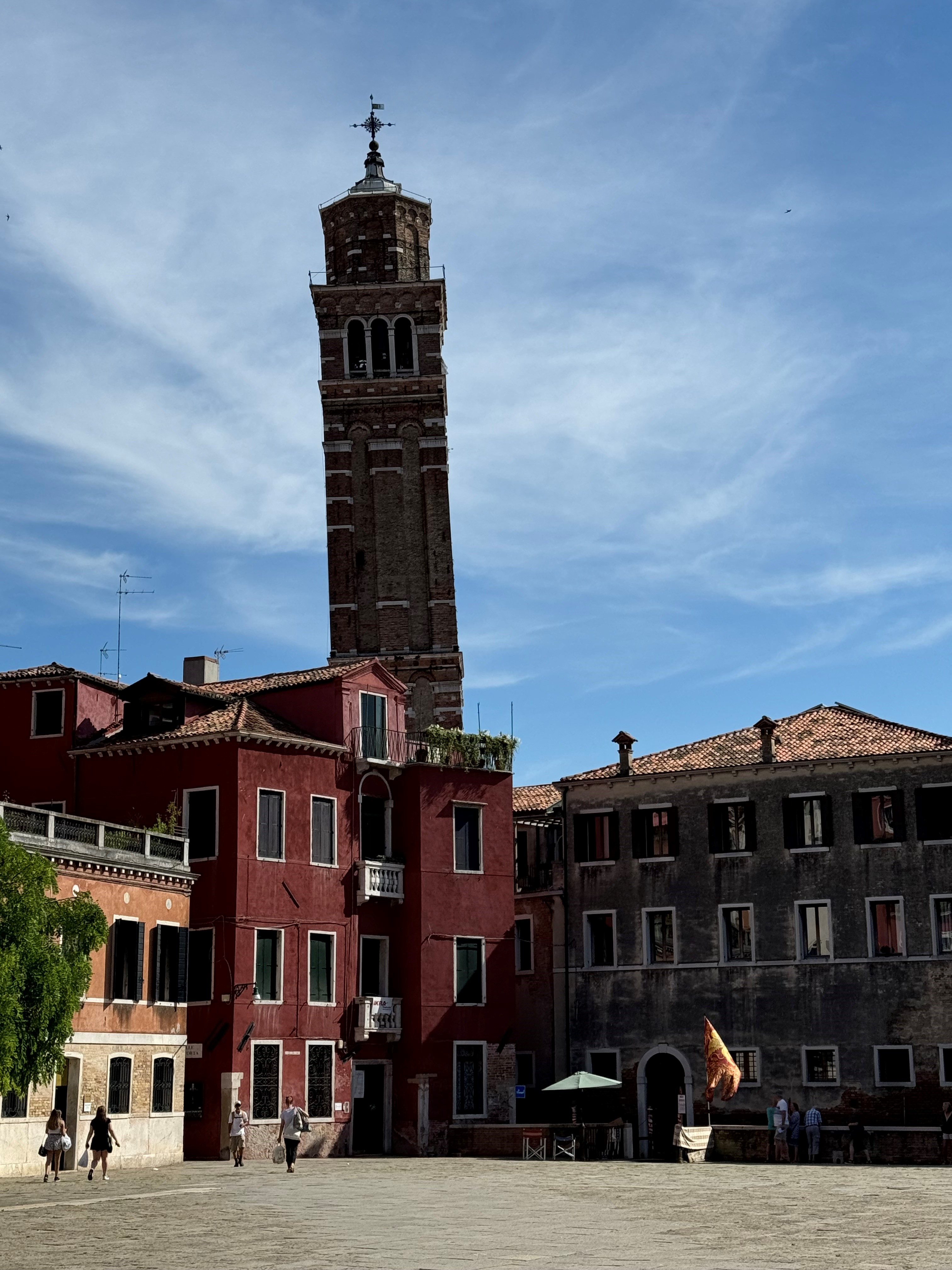
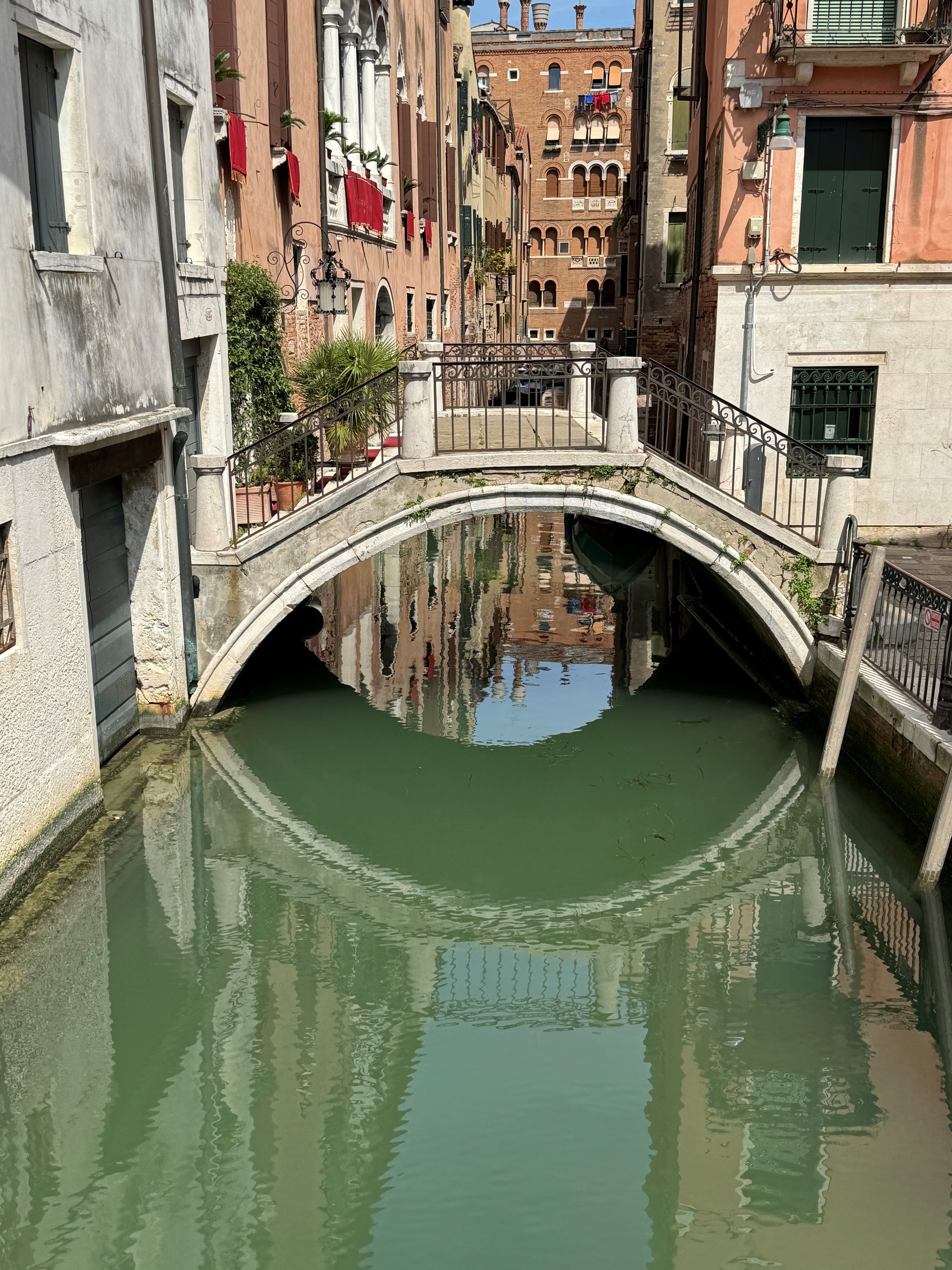
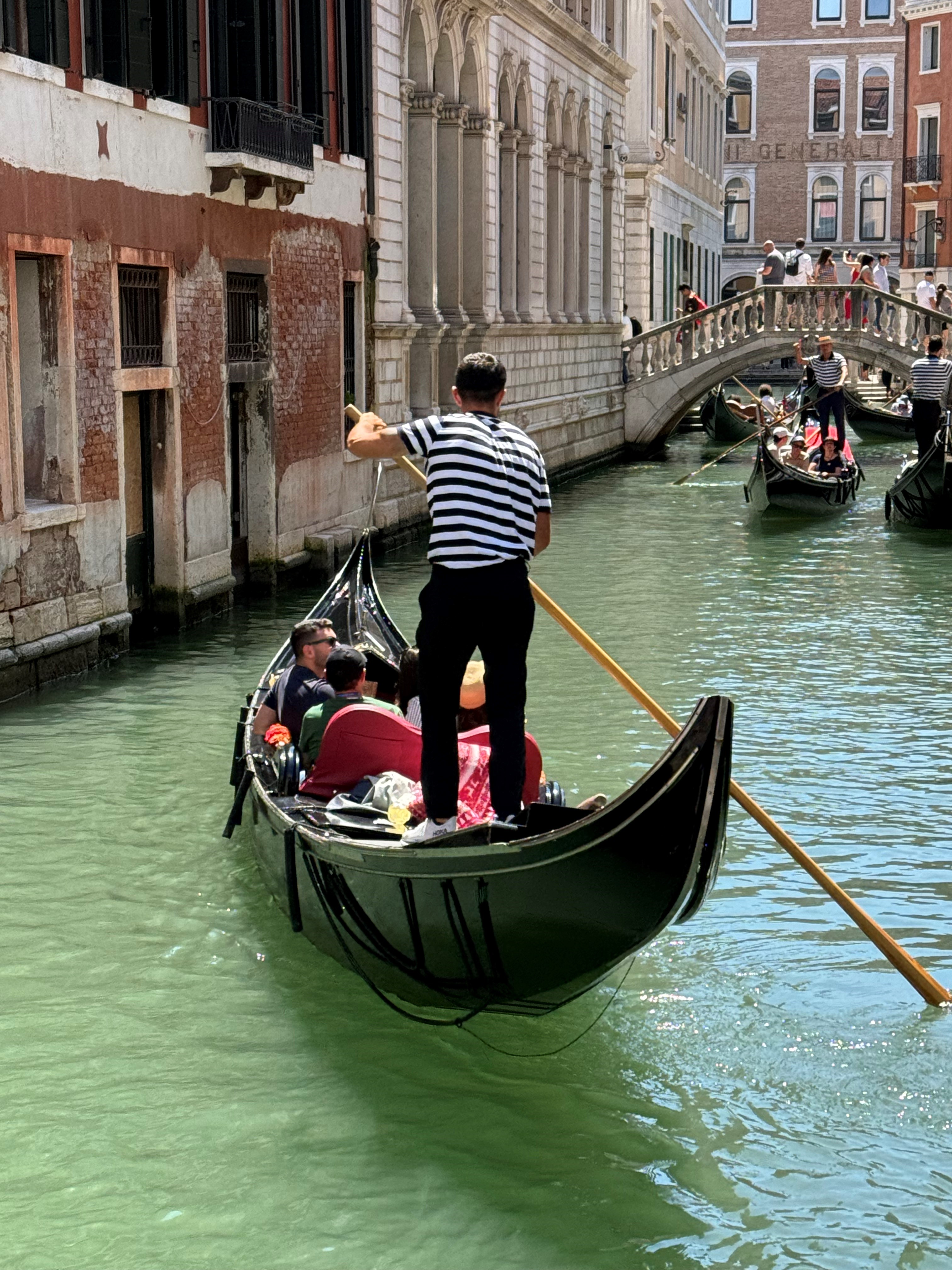
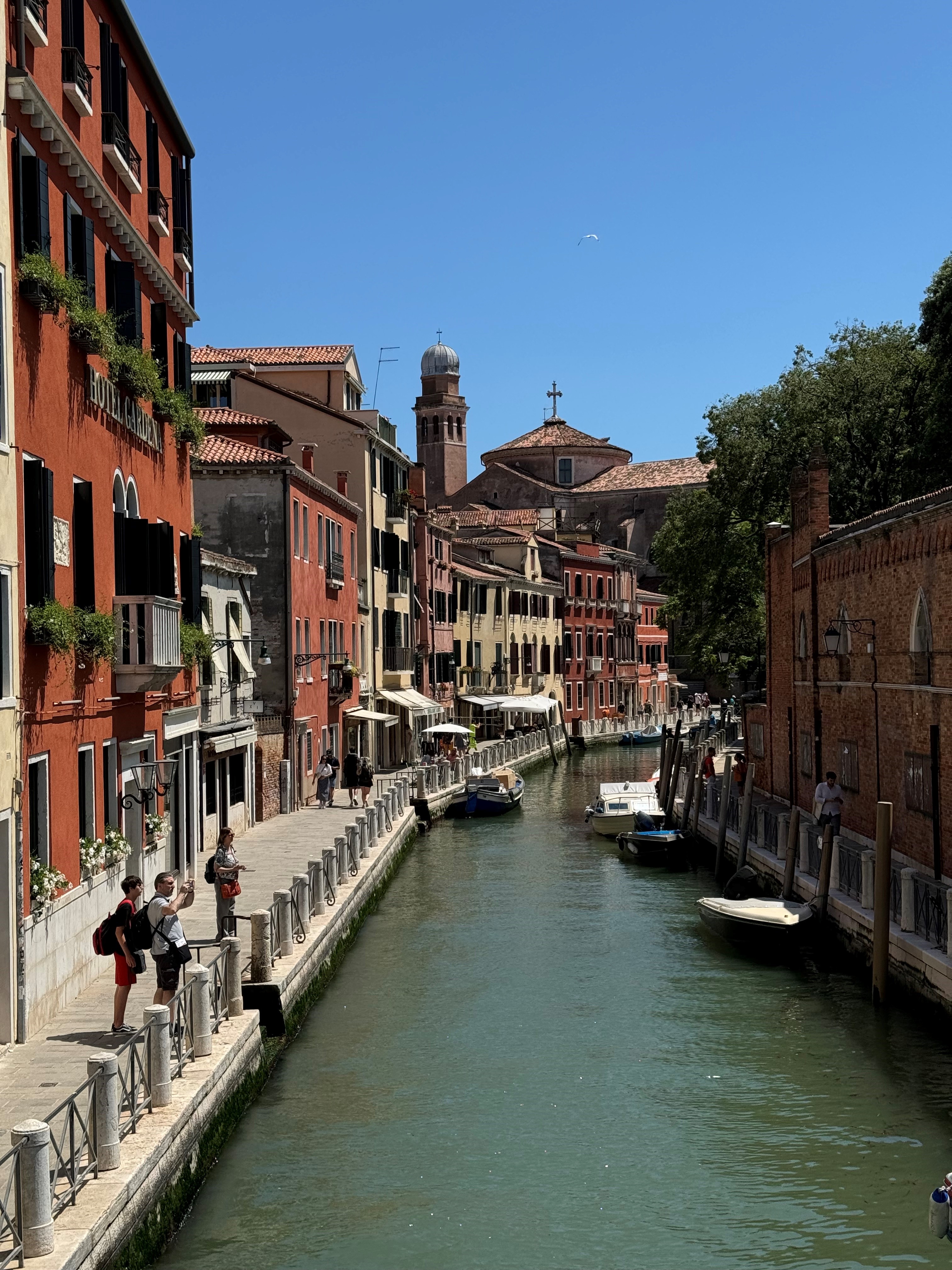
Unveiling Venice: From St. Mark’s Square to Charming Island Adventures

It is the city of mirrors, the city of mirages, at once solid and liquid, at once air and stone“, Erica Jon.

I had actually been to Venice once before, during the winter of 1994. I was based in Cyprus withe the British Army and had been posted to a unit in Germany. As we had a car to take back, we decided to take it as a bit of a holiday and got a ferry to Greece. We then drove across Greece and picked up a ferry to Italy. We stayed outside of Venice in a place called Padova back then.

My lasting memory was of how cold I was! I have, somewhere, a picture of me in St Mark’s Square, but can’t recall too much of the place other than the cold. In fact, I recall how I even wore most of my clothes to bed while in Padova! It probably wasn’t that cold, but I was coming from Cyprus.

There were no such complaints from me this time in Venice. It was firmly in the mid to high 20s, and was even very humid on our last night there.

If you read my last blog on Italy, you’d know that Josanne and I had spent 3 days in Rome after a work trip to Paris. Leg 2 of our holiday was 3 days in Venice (well, in reality it was just over two days as the first day was far from a full one given our mid-afternoon arrival). It was enough for what we wanted to do, and I definitely wanted to create memories that didn’t revolve around the cold! I’m happy to say that I was thoroughly successful in that aim!

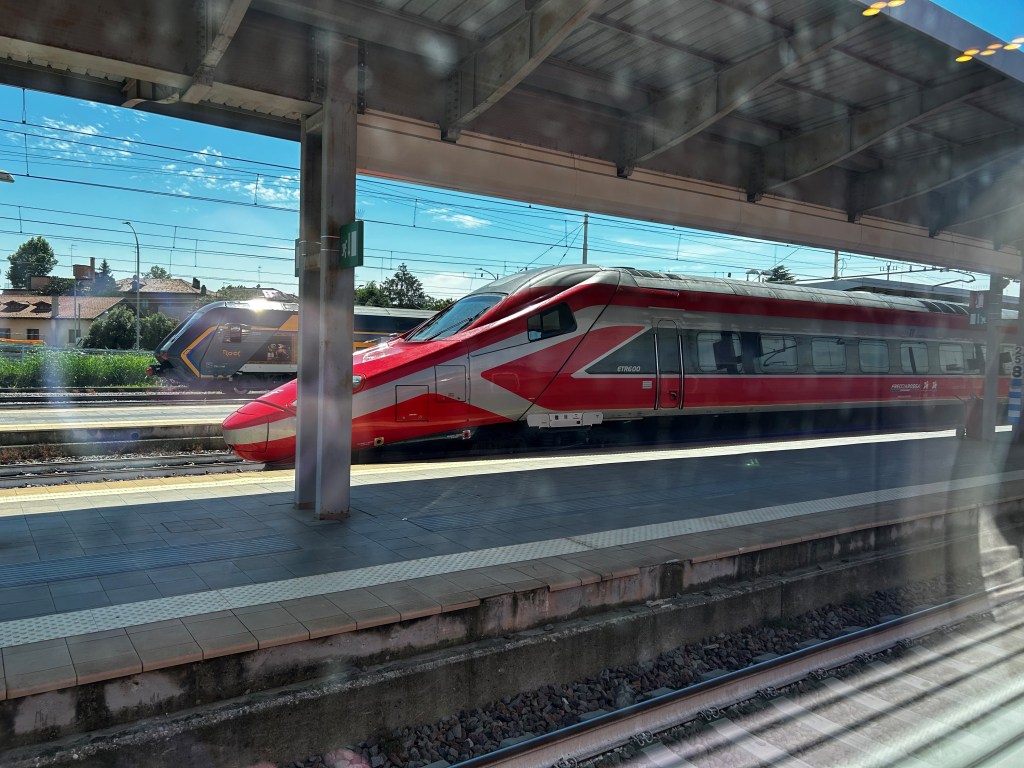
We decided that rather than fly from Rome to Venice, we’d get the train. It took around 4 hours on a fast train (and at times it was doing 250km/h so it was genuinely fast). On arriving in Venice, we took a shared water taxi to our hotel, the Palazzio Veneziano, which was great as the drop off point was right outside of the hotel.

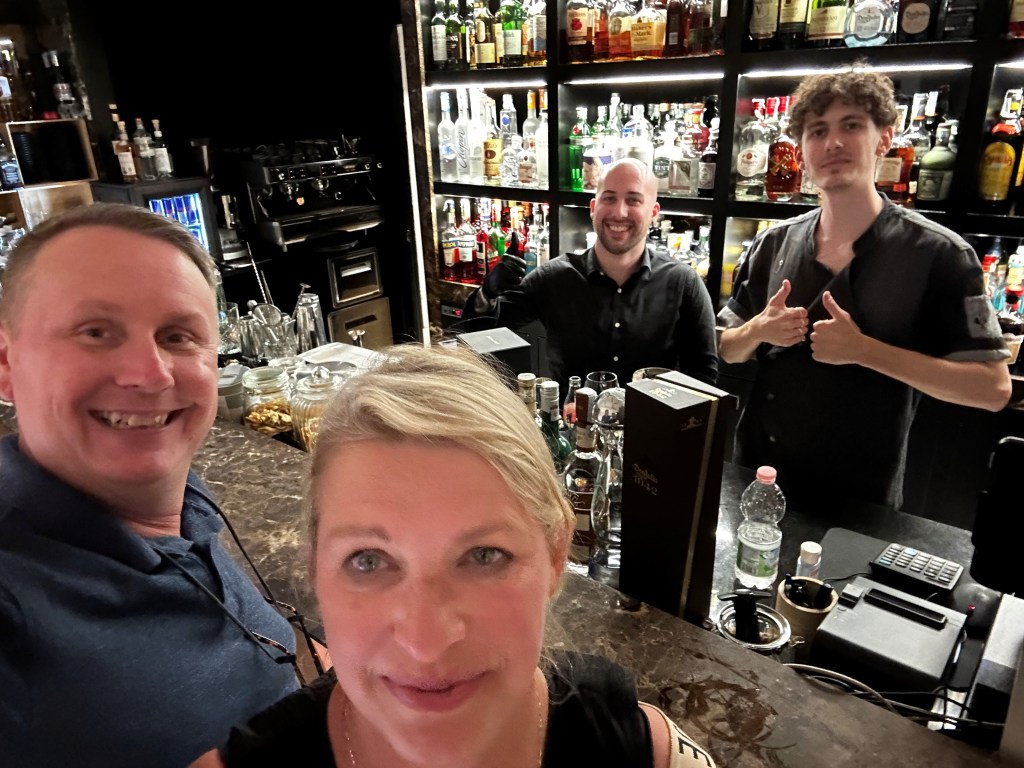
The hotel itself was great – I’d recommend spending some time at the bar as the bar manager was superb at explaining some of the drinks he made – including an award-winning margarita. For any whisky or gin connoisseurs, he had a great array of options to try!

We arrived in Venice in the mid-afternoon. We had to wait around for around 25 minutes for our shared water taxi, but once we got in, we were the first ones to get out and it only took around 25 minutes to get there.

As we’d only come up on the train, there was no need to freshen up on arrival so we just put our cases in the room, spoke with the concierge about where we were on the map and set out to explore. The concierge was incredibly helpful, providing multiple suggestions for where was worth walking to.

As with every holiday we take, walking is an integral part of what we do. We’d decided that we’d head across to St Mark’s Square and see what there was to see while we were there.

The walk only takes 15-20 minutes. Or it would if you didn’t stop to look around all the time! We probably got a little better at that as we took subsequent walks.

Day 1 – Finding our way to St Mark’s Square

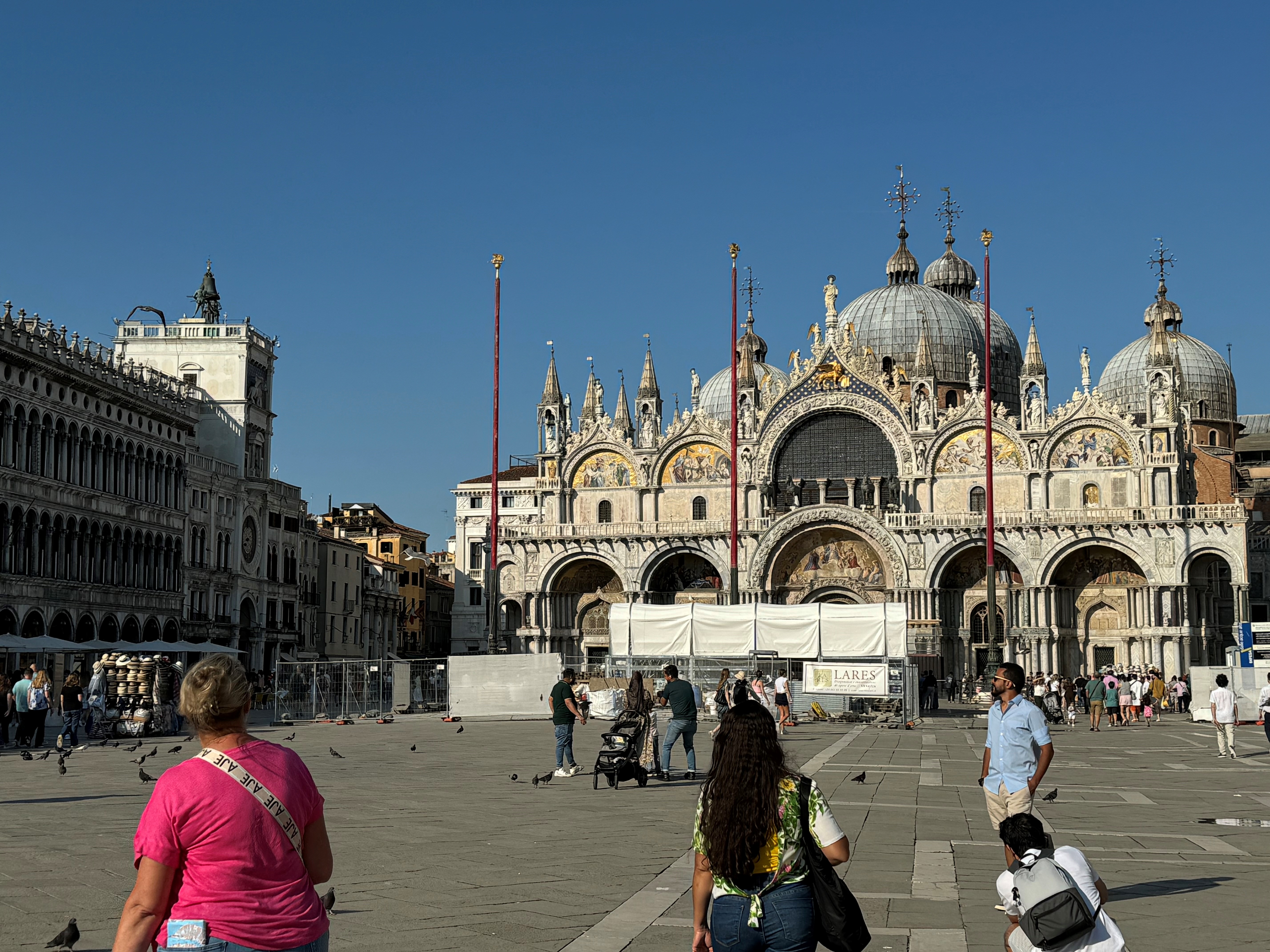
So after putting our luggage in the room and donning some comfortable footwear, we set off for St Mark’s Square. It took longer than 15-20 minutes to get there, but most of that was down to us stopping and looking around.

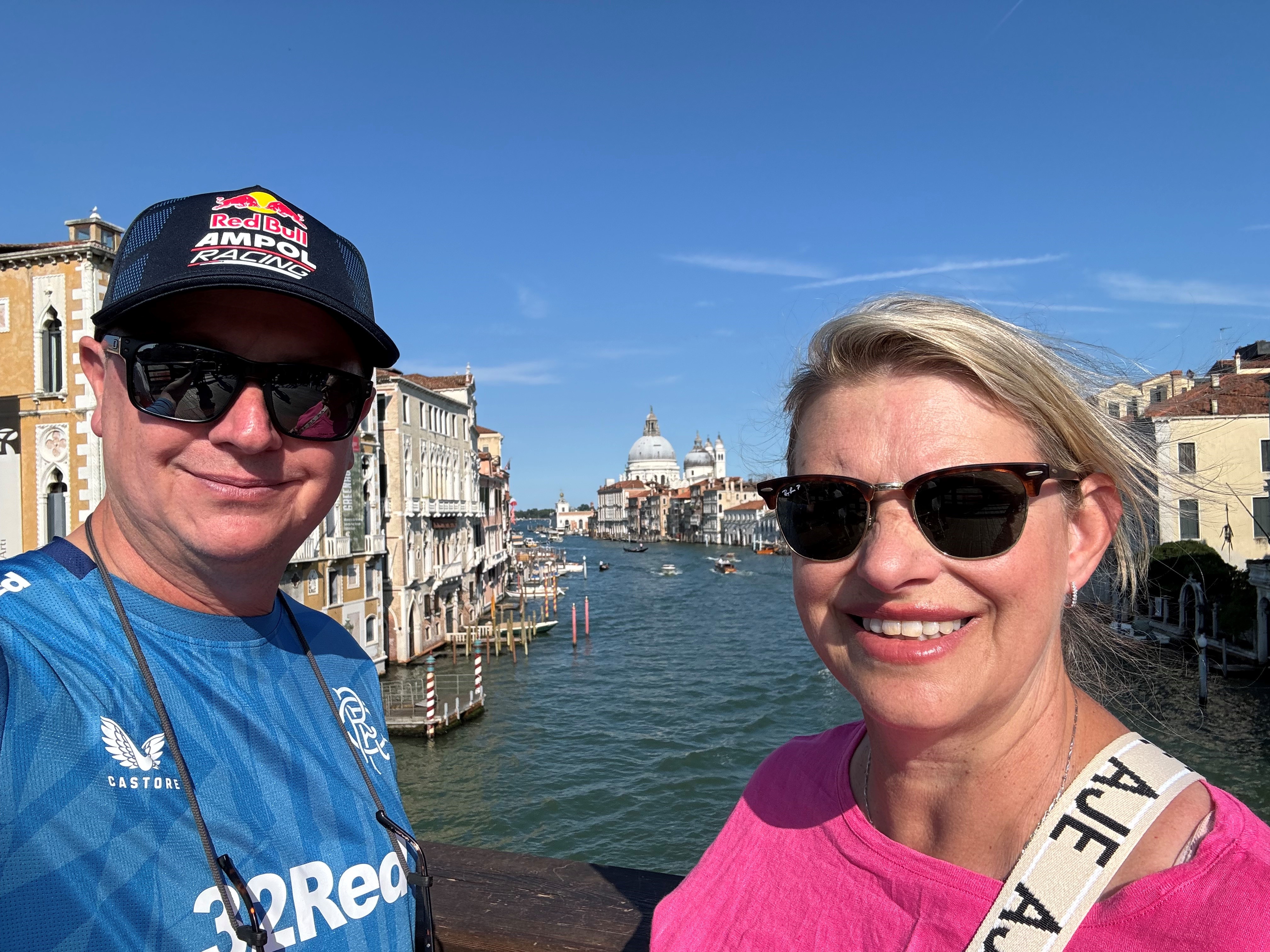
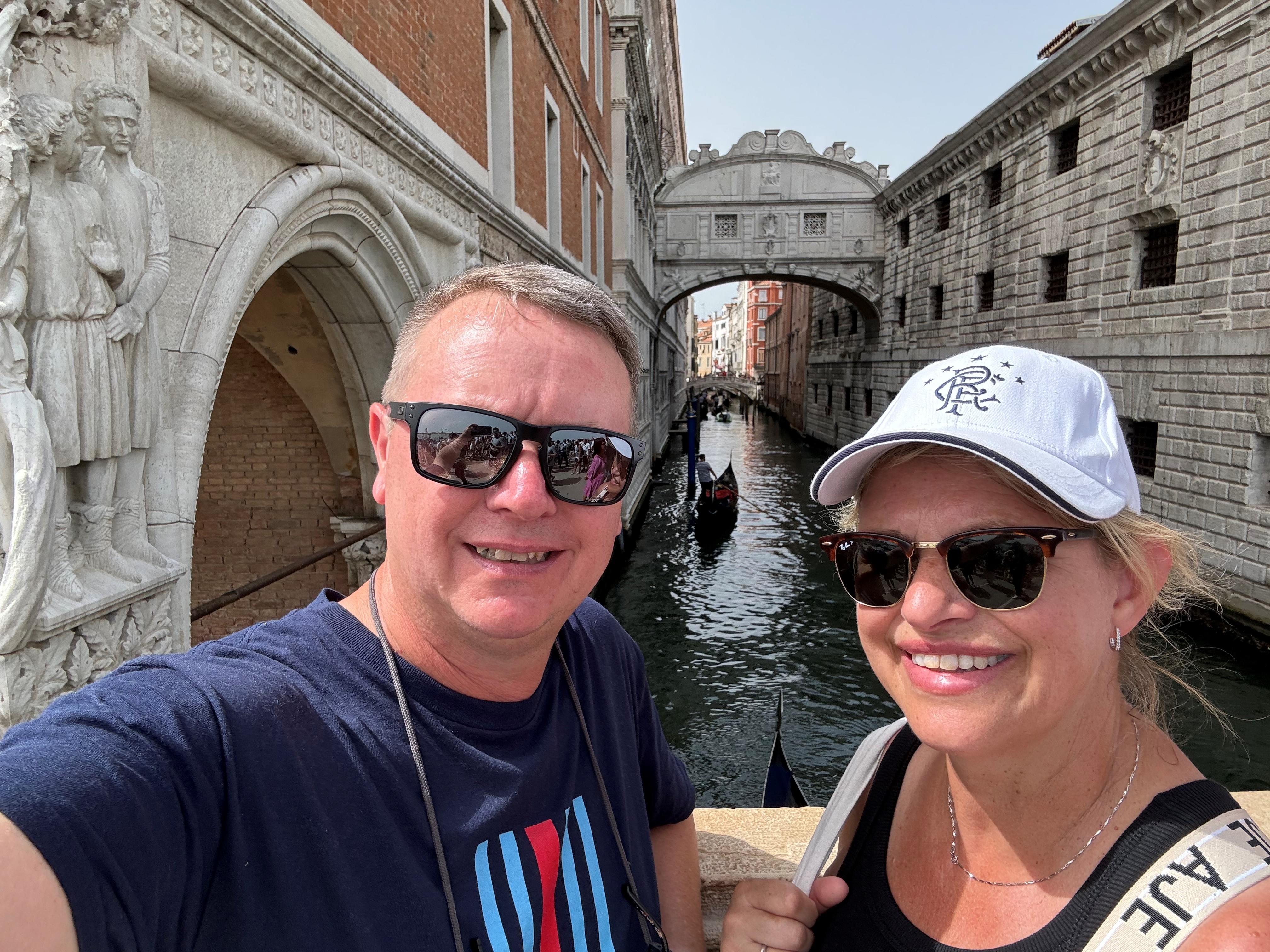
It didn’t take long for photo opportunities to start appearing, as we had to get an old wooden bridge across the Grand Canal. I think we ended up hanging around there for around 10 minutes. As we had to walk across it every time we went into central Venice, we got better though.

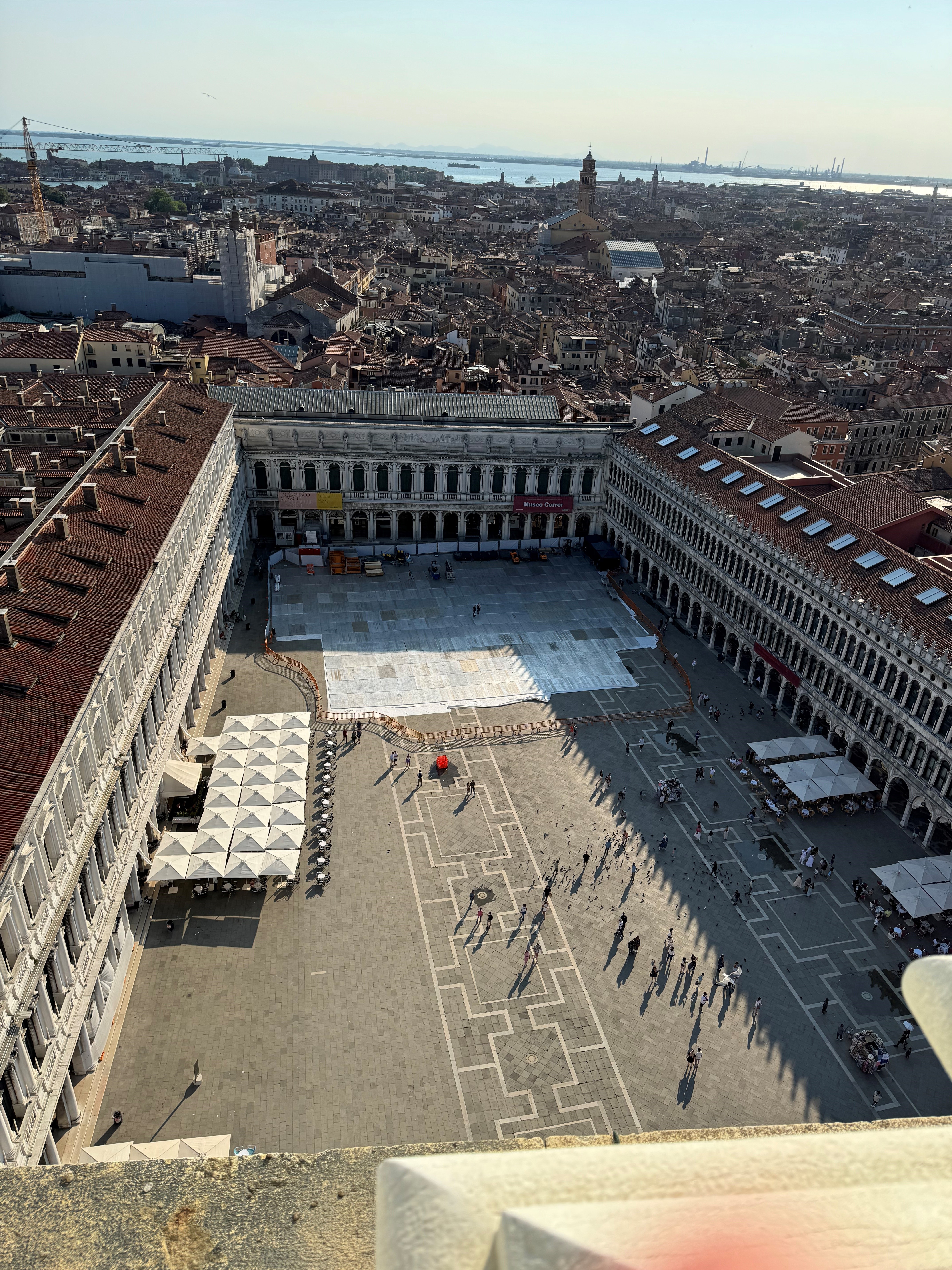
From here, we eventually managed to carry on and via a few side streets, somehow popped out at the far end of St Mark’s Square.

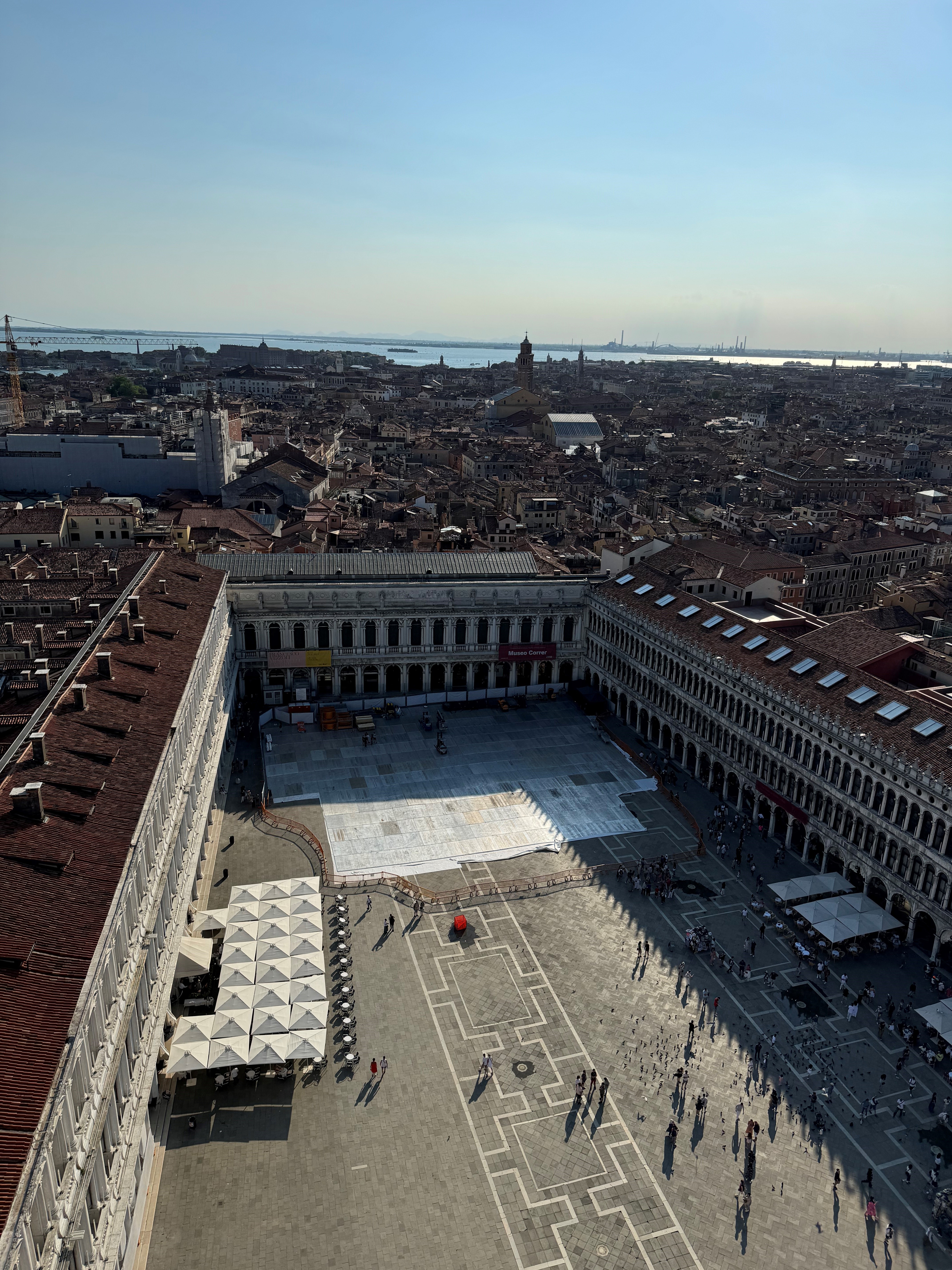
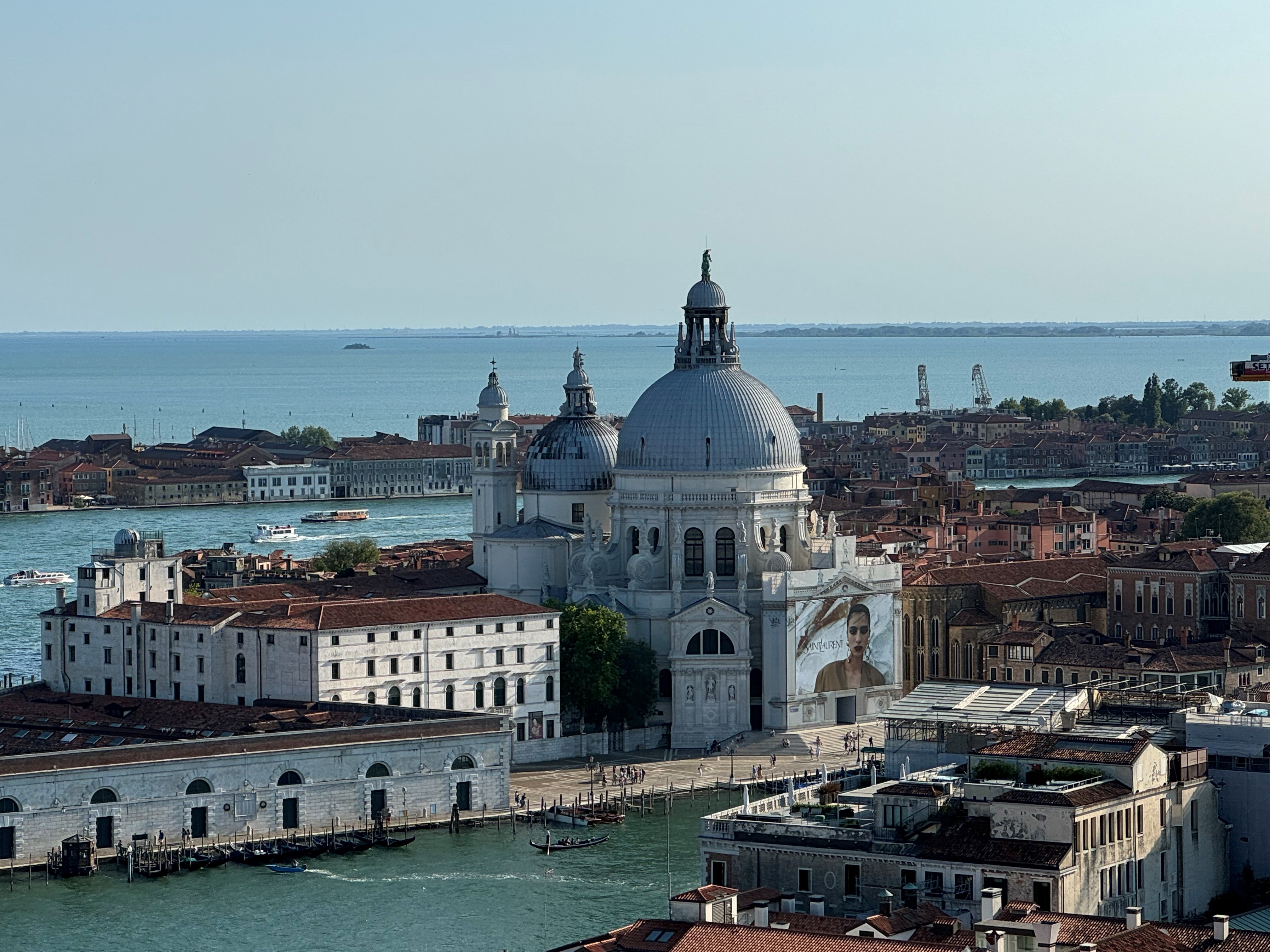
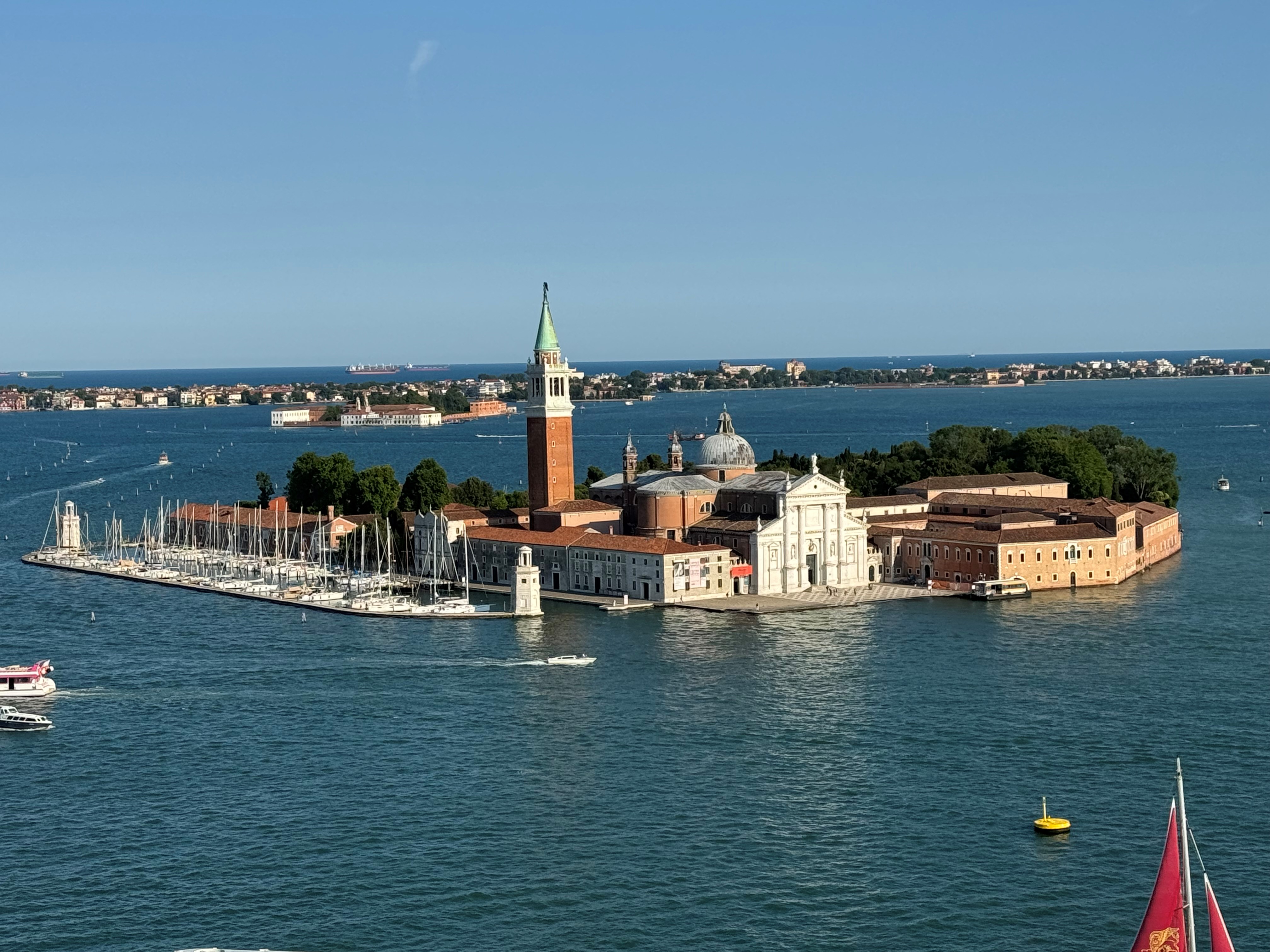
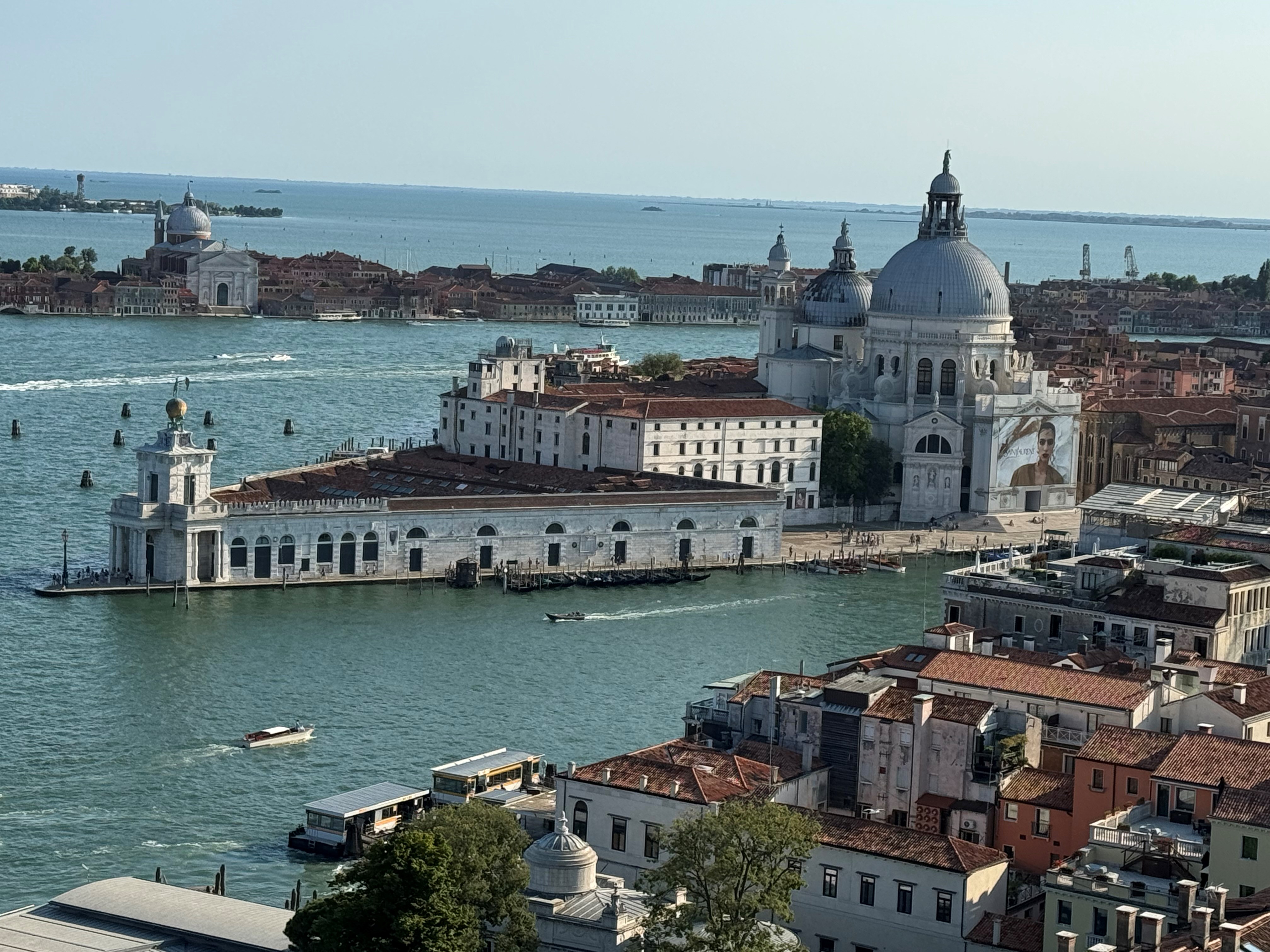
There was only a small queue for the Campanile di San Marco (or St Mark’s Campanile), so we joined it and jumped in the lift so that we could have a look at Venice from on high. It wasn’t expensive and it was worth it.

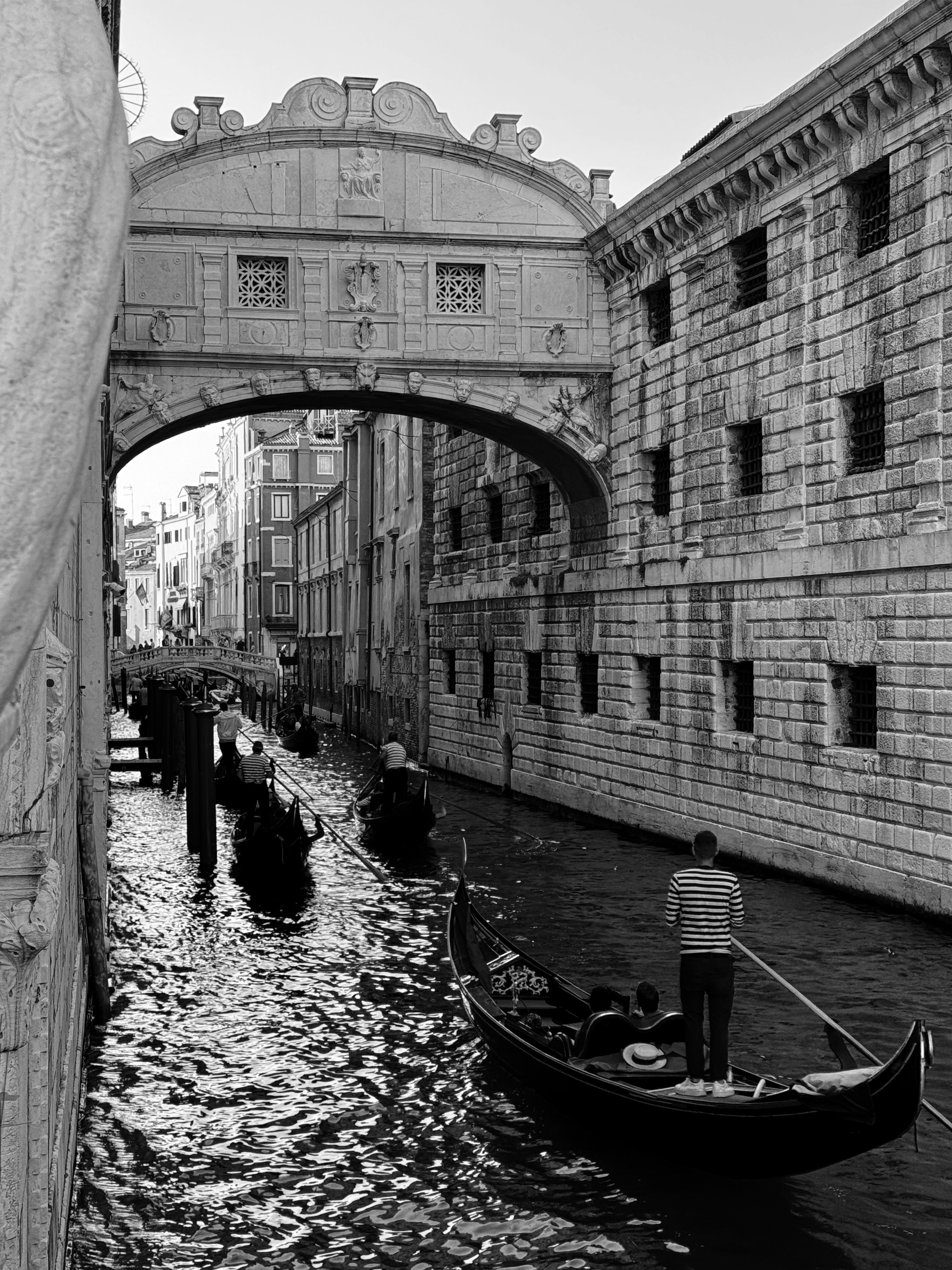
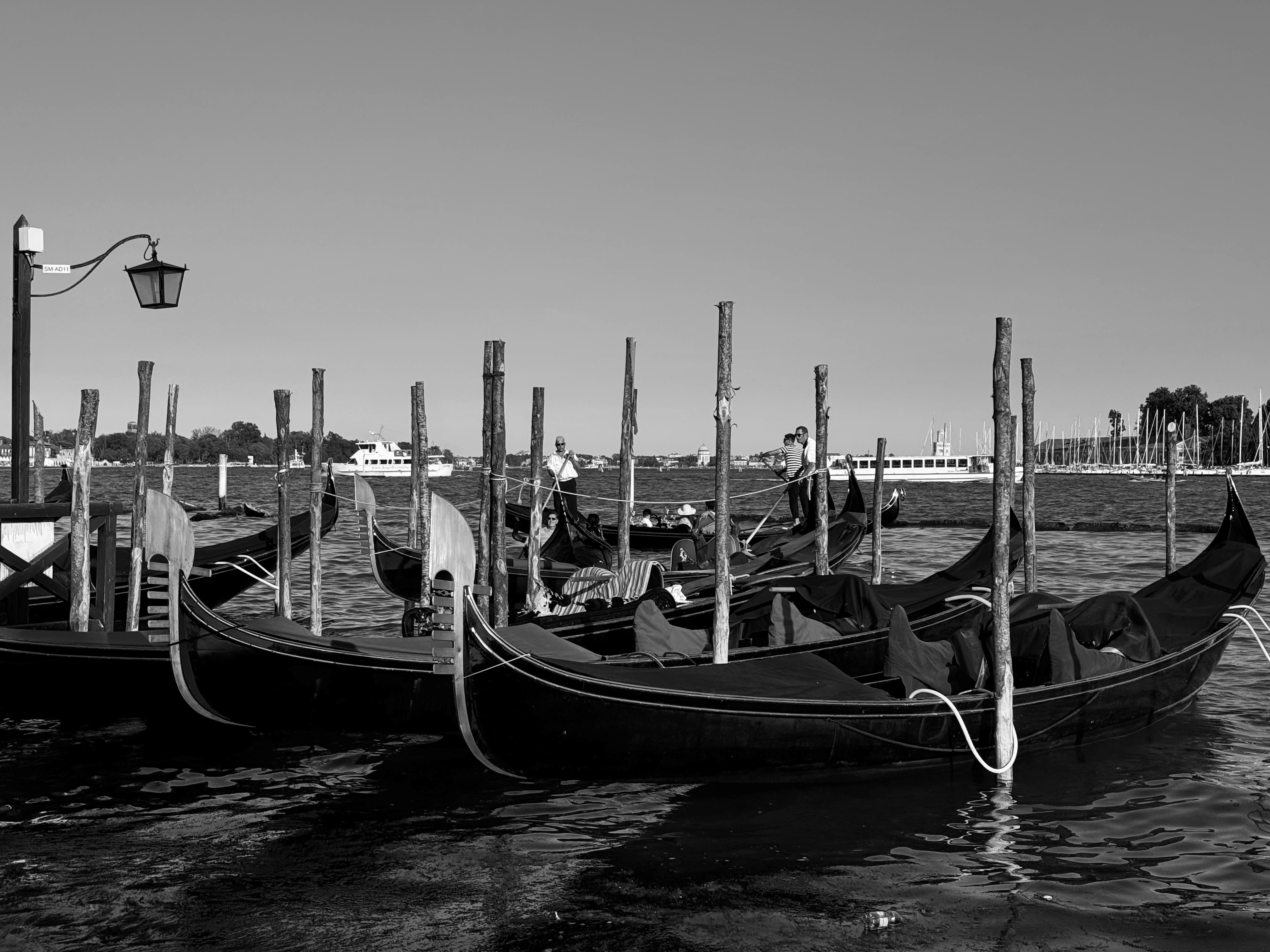
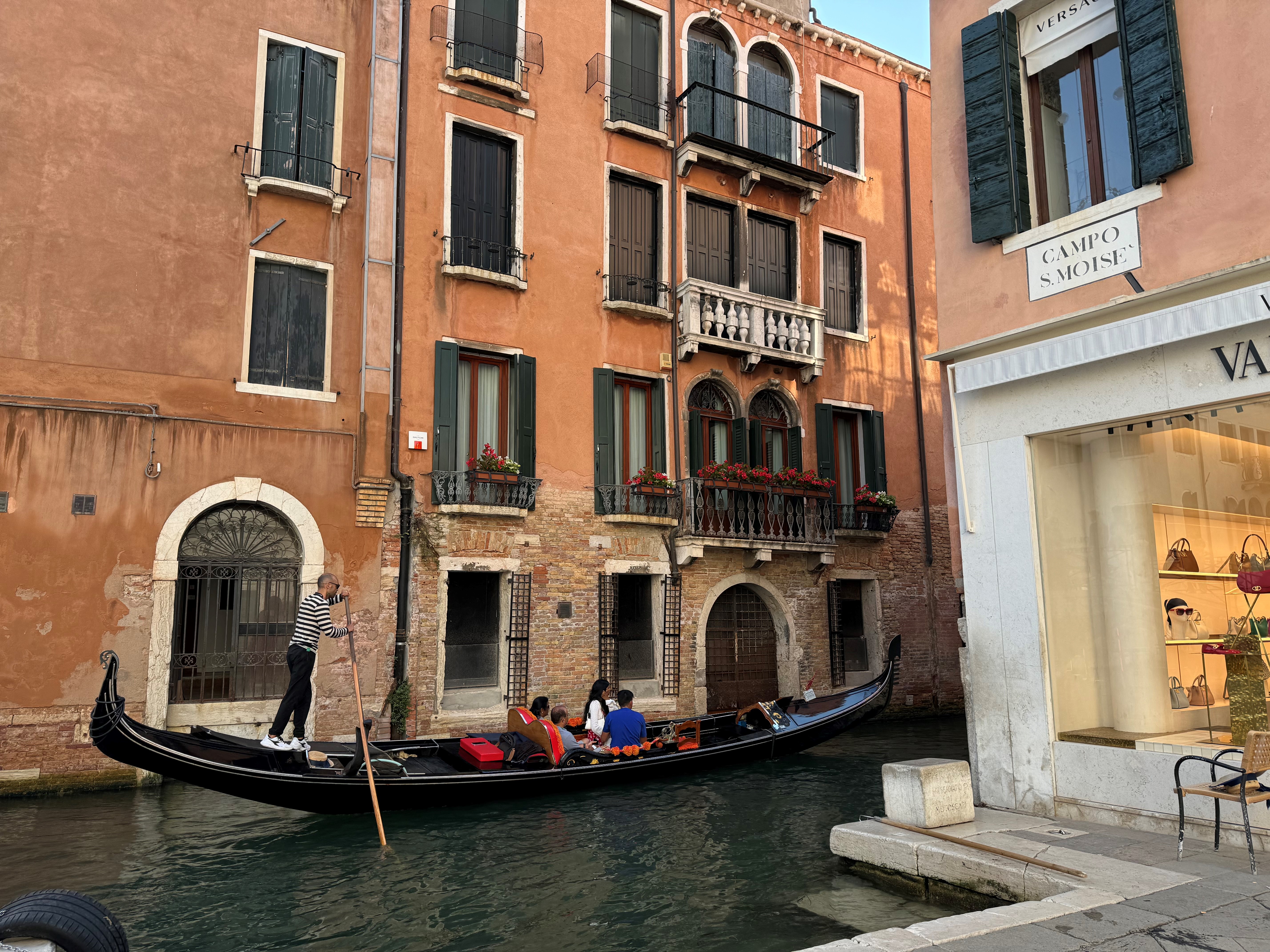
From here, it was back to exploring the St Mark’s area of Venice, which included some picturesque canals and, of course, gondolas.

Day 2 – Lost but not really lost

Day 2 was supposed to commence with a walking tour of the city. Some friends had recommended a tour guide, and she was supposed to show us around the parts of Venice that tourists don’t usually see, using her knowledge of the city to show us a different side of it.

She was supposed to pick us up at 10.30am. Alas, when she hadn’t arrived by 11am, we managed to get in touch with her. She’d “forgotten” but said that she could meet us at 4pm instead. We declined and decided that we’d do our own tour of Venice. We figured that if we didn’t use Google Maps, we could just see where our noses led us. We’d stop somewhere for lunch and then head back to the hotel to clean up before dinner.

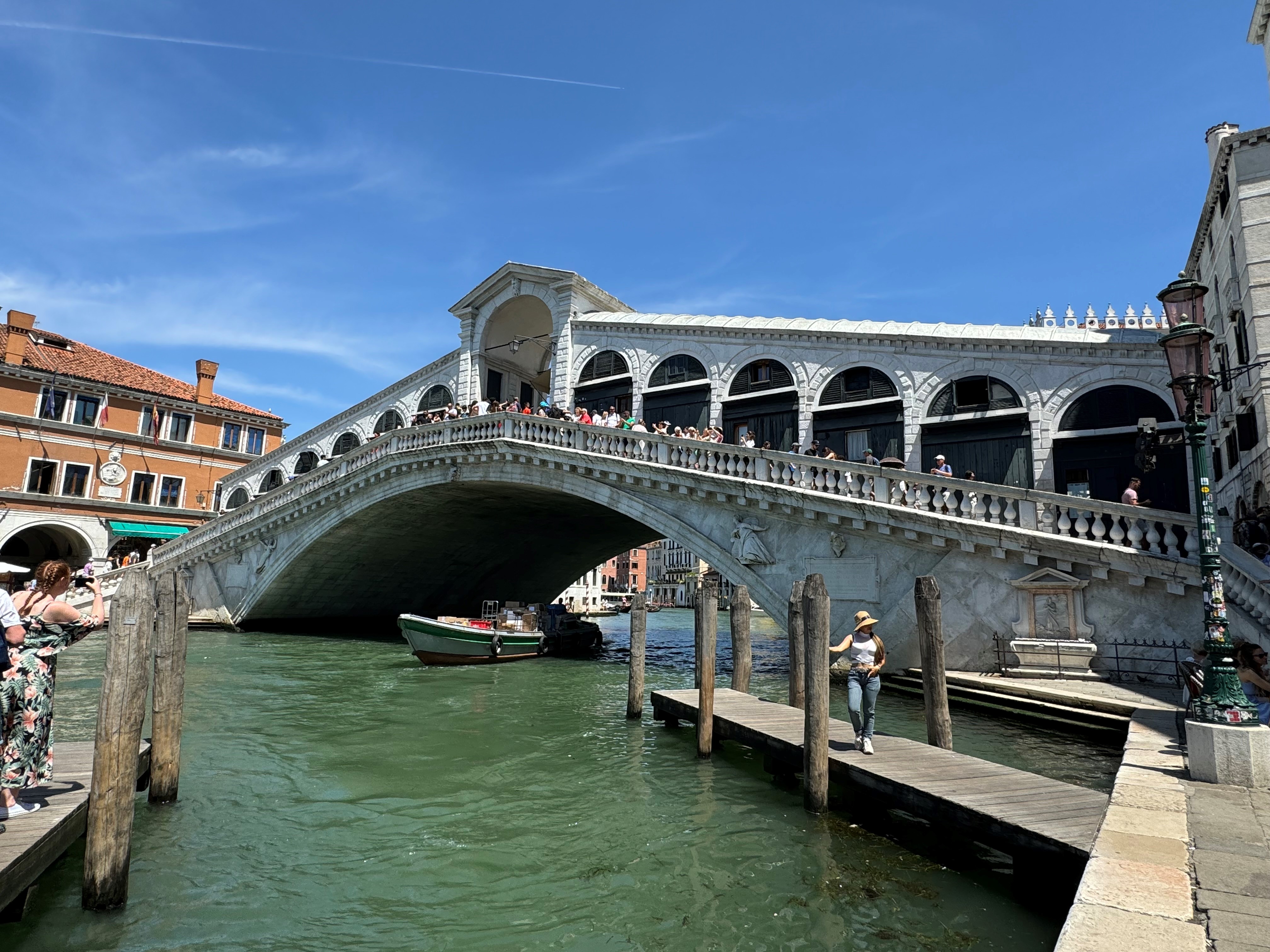
While the plan was to get off the beaten track, there were also some things that we did want to see, such as Rialto Bridge.

But the rest was to be left to chance.

I probably stopped and took a photo of just about every narrow street, every narrow canal and every bridge over the water!

However, I also took photos of people’s washing (is that weird?), empty cafes that were just awaiting throngs of hungry people to arrive for some of the Italian delights that they sold (or maybe just an Aperol Spritz, which seemed to be the tourist’s drink of choice in this beautiful city). I tend to take lots of photos and then delete the ones that I don’t like. Getting lost (but not really lost) meant that we saw lots of things that I found exceptionally interesting.

This first group of photos don’t actually include any water:

Bridges. There are plenty of the around Venice!

And lastly, I managed to get some pictures of waterways from the Grand Canal to some of the narrower ones, not forgetting some of the gondola jump on / jump off points:

I think that we must have walked close to 20km on day 2, so headed back to the hotel, had a nice shower, a pizza by the water and then retired to the hotel bar to try a multitude of gins, whiskies and even threw in a margarita for good measure! I even found a selfie on my camera the next morning!

Day 3 – Murano, Torcello and Burano

Murano

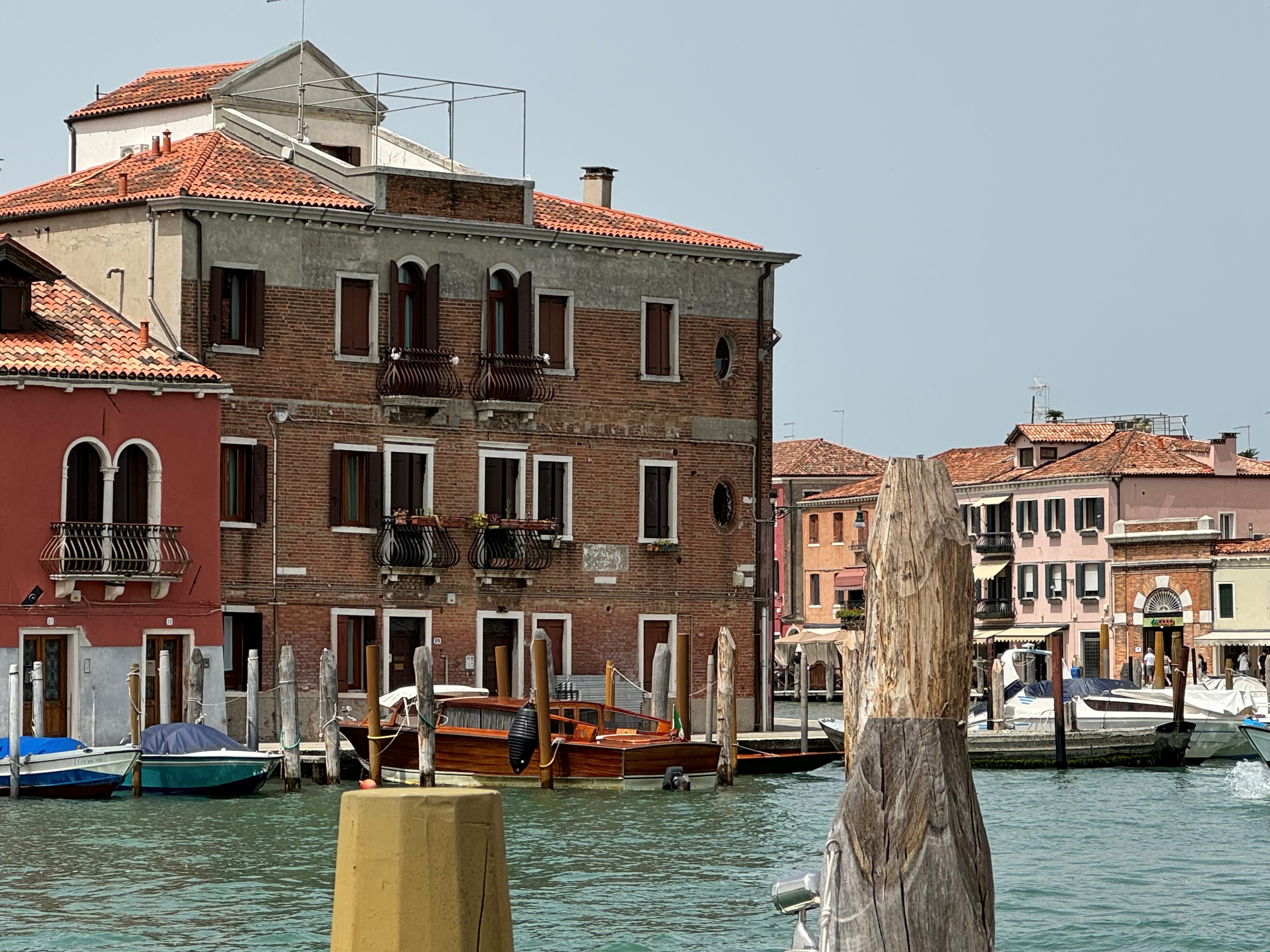
I’d booked a relatively cheap tour of the islands of Murano, Torcello and Burano. It came with a guide, although to keep the cost down, the guide was only on the boat and she’d tell you what to look for and expect on each of the islands. It was a half day tour, but you only spent around 50 minutes on each island.

First stop was Murano, world famous for glass blowing. We stopped there for the obligatory demonstration, followed by a look around the shops before jumping back on to head for Torcello.

Murano glass is very expensive, but Josanne managed to find a couple of cheaper trinkets to bring back.

Torcello

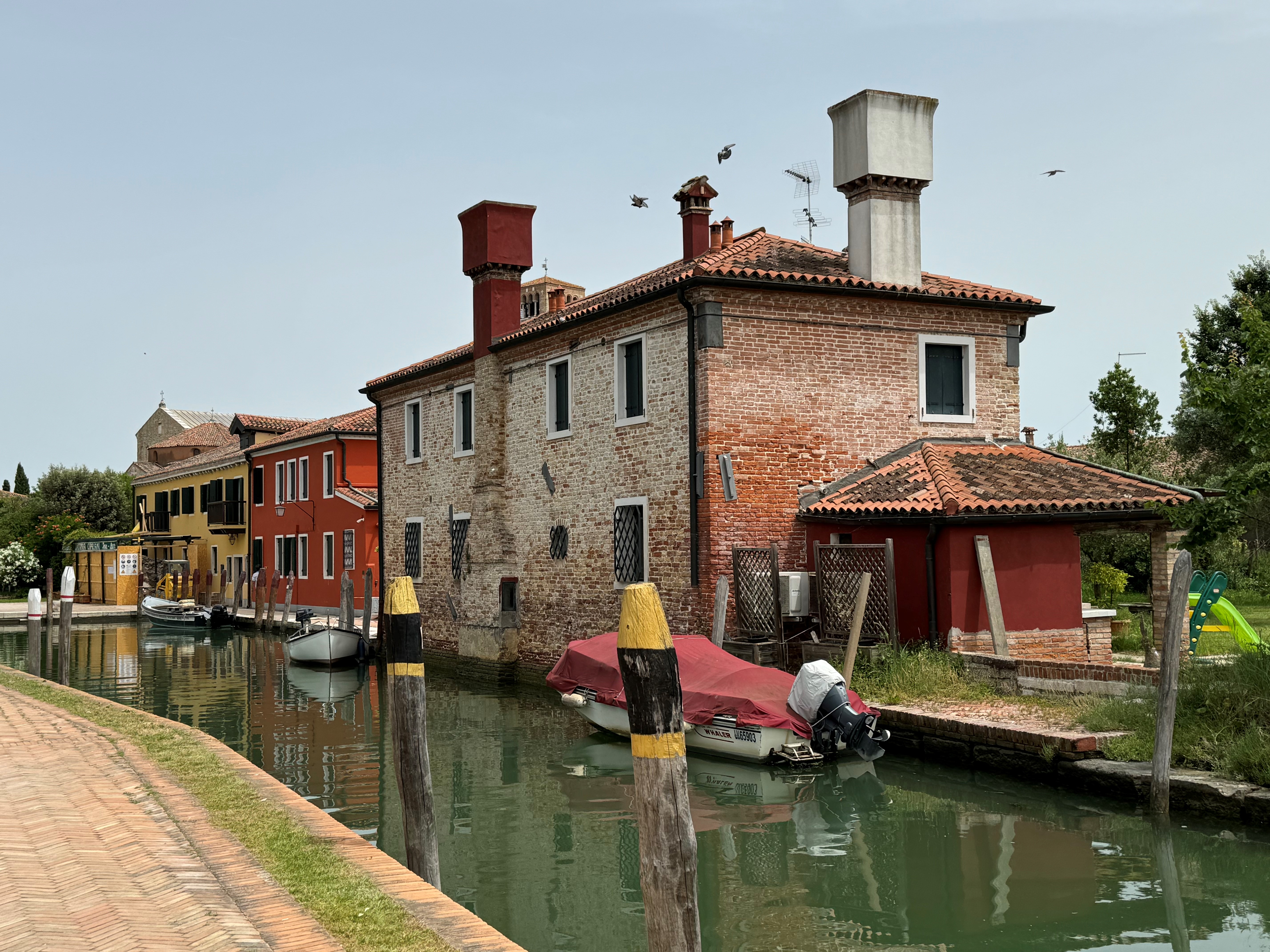
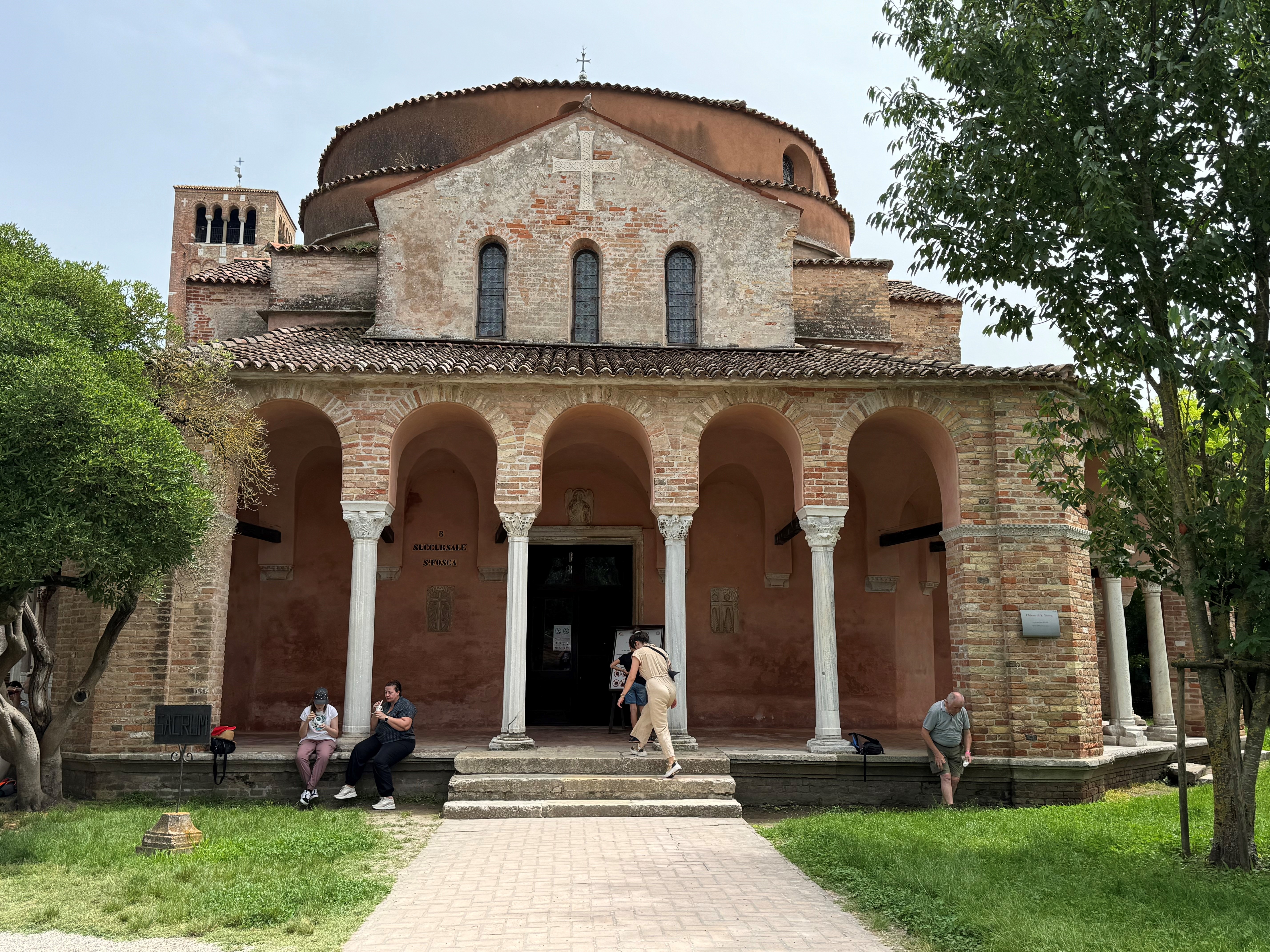
Torcello is one of the oldest inhabited islands, but I’m sure that the guide said there were only around 5 permanent inhabitants on the island. It was originally a fishing port. It does have an ancient 7th century cathedral and a bridge with no sides that dates back to the 15th century. There were some cafes by the side of the canal to eat at, but there were large queues at these, so we didn’t really have time to grab a bite to eat after we’d looked around.

Burano

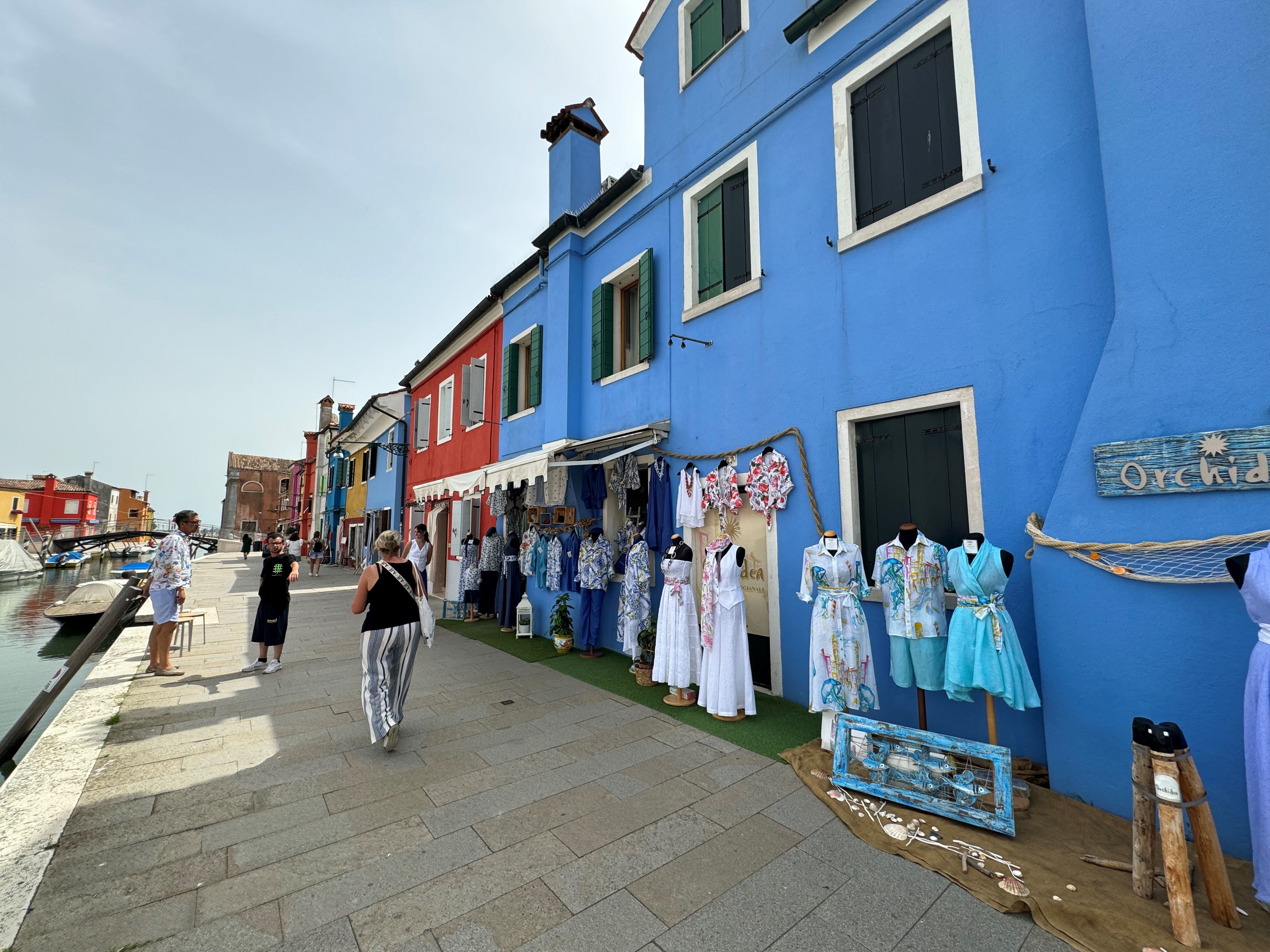
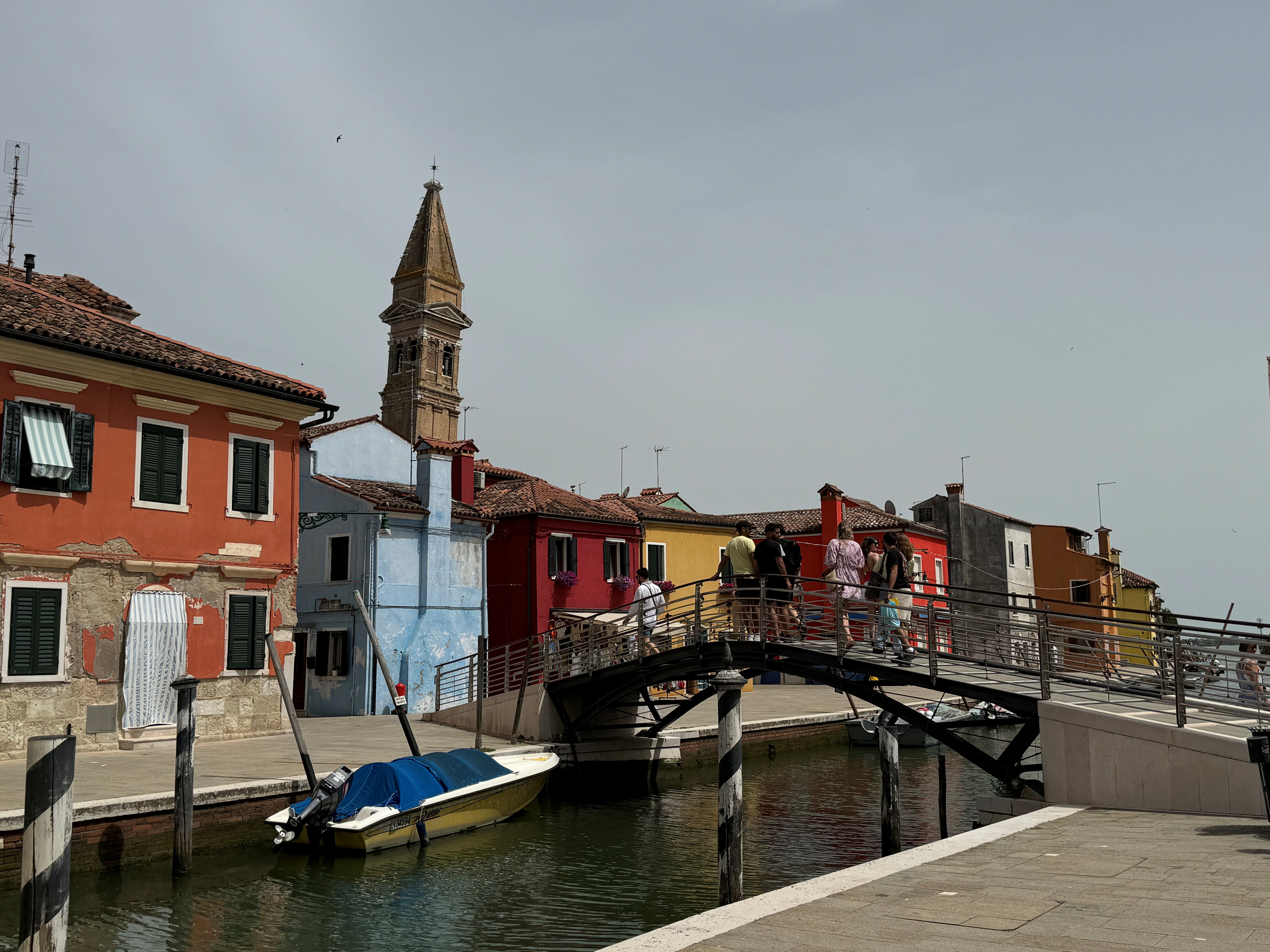
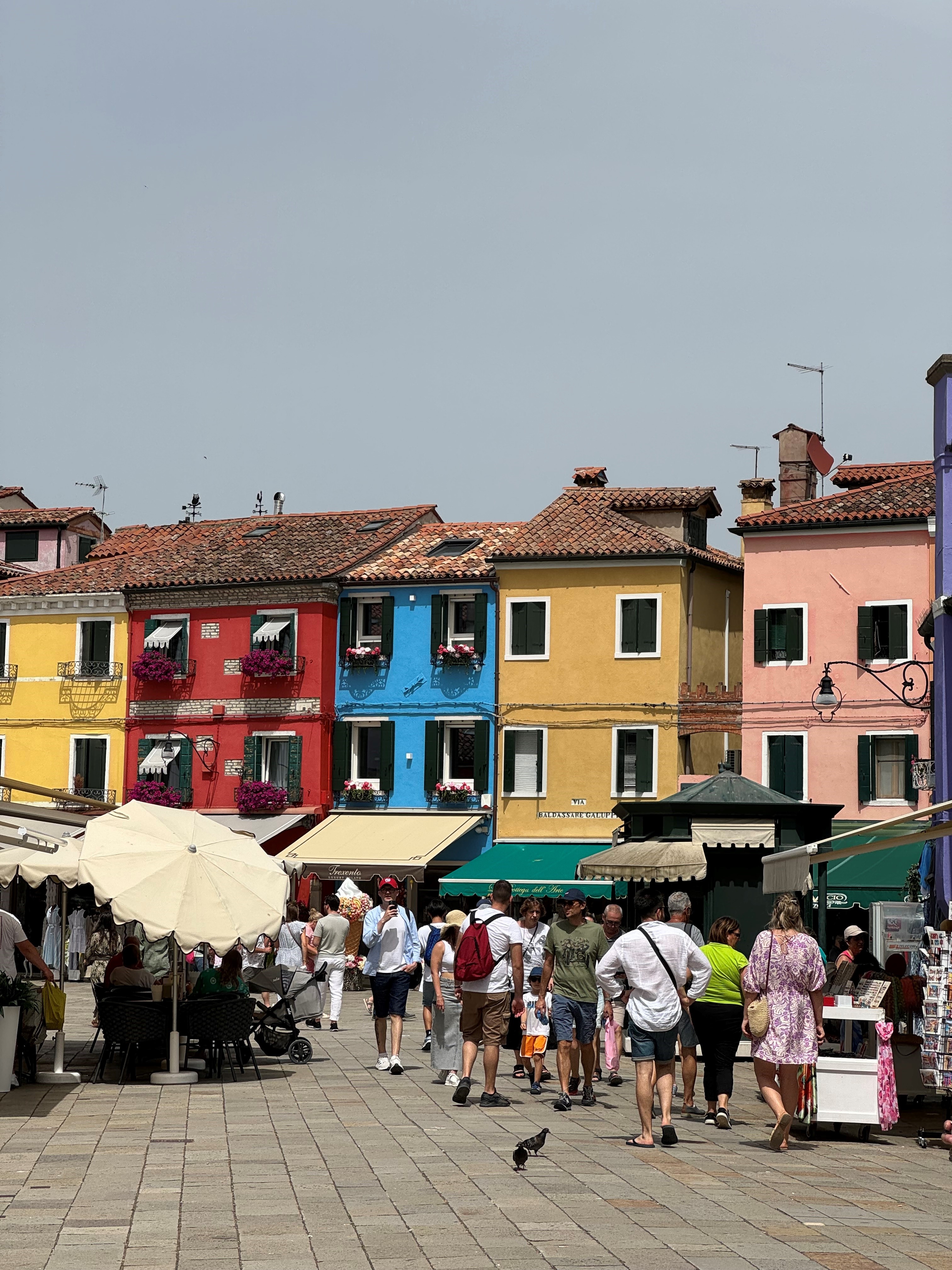
The third and final stop was one that I’d have gone back to again if we’d been staying for longer. There were more shops, cafes and restaurants here. While we stopped for a very quick bite to eat, most of our time was spend just looking around. We almost lost track of time and had to rush back to catch the boat back to Venice.

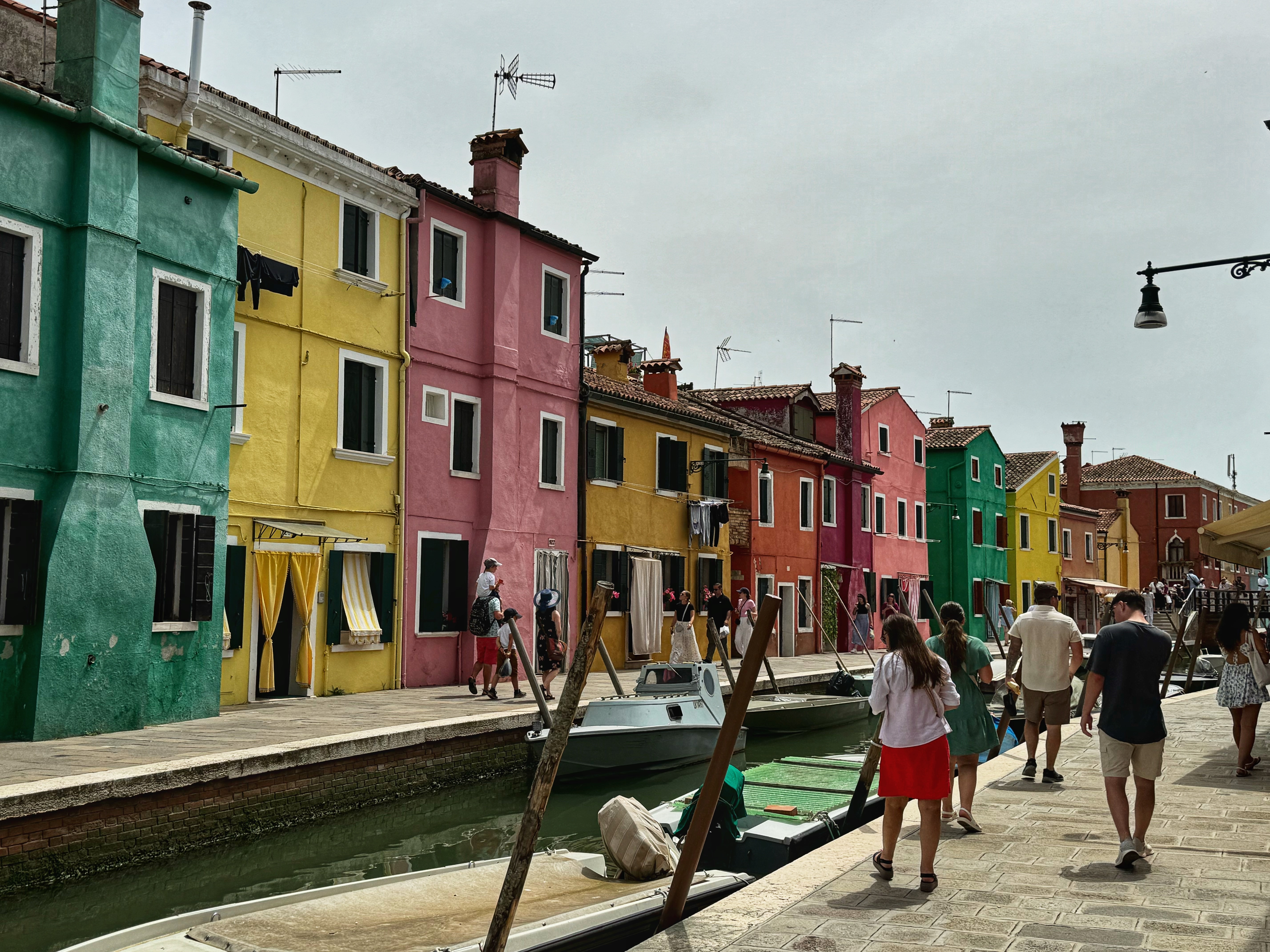
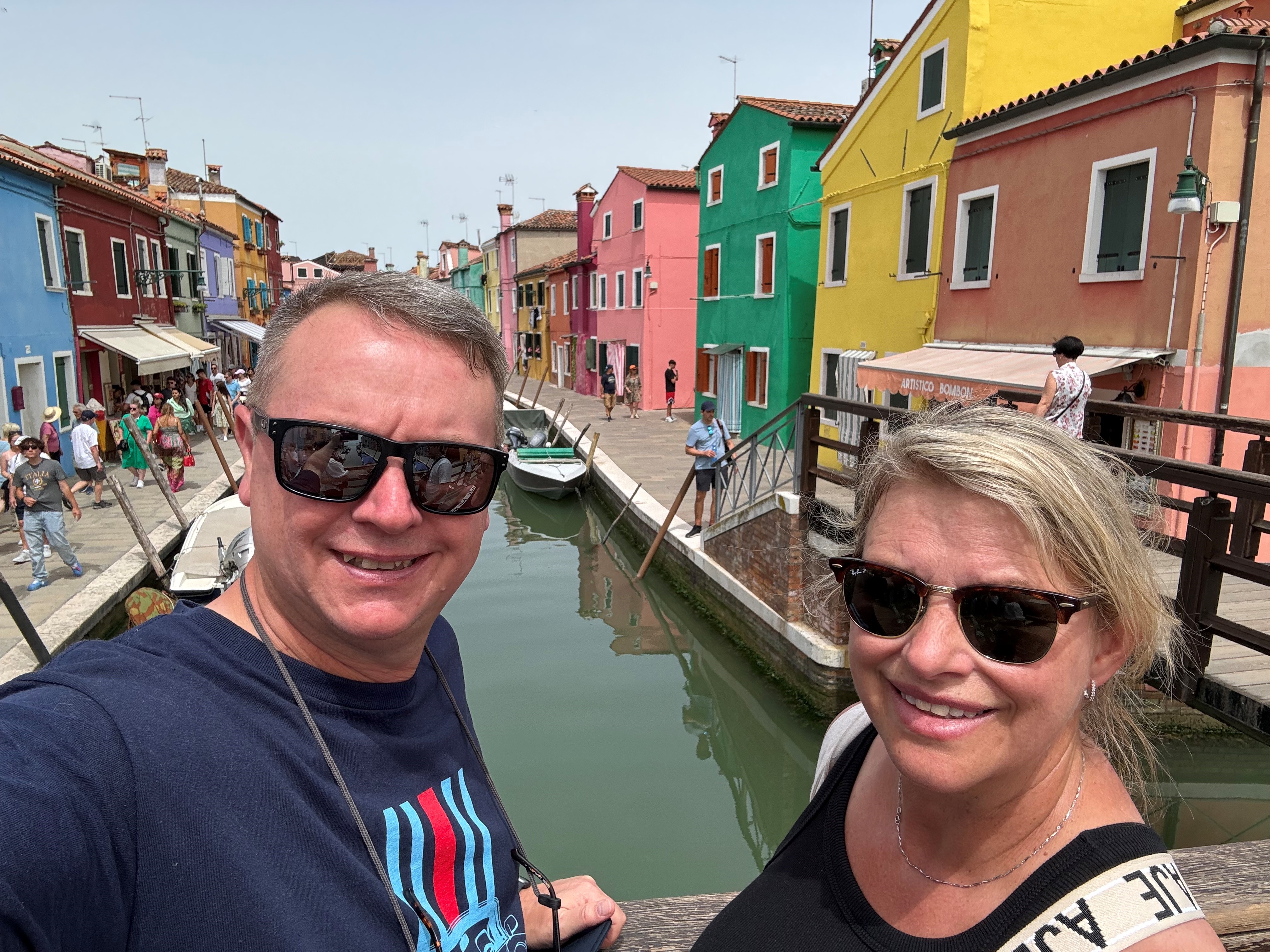
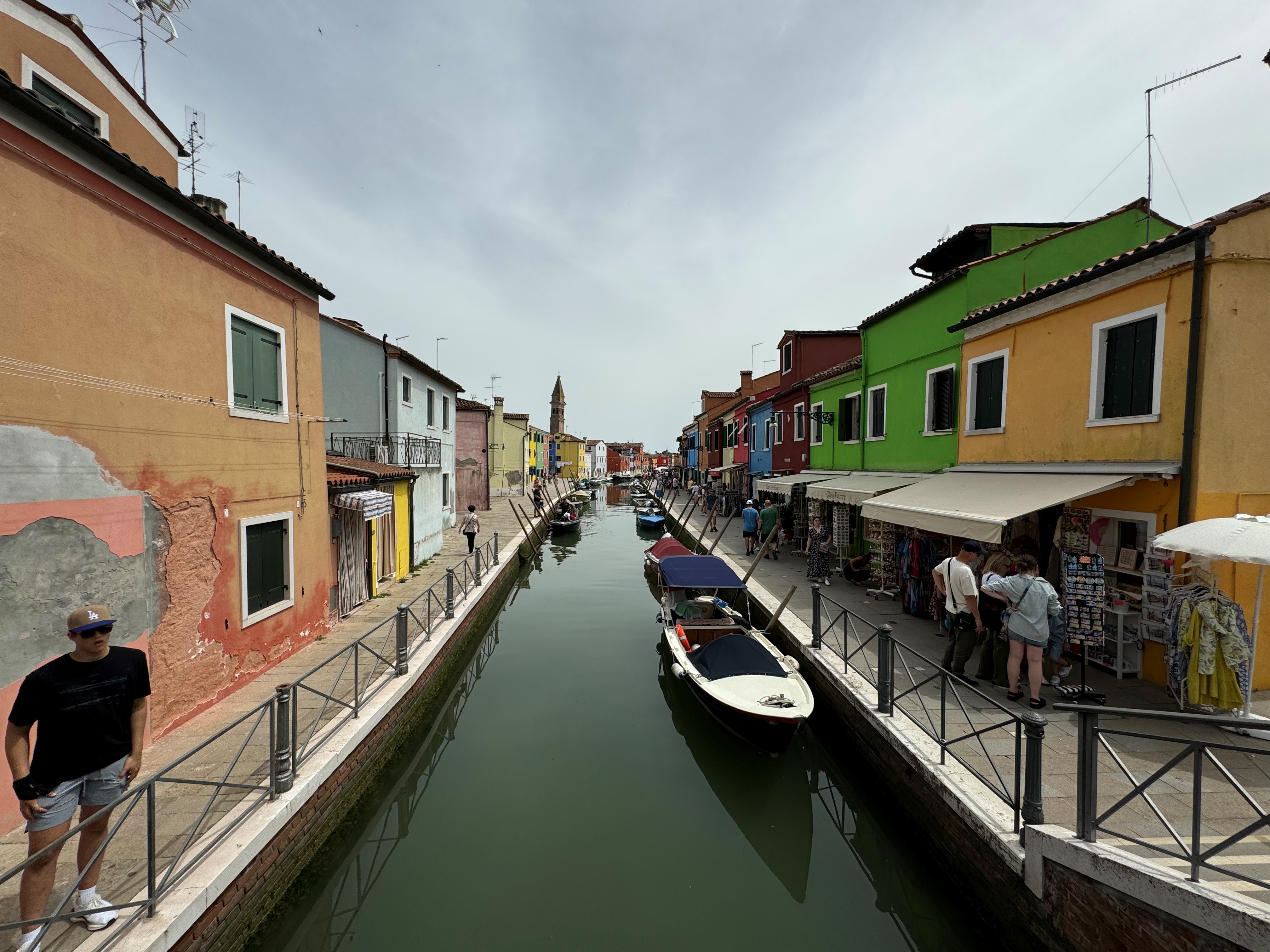
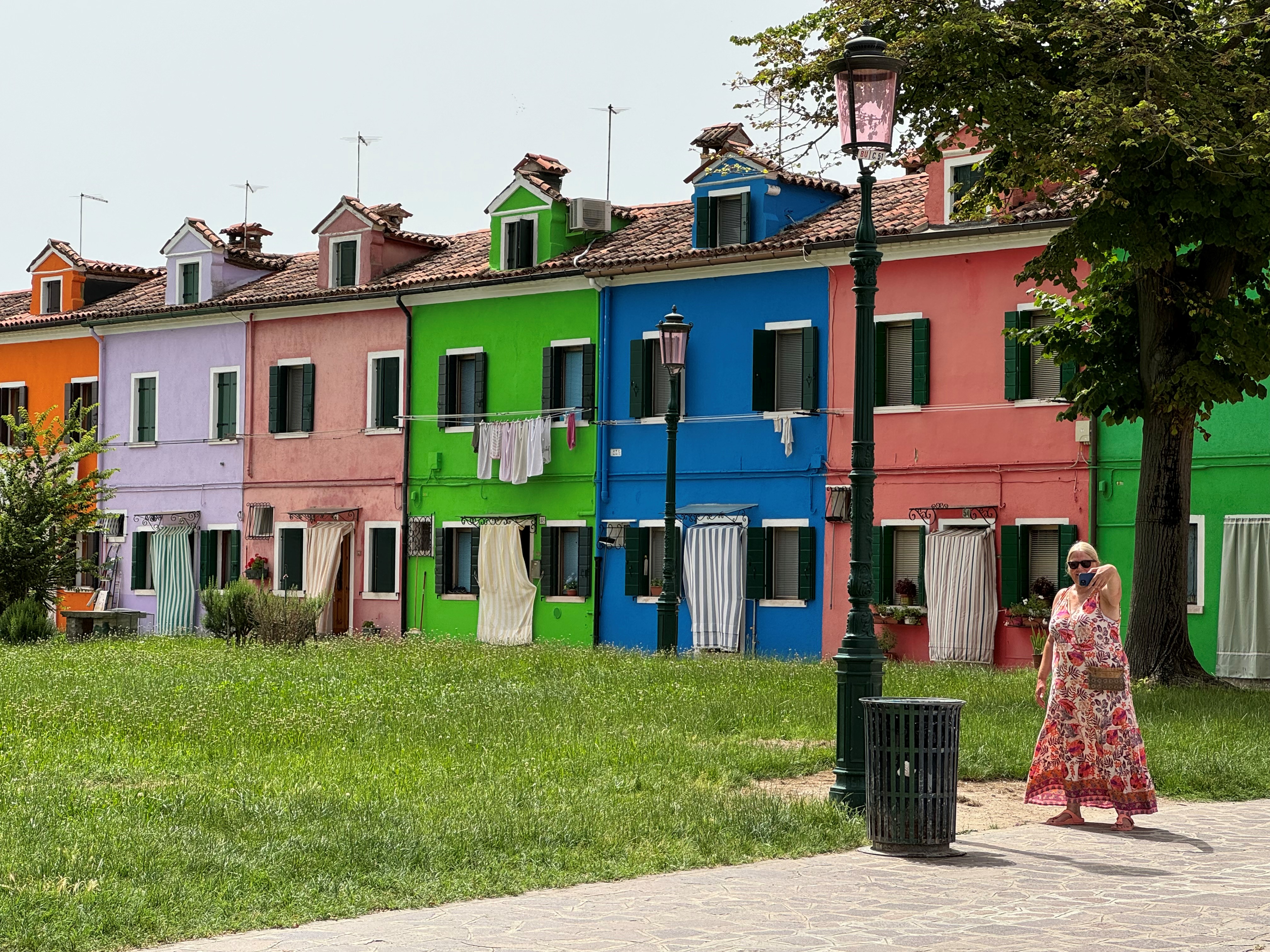
While Burano is famous for its lace, it was the beautiful houses in a myriad of different colours that caught my attention. This was easily the prettiest of the three islands we visited and if you have the time, it’s worth spending more than just 50 minutes on!

Fifty minutes flew past here and with all of the recent walking (and maybe the late night in the bar on the previous evening), we both had a snooze on the boat on the way back.

Once we got back to Venice itself, there was the opportunity for a few more photos on the way back to the hotel. We also took a walk to discover where we would get the water bus to the airport the next day as we were flying back to the UK for our trip to Scotland. When it comes to writing that one up, I’m going to have great difficulty in choosing the photos!

So, what were my thoughts on Venice? Well firstly, it wasn’t freezing like it was in November 1994, so that was a great start. It’s a fascinating place to look around, and very easy to fall in love with. It must be a photographers dream as there are so many opportunities to just stop and take photos.

It is busy, but they are putting a tourist tax on, one supposes, to try to limit the large crowds who are evident at every turn in the city. I suspect it’s far less busy outside of the summer months though.

Our 2-3 days there felt just about enough. Sure, I’d have liked to have had our walking tour, but we didn’t do a bad job ourselves I thought. A bit more time on Burano would also have been nice, and I’d have skipped Torcello to be able to do that. If I lived in Europe, it would definitely be a great place for a long weekend. Alas, from New Zealand, it’s a little bit far away for that!

Helpful hints

  • Wear comfy, loose clothing and be prepared to walk – you will see so much by doing that.
  • There are plenty of places to eat and drink – and so many gelato stores! Do try the gelato, it’s superb. Our favourite was the bitter cherry!
  • Getting to the train station / airport can be very pricey (they wanted 140 Euros when we were there). Getting one of the water buses is much cheaper, although it does take longer. We opted for a shared water taxi one way (to “get the experience”), but then just took the water bus to get back to the airport.
  • If you get the chance to visit some of the outer islands – do! It wasn’t expensive to do so. I’d suggest finding a way to spend longer on Burano.
  • It’s not hard to find your way around Venice, but it’s also quite easy to get lost. It’s actually fun being lost and just exploring. You’ll get lots of photo opportunities by doing this! And it’s easy to find your way back onto the main drag.

Rome 3-Day Itinerary: Spanish Steps, Trevi Fountain, Colosseum and much more!

Day 1, The Spanish Steps and Trevi Fountain

I was in Europe for a business trip and we decided that it was time for us both to see Rome. We’d been to Italy several times, but never actually made it to Rome. Josanne wanted to see the Sistine Chapel, and I’d always wanted to see the Colosseum, so both of those were on our “must do” list.

I’m not sure on exactly what needs to be done to be like a Roman in Rome (per the “When in Rome, do as the Romans do“), but as we only had 3 days to spend there, we ate, we drank, we walked (and then walked some more) and we took in the sights. That felt sufficiently Roman to me!

We had pre-booked 3 excursions before arriving via Tripadvisor / Viator:

  • Skip the queue for the Vatican and Sistine Chapel,
  • The Colosseum and Roman Forum, and
  • a Walking Food Tour.

We flew into Rome Fiumicino airport from Paris Orly and then jumped on the train into the city. This was quick, easy and efficient. We’d booked into The Hive hotel, which was only a 5-minute walk from the Termini railway station. We put our bags in the room, put on our walking shoes and set out straight away to explore.

One thing that we always do when overseas is walk wherever possible. You get to see so much by not jumping in a cab or on a train / metro.

Due to it being a short visit, we wanted to maximise our time, so on day 1, the challenge was to get to the Spanish Steps, the Trevi Fountain and to grab a bite to eat.

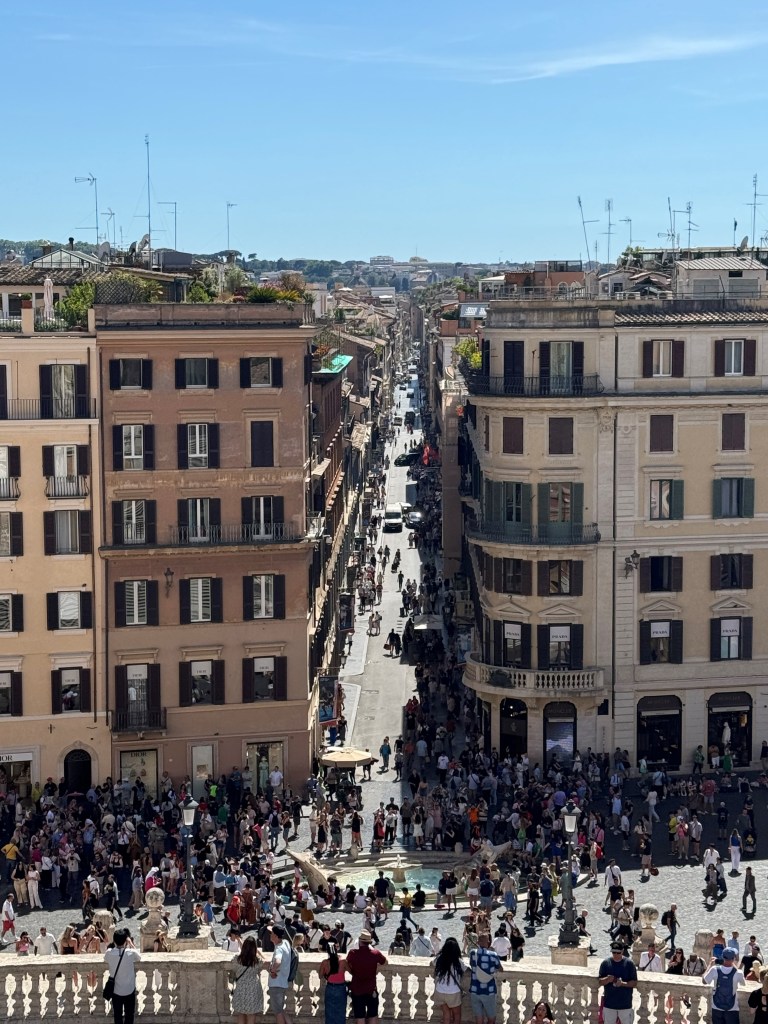
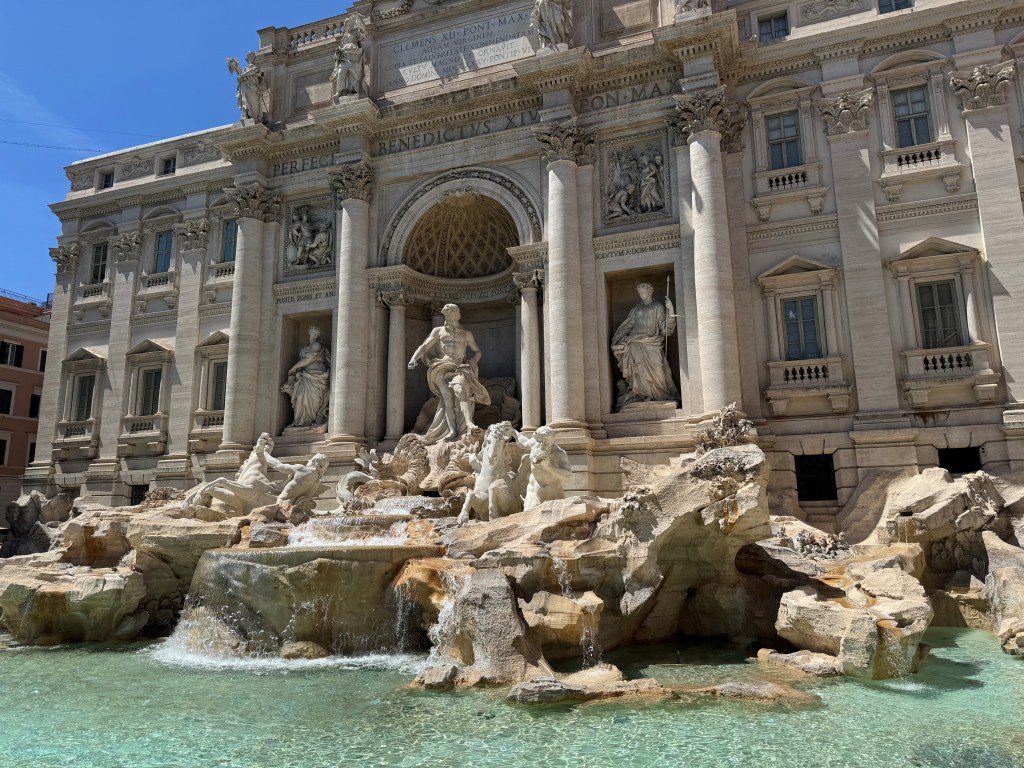
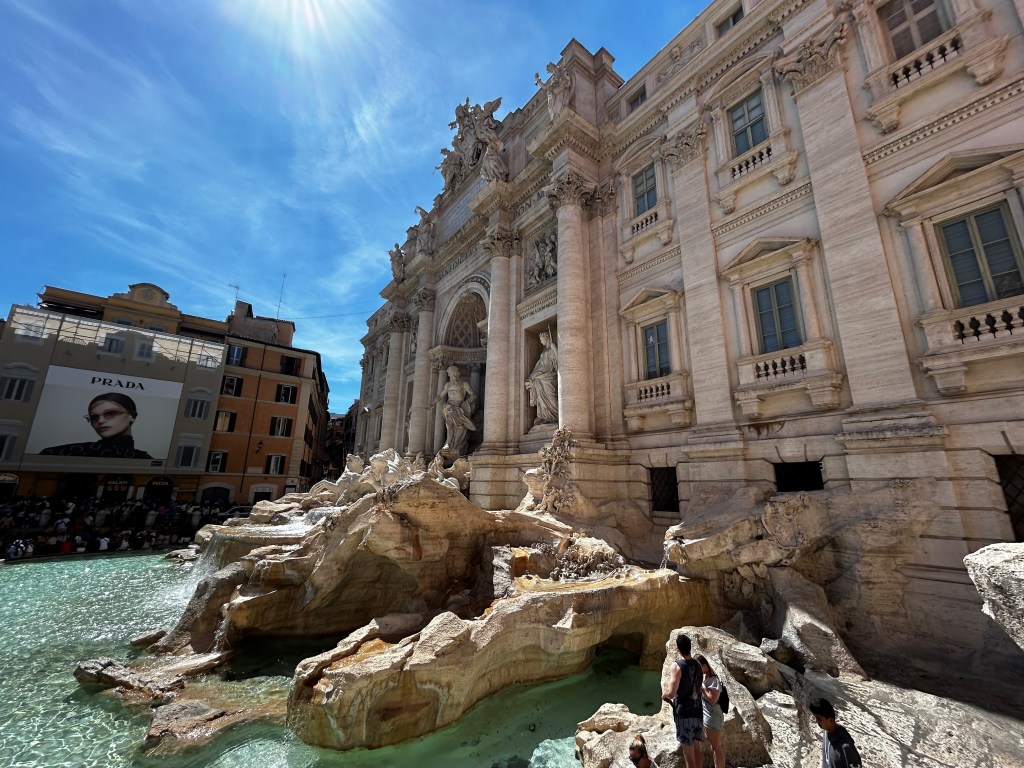
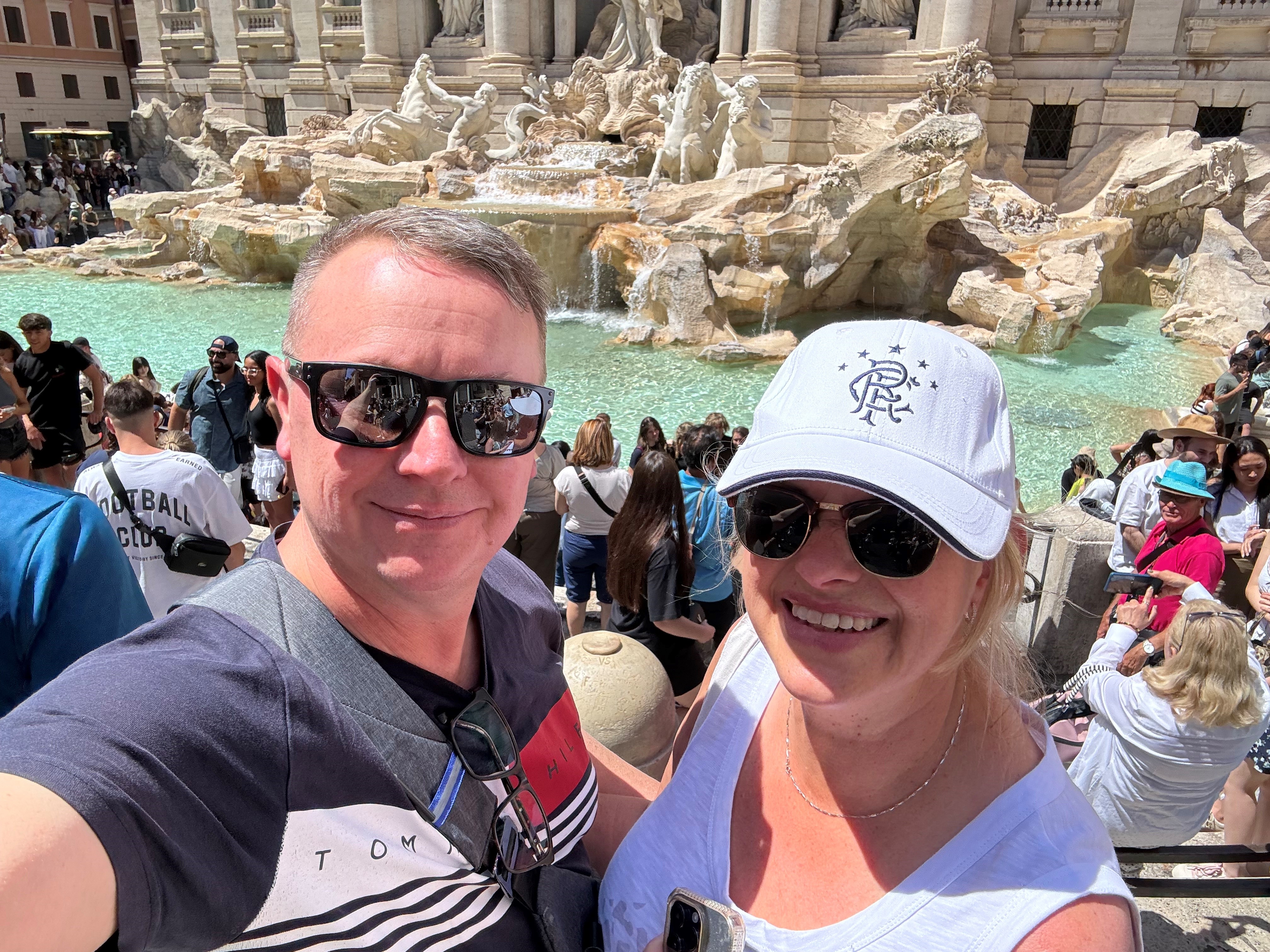
Now the first thing to be clear on is that getting photos with no-one in is always a significant challenge in large cities. Sure, you get the photos that look like no-one is there, but if you pull the camera back……

Rome is no different and as you can see with the photos below, you can “sort of” create the illusion that you are there on your own. But zoom out just a little bit and the truth becomes very apparent!

They always tell you to be very careful of pickpockets in Rome. I bought myself a bag that you wear across your chest. I could fit cash, credit cards and a phone into it easily and it kept it all in front of me and out of my pockets. We had no issues at all with people trying to pickpocket us, but anywhere there was a crowd, we were always wary.

We managed to spend several hours looking around Rome in the area between our hotel and the Trevi Fountain, before heading back to shower and get ready for dinner as Day 2 was a big (and busy) one for us. At this stage, we didn’t know that Viator were about to let us down in a big way!

That evening, we decided to eat at the hotel. It was the first night of Euro 2024, Scotland were playing Germany and after the first 45 minutes, I knew it was going to be yet another disappointing tournament for Scotland. There, got that off my chest and I don’t have to mention it again!

The plan for Day 2 was to do the Vatican and Sistine Chapel followed by the Colosseum. It was a warm day, close to 30 degrees.

Day 2 – The Vatican, Sistine Chapel and Colosseum

We were up nice and early and headed off for the meeting point for the 7.30am tour. I’d deliberately booked both of today’s tours as “skip the queue” ones through Viator as we only had limited time to get around. We arrived around 30 minutes before it began. Unfortunately, while Viator had taken our money, they hadn’t actually booked us on the tour.

We eventually managed to speak to someone from the tour company who basically said “Sorry, we can’t do anything for you. We suggest you find another tour“. I asked if they could get us on one the following day, but they said no. We were both disappointed but with no other choice, we set about doing what we didn’t want to do – stood in queues to get in. I was kept amused with some conversations with friends back in New Zealand, both of whom are journalists and were making up spoof headlines for my predicament!

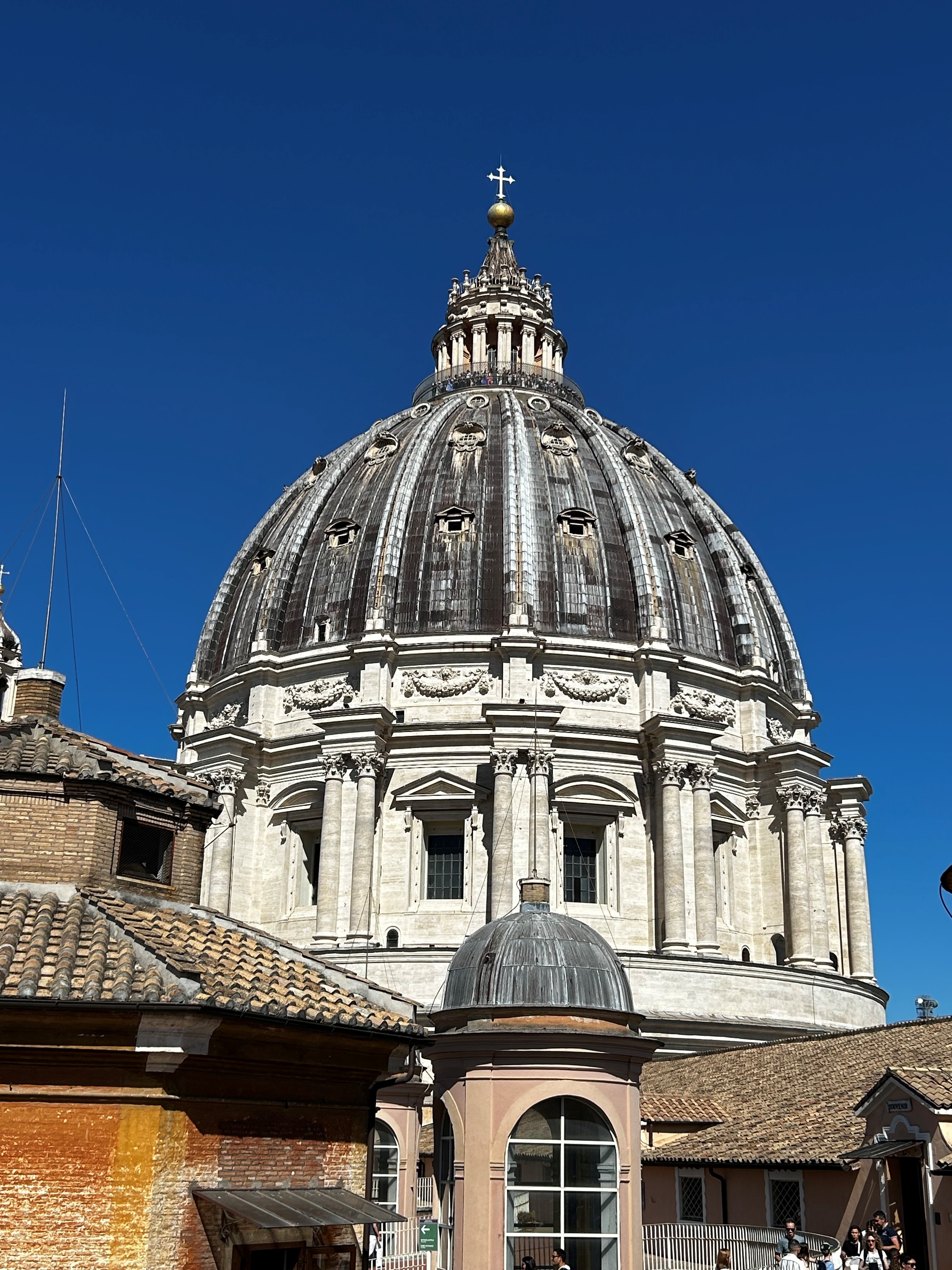
Josanne somehow guided us to a relatively short queue to get into the actual Vatican. For 10 Euros, we got right to the top for some stunning views down to St Peters Square as well as seeing inside of the Vatican. Although I’m a Rangers supporter, I’m happy to say that I didn’t burst into flames!

It was an interesting climb getting up to the top and there were parts where it felt that they were out to get those who were both claustrophobic and scared of heights!

We were fortunate that this was only a 30-minute queue to wait in, as we had a longer 3 hour wait in the queue for the Vatican Museum and Sistine Chapel. Josanne really enjoyed seeing Michaelangelo’s work though, especially the fresco of The Creation of Adam. That said, we couldn’t hang about, as thanks to Viator, we only had a short period of time now to get across the city for our tour of the Colosseum.

Some views of inside the Vatican:

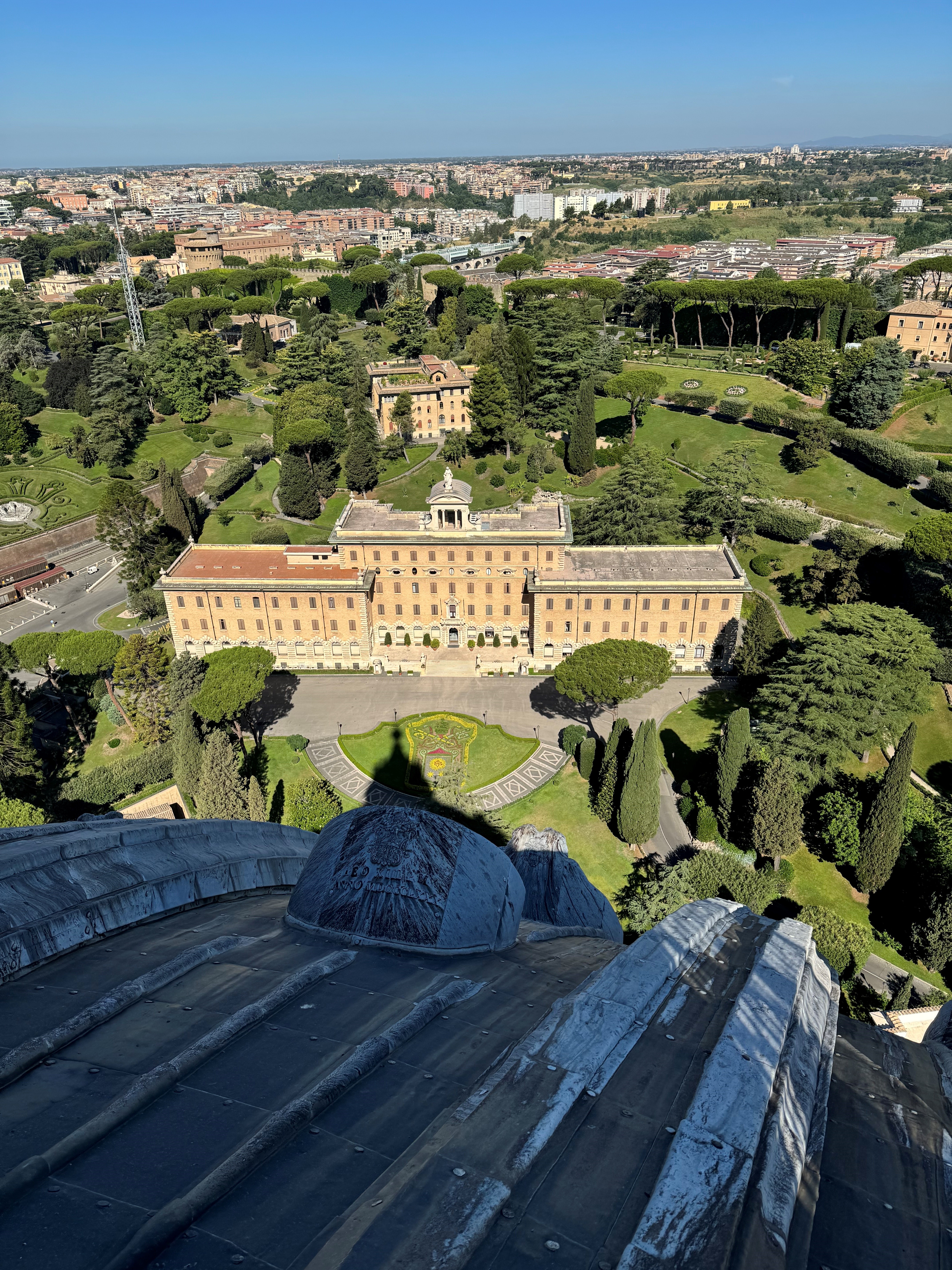
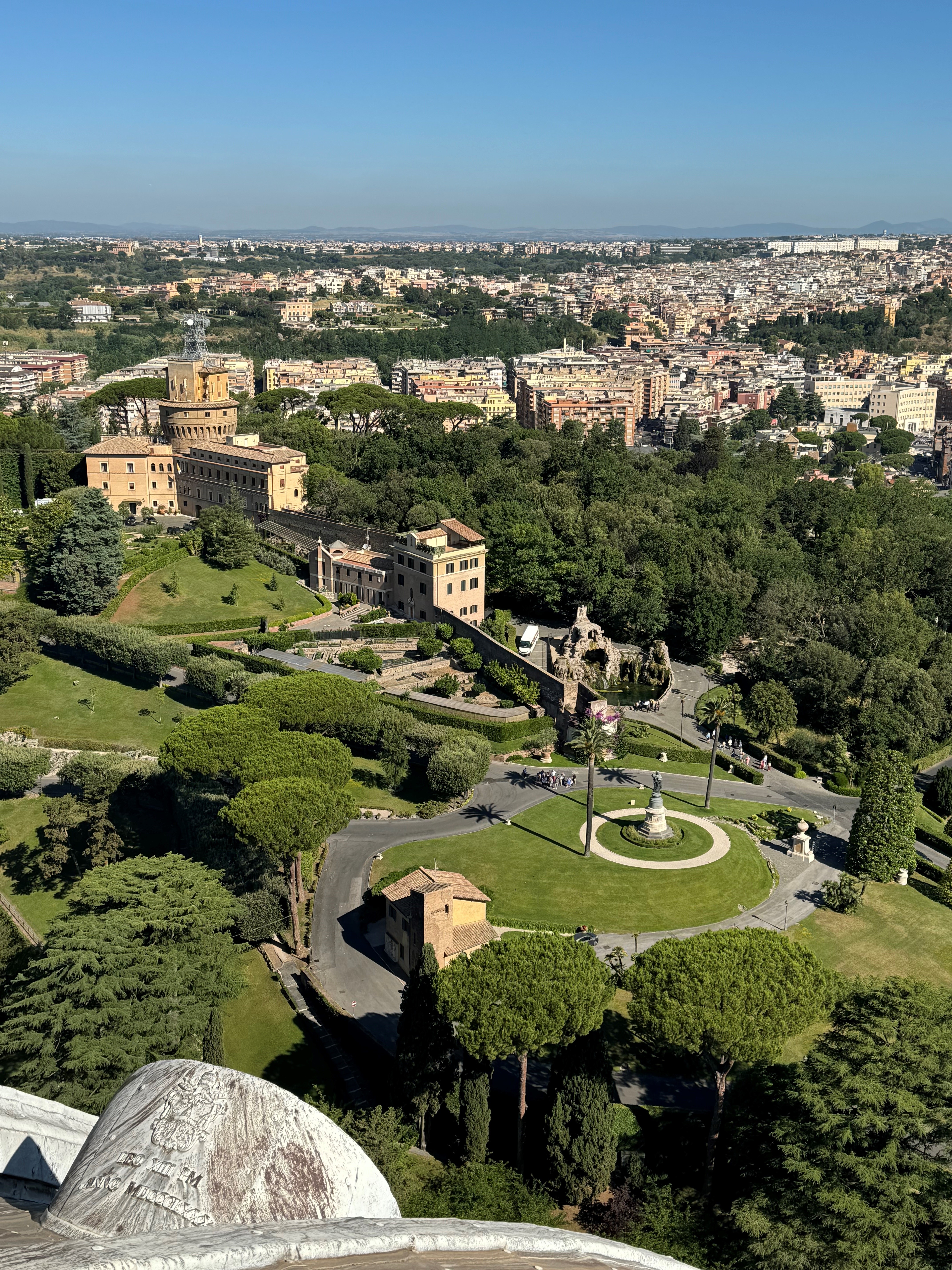
Once we made it to the roof, the views were stunning:

There were also, of course, the colourful Swiss guards on show. Given that there are only 135 of them in total, there are 1.48% of them on show in the photos below!

Once finished in the Sistine Chapel (no photos are allowed in there), we had to grab a taxi to the Colosseum as we didn’t have the time to walk or take the underground. Be aware that in Rome, taxi drivers will frequently want cash. As we had none on us, it took us a while to find one who would take us. Once we did though, he got us there pretty swiftly.

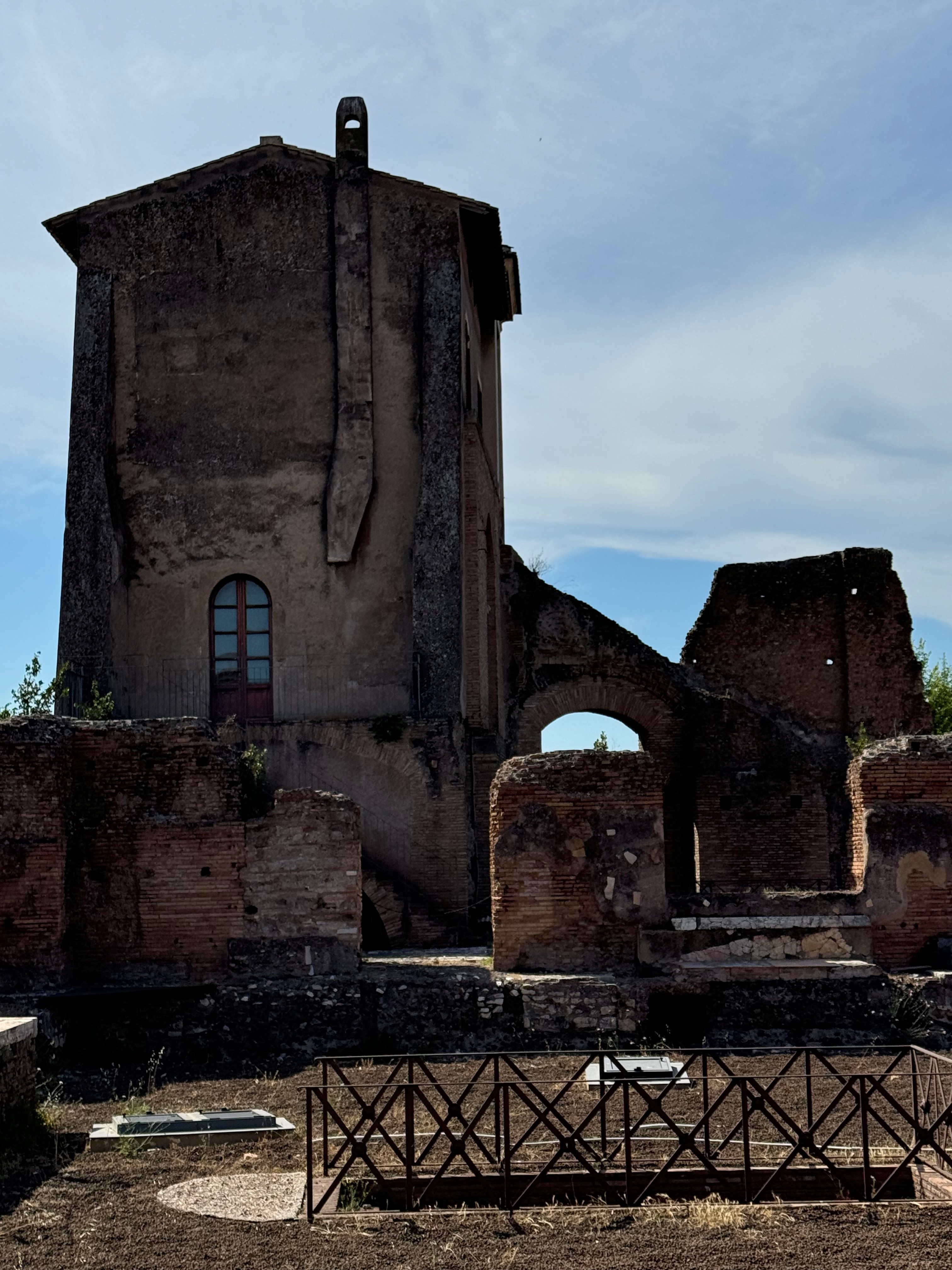
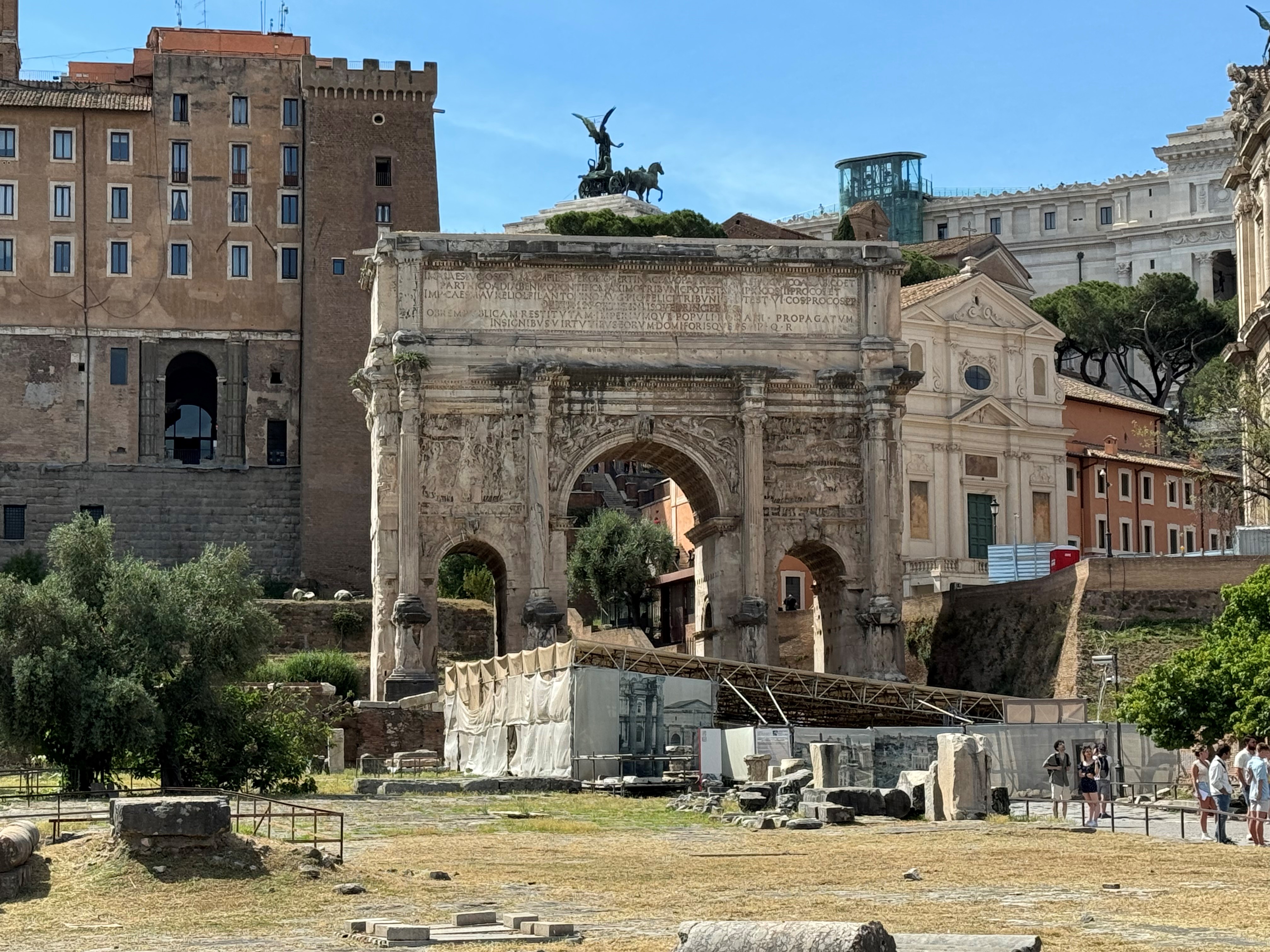
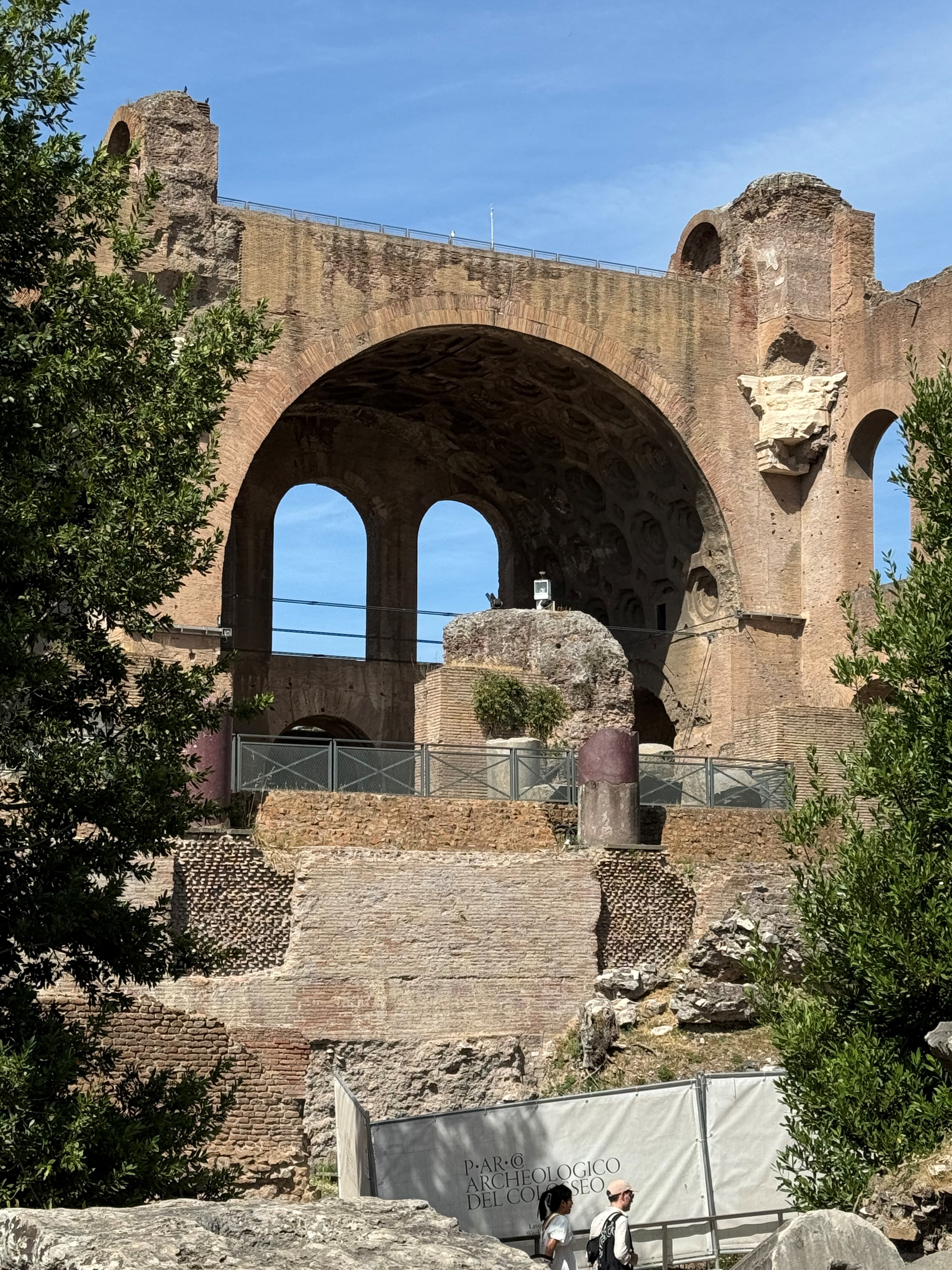
The Colosseum was everything that I hoped it would be. However, our tour guide kept us in suspense, as we were first taken around the Roman Forum. This was also very worthwhile from our perspective, as it gave you a great insight into the history of the area. It’s definitely worth spending some time looking around the Forum, especially with a guide. It was hot, and there isn’t much shade around, so a hat and water were essential.

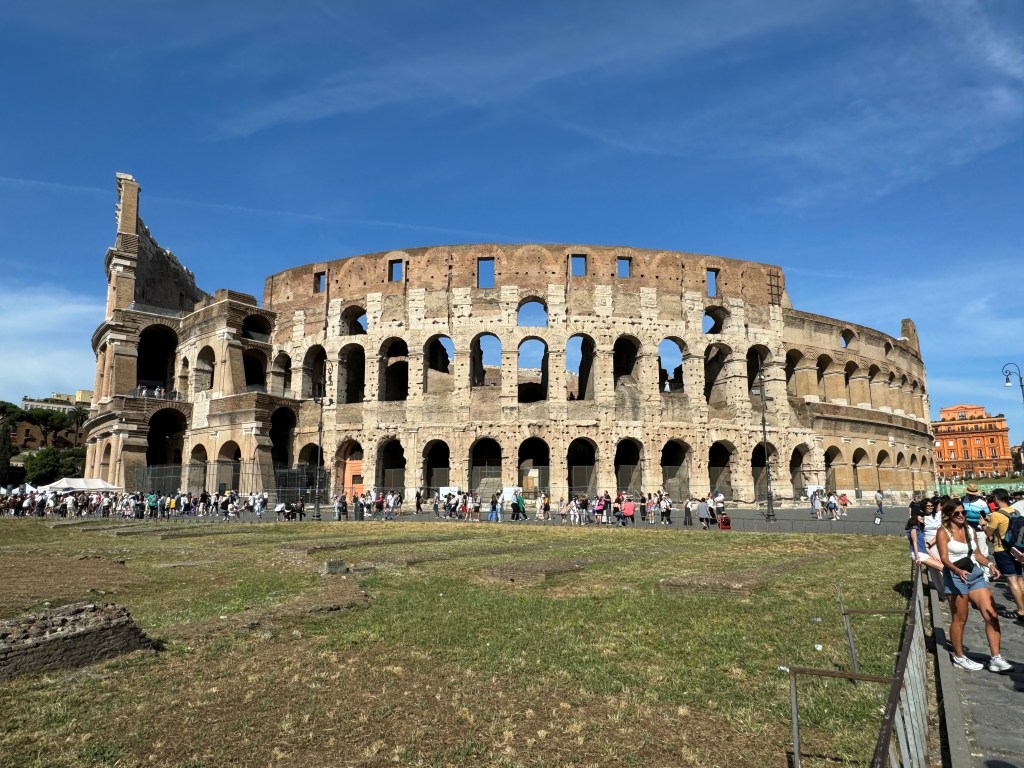
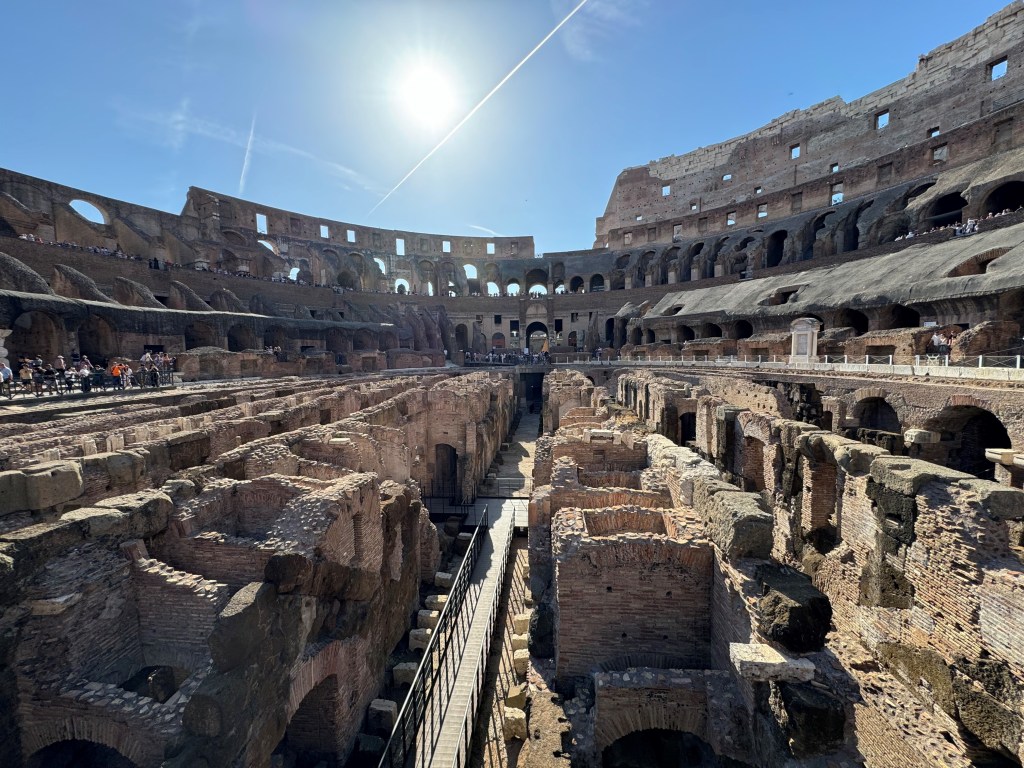
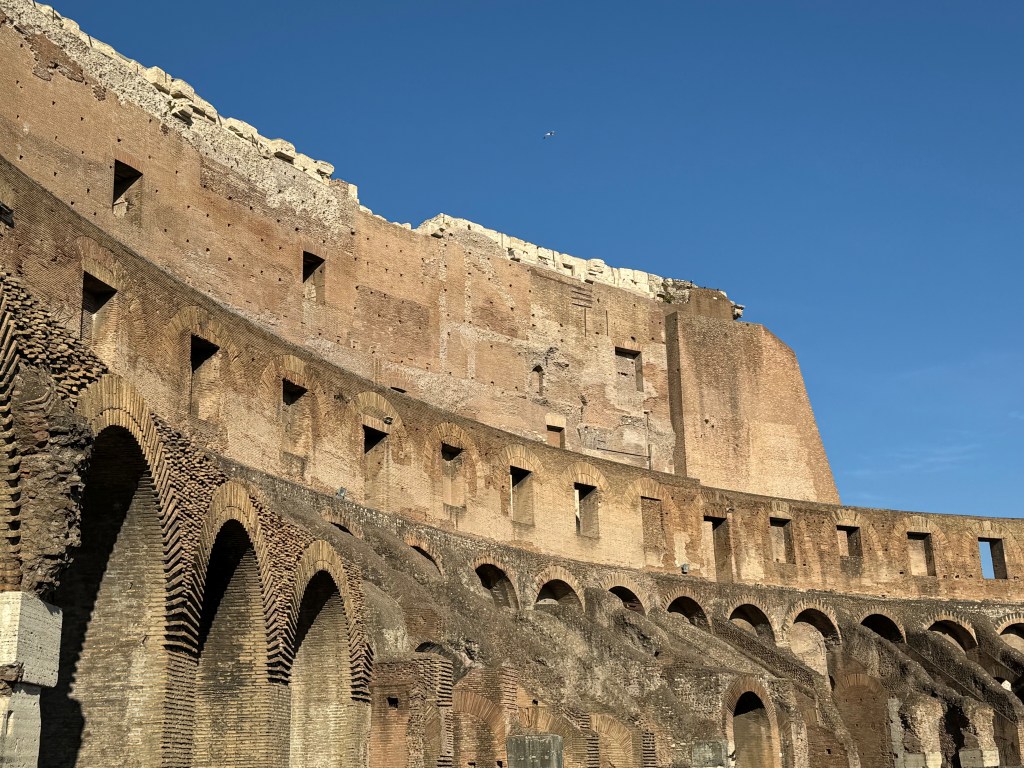
And then it was onto my undoubted highlight of our time in Rome; the Colosseum. It’s something I’ve always wanted to see. When you take the modern-day arena or stadium, no matter the sport that you are watching, this was its predecessor. Built between 72 and 80 AD, it is just over 1,950 years old.

That it is still standing is fortuitous if you believe the folklore that says,

As long as the Colosseum stands, Rome shall stand; when the Colosseum falls, Rome will fall; when Rome falls, the whole world will fall“.

It’s probably as well that it was built on such solid foundations!

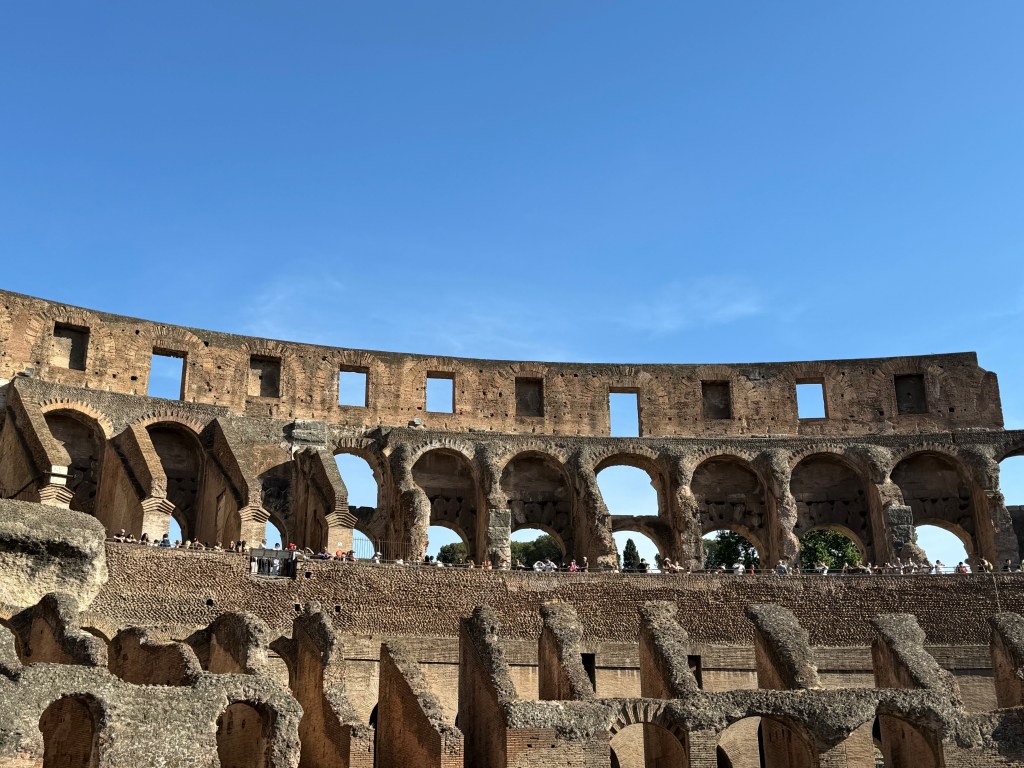
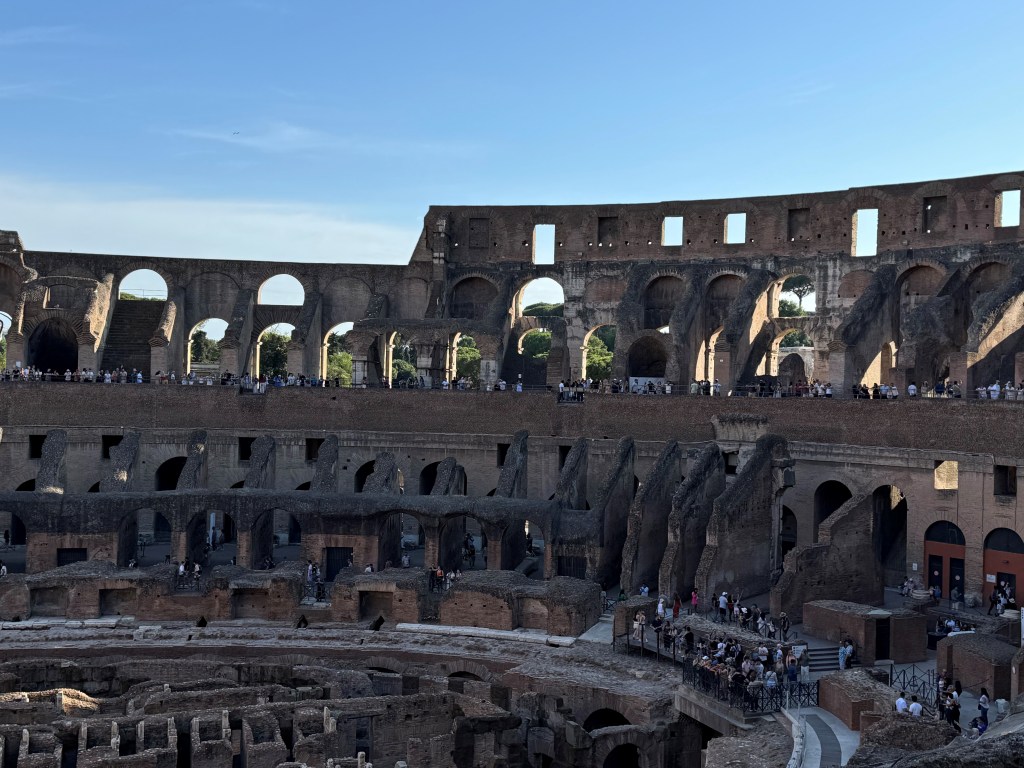
The Colosseum didn’t disappoint. It was all I’d hoped it would be and more. Majestic in appearance, I stood in awe looking at it from the outside but was much more in awe on stepping inside and looking down at the floor then up at the stands. I took the time to stop, to listen, to imagine the cheering crowds who will have witnessed sights that, fortunately, I never will. It’s as stunning a monument as I’ve ever seen.

After only a brief wait in the queue, and the obligatory bag x-ray, we were inside. The tour guide spent around 25 minutes giving us an overview of the history, after which we handed back our headphones and were left to continue exploring on our own. I could have spent the whole day there!

We stayed inside until closing time and I lost track of the number of photos I took. I only had my iPhone with me and not my actual camera, but the photos with just a phone were impressive enough.

We managed to lose each other inside, but as there was only one way out, I hung about and waited for Josanne. The Colosseum closing coincided with Rome’s very large Pride Parade, so it took us quite a long time amidst a plethora of colourful characters in various states of (un)dress, to get back home.

One of the things that I loved about the underground in Rome is that you can just use your credit card to tap on. You did this and it gave you 90 minutes access to it. This was eminently more sensible than queuing to buy tickets, although sadly, I only found this out on the last day!

On finishing our walk home, we were so tired that we just stopped off for a McDonalds, had a shower and an early night to be ready for the next day.

Day 3 – Exploring the lesser-known sights with a Roman Historian

On our last day, we were very fortunate that one of Josanne’s friends, a Roman Historian from Auckland University had said that he’d give us a tour around the city looking at some of the “less famous” but equally interesting sights.

Jeremy met us just after breakfast at the Pantheon and we walked around the city for 3 or 4 hours before stopping for lunch (and a couple of drinks). I only had one Negroni as it was so strong and settled for an Aperol Spritz as my second one.

The queue for the Pantheon was already very long so we didn’t go in. Jeremy noted that one of the best things inside was the floor which gave a great indication of floors from that period.

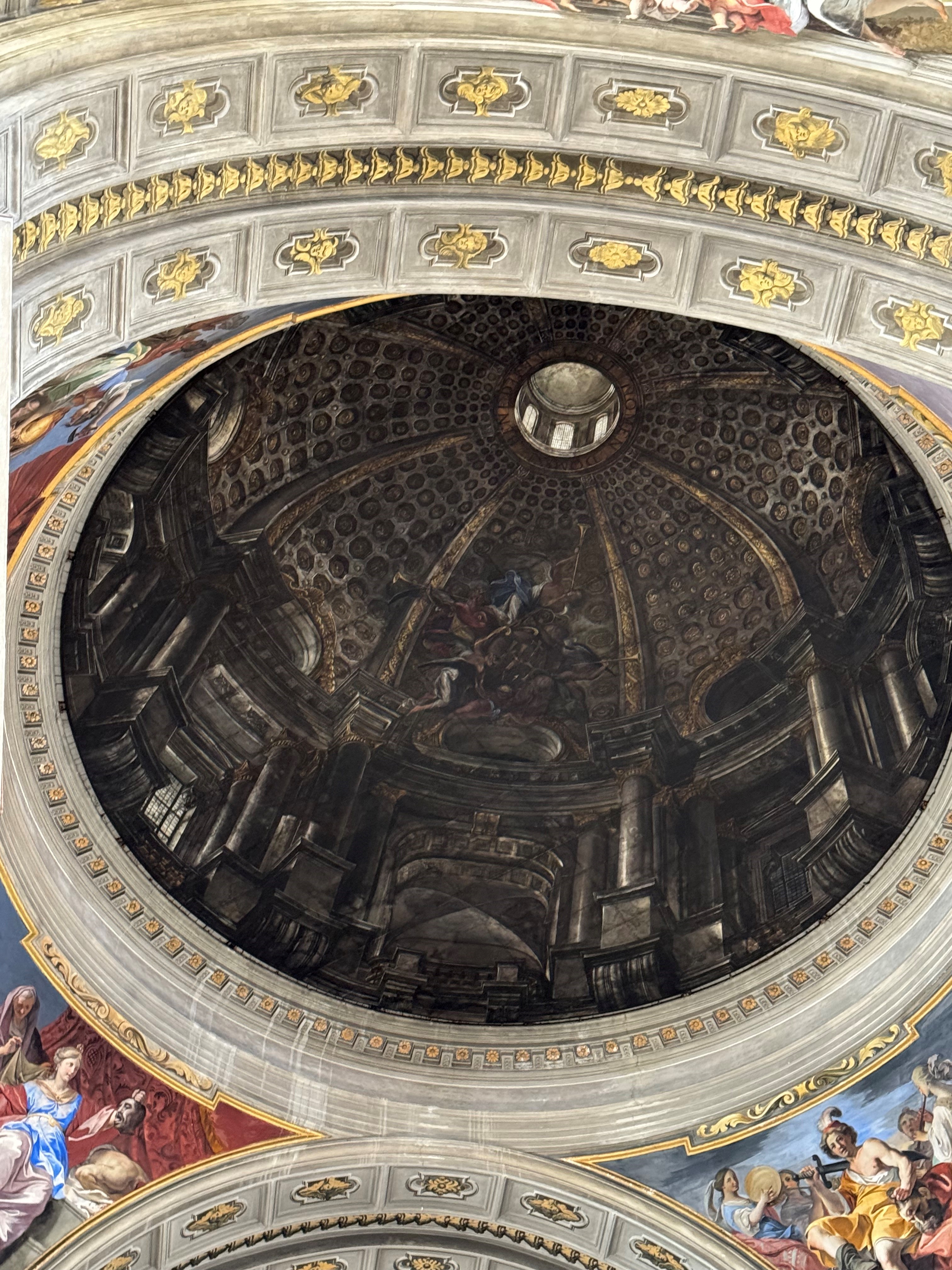
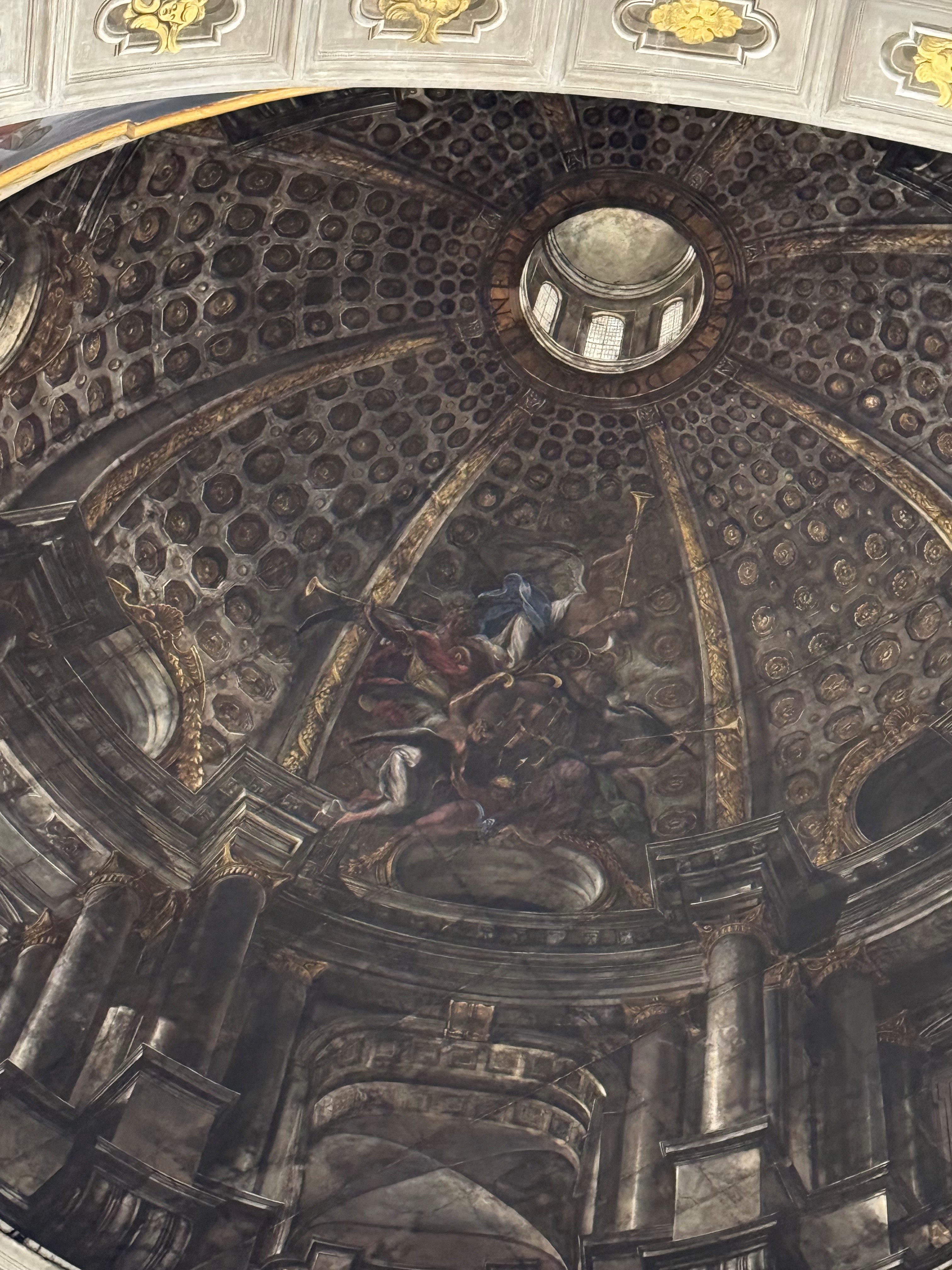
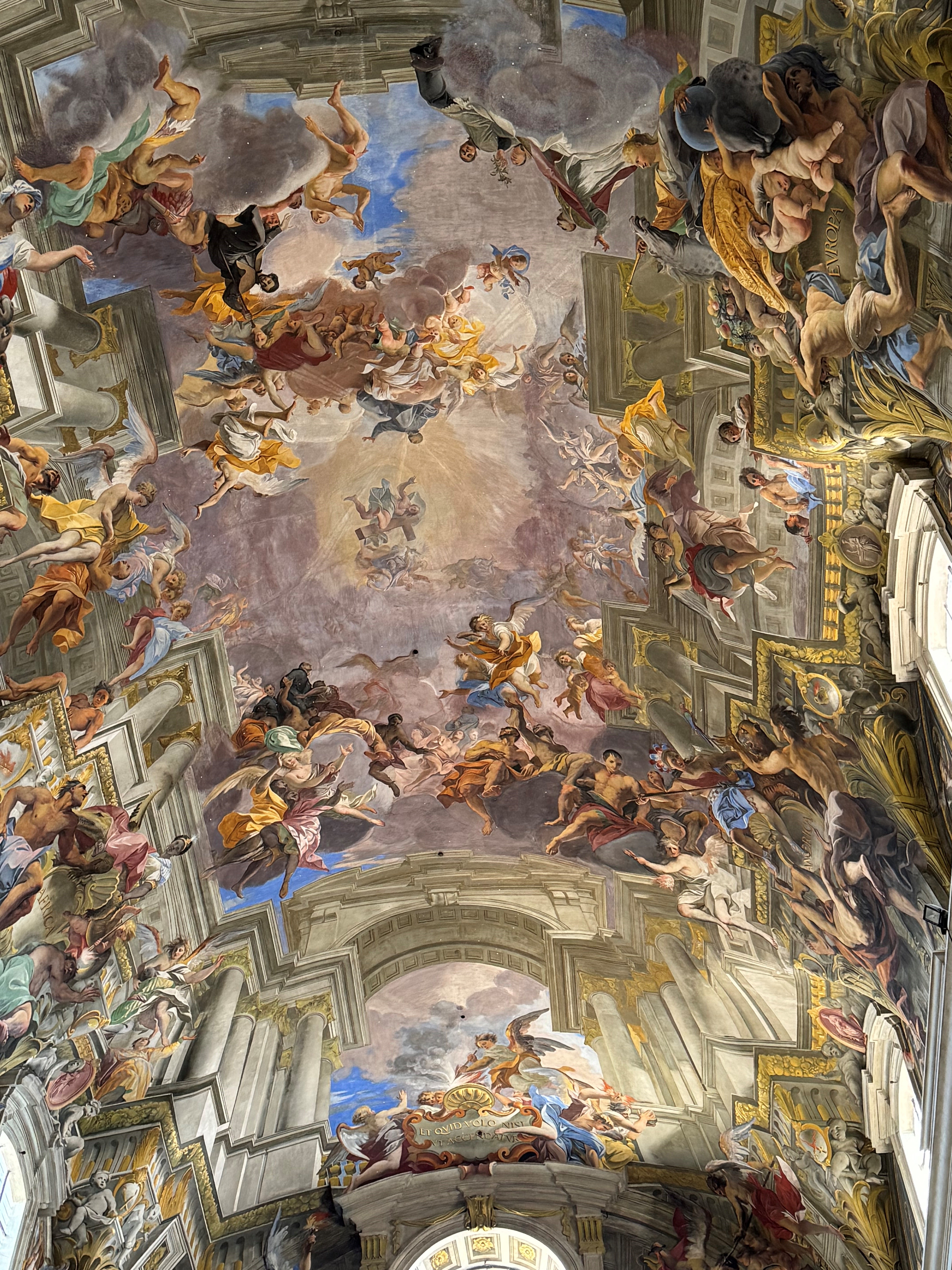
We next went into the Sant Ignazio of Loyola Church. There were lots of people taking pictures of the frescoes via a mirror in the middle of the church, but that wasn’t why Jeremy had taken us in there.
On walking up to the end of the church and looking up, it appears that you are looking up at the inside of a Dome. But look closer (and you have to look very carefully and get right up underneath it) and you can see that it is actually a fake dome. The artist, Andrea Pozzo, has actually painted it on a flat surface to make it appear as a dome after a fire destroyed the original one.

The other frescoes in the church are also fascinating and give a 3D impression of characters floating upwards.

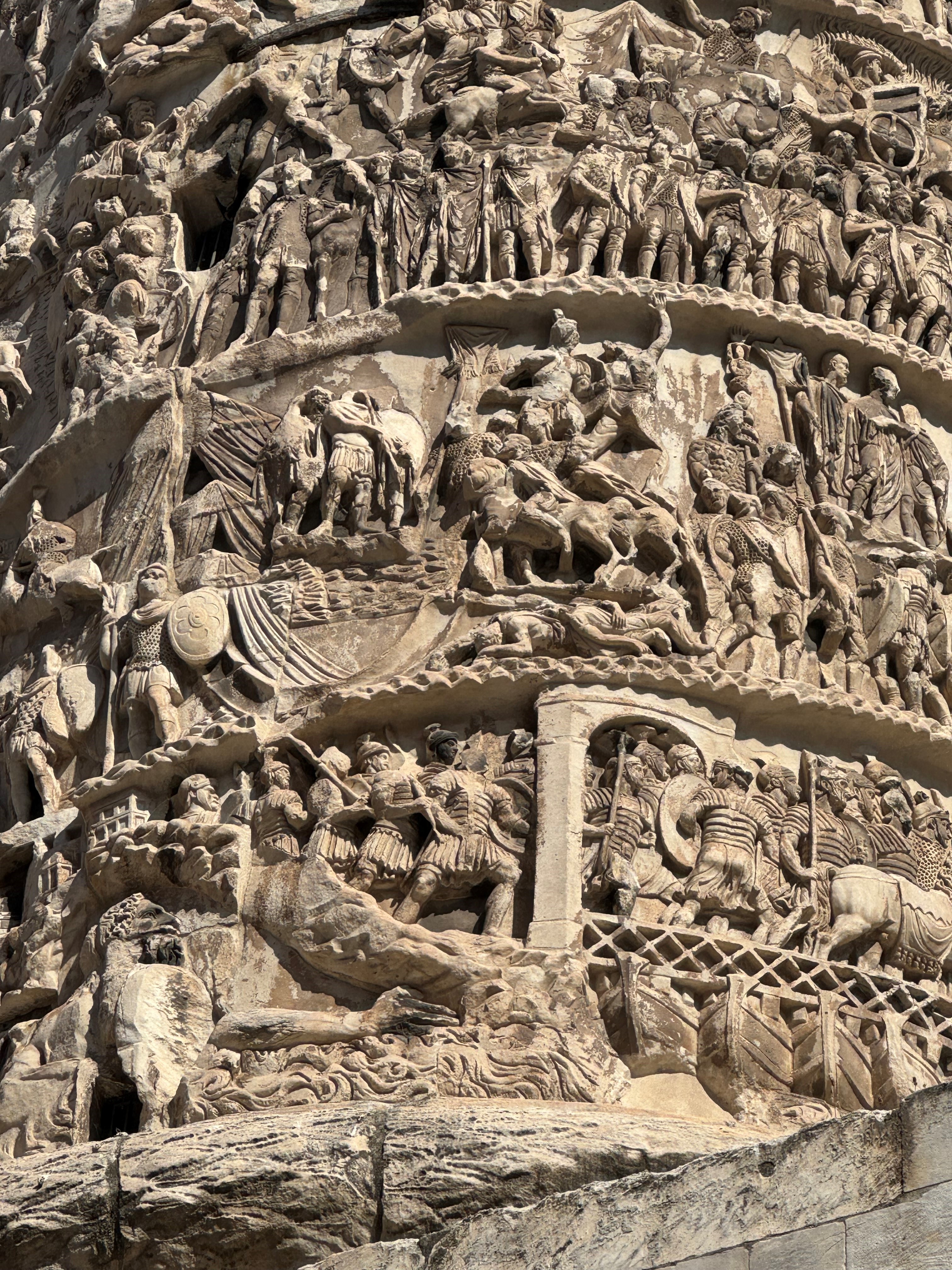
Next, we headed to the Piazza Colonna, where there is a marble column of Marcus Aurelias (think Russell Crowe in Gladiator and it’s that Marcus Aurelius). The column tells the story of his battles, so provides a very good overview of life in those Roman days.

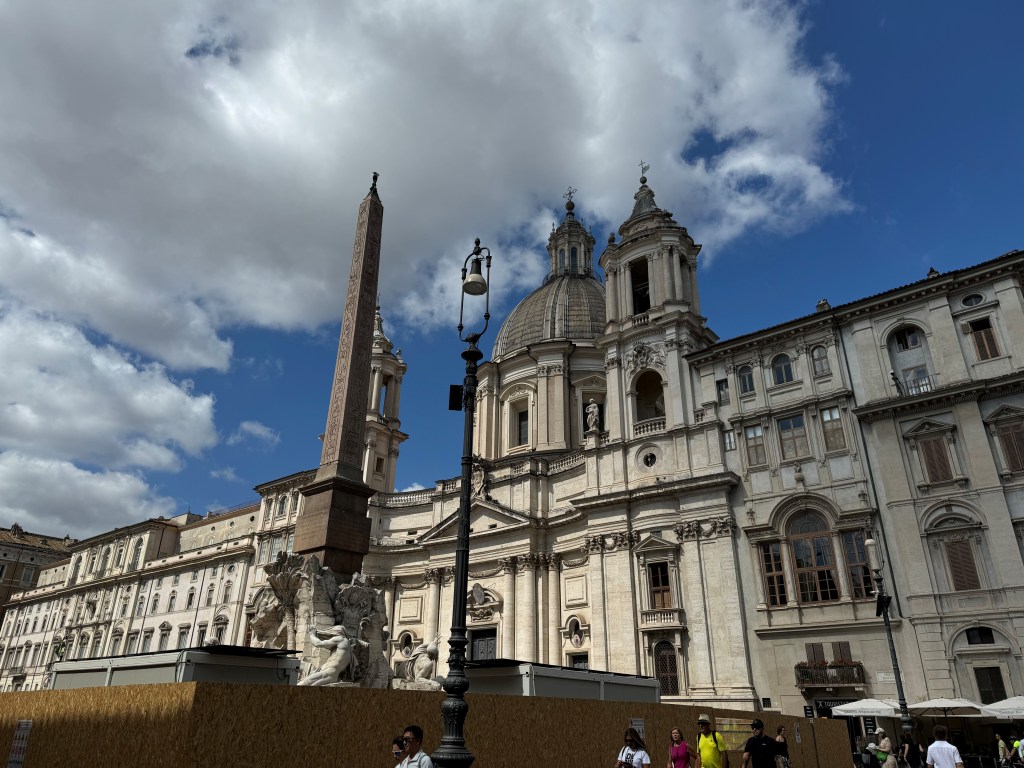
The Piazza Navoni was next, although we couldn’t really get good photos here as all the fountains were covered up and being worked on. Jeremy noted that you’d get very expensive but poor-quality food here, so we didn’t stop for lunch.

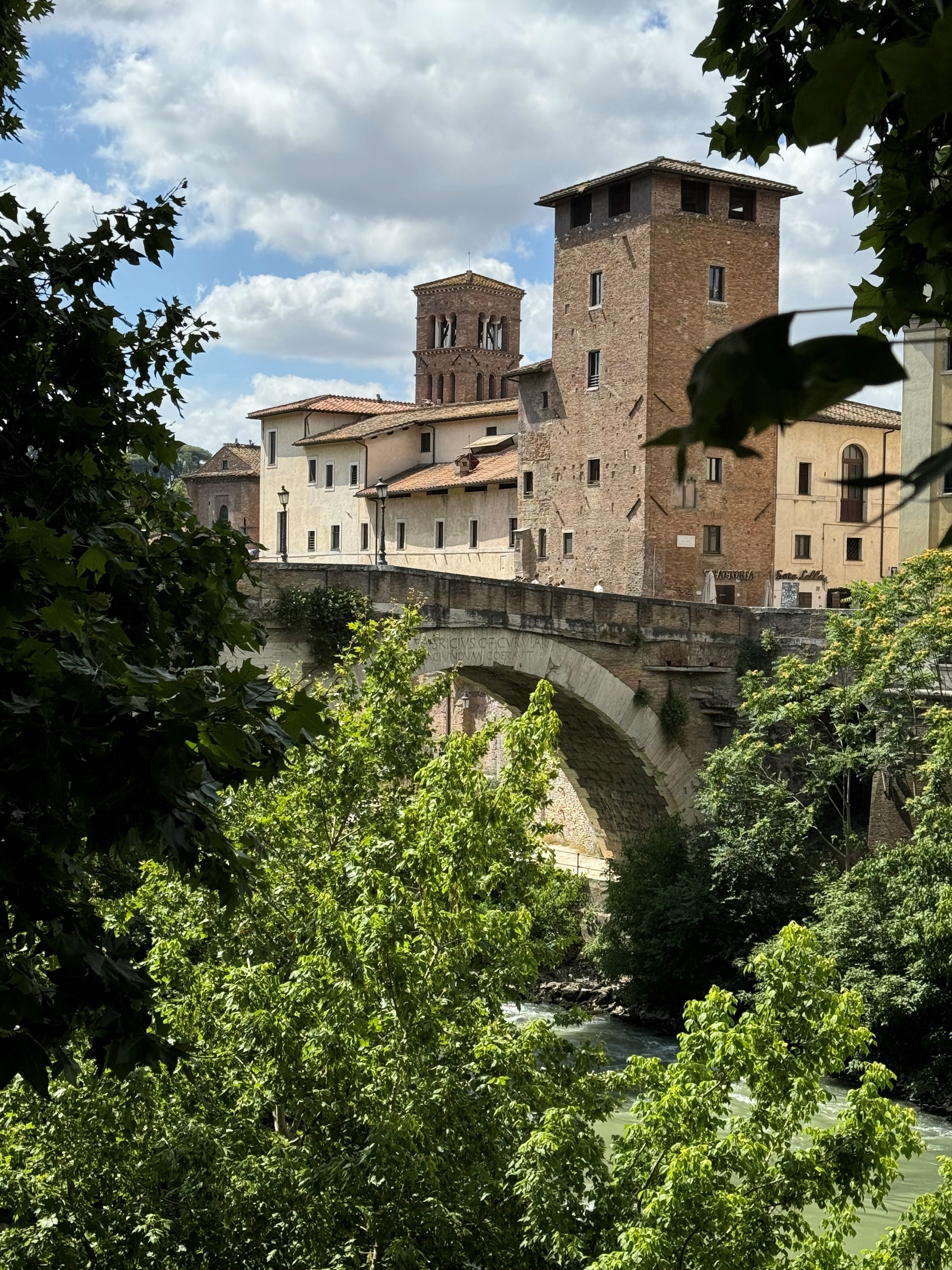
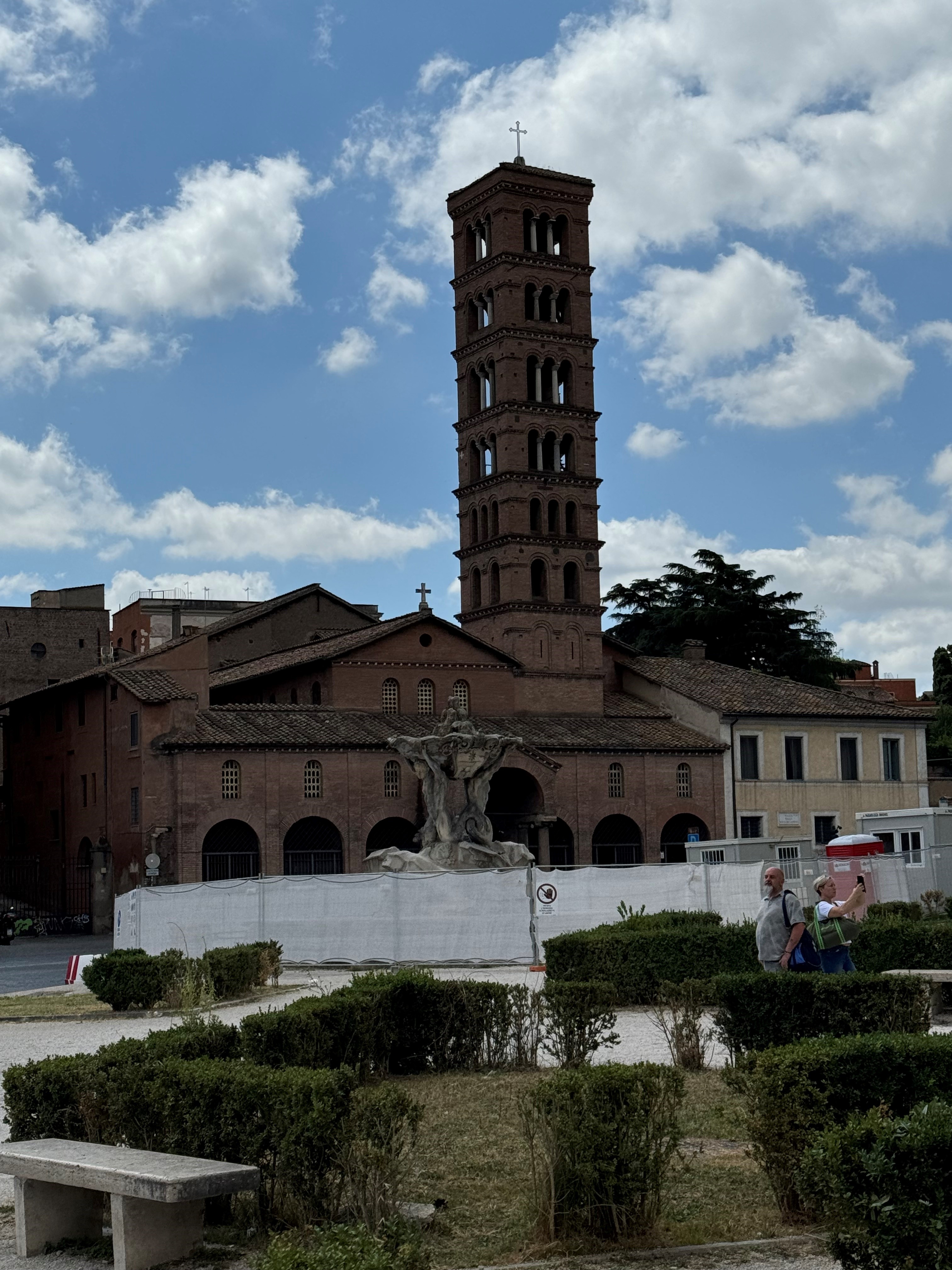
In quick succession, we then took in a quaint old bridge into a newer part of the city (which turned out to be handy as it’s where we picked up our walking food tour later that evening) a couple of temples (one of Portunus, the other of Hercules Victor), the Santa Maria in Cosmedin Church (famous for the Mouth of Truth – I didn’t get a photograph of this – but the floors in the church were also worth seeing as they were typical for that period).

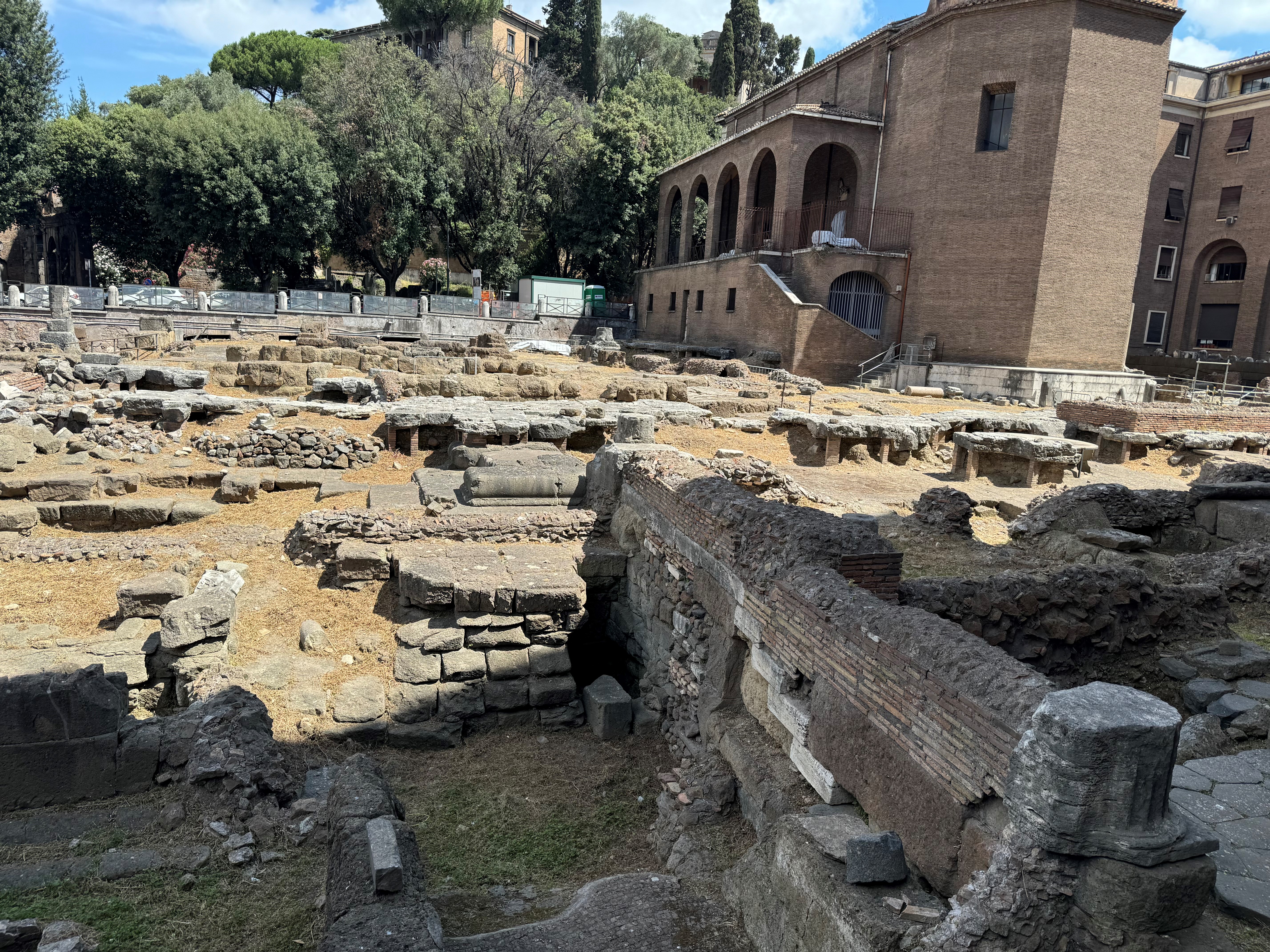
Jeremy then showed us the first known solid building in Rome, as this was one of the digs that he had been on.

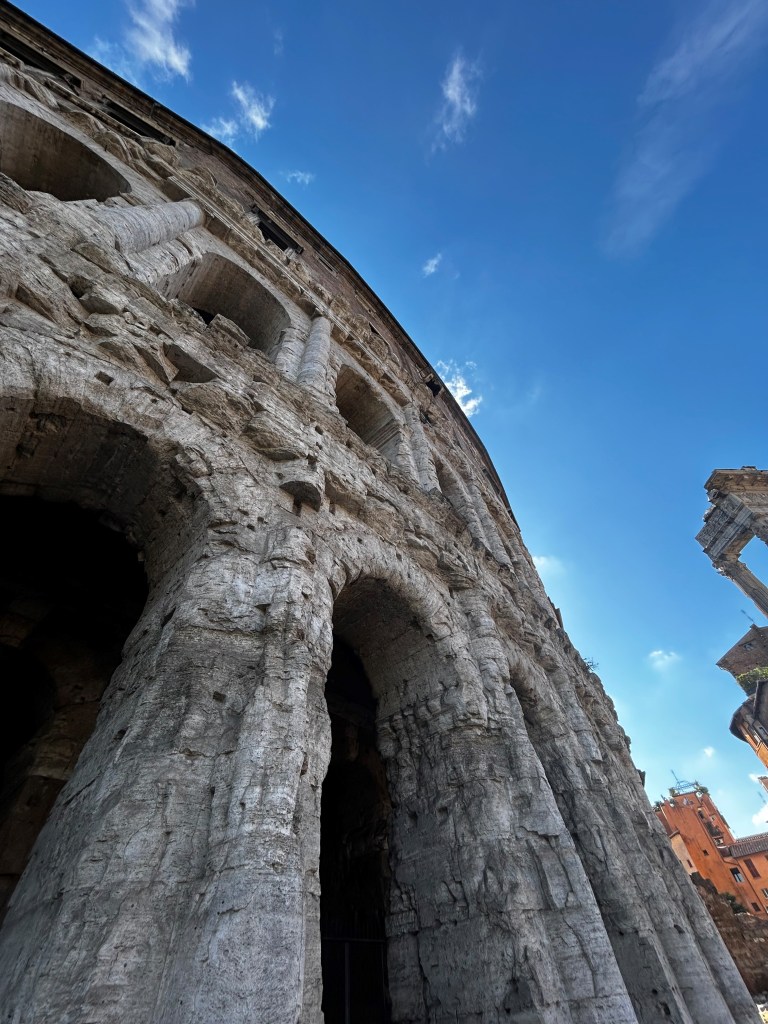
The next area we passed was one that I found particularly fascinating, as it was an old Roman theatre, upon which some apartments had been built. They are still inhabited, apparently by a very wealthy (and one assumes powerful) Roman family. We walked past this area a couple of times during our stay, so I’ve attached the various photos I took from both;

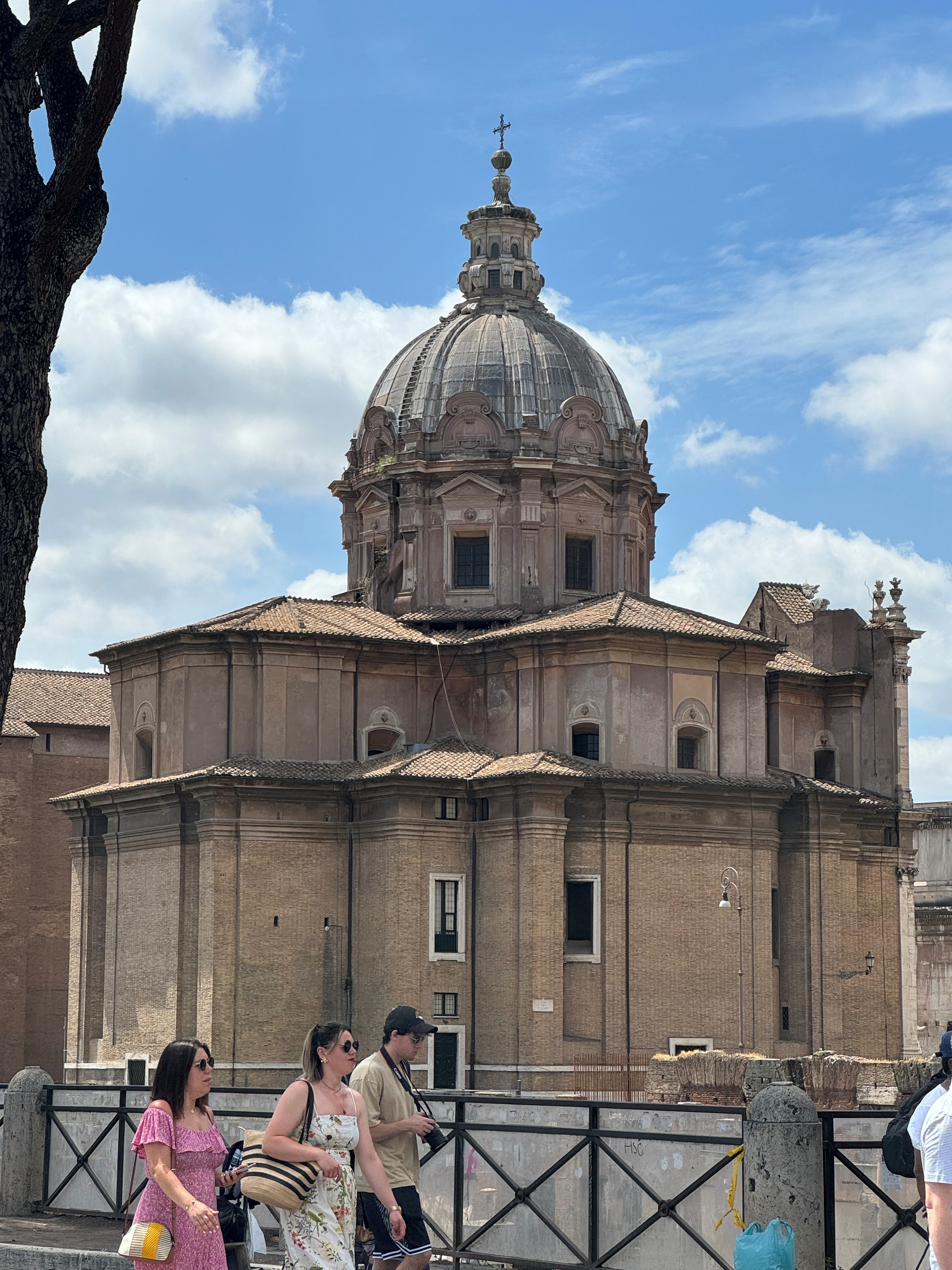
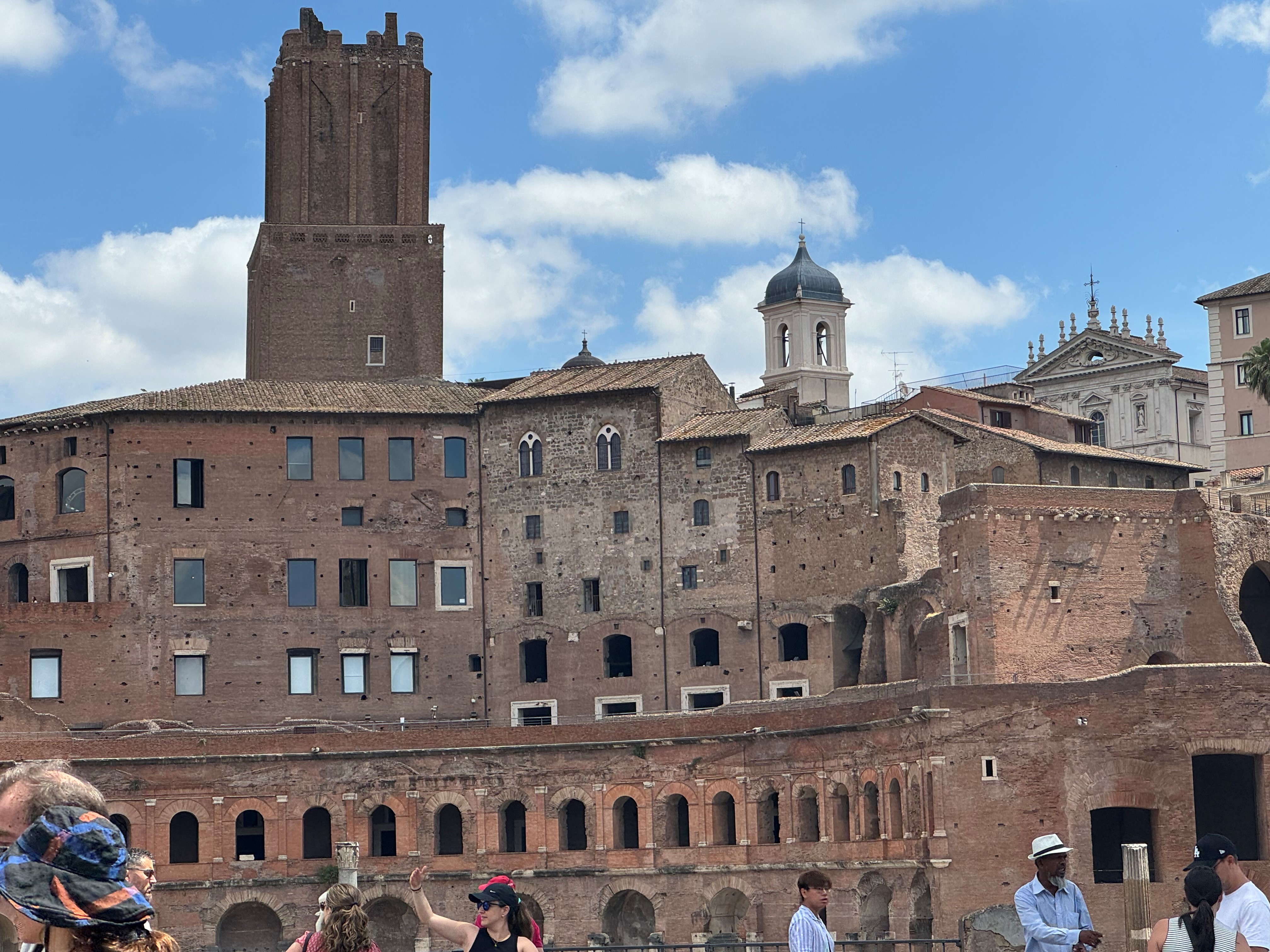
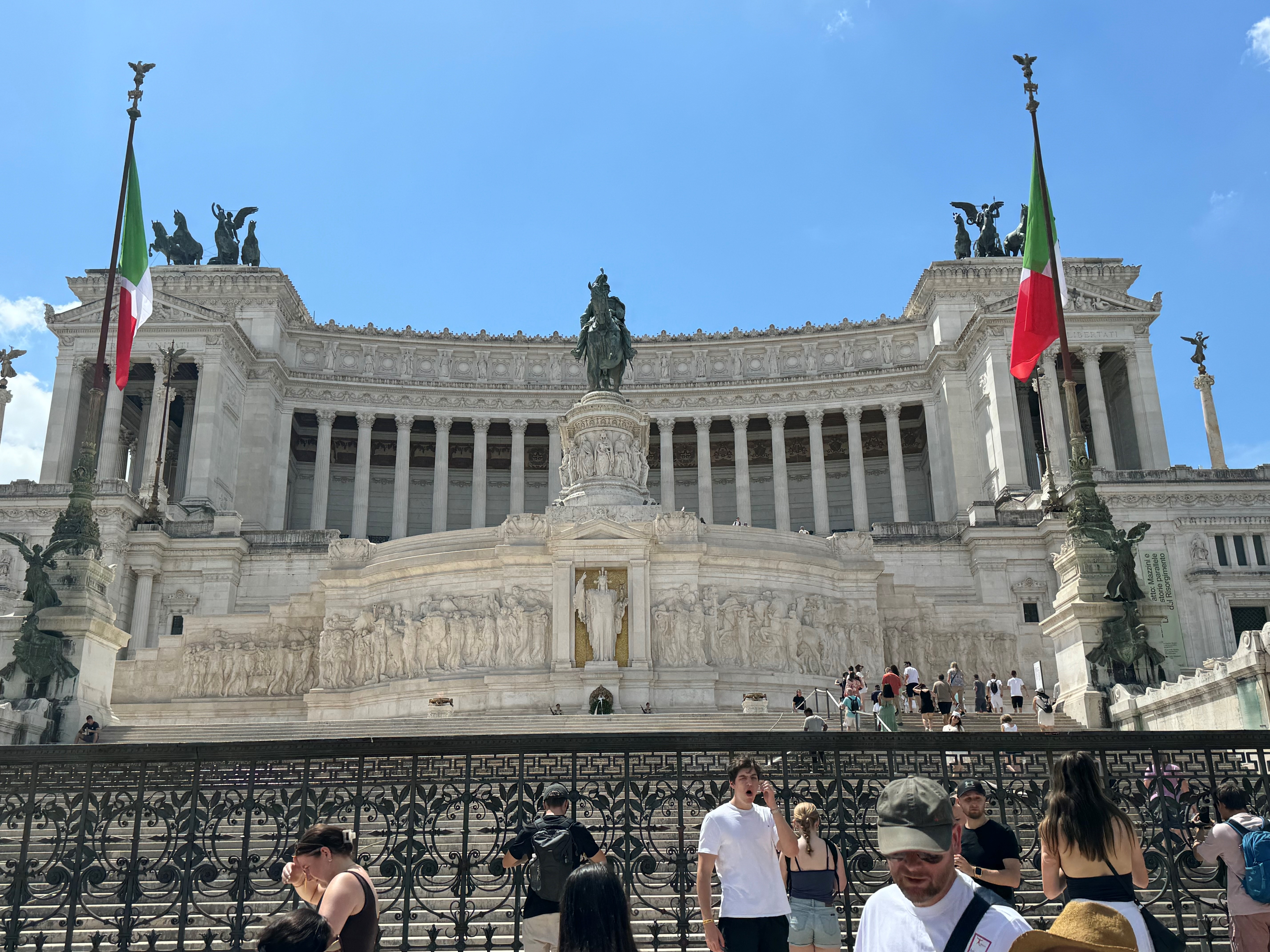
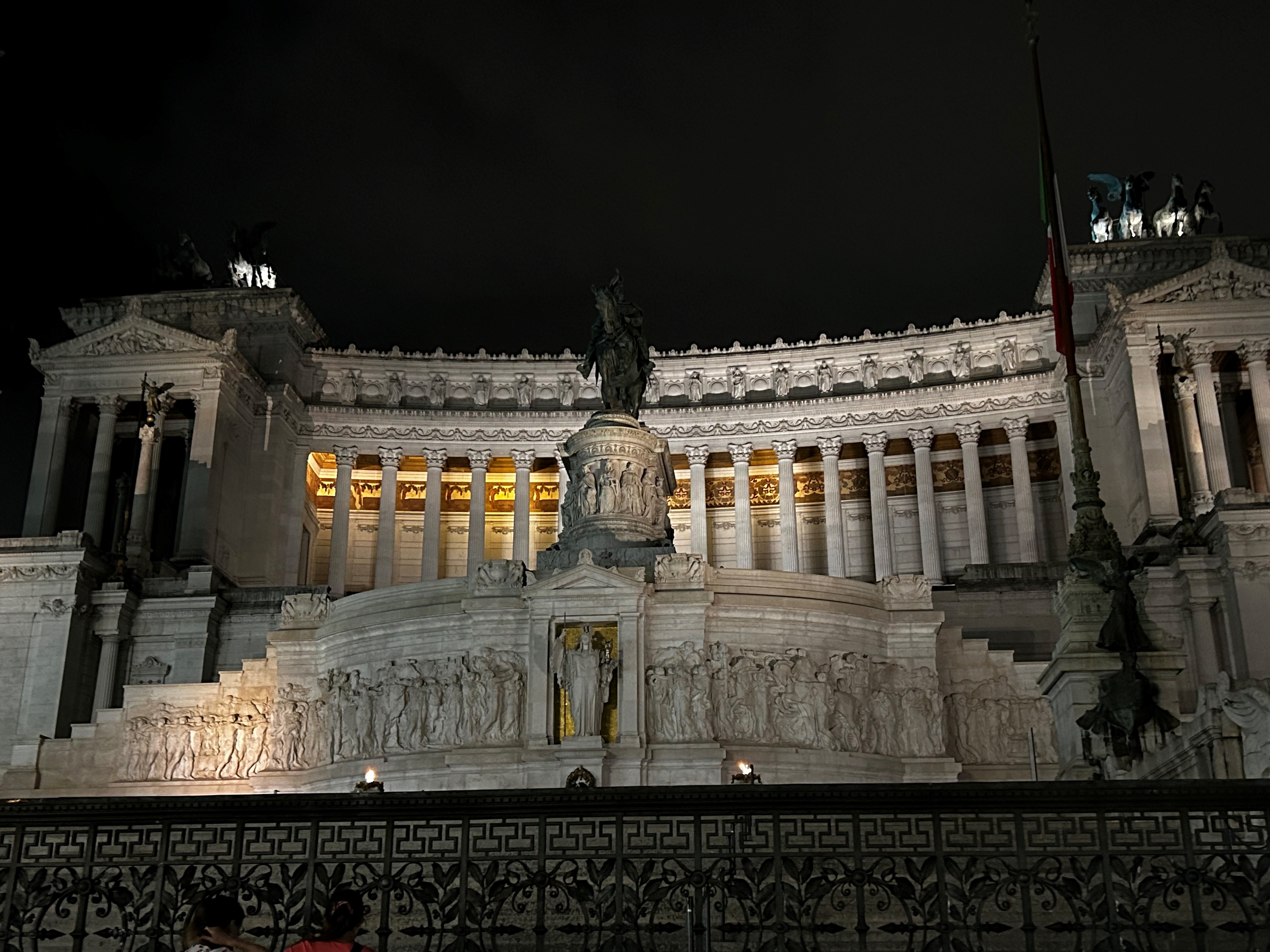
By now, we knew we had to start heading back to the hotel to freshen up for our walking dinner that evening, but Jeremy still had time to whisk us past the Victor Emmanuel II Monument (referred to as the wedding cake), the Forum of Caesar, the Santi Luca e Martina church, Trajan’s Market, Trajan’s Column, the Spanish Steps (from a different viewpoint this time), the Piazza del Popolo with its two matching churches (Santa Maria dei Miracoli and Santa Maria in Montesanto), the Flaminio Obelisk and the Piazza del Campidoglio.

We’d bought Jeremy lunch part way through to thank him for showing us round and I must say, we saw and appreciated so much more from having been shown around by a Historian. He kept apologizing for going into teaching mode, but we loved every minute of it, and it certainly added to our enjoyment of the visit.

Our Walking Food Tour

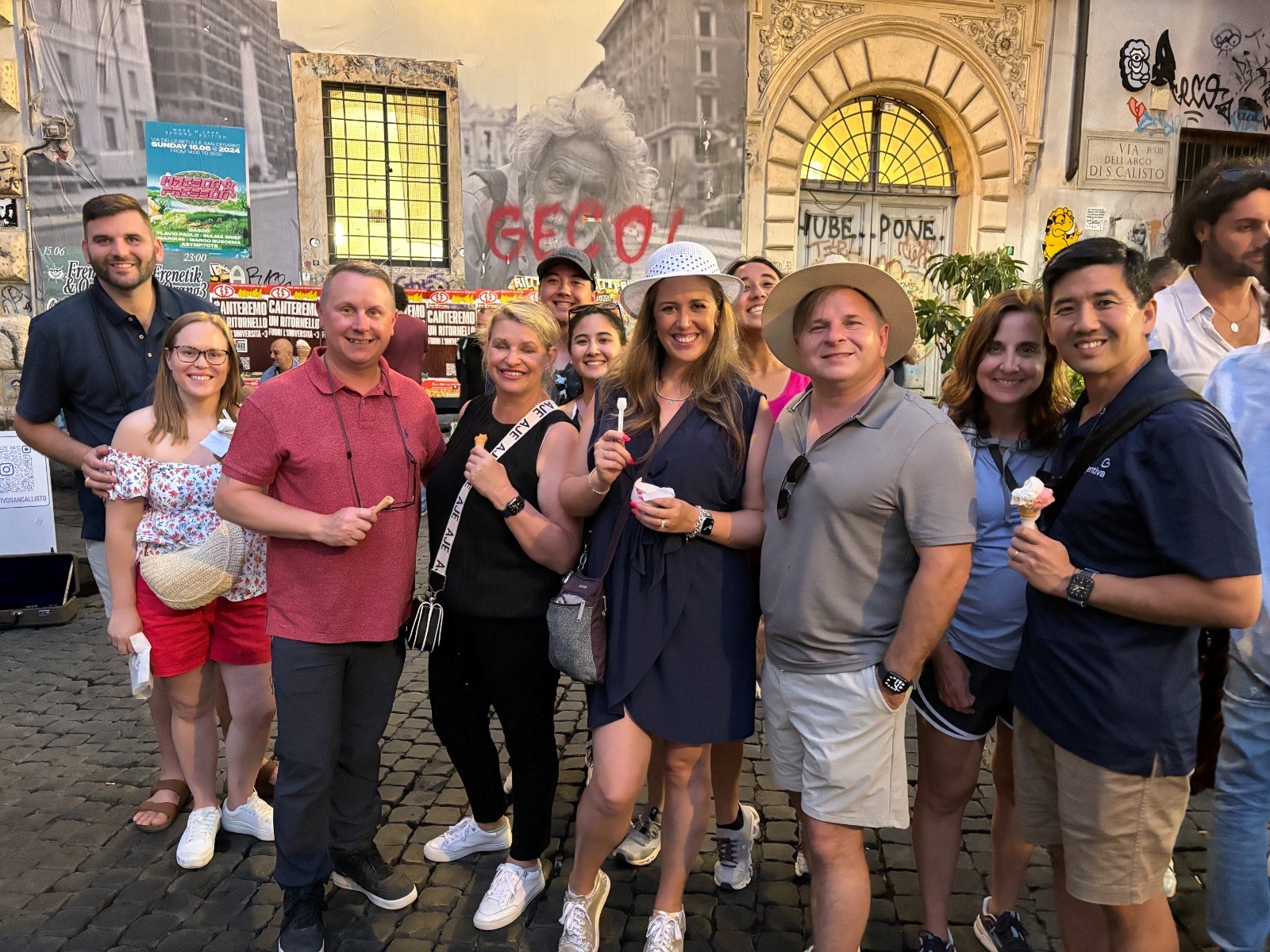
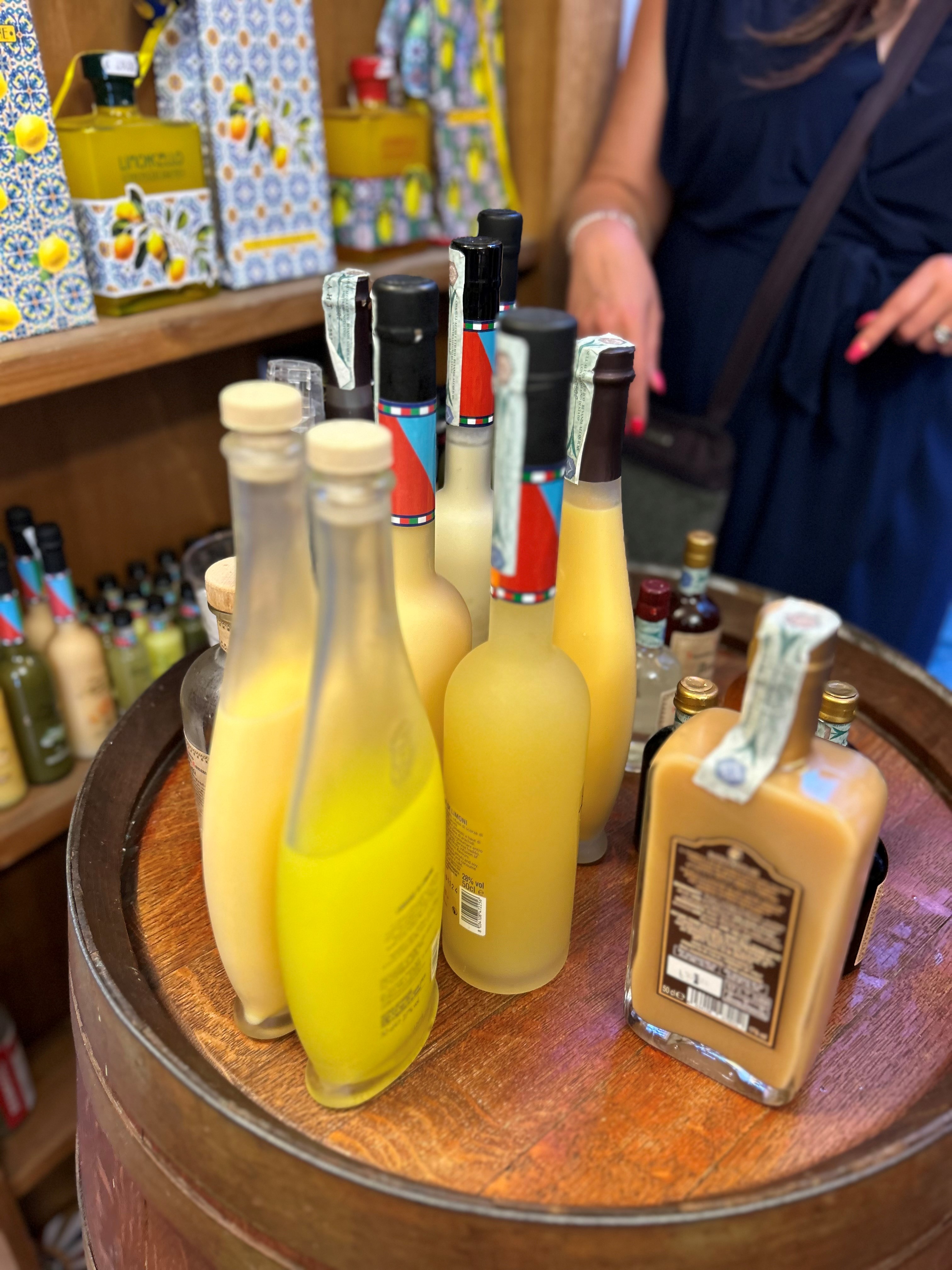
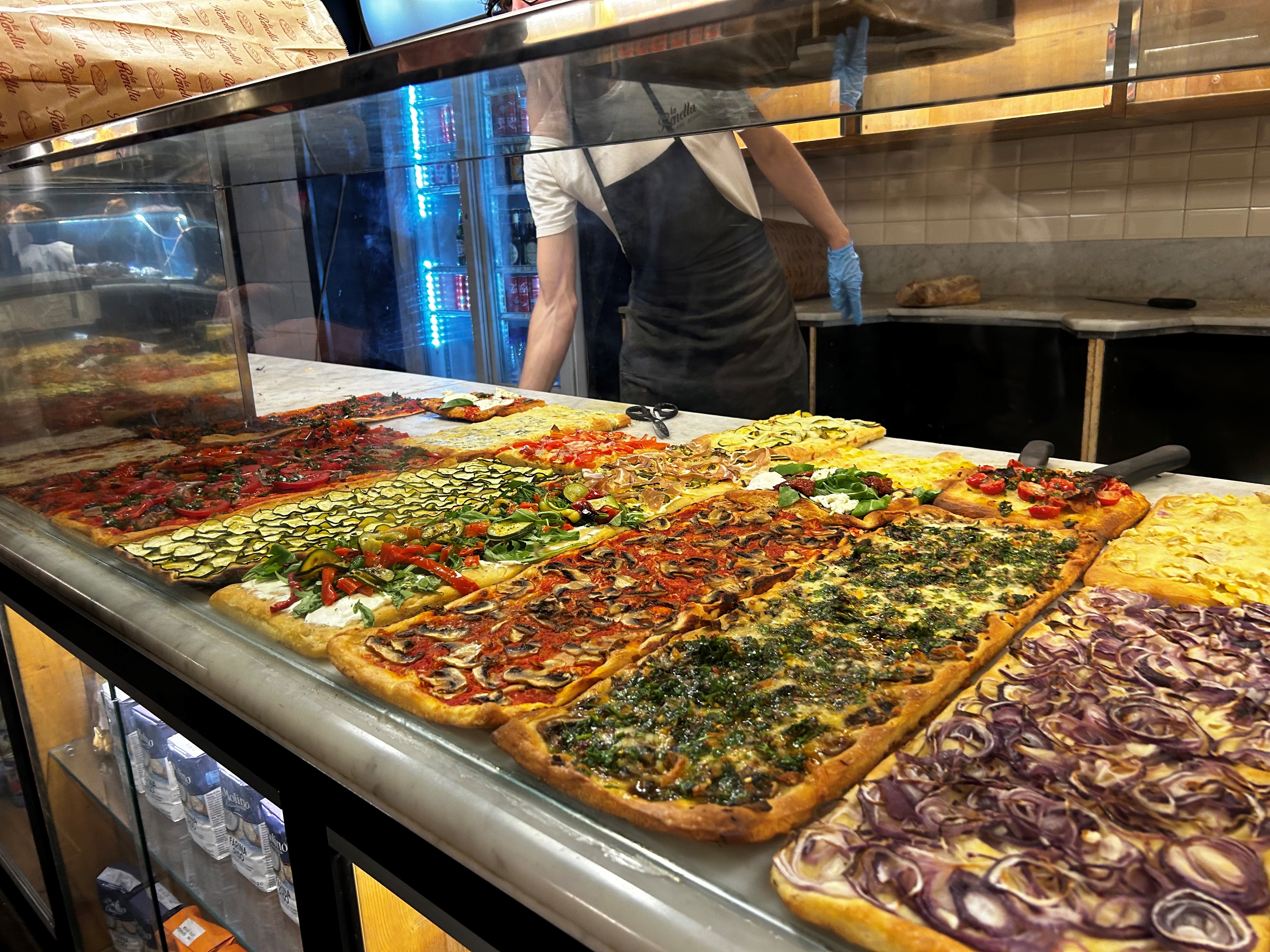
And so, after yet another quick shower and change of clothes, we were back out for our last outing in Rome – our Walking Food Tour. I can’t remember every course that we had, but we started in a restaurant that had over 2,000 wines on their wine list, had an absolutely delicious cheese board, pizza and limoncello tasting to name but a few.

And with the end of the food tour, our 3 days in Rome was at an end. All we had to do was get back to the hotel, get packed up, have one final sleep and then it was off to Venice for the next three days.

But as I said at the start, we love to walk wherever we are and that brought us the last, pleasant surprise of our trip. Getting to see some of the landmarks in the dark was equally as impressive as during the daylight.

We could easily have spent another couple of days in Rome and kept exploring. But we were on a tight schedule and 3 days was what we could manage with everything else we had to fit in. It was a great adventure. Rome is a very walkable city and we managed to get in the main things that we both wanted to see. Having a tour with a genuine archeologist was a fantastic bonus.

Would I go back?

Absolutely.

And given that we both threw a coin over or shoulder into the Trevi Fountain, I believe that means it’s inevitable!

Useful tips for the traveller

  • Light comfortable clothes are best in summer, when it is hot and humid.
  • Don’t be a target for pickpockets – it’s easy to get a bag that you can have in front of you and close to your chest
  • Try to walk as much as you can – you’ll be amazed and how much more you see. We occasionally used the underground, but only when we had to.
  • Carry a water bottle with you. There are plenty of refilling points around the city with fresh water from wells.
  • Expect taxi drivers to ask for cash. They almost seemed upset that we didn’t have any on us.
  • The skip the queue tours are really worthwhile – especially if you are on a limited amount of time. They aren’t cheap, but it’s better than standing in a queue for 3 hours. If you don’t want to pay extra, be wherever you want to be early as that will limit your waiting time.

One of these is very different.

What’s left of my collection of Rangers tops / sweatshirts and jackets

There’s a belief that most of us end up supporting the team our dad supported.

That wasn’t possible for me.

If it didn’t have 4 (or preferably two) wheels, my dad really wasn’t interested in it. As a youngster, I could never understand why he, or anyone else for that matter, couldn’t love “the beautiful game”. For him though, football was never a passion. I think that while I had so much in common with my dad, I can only remember him taking me to one football match and that was a Scotland under 21 game in the early 1980s.

My dad was killed in an oil rig accident when I was 22. I was in the Army at the time, so hadn’t seen much of him on a regular basis since the age of 17 when I signed up. At the time of his death, we was living in Australia. I’d been excited as he was due to be heading back to UK to live so I’d get to see him again. Alas, that never happened.

Although going to the football with him was never a thing for us, I spent many happy hours in his company watching car and motorbike racing. He was going to pay for me to have motorbike racing lessons for my 18th birthday, but I joined the Army so that never happened. Now that I live in New Zealand, I’d say that my other sporting love is V8 saloon car racing, something I definitely did take from him. Sadly, Covid-19 has just put paid to the NZ round of the Australian Supercars competition.

But I digress.

My dad always said to me that he didn’t know how I’d started supporting Rangers given his total indifference to the game. He acknowledged that I seemed to be supporting them almost before I could walk. My earliest personal recollection of wanting Rangers to win a game must have been around 1973. I can recall, as a 5 year old, sitting on the couch in our Livingston council house, watching a cup final. It was in colour, so would have been after we got our first colour tv. There was a team in blue playing a team in green and white and I recall wanting the team in blue to win. I can’t recall much of the match, and certainly not the result, but seeing as Rangers beat Celtic 3-2 in the 1973 Scottish Cup final, in my mind it’s always been the time that I started following Rangers – whenever it was, it was my first recollection of being a Rangers supporter.

Although my dad never actually took me to a single Rangers match, he did ensure that I was ably supported in getting along to matches. Either with friends of his or latterly with Supporters Clubs, my love of Rangers was cemented.

The other day I was talking with some good friends from the Rangers Supporters Club in New Zealand, the Kiwi True Blues. We happened to get talking about football tops that we each had; our favourites, our ones with the best memories, the ones that meant the most to us.

I’ve never actively “collected” football tops. I just stopped getting rid of them when I grew out of them, or when the next one came along (sadly, I wasn’t always like this so have lost a number of tops over the years, when I either wore them to death or threw them out when I stopped wearing them).

Ever since I joined the army back in 1985 (and therefore had my own money!), I’ve always bought each home top (banter years excepted) and, if I liked them, I’d grab the away top as well. The picture at the top of this article shows the ones I’ve managed to keep hold of. I have a similar collection of baseball caps and t-shirts from V8 racing teams, but that’s a story for another day.

The more astute among you will have noticed a Hearts home top in among my Rangers ones – the reason behind the story line of “One of these is very different”. It’s not mine. Or at least I didn’t buy it. And never intended even having it!

While my dad wasn’t interested in football, my grandfather – James Blyth – was. From Edinburgh, he was a big Hearts fan.

All through my formative years, we used to have plenty of banter around football. Sometimes he got the last laugh, sometimes it was me. He was a hell of a character. He could burst out laughing for literally no reason, and within minutes, have the entire room crying with laughter without anyone even knowing what it was that they were laughing about. It’s the thing I remember most about him – his infectious laughter.

Whenever I visited my grandparents while on leave from the Army, the first thing I’d do was to make him get his jacket on and we’d go off for a couple (ish) of pints together. He got away with it because I was on leave – but would be in the bad books if he’d nipped out for a beer on his own. He’d tell me stories about his youth when he’d get lifted over the turnstiles at Gorgie Road “can ye lift us over mister“, so that he could get in without paying as a child.

When Josanne and I first came to New Zealand, we shouted my grandparents (Jim and Gertie as they were known to everyone) across for a visit. We’d done the same when we were in Cyprus with the Army for their 50th wedding anniversary. They were two trips that, I’m told, they both talked about for months afterwards. Living on their pensions, it wasn’t something they could have done themselves, but was something that we wanted to do for them.

Sadly, my gran passed away a few years after we’d moved to NZ. My granda was totally lost without her. Six weeks after she’d passed, he had a heart attack on Xmas day and died on Boxing day. We discovered after he’d died that he’d been buying “I miss you” cards every time he went to the shops, something that I find truly sad even now.

And what about the Hearts top?

Josanne and I had decided that it would be good for my granda to have a break, so we had booked him a flight to come back out to NZ to spend some time with us. My gran had died in November and we were going to get him across in February for a month. I’d joked to him, as I always did, that if he turned up in a Hearts top, I’d be sticking him on the first plane back home. His great grandchildren, thinking that this was a great laugh, had all chipped in and bought him the Hearts top for Xmas. The plan was that he’d get off the plane wearing it. Alas, his heart attack meant that he never got to have that last laugh! I don’t even know if he managed to wear it at all.

But after he’d died, the same great grandkids who had bought the top, thought that it was only fitting that it should be sent to me.

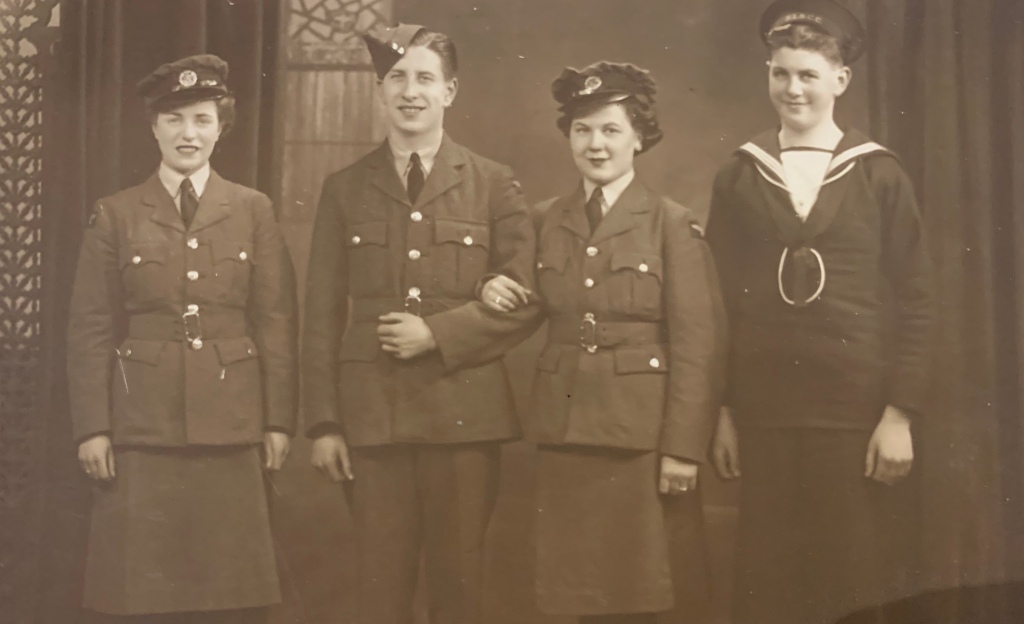
My gran and granda at their wedding on 10 March 1943.

So while I’ve never supported Hearts, I’m more than happy to have this one in my collection of football tops. We went on holiday to Rarotonga shortly after it arrived. I wore it out one night and toasted him and my gran. While my love of Rangers was purely down to me, he certainly had an impact on my love of football, with my dad being entirely responsible for everything involving the internal combustion engine!

While one of these is very different, it actually means much more to me than it ever should!

Beijing – a Far Eastern delight


The Great Wall of China was a Bucket List destination that, for me, was sufficiently distant that ticking it off would not be without difficulty.  That said, it didn’t stop it from actually being on my List.

As I’ve become older (and I hope, just a little wiser!), I’ve gained an increasing interest in history – something that I was at pains to avoid while at school. Not the sort of history that just involves having your head stuck in a book, but the sort that involves visiting the place that is talked about in the book; about experiencing the history alongside its modern inhabitants; about looking, feeling, touching and tasting the history as it envelops you.

I think that being my wife’s proof-reader while she studied ancient Egyptian history only served to reinforce my interest in what I’ll call “travel history”. It was certainly far more interesting than the business degrees that I’ve had to do to keep me in gainful employment!

IMG_2283

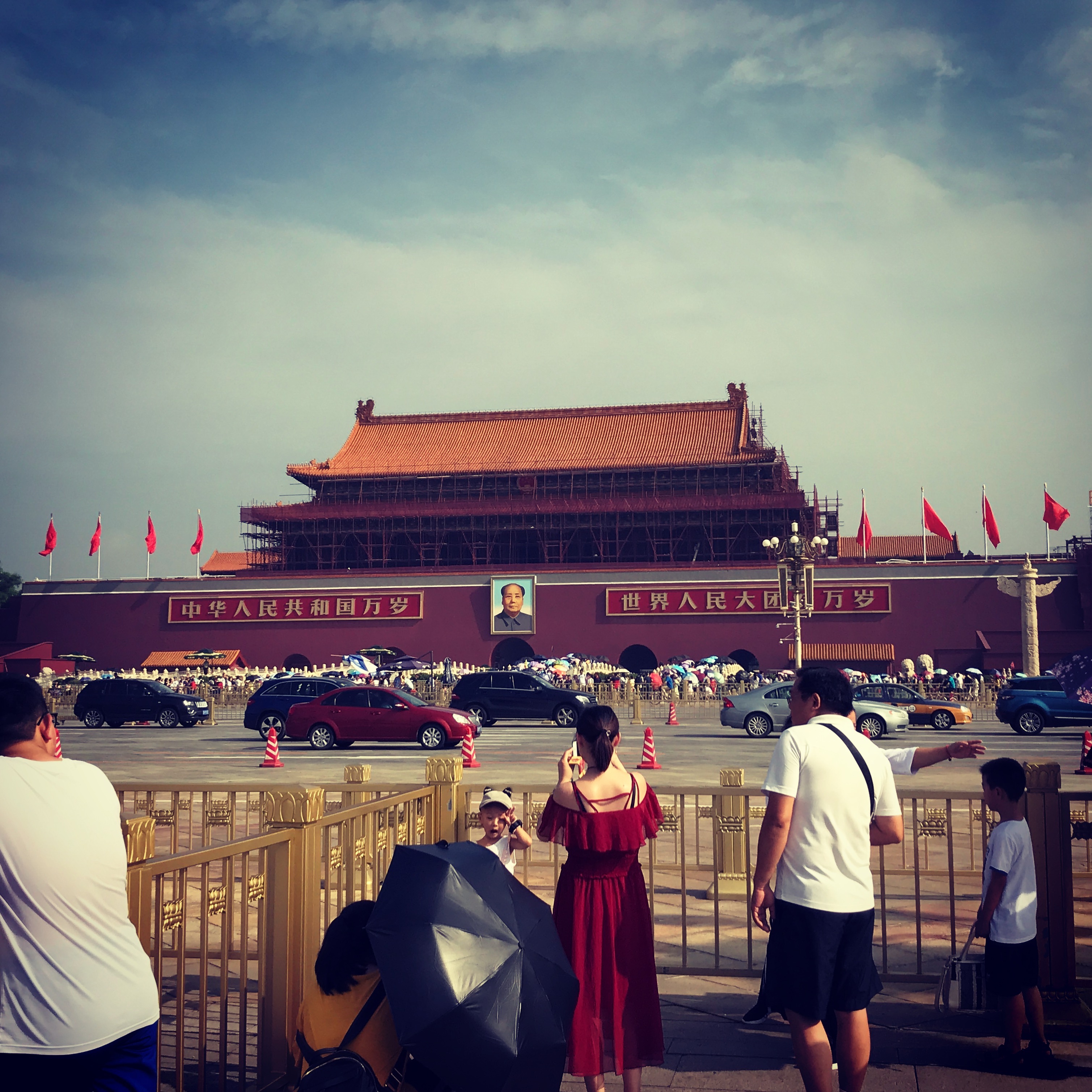
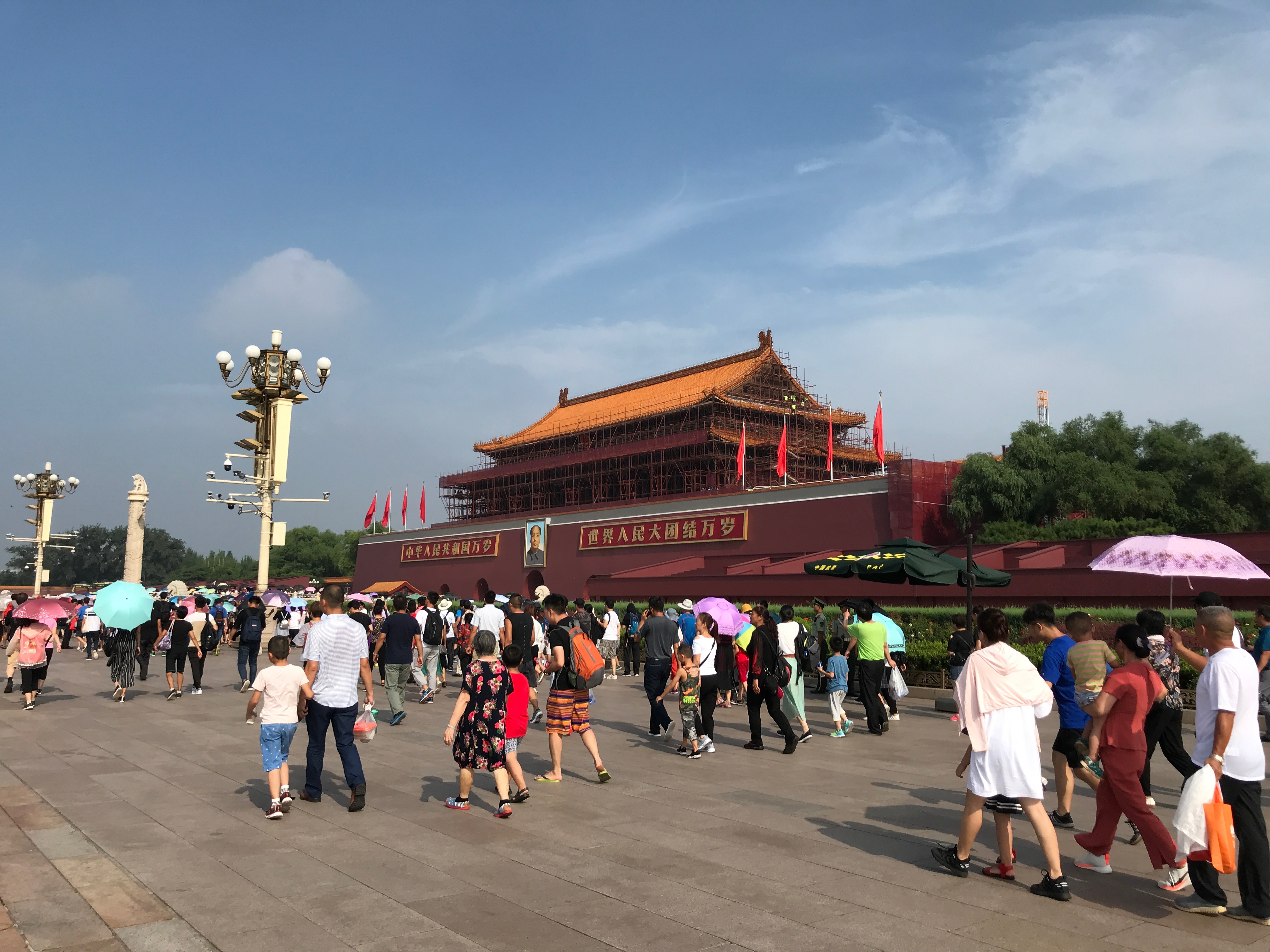
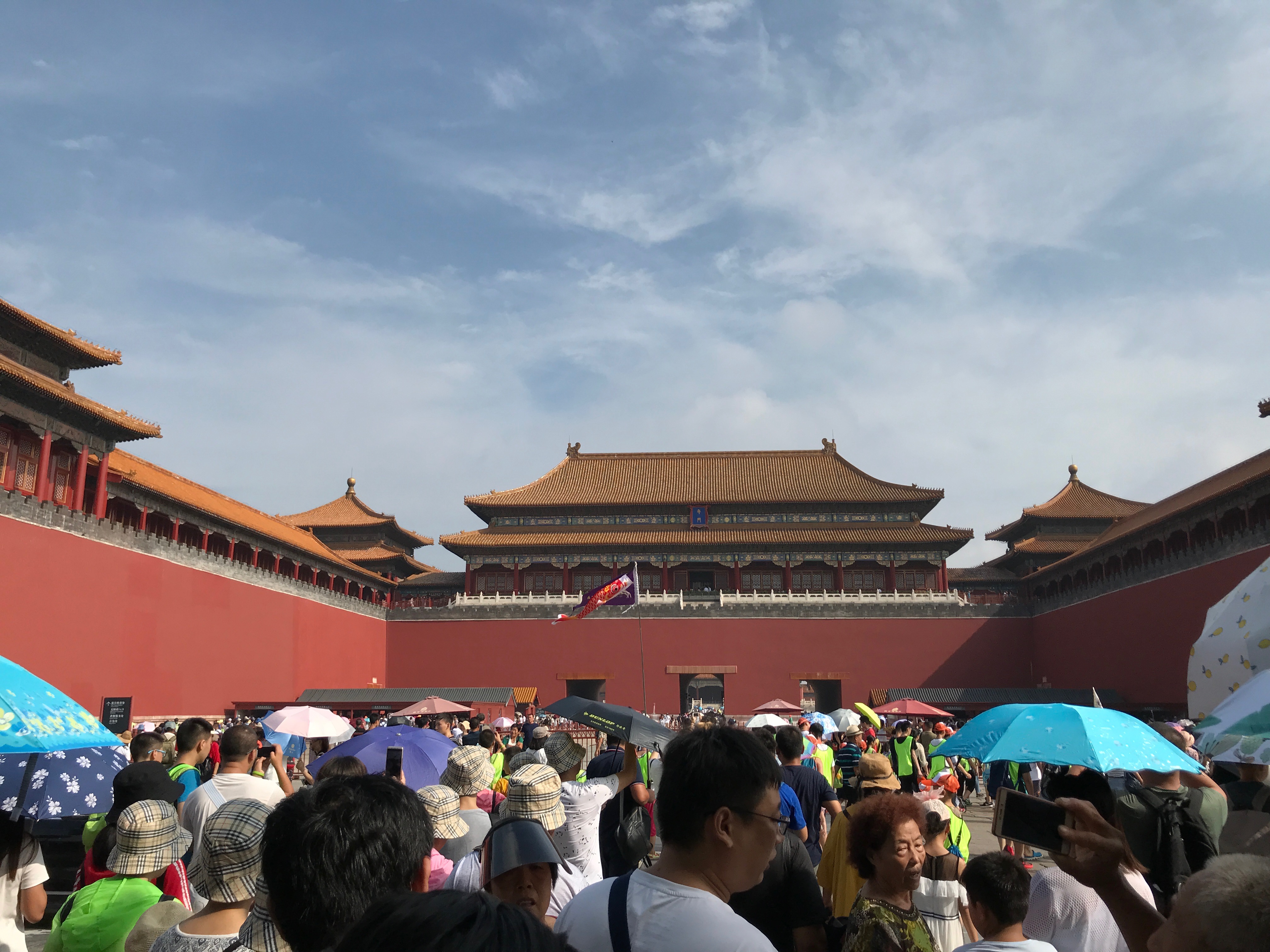
Right next to The Great Wall on my list was the Forbidden City, so I had a quinella of an opportunity.  This was promptly turned into a trifecta by being able to visit Tiananmen Square, made famous by the student who stopped a column of tanks during the much publicised 1989 protests.

IMG_2220
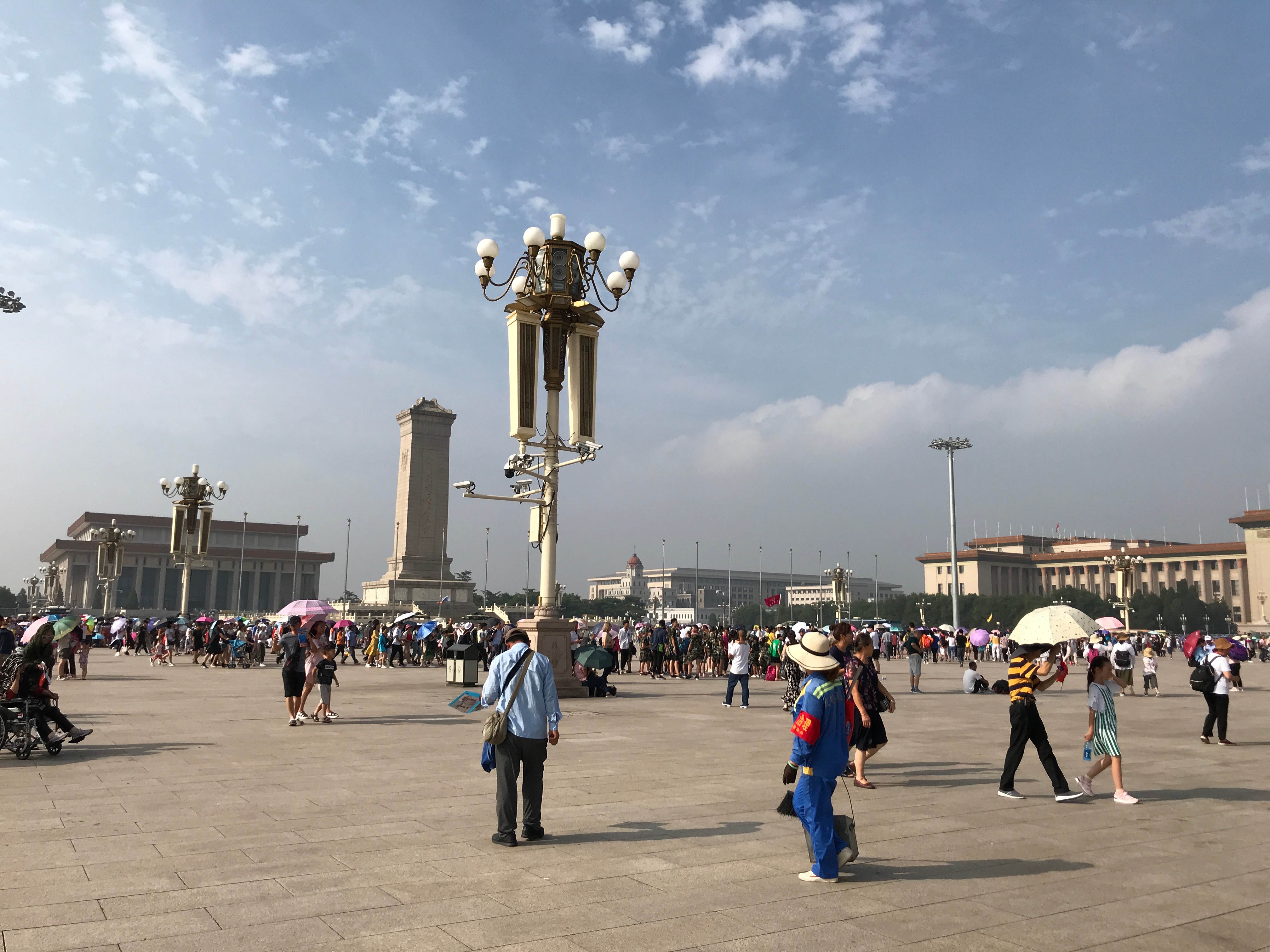
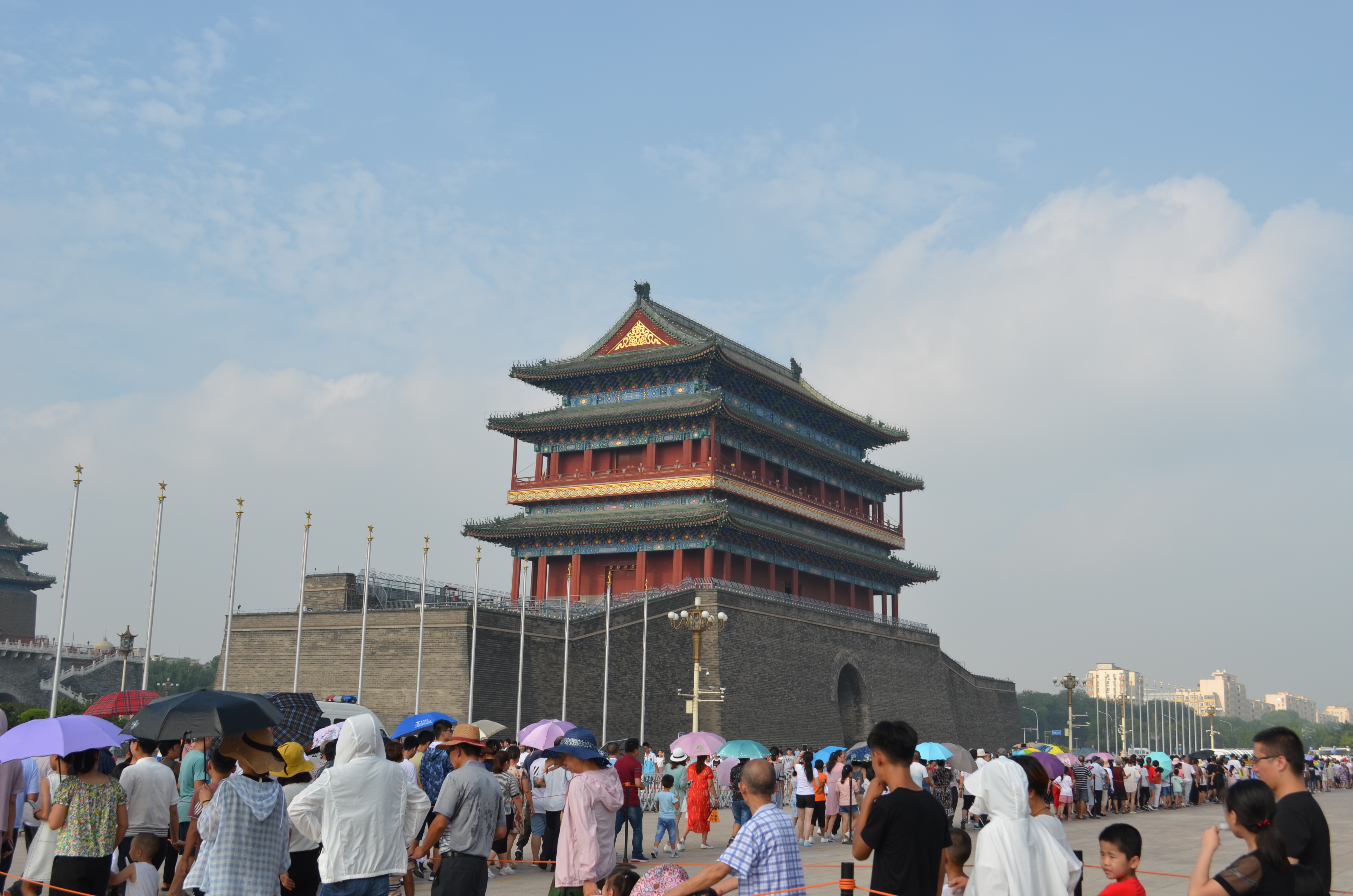
Tiananman Square.  I think that there were queues just to queue!

I’m also very fortunate in that my job sometimes takes me overseas.  When the opportunity to head to Beijing in August 2018 arose, I knew that I had the ideal opportunity to figuratively get my Bucket List marker pen out of the drawer.

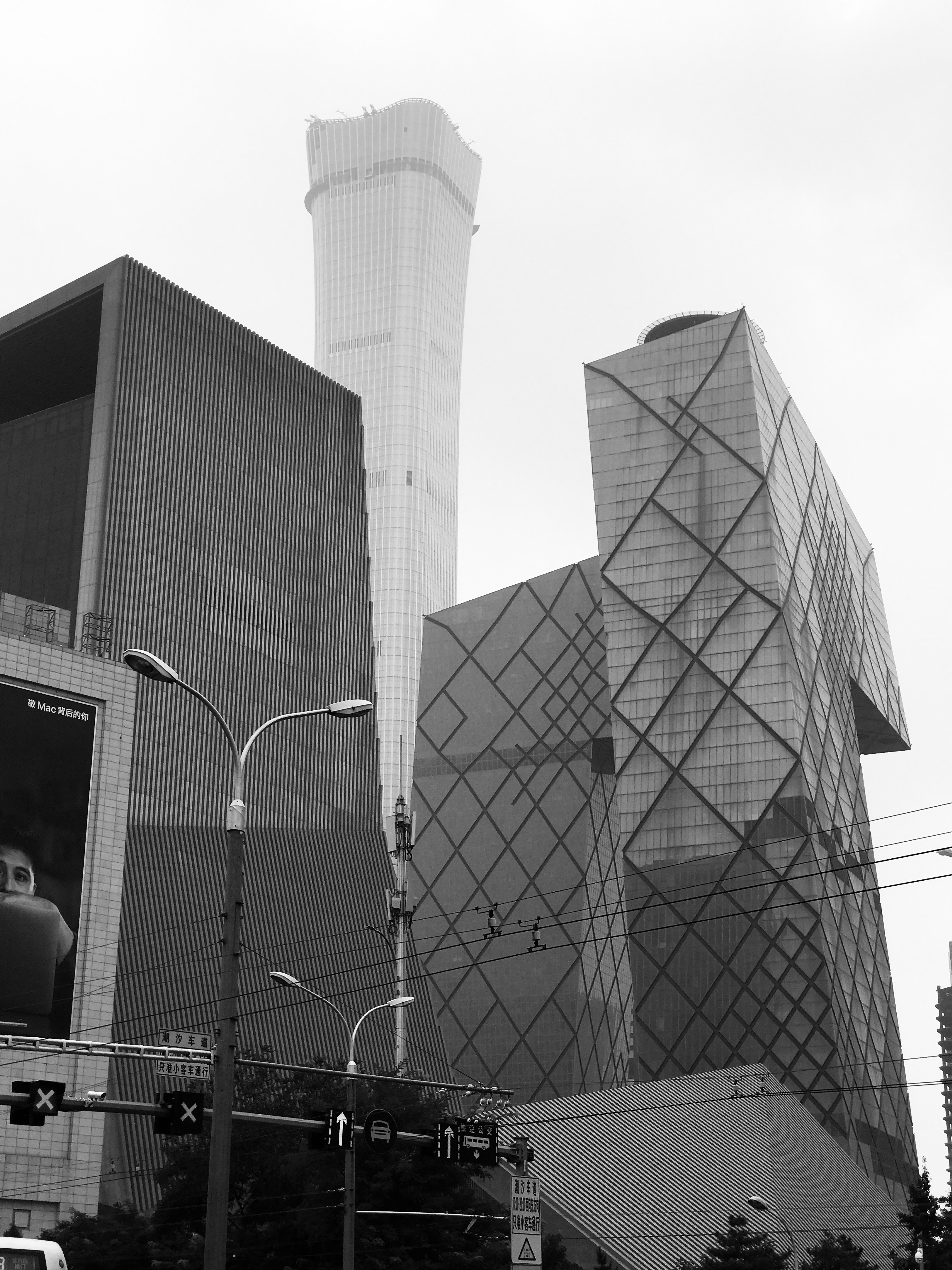
Beijing, a city of over 21 million people, wasn’t quite what I expected.  Sure, there are some areas that look and feel fairly communist, but it’s also a real mixture of new and old.  Some of the architecture, while not along the same lines as Shanghai, is definitely interesting, undoubtedly drawing off feng-shui.

IMG_2571
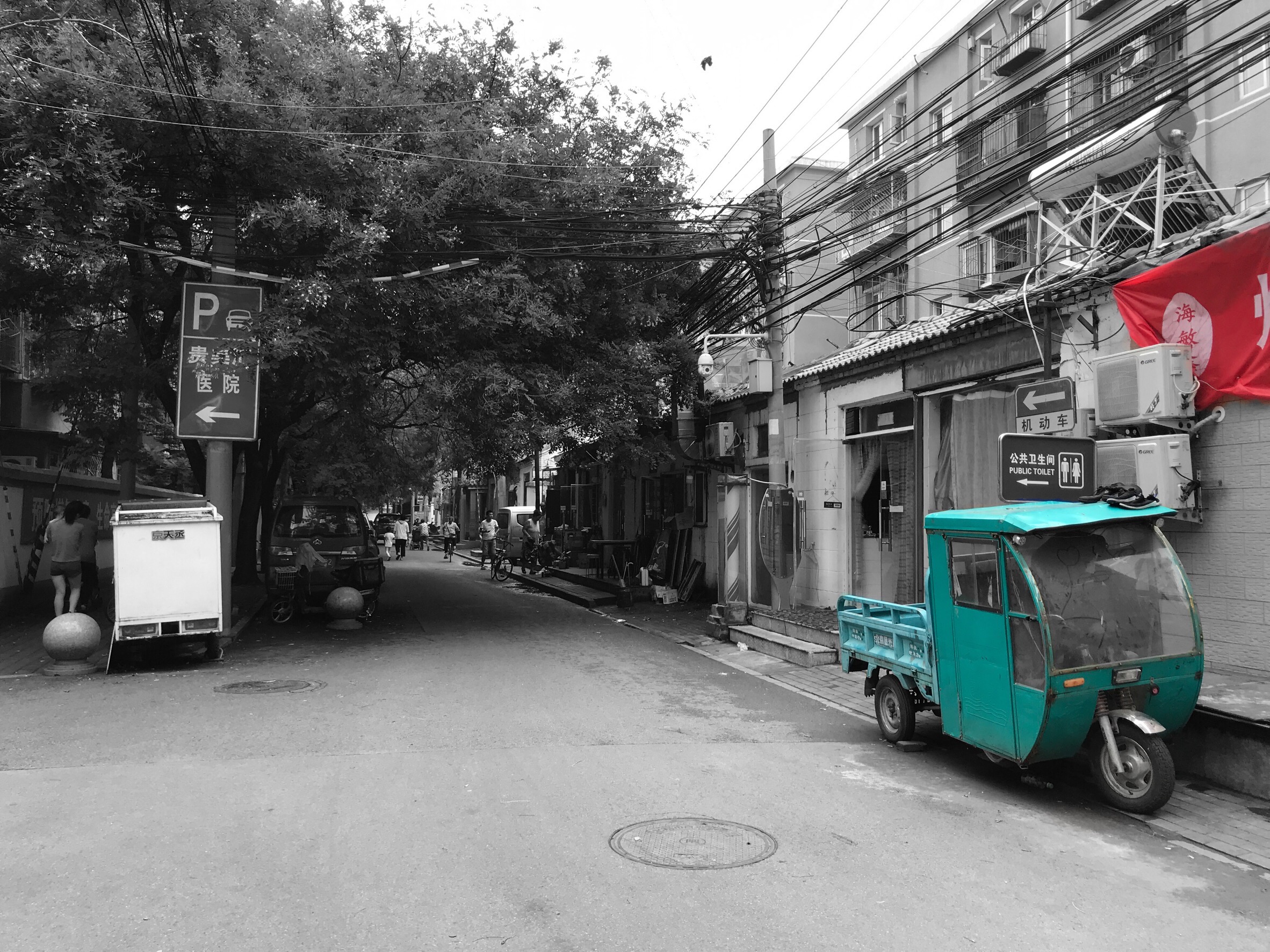
The old.  Side streets close to one of the parks close to the hotel where I stayed


IMG_2554
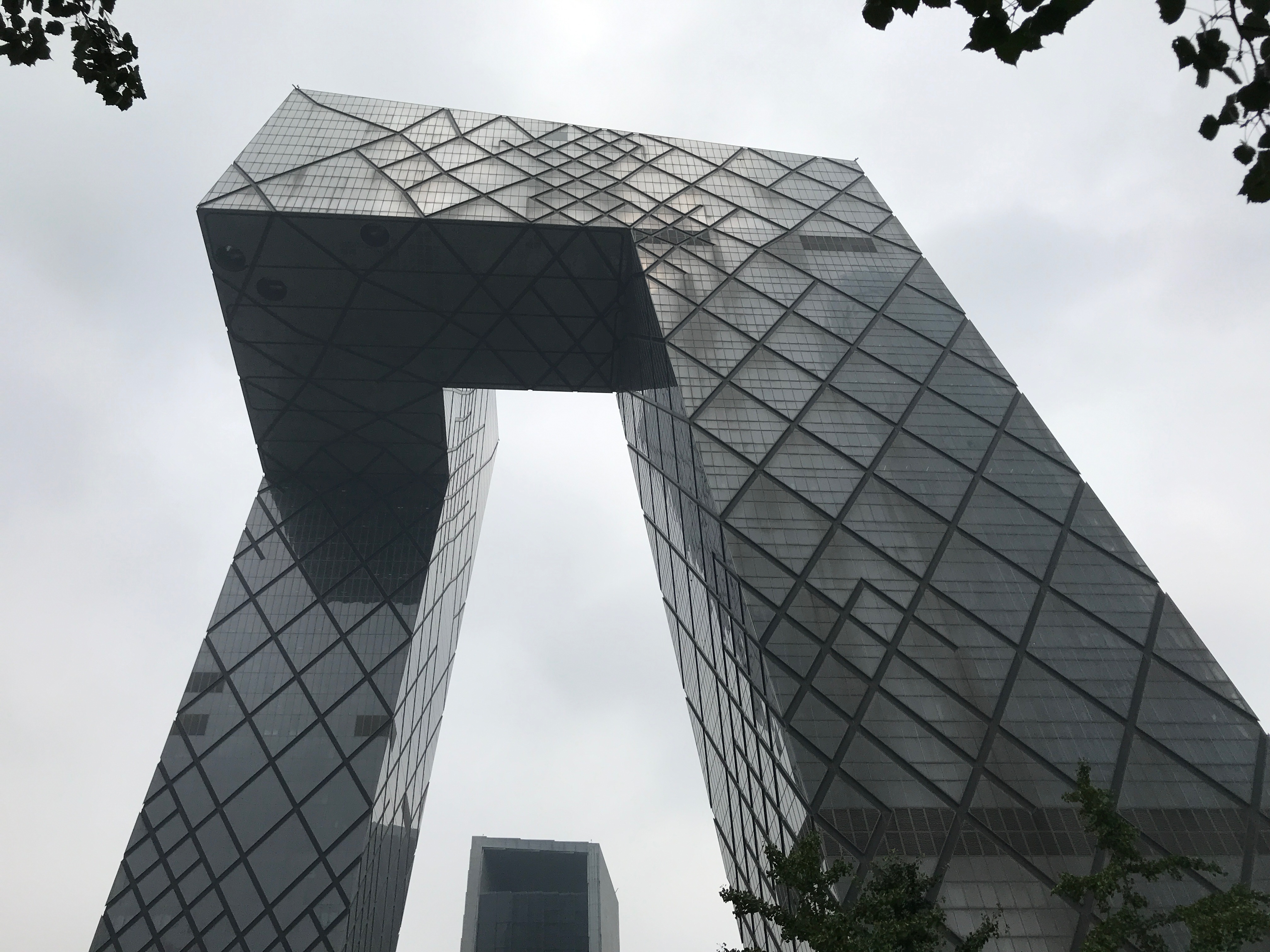
The new. This was the HQ of one of the Chinese TV stations.

IMG_2514

Getting there

The only direct flight to Beijing from Auckland is currently with Air China. The flight takes 13 hours, although we were slightly delayed, I assume, due to weather en route.  I’d booked my flights to arrive on Friday, so that on Saturday and Sunday I could spend some time fulfilling my travel history chores.

Alas, while the weather had been fabulous in the weeks before I travelled, as I got closer to setting off, I could see changing patterns, to the extent that the Saturday and Sunday were now promising thunderstorms, with Friday being the only decent day, given that I’d be working the following Monday to Friday.

With this in mind, I’d been liaising with the concierge staff at the Conrad Hilton in Beijing to try to arrange something for the Friday. This in itself came with a number of risks and difficulties, not the least of which was that I wasn’t scheduled to land until 4.30am on Friday and the tour would set off sometime between 7-8am.

They booked me on a tour that was available and said that they would cancel it if my plane was delayed. Which it was. Fortunately, it wasn’t delayed sufficiently to prevent me from getting to the hotel, showering, changing and heading off!

About the tour

I’d somehow envisaged that I’d be on a bus tour. I suppose that was the intention of the firm that ran them (I used Gray Line tours www.grayline.com) and I opted for their “seat in bus” tour that they called – rather appropriately I thought – “Bucket Life”.  This tour would take in Tiananmen Square, the Forbidden City and the Juyongguan section of the Great Wall.

On the day I went there was only myself, a Canadian lawyer filling in a day after a number of meetings before flying back to New York, and an American teacher living in Tokyo, who had flown in for 3 days of sightseeing. Our guide Liu (who insisted that we just call him Leo as that was easier) therefore didn’t have to shout to make himself heard – not least of all because we were in a car rather than a bus.

So just an hour after getting to the hotel, I was cleaned up and heading off out. My mind and body weren’t entirely sure what time of day it was, but I assumed I’d get wakened up by either of my travelling companions to take photos if I fell asleep!

But that wasn’t to be a problem. Much of the tour would be spent walking. And unless I mastered somnambulism, I’d most certainly be awake! Not to mention hot and dripping with sweat in the humid 34C conditions.

Tiananmen Square and the Forbidden City

The first part of the tour was the part I thought would be quick and easy. What I hadn’t realised was that Tiananmen Square was 109 acres with the Forbidden Palace being an additional 180 acres on top of that. Leo told us we’d be walking in this area for the first two hours of the tour (it didn’t say this in the description of the tour, so comfy shoes are a must).

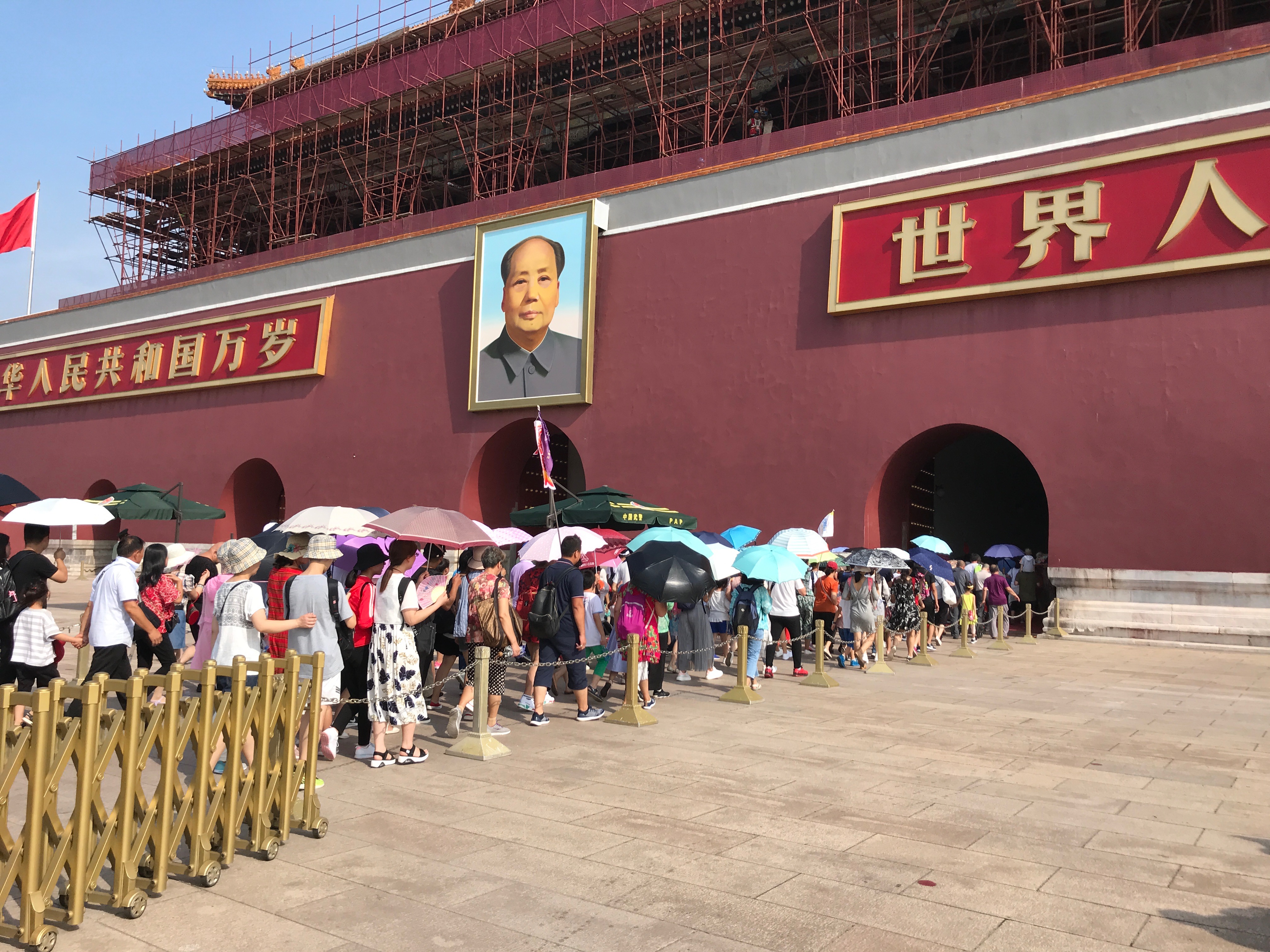
We started the tour along with many other thousands of (mainly) Chinese tourists close to the Mausoleum of the still revered Mao Zedong, chairman of the Chinese Communist party from 1945 until he died in 1976. The queues of those wanting to see his final resting place were incredible. Leo told us that we were lucky that we were visiting on Friday rather than Saturday, when they’d have been even longer! We were not going to see Mao, so we spent some time looking around the square (which I believe is the largest in the world), taking in the Monument to the People’s Heroes, Parliament (the Great Hall of the People) the National Flag (guarded by Chinese troops stood rigidly to attention in the 34 C heat), and the National Museum before heading down to Tiananmen which Leo told us literally stood for entry to the square if my mind serves me correctly.

DSC_0116
This was the queue to see Mau’s mausoleum.  It was thousands deep and stretched from one end of the square to the other.

We had a few photos within the square before using the underpass to get to the entry to Tiananmen, where we would enter the actual Forbidden City.

We were told that the 80,000 tickets for that day had all been sold out by the previous evening. No tickets meant no entry, so it was lucky that we’d been on the tour and not just turning up as solo tourists (so if you do decide to do this on your own, it’s worth bearing in mind – book your tickets in advance – don’t just turn up).

It felt as though all 80,000 ticket holders were setting off at the same time as us. Each of them seemed to have an umbrella (as protection from the sun rather than rain), and I was to be hit in the head on many occasions as we covered the 180 acres during an incredibly hot and humid day.

IMG_2303
Tiananman Square and the entrance to the Forbidden City

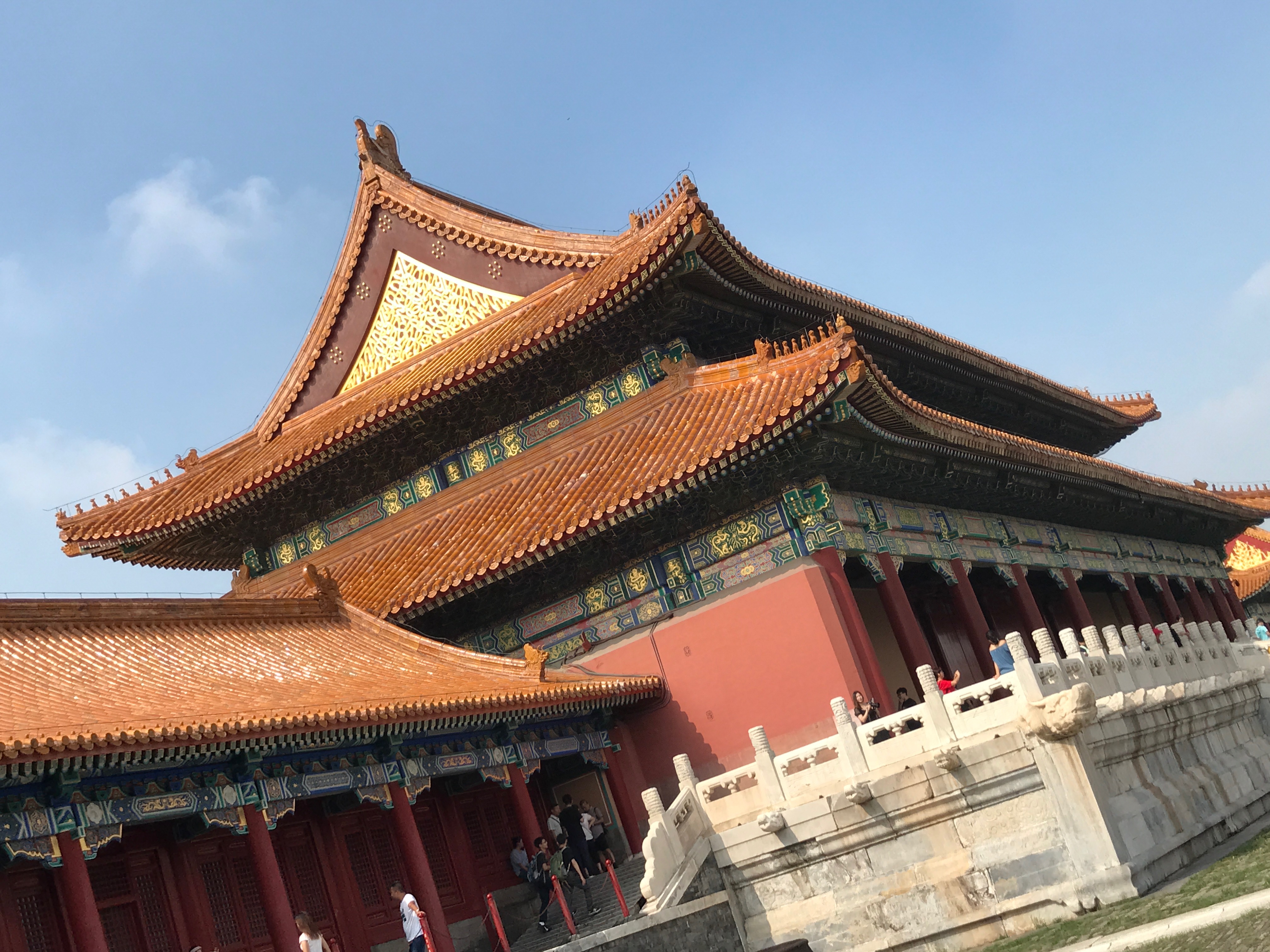
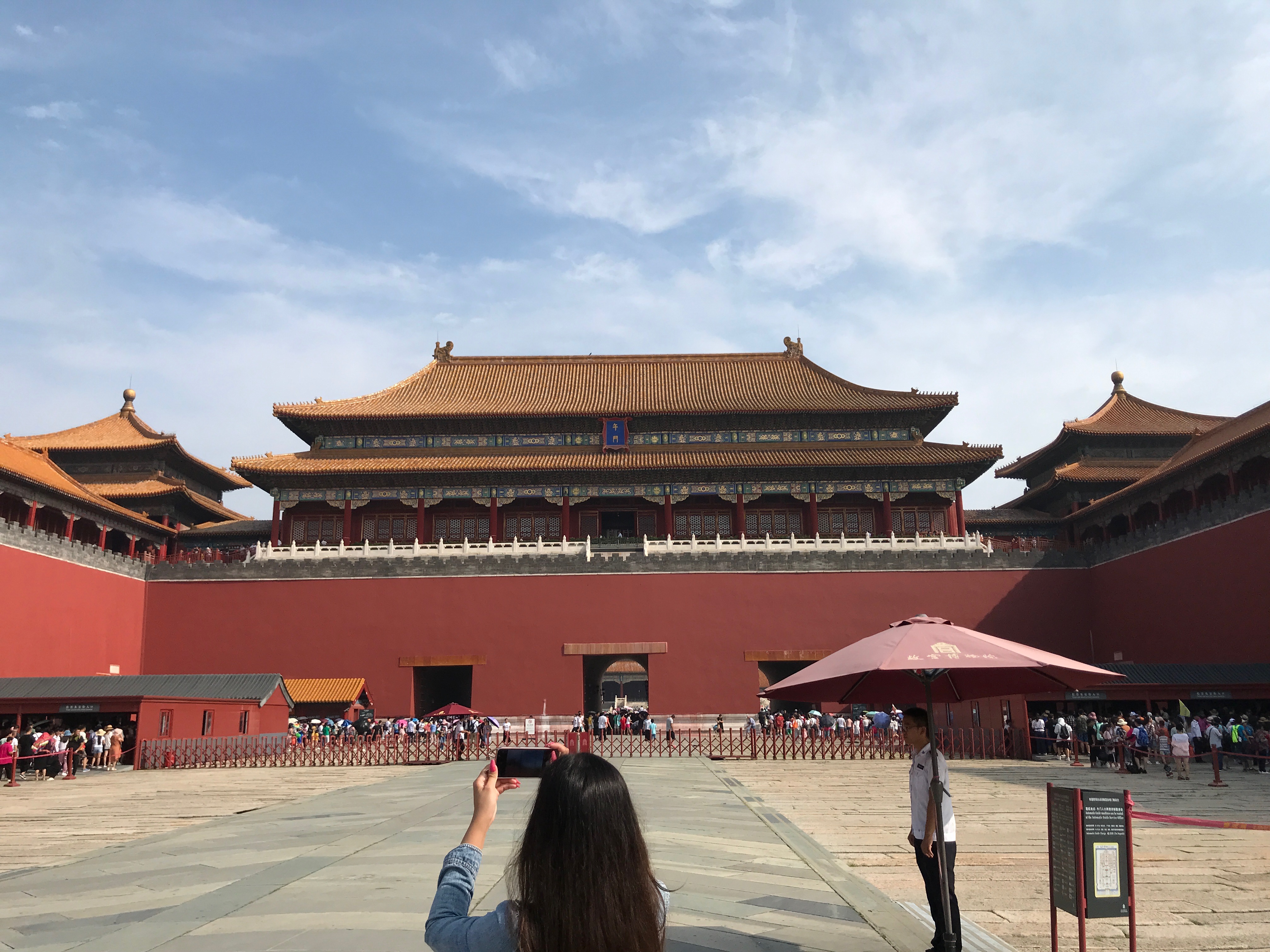
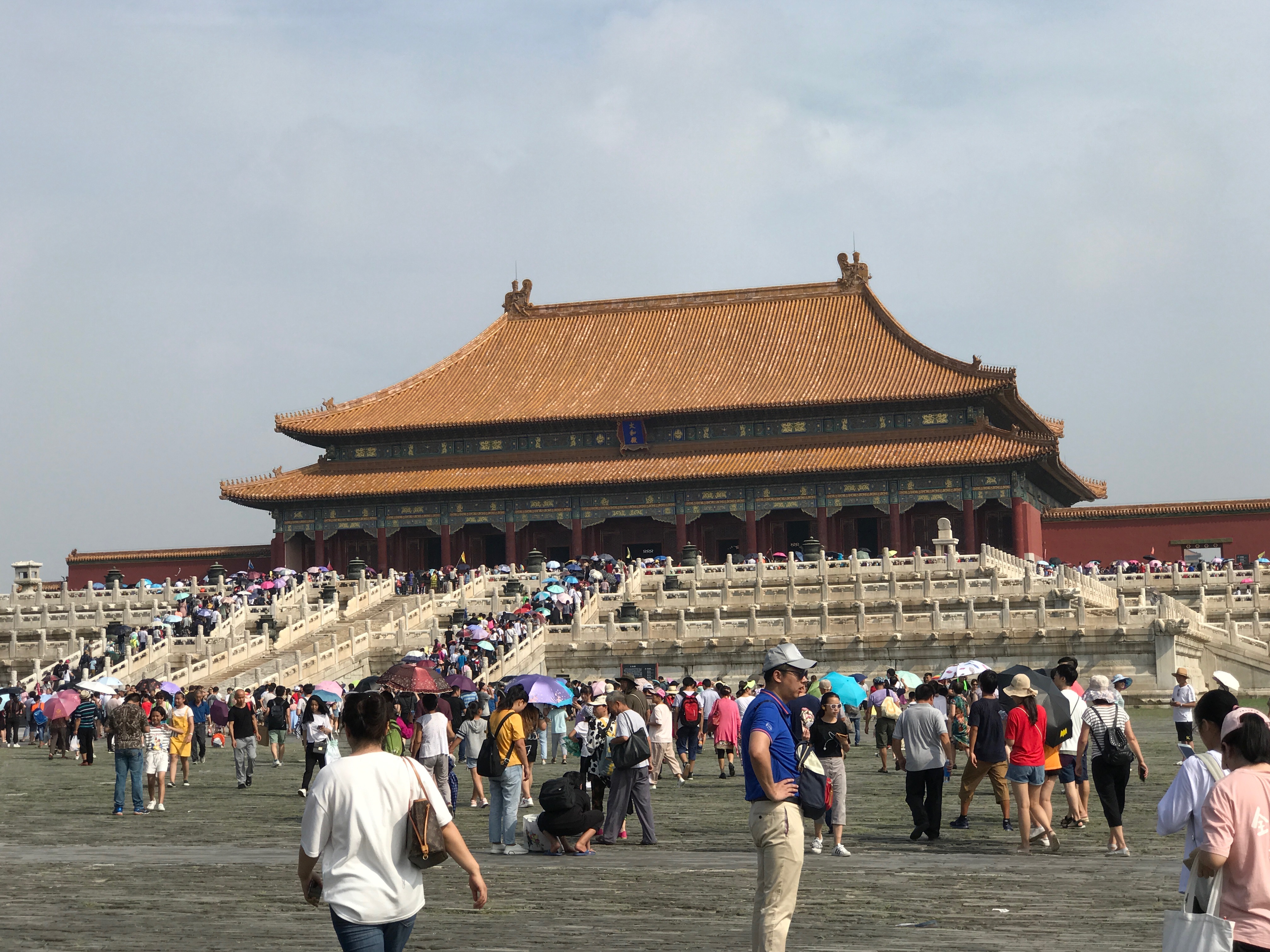
We set off through Tiananmen, passing into the Forbidden City through the Meridian Gate, across the bridges over the Golden Water, the Gate of Supreme Harmony, the Hall of Supreme Harmony – Harmony seems to be an integral part of Chinese culture –  the Hall of Middle (you guessed it) Harmony, the bedrooms, and out of the Gate of Heavenly Purity (what? Not Harmony?) via the Imperial Garden. The latter was very small considering the overall size of the site and it was about the only shade afforded during the tour.  I guess that as it was only the Emperor and his family who could use the gardens, they didn’t need to be big.  Their size and position was also an important part of Feng Shui we were told.

IMG_2231
The approach to the Forbidden City entrance

IMG_2246
Are you really Chinese if you don’t have an umbrella?

IMG_2262
How the brochures probably tell you it looks like inside…..

IMG_2256
….versus how it actually looks.  80,000 people is a lot of tourists to get through every day!

IMG_2287

It is impressively large inside with virtually no shade.

It took us the full 2 hours to get through and we were literally soaked in sweat, and in need of a couple of bottles of (cold-ish) water by the end.

From here, we set off to have a traditional Chinese lunch (and an obligatory viewing of a silk quilt making factory (where I bought nothing more than a couple of fridge magnets), but where there seemed to be an expectation that I needed a silk-stuffed duvet to take home, before making our way on to the Great Wall.

The Great Wall

DSC_0189

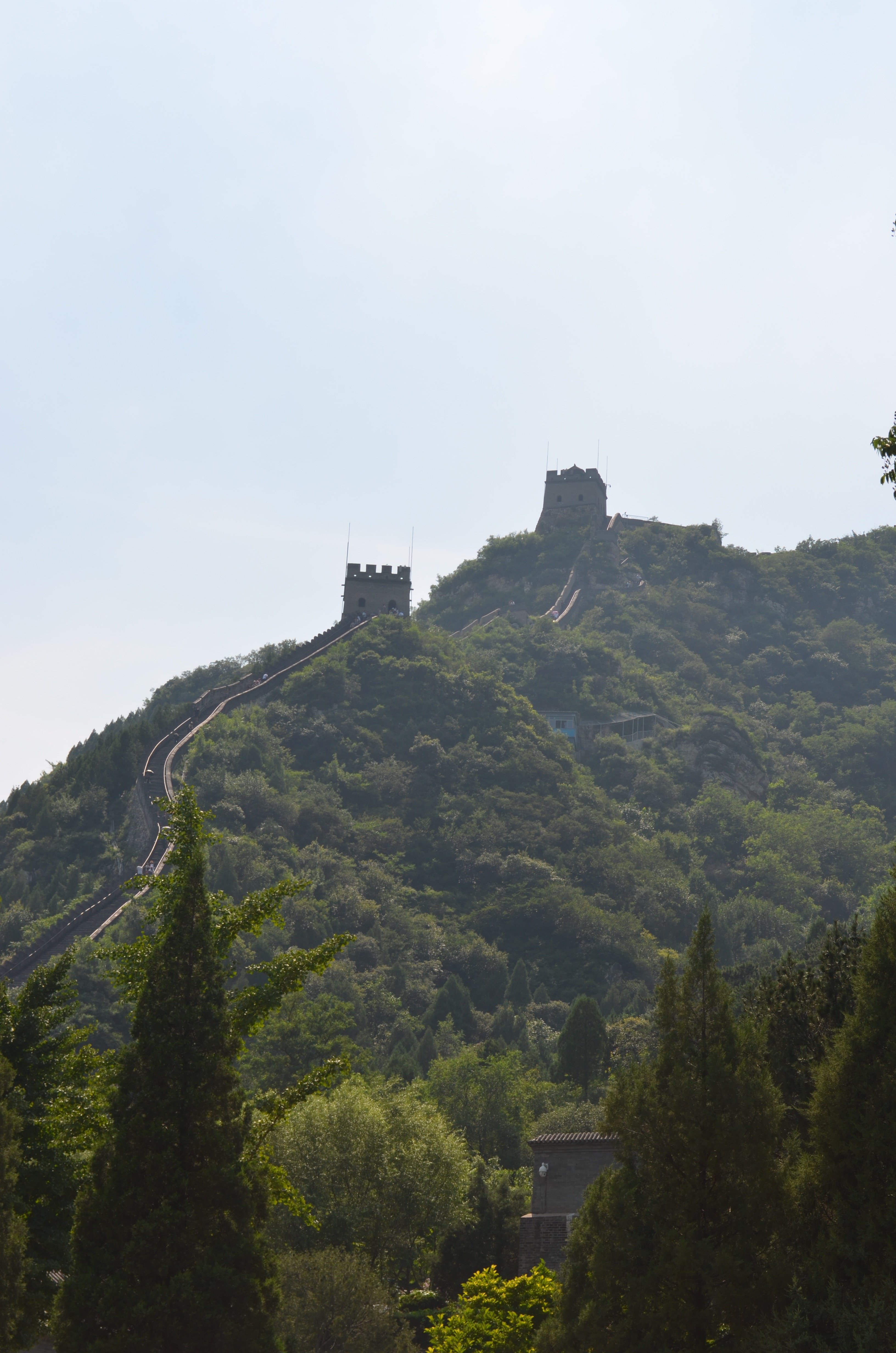
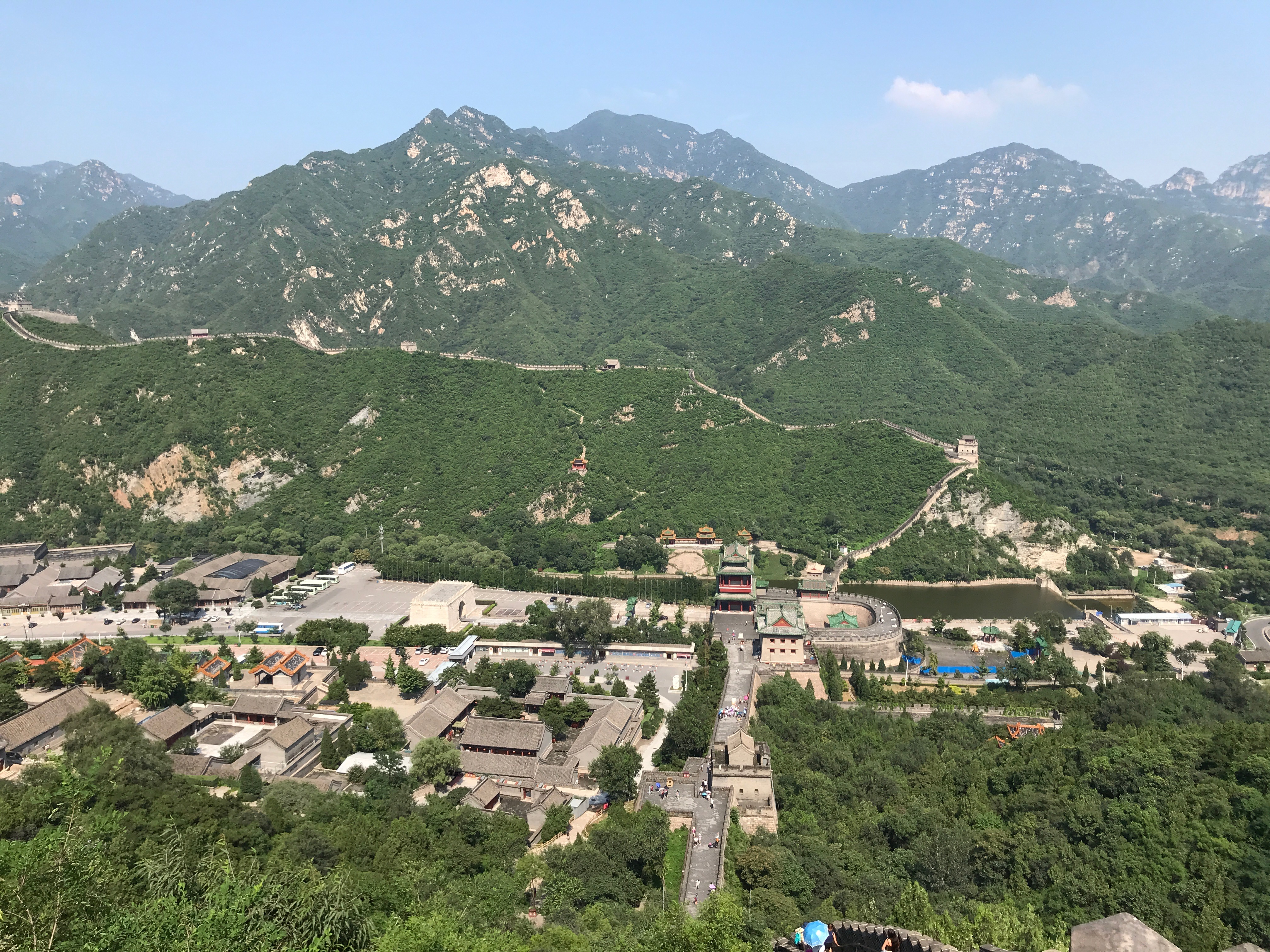
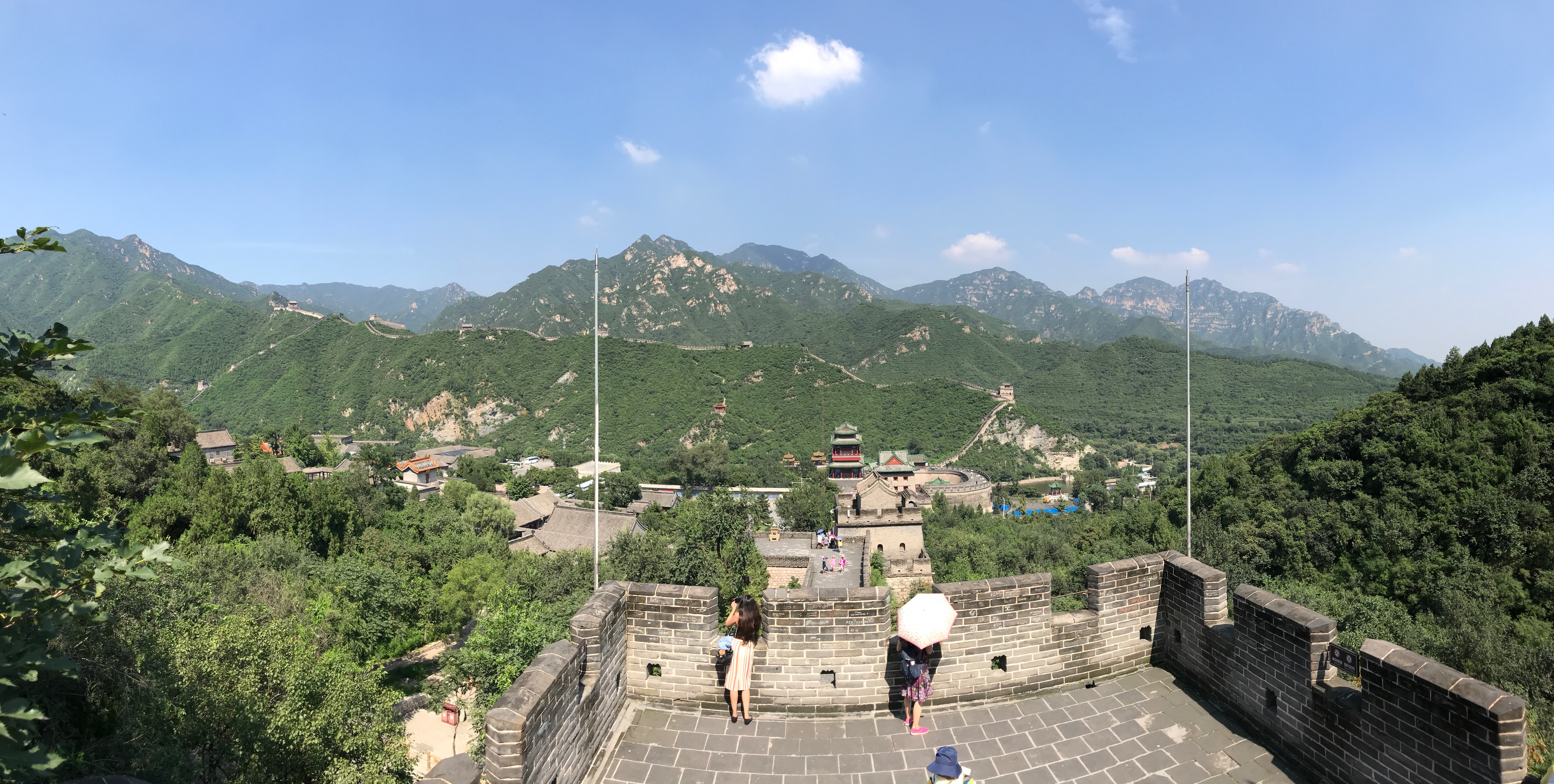
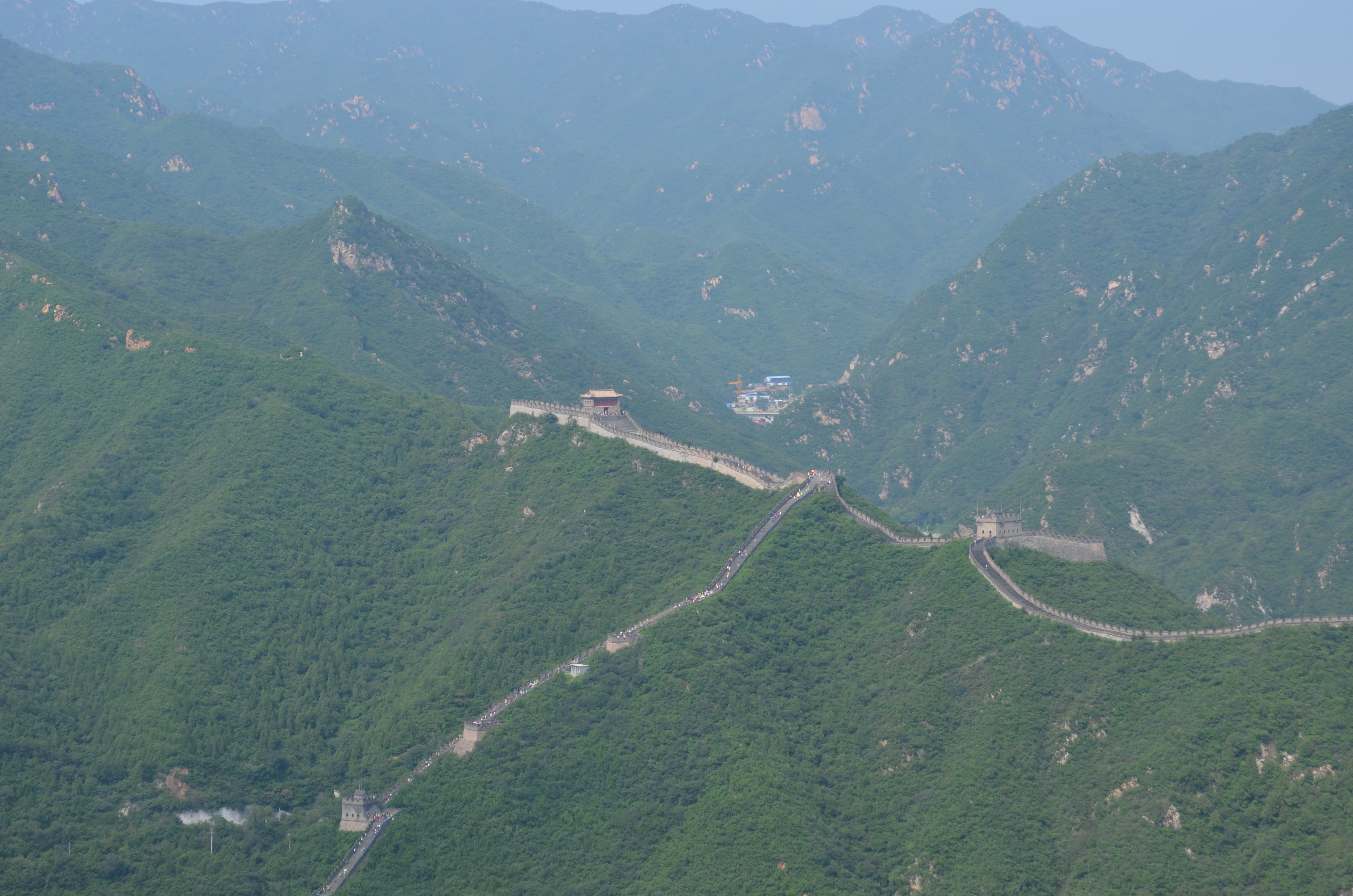
At some 21,000km long, there are plenty of places where you could go to see the Great Wall. The trip I’d chosen was to the Juyongguan section.  The booking guide notes that this area literally means “First Pass under the Heavens” and that it was a fortified pass often referred to as the Throat of Beijing. There are many others to choose from, but this one was only around 1.5 hours from Beijing and I neither had the time nor the inclination to sit on transport for any longer than that off the back of a 13-hour flight!

DSC_0208

And it was everything I’d expected. On the way, we’d learned that while parts of the wall had been started as long ago as 700BC, most of what we know today as the Great Wall was built around 200BC, predominantly to protect the country from nomadic raids.  When used for defence, smoke (during the day) and fire (at night) were used to alert soldiers up and down the wall if raids were being attempted.

IMG_2343

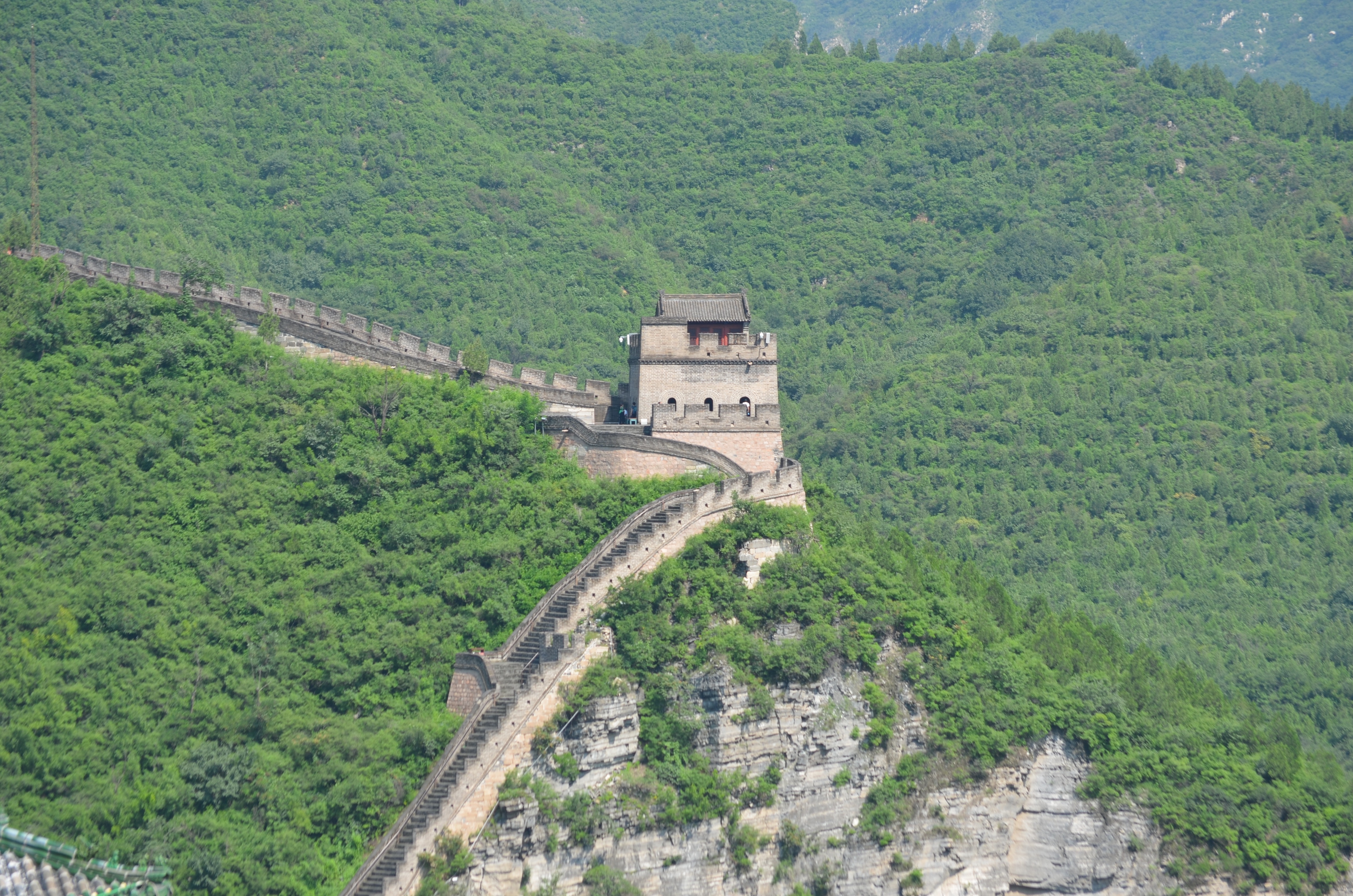
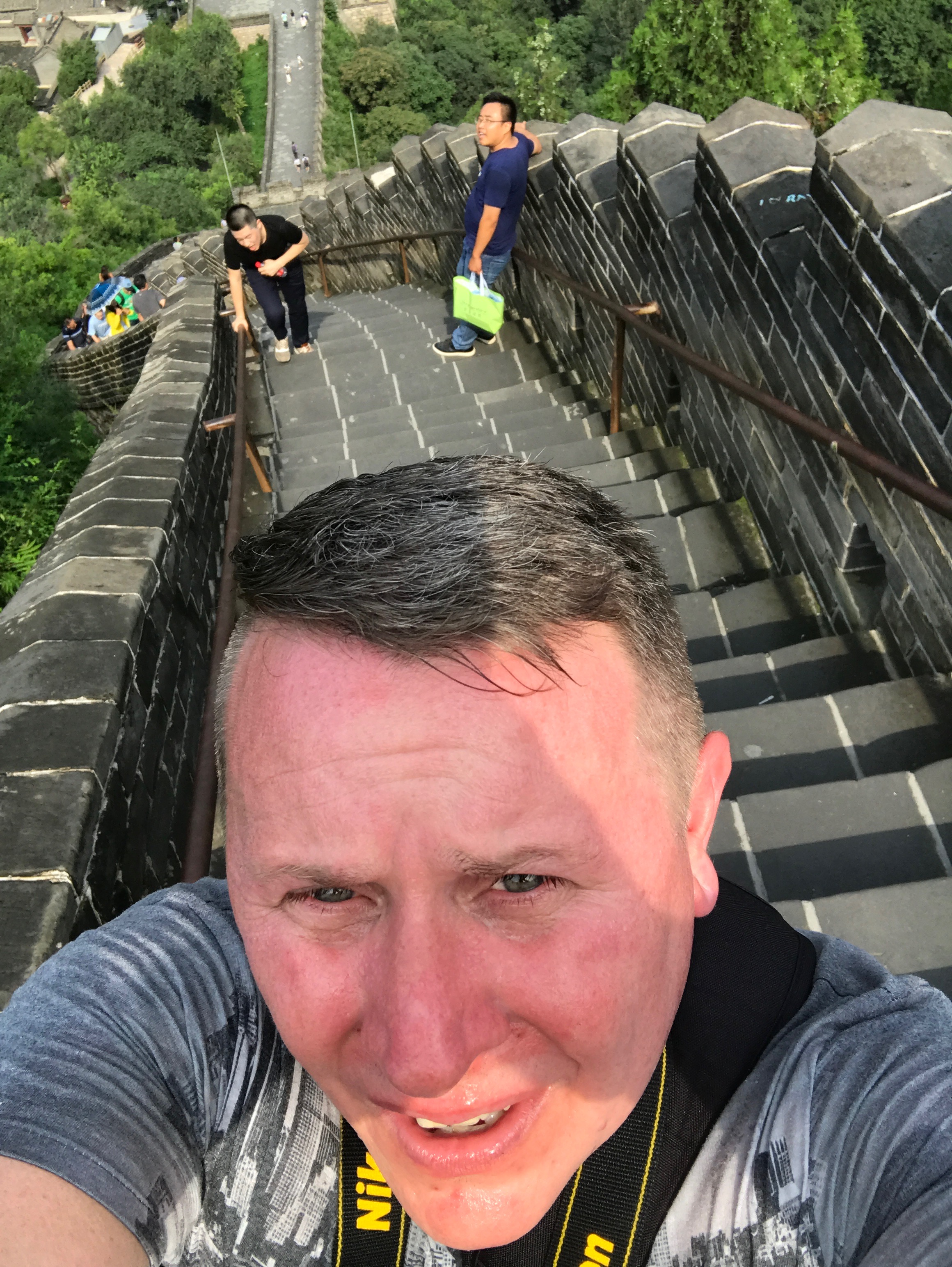
I hadn’t anticipated quite how steep some sections of the wall were. They were clearly built on ridge lines to maximise their effectiveness but following contours must have made it exceptionally difficult to build. This area has been well reconstructed, so it’s a good choice for a visit. While it is steep, imposing and stark, it didn’t actually always do the job for which it was intended and in the mid-1600s it was breached by the Qing dynasty who defeated their predecessors, the Mings. But the intention of this isn’t to be a history lesson – just to note that it’s a good section of the wall to visit!

IMG_2388
I hadn’t anticipated quite how steep some sections of the wall were.

We only had a couple of hours here – long enough to cover a couple of the watch-towers and to get up sufficiently high to take some great photos, showing the extent of the wall in the area. While I consider myself “relatively” fit, I don’t mind admitting that I was sucking in air like the best of them. It’s a steep climb, some of the steps are very large, and if you don’t have a head for heights, looking down could be problematic. That said, it was definitely a worthwhile visit and one that I enjoyed. My legs were definitely a bit stiff the following day though!


IMG_2335

A tea ceremony

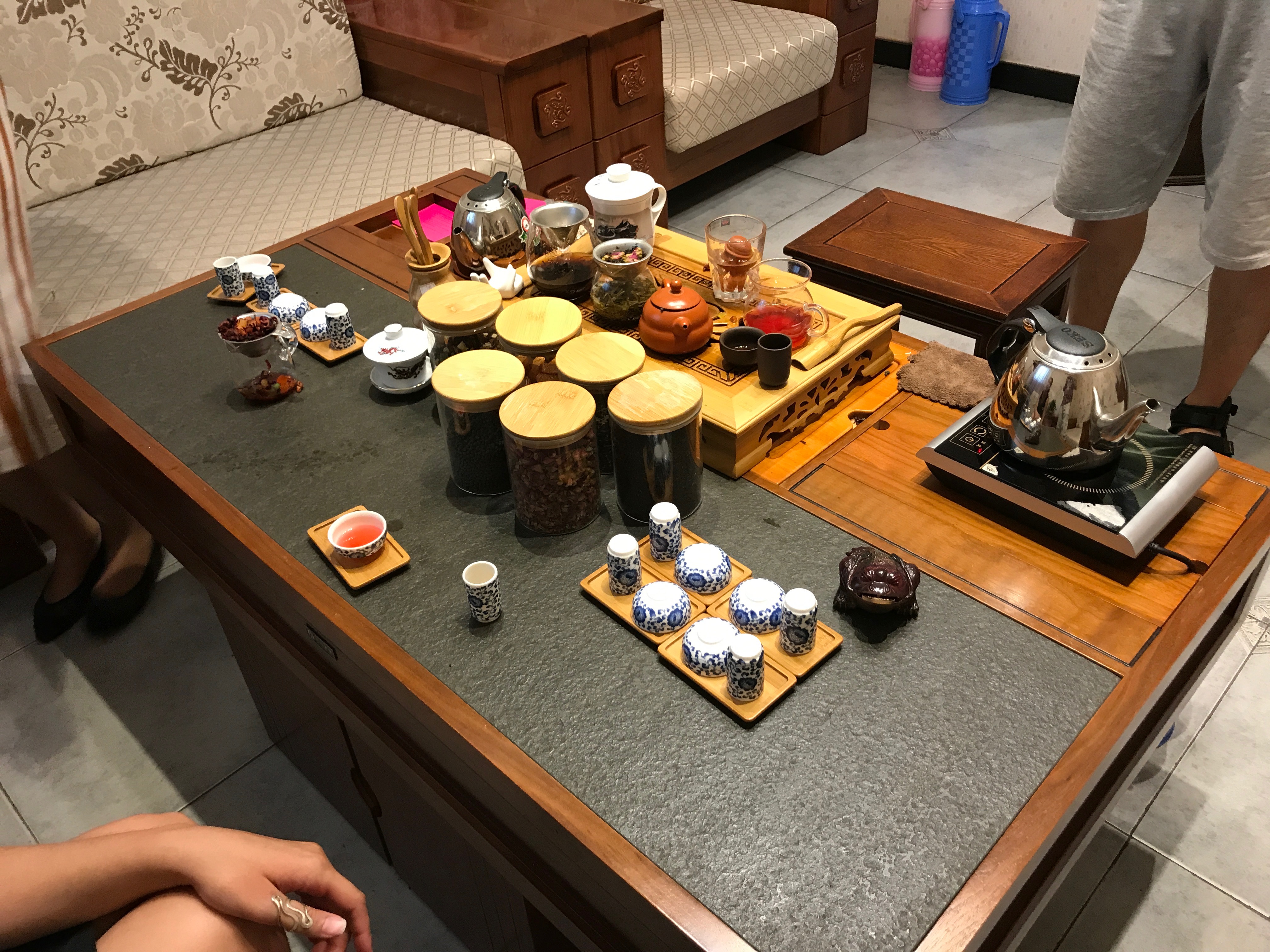
Our tour finished with a visit to a tea house for a tea ceremony. Not being a huge tea drinker (I like the odd cup of earl grey with milk and sugar – which I suspect would be frowned upon in China), I wasn’t too bothered if we did this piece or not. That said, it was good to see how it is made and to try a number of different teas (slurping was actively encouraged, and it turns out I was a natural at that)!  Truth be told, a cold beer ceremony would have gone down exceptionally well after climbing in all that heat!

IMG_2405
Getting ready to try 6 different types of tea (all of which were actually quite nice if the truth be told).

And from there, it was straight back to the hotel. Well, when I say straight back, we were now in Beijing rush hour, so it wasn’t the quickest of returns.

About the food….

I often think that I like to travel to where I like the food.  The food in China didn’t disappoint! I’ve no idea what some of it was but I had Peking Duck (twice) – which is part food and part theatre to be fair – and Hainan Chicken twice.  I think that it’s probably more Singaporean than Chinese.  I had it once in the hotel (it was raining heavily and I couldn’t be bothered venturing out that night and it was OK.  But I also found a local, cheap restaurant where it was fantastic – and with a beer cost me around NZ$8.

A few final points

I had a limited amount of time to do the trip but knew what I wanted to see.  Often when travelling, I’ll do my own thing and make my own way, but when time is of the essence, tours really are useful to make sure you see as much as you can in a limited amount of time.  While I booked it via the hotel, I could just as easily have done it online.  The “Bucket Life” tour did what it said on the tin.  I got to see my trifecta of Tiananmen, the Forbidden City and the Great Wall within a day. It cost me CNY560 (so around NZD125) and I thought that was good value for money, especially as it did include lunch. I was expecting to be on a coach full of people for that amount but there were 3 of us plus the driver and guide. You can do it on your own with a driver and guide, but this is much more expensive.

The only other thing I’d say is that if you’re visiting in summer, don’t forget a hat, sun block, sunglasses and water. You’ll also do well to wear comfy trainers (you don’t need any more than that) and I’d have loved a change of t-shirt, given that I was literally dripping with sweat on two separate occasions during the day! Other than that, just enjoy it. If, like me, you’ve just come off a flight and are a bit jet-lagged, the beauty of this trip was that there was so much walking, so you couldn’t possibly fall asleep.

Now, I need to find 3 additional items for my Bucket List (I could have said 4, but a tea ceremony has never actually been on my bucket list!)…….

DSC_0241

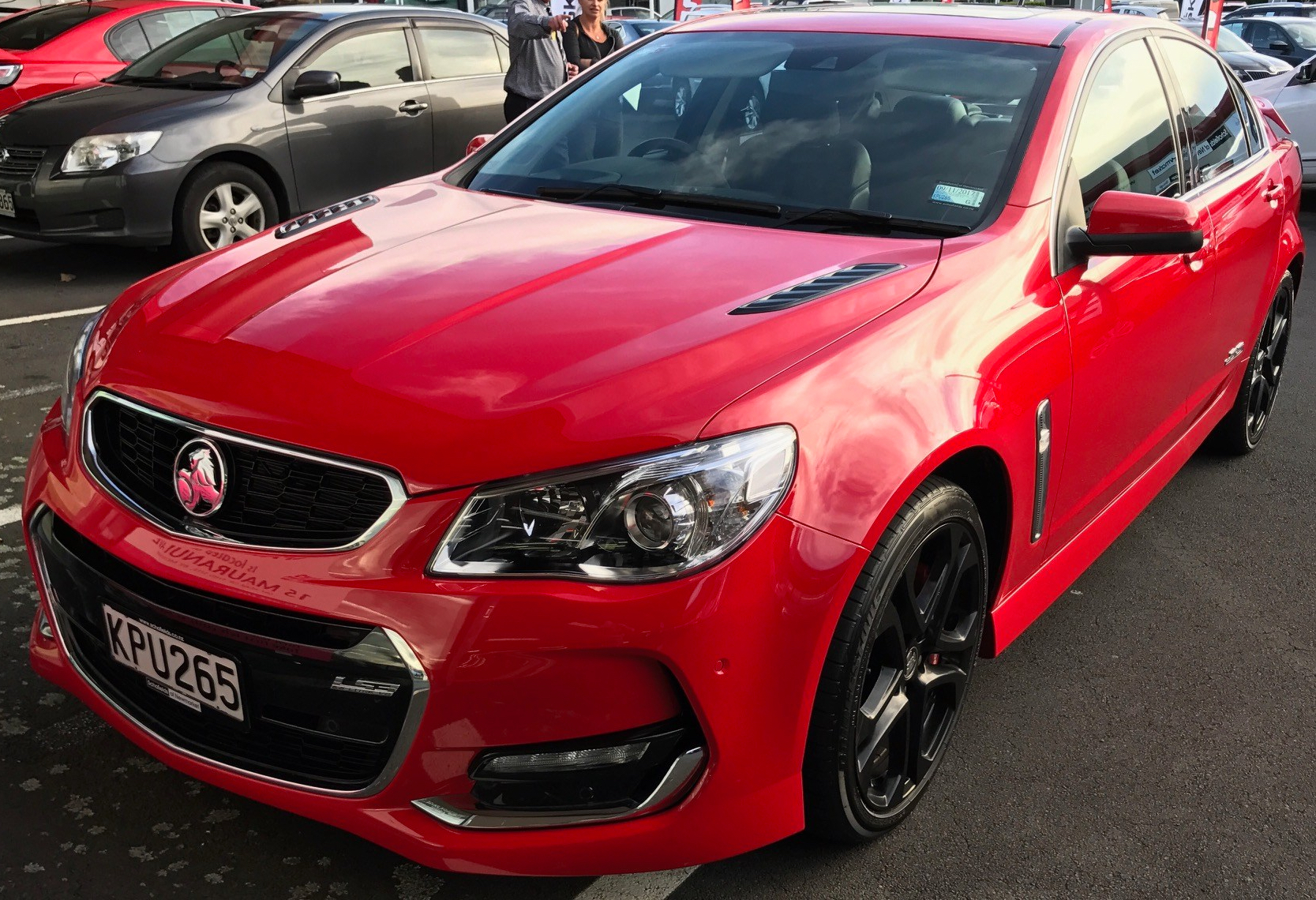
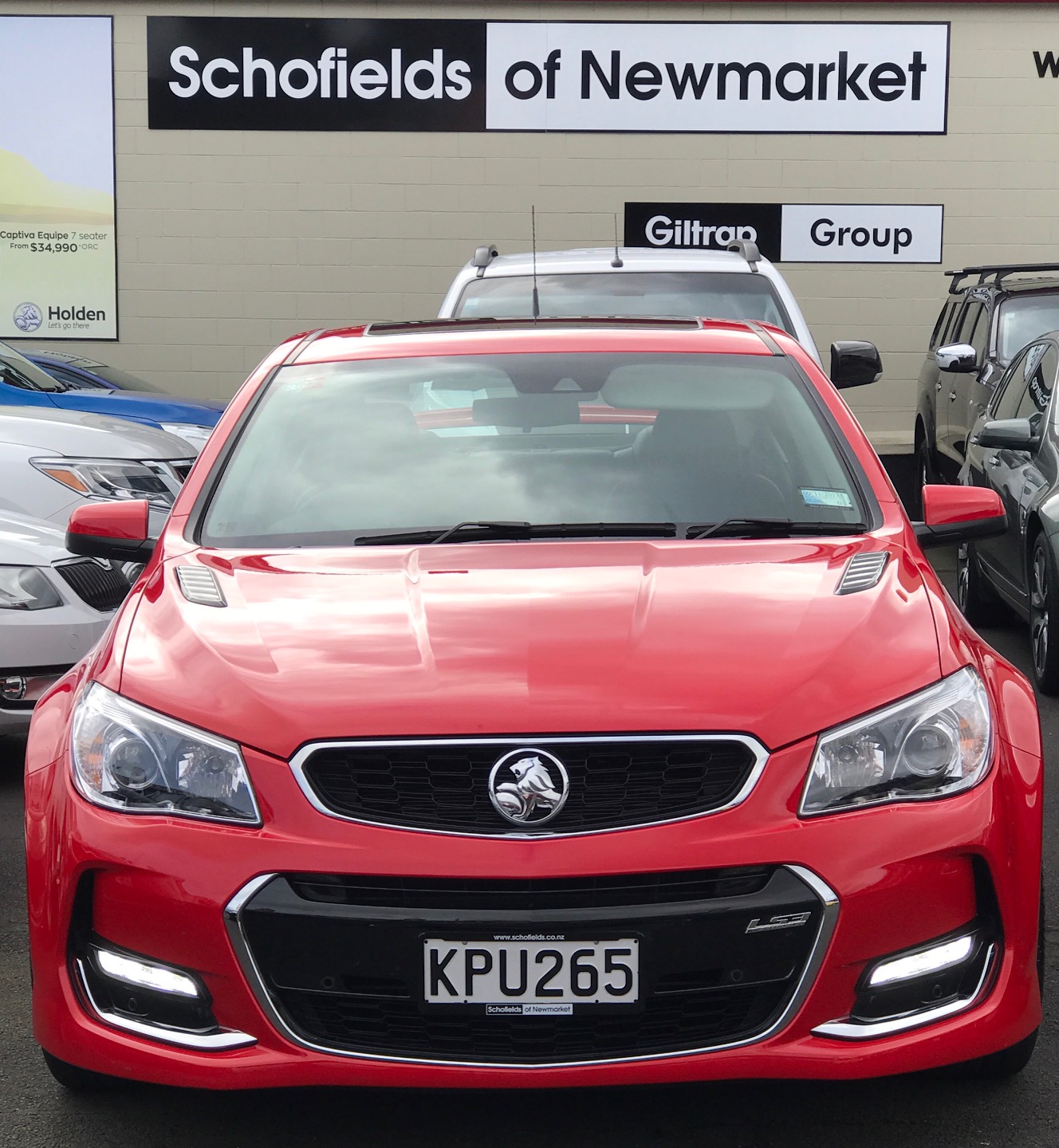
Holden Commodore VF2 Redline – they saved the best till last!

6.2 litre V8 VF2I’ll start this blog with a brief confession.  I’m a bit of a petrolhead.  I’ve owned 12* cars myself (starting with a Triumph Spitfire that used to have a small problem with it’s steering wheel.  And by “small” problem, I mean it was forever falling off as I was driving – not an ideal attribute in cars, but one that, perhaps worryingly, used to amuse rather than scare me at the time).

This is the third V8 Commodore that I’ve owned (one being an HSV Senator).  And it’s easily the best.

As a New Zealand import myself, I come from a land where V8s are not particularly numerous –  primarily, I suspect, due to the accompanying petrol prices that require regular mortgage top-ups to fill the fuel tank.

I’ve long been a fan of the throaty American V8, with their gravelly, lumpy cam burbles.  It probably goes back to car chases in Starsky and Hutch and the Streets of San Fransisco that I used to love as a kid.  My dad was a petrolhead too, and I guess I was destined to follow in his love of the internal combustion engine.

I said that I’d owned three Commodores.  I only half-jokingly consider them to be part of my mid-life crisis (!) and I’m probably quite lucky that my wife has humoured me (thus far) with this on-going issue.  I’m not entirely sure how much more she will humour me; my expectation being probably not much – so I’ll be enjoying this one for a while yet!  It kind of helps that she loves cars too mind you!

My first foray into the V8 market was the 6 litre VE Commodore SS.  To properly love this car, I had to rechip it, put an OTR air intake on and fit an after-market Di Filippo performance exhaust (Holden made it far too quiet for a V8).  The exhaust was needed to make it sound better, but it was the re-chipping and OTR air intake that made the difference to the performance, especially its torque.

Click here to see my VE SS

Believe it or not, I traded this one in for a Porsche 911 Targa 4 (part 2 of my mid-life crisis!).  I started off using this as my daily drive, but was putting way too many kms on it. It now stays in the garage and comes out at the weekend, when the weather is nice.

Shortly after buying it, I was made redundant and used some of my redundancy to buy my second V8 – a very second hand VZ Senator (it had seen better days).  It was older, but still sounded nice, had decent power, but I found that the suspension on it was way too spongey, giving it a bouncy rather than firm ride.  It didn’t hold the road as well as the VE.

When I’d bought it, it only came with one key.  I was in the dealership looking at getting another one made when I saw the Holden Insignia VXR.  I really liked the look of it and decided to trade the Senator in.  While it was only a 2.8 litre V6 Turbo, I convinced myself I’d love it.  And I did.  Just not as much as the V8.

So along came the VF2 Redline.  I’m not going to get all deep and meaningful with specifications, as there are far better sources out there for that.  Suffice to say that it has the 6.2 litre LS3 alloy engine (out of the Corvette in the US market), producing 304kw (or 408hp in old money) and 570nm of torque.  When compared to my original VE with 270kw and 530nm of torque, this was a decent increase.  But the improvements didn’t stop there!

There are a couple of aspects about the car that I don’t like, so I’ll get those out of the way first;

  • The wing mirrors annoy me.  If I was to break into technical parlance around these, they are what I’d call “bloody small”.  For a big, grunty car, I’d have thought that Holden could have given it slightly larger mirrors.  They have the proximity warnings on them, which is great, but 50% larger might have been nice.
  • The horn is also somewhat embarrassing for a big gas guzzler.  It’s subdued and tinny.  I’d have expected something rather more like a “look at me” air horn.  Alas, you settle for a bit more of a “toot toot” with this.
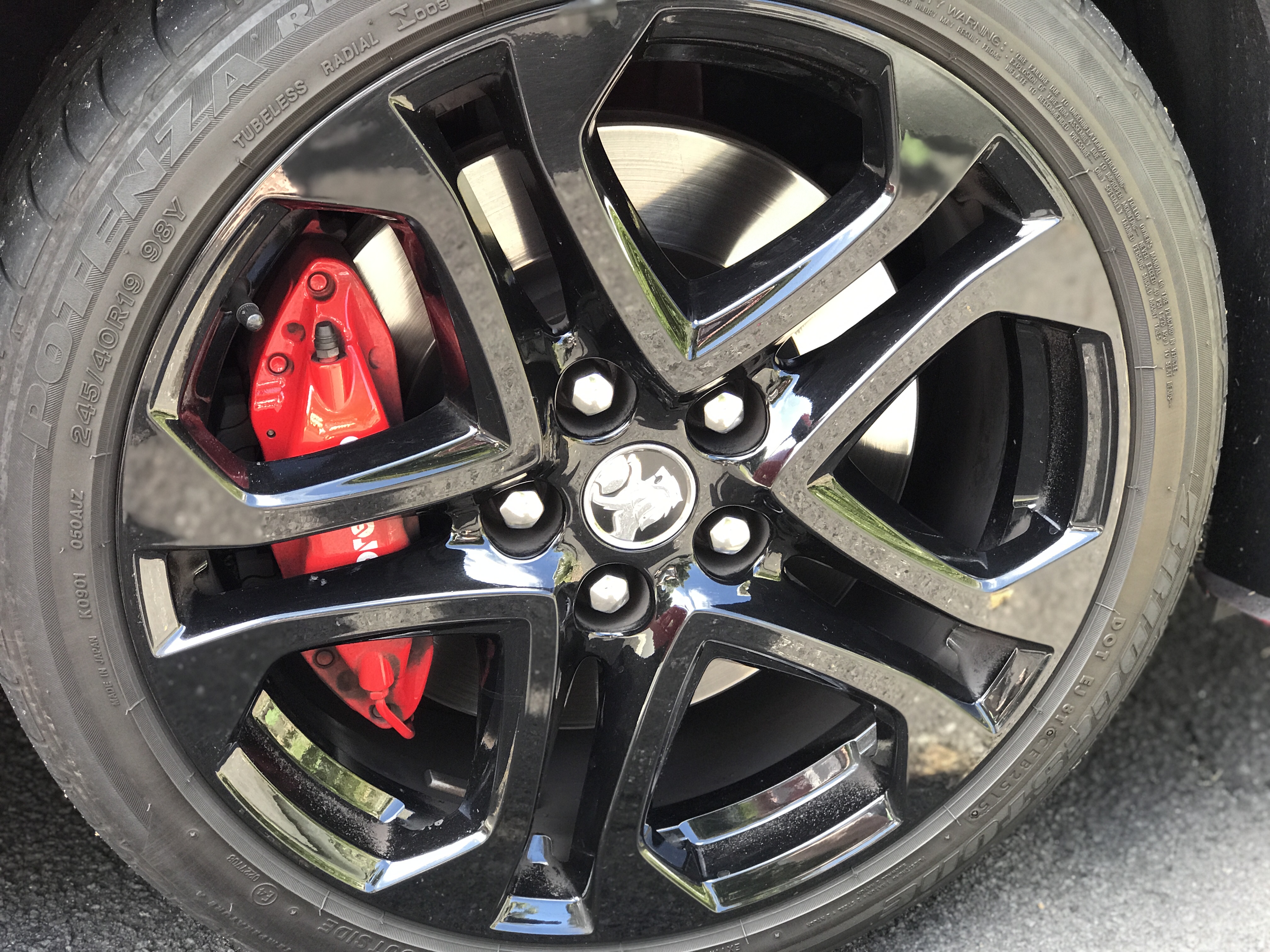
  • There was also a small issue that I had fixed under warranty.  The rear brakes were incredibly squeaky, especially when reversing.  This was fixed very quickly by Holden fitting a spacer to the rear Brembos.  It’s been perfect since then.  And  that’s probably about it for what I don’t like about the Redline.

So, what do I like?

Well, the first thing I have to say is that Holden gave this one a proper exhaust!  An exhaust that any self-respecting petrolhead will nod at and smile.  Similar to the higher spec HSVs, it has a bi-modal version, which basically means you can have it set to “quiet” or “gnarly muscle car” (note – these aren’t the options that Holden list).  I refuse to believe that anyone buys a V8 to use a “quiet” setting (sort of defeats the purpose surely?), but it has one.  You may be unsurprised to know that apart from putting it on to check it worked, I want my car to sound like the muscle car that it is.

One of the best parts about the exhaust is appreciated when you are in overrun – you get some great pops, cracks and burbles out of the exhaust.  It’s that genuine, gravelly muscle car sound that I’ve loved since I was a kid.  Whenever I’m on my own, I can have hours of endless fun accelerating in 2nd or 3rd, taking my foot off the accelerator and just listening to those aforementioned cracks and burbles.

Ok, who am I kidding – I don’t have to actually be on my own in the car.  I do it all the time, no matter who is in the car. I’m one of those potentially annoying people who likes to use the paddle shifts to slow down rather than braking – an unintended consequence of which is even more burbles!  It even pops a couple of times when you start it up, getting my day off to a positive start every time:

As I noted earlier, this car is the LS3 304kw engine.  While that’s nowhere near the top of the range (Walkinshaw can give it 507kw if you have a bit of spare cash) for power and torque, it’s plenty for New Zealand’s roads.  It’ll get you from 0-100km/h in around 5 seconds (not too dissimilar to our Targa 4), and it will do it with a fair bit of noise and muscle.  As well as the nice sounding external exhaust, you get some great sounds from the engine piped into the cabin, enhancing that V8 experience.

The 304kw means that, even with the traction control on, it’s easy to make the rear of the car slip out and get those wheels spinning (not advisable, as the 19″ wheels mean you’ll be forking out a fair old whack on tyres if you do this too often), especially if you apply the power before you’re in a straight line.  If it’s wet, this becomes even more likely.

The Redline comes with big Brembo brakes and black 19″ wheels as standard.  Those all round Brembos mean that as well as getting you up to speed quickly, it will do a pretty tidy job of getting you stopped again.  They look great too, in red.

IMG_8860

It also comes, as many cars do these days, with daytime LED running lights (see below).  I do like the slightly remodelled front end of this compared to the older VE Commodore.  As well as the LED lights, it has some functional brake cooling ducts.  On the bonnet it also has a couple of vents that help cool that mighty V8 that hides below.

IMG_4625

It also has a handy heads-up display with a number of settings.  My preference is to leave it with the speed, the speed limit and the temperature, but there are a number of other options, including revs and g-force.  The main thing for me is to make sure that my heavy right foot doesn’t get me into too much trouble, hence leaving it on this setting. The downside of this, is when I get into the Porsche or my wife’s Golf GTI, I find myself looking at the window for my speed and finding nothing!

IMG_8827

The Australian V8 racing teams who use the Holden have done a decent job of keeping the car look like the road variant on which it is loosely based (as noted in Shane Van Gisbergen’s #97 Red Bull Holden Racing Team Commodore below).  For me, this is part of the attraction of these cars.  You can own a car that is powerful, sounds great and (with a bit of imagination) you could be racing the Supercars guys around Bathurst.

img_8330-1-e1515146040524.jpg
Continue reading “Holden Commodore VF2 Redline – they saved the best till last!”

Tahitian Adventures on the Paul Gauguin

I’ve been meaning to write this review for quite some time now and upon being presented my gold medal for procrastination, I thought I’d best pull my finger out! 


A couple of years ago Josanne threw out a line that it might be nice to spend her next birthday in Bora Bora.  It was a significant birthday (ie ending in a zero) and I thought that this would be a great opportunity to tick off one of our joint bucket list locations.  As such, I set about working out what the options were.

After considerable research, I settled on a 7 night cruise aboard the Paul Gauguin.  I wasn’t entirely convinced that we were of a sufficient age to do a cruise, but everything I read suggested that this one would suit people of all ages and that the ship was small enough to remain personal, unlike some of the larger 2-3,000 passenger ships that I regularly see docking in Auckland.

The Paul Gaugin, named after the famed French artist who spent a considerable time in French Polynesia, is small (catering for a mere 332 passengers).  This results in a personal, somewhat intimate experience where the crew even learn your name.  They can’t do enough to ensure that you get total value for money on board this floating 5 star hotel / restaurant.

The package included accommodation, food and alcohol (and to be perfectly honest, when you look at what it would cost to stay in a hotel on Bora Bora, it works out to be very cost effective by comparison). We booked a basic cabin (portholes and no balcony), but as you can see, it was perfectly acceptable.  We didn’t spend much time in it anyway!  The beer and soft drinks in the fridge were topped up daily.

cabin

To ensure we were there for departure, we arrived the day before, spending the night in Central Papeete (we wanted to eat at the waterfront food trucks that we’d heard so much about) and at the Intercontinental close to the airport on the final day.  This worked really well for us.

We had to laugh at ourselves on the first night on board.  Being novices, although we knew the package included alcohol, we weren’t sure if it was all alcohol or just the cheaper brands.  To determine which of the two it was (without having to look stupid by asking) I ordered us two Bombay Sapphires (they also had Gordon’s on the shelf). The barman cheerily made these, handed them over and didn’t ask for our room number!

Result! We now knew that all alcohol was included in the cost.

Finding this out was really useful and we instigated cocktail hour every night before dinner.  The downside of cocktail hour is that I now know that I’d make a rubbish James Bond.  The only martini that I didn’t like was the vodka martini (ordered shaken not stirred of course)! The chocolate martini or apple martini on the other hand……

We’d initially worried that (relatively speaking) we could be the only “youngsters” on board.  We needn’t have worried.  There was an eclectic mix of ages and nationalities.  Yes, there were some older people (who knew full well that they could order anything from the bar), but there were also honeymooners and other younger couples celebrating special occasions.  We still keep in touch with a great couple we met from Sydney (Hi John and Priscilla Gregory if you’re reading this!).

At the end of our week, I discovered the only downside of cruising was weight gain!  The food on board was exquisite, rich and decadent (unfortunately there’s a 4th adjective directly related to the previous three – calorific). At home, we never eat three large meals a day.  On board I felt obliged to.  And afternoon teas. And beer. And cocktails. And….. well, you get the picture.

There is a gym on board.  I know this because I made a point of finding it on our first day.  And then walked past it every single day without actually going in!

You had to book for dinner in two of the three restaurants.  The third was where we ate most nights (because I kept forgetting to book!).  You can also choose whether to eat on your own (i.e. a table for two) or with a larger group.  I recommend the latter, as we met loads of great people that way.  One of the restaurants did a beautiful degustation menu.  It was heavenly.  Looking back at my weight gain though, I’m very glad we only did it once (surprisingly, I remembered to book for it!).

At mealtime, there were a couple of choices of red and white French wines included in the price.  If you wanted, you could choose wine from the menu.  This was the only time that you needed to pay for alcohol.  The wines supplied as part of the package were perfect though.

After dinner entertainment consisted of a small casino, a theatre that put on shows,  karaoke in one of the bars (which I stayed well clear of), and themed evenings. We’d generally meet up with friends and just have a drink in one of the bars.  I’m fairly certain that I’ve tried just about every cocktail known to mankind as a result!


Each night when you left port, most passengers made their way up to the main deck where cocktails were served.  Not only was this great for catching up with people, but you got some great photos.  It was also how we tended to meet up with whomever we were going to have dinner with (necessitated by yours truly not booking.  I’m sure you’re getting the picture by now).

So I’ve talked about the cabins, the food, the alcohol, the outstanding staff.

What about the location? Was it worth it? Would I recommend it to anyone else?

I can only answer with an emphatic Yes, Yes and Yes.

Our itinerary took in the islands below (I’ve taken this directly from Paul Gauguin’s website).  The order in which we visited them changed slightly as the captain moved one destination as there was a large cruise ship that would have been in port at the same time as us.

cruise-map

We started in Papeete, moved to Taha’a, followed by Huahine, Bora Bora and Moorea.  We did excursions in each port (you do have to pay for these, but you choose what – if any – you are going to do).

Our first stop was to the Paul Gauguin owned island of Motu Mahana off Taha’a.  We spent the day, or as much time as you wanted to, there.  Lunch was an extensive barbecue with  plenty of cold beers and cocktails to get us through.  After the exhaustion of lounging about, we deserved a cold beer if nothing else!

motu-mahana
The changes in the colour of the ocean are exquisite; from dark blue to bright turquoise.  This is the tender taking a group of people to Motu Mahana.

tahaa-from-the-tender
The view approaching Motu Mahana from the tender.

Lots of the passengers tended to congregate on the main beach area on the island, but if you walked around to the other side, you had the place almost entirely to yourself:

motu-mahana-panorama
A panorama from the other side of Motu Mahana.

tahaa-beach-chair
Clearly no need to fight for this deckchair!

tahaa-palm-tree
Sorry about the third person in the ocean here.  We arrived at rush hour.
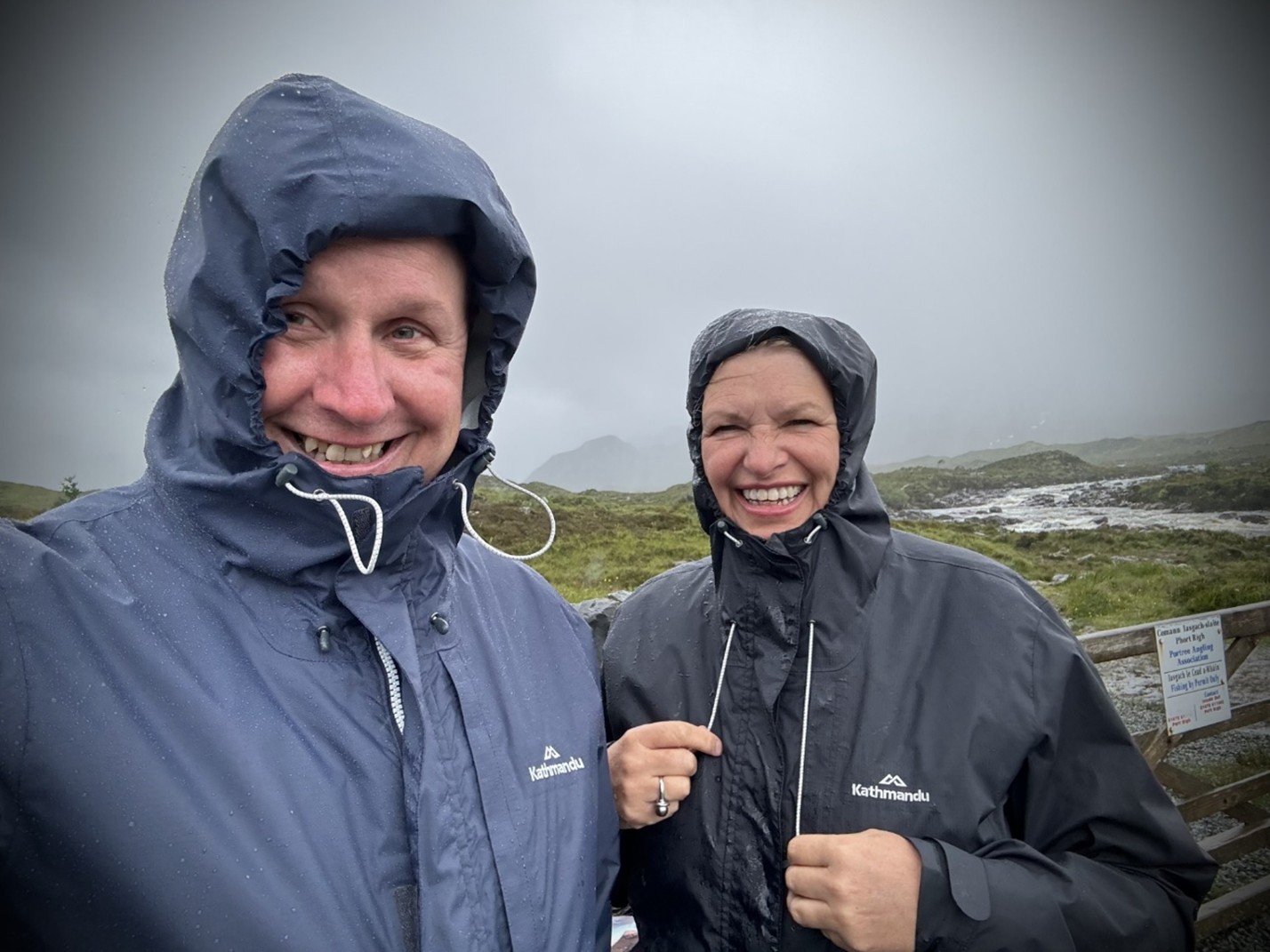
After spending the day on Taha’a, it was back to the ship to head off to our next destination – Huahine.

One thing to be remembered is that you are in the Pacific.  You don’t get the greenery of the islands without rain.  So while you can have glorious days of hot, humid sunshine, you can also get some impressive bursts of rain.  The panorama below shows one of these downpours as we left Taha’a.  As we were back on the ship, it didn’t affect us at all – other than having to have our cocktails indoors (such hardship)!

leaving-tahaa-to-some-rain

Another of the benefits of this cruise is that most of the sailing is done at night, meaning that you have access to the islands for most of the day when you’re in port.

On Huahine we did a trip out to see one of the Tahitian black pearl farms.  While Josanne didn’t buy a pearl there, she did get round to buying one in Bora Bora. It was supposed to be made into a ring. Supposed to being the operative word.  I’m sure she’ll get round to it at some point (a bit like me getting round to writing this review).

huahine-island


We also went inland and fed some blue eyed eels.  The guide used a tin of tuna and this got them right up out of the water eating it.

As is the way, cocktails on leaving Huahine enabled us to get some nice photos.  It had started to cloud over, so we missed the sunset.

huahine-leaving
People actually lived on this tiny island!

Our next stop was what the trip was all about – Josanne spending her birthday on Bora Bora!

It has to be said that if you don’t have Bora Bora on your bucket list, you need to move something off of it and put it on.  I’ve been to a number of the Pacific Islands and Bora Bora easily surpasses all of them for beauty, cleanliness and for what I can only describe as pristine turquoise waters.  And believe me, my description does nothing to describe the genuine beauty of those waters.  It really needs to be seen to be believed.

As we spent a couple of days in Bora Bora, we did three excursions; two of which involved feeding sharks and stingrays, the other dolphin and whale watching (we got lucky with the latter as it was the end of the season and most of the whales had already headed back south with their calves).

bora-bora-sea
Have I mentioned the clear, turquoise waters at Bora Bora yet?

The first experience of feeding sharks and stingrays ended up with me getting into trouble (without even trying).  I apparently got too close to the sharks when they were being fed.  As my head was under the water, I was oblivious to my telling off.  That said, given how the sharks were fed the next day at the Lagoonarium, I suspect that the guide was taking Health and Safety way too seriously for a Tahitian!

I’d bought a cheap underwater camera off Trade Me (big mistake – it stopped working on day 1!), but thanks to John Gregory with his GoPro, we managed to get some underwater shots of the sharks and rays:

bora-bora-sharks-and-rays
The sharks are more wary than the rays, which will crawl all over you to get fed.  Photo thanks to John Gregory.

bora-bora-swimming-with-sharks
Photo thanks to John Gregory

feeding-stingrays
I managed to get this photo from above the water

black-tipped-reef-shark
As soon as the boat got close, sharks started coming in.  They clearly knew they were going to be fed.

Later that day we went dolphin and whale-spotting.  It didn’t look like we were going to see any whales when suddenly a shout went up that a mother, her calf and another male were in the area.  In the end, they came up right next to our boat.

moorea-whale-watching-2
The weather had started to turn for the day and most of the way back we were in the rain (warm rain though) and getting over the reef was like a big aquatic roller coaster!

moorea-whale-watching
With a wave of the tale, these whales were off to join the others, heading South.

On day 2 in Bora Bora, we decided to visit the Lagoonarium.  This has a number of sharks  in a more enclosed area.  You get in at one end and snorkel up to the other while one of the guides throws great chunks of fish in.  The sharks are swimming around and under you (the water is deeper here) and if I’d had an underwater camera, I’d have got some great photos.  Next time!

bora-bora-lagoonarium-2
That’s me in the blue shorts, sending out vibes about how bad I’d taste. Just in case.

We left Bora Bora that night and headed to Moorea – the last stop on the voyage.  I had the tick in the box for Josanne being in Bora Bora for her birthday though.  I think my brownie points for that will have expired by now.

bora-bora-panorama
A breakfast-time panorama of Bora Bora from the Paul Gauguin.

leaving-bora-bora
Cocktail in hand, taking photos of the sun going down as we headed off from Bora Bora.

leaving-bora-bora-2
A small spot of sunshine striking the water as we headed for Moorea.

There was some heavy rain during the night after we left Bora Bora.  This meant that the planned excursion we had for the next day (4WD driving to some spectacular spots for taking photographs) was cancelled, as it was too muddy for even the 4WDs.

moorea
The view of Moorea as we headed in on the tender.

As the weather had cleared up, we decided to take the tender ashore and walk up what was known as Magic Mountain.  How hard could that be in 30C heat and 95% humidity?!

It was very hot and very sticky. Once we’d finished, we decided to head back to the ship for a shower, lunch and a cold beer.

I’d ordered a couple of cold beers from one of the waiters, had grabbed my food and was back eating it at the table.  I was busily thinking that Josanne was taking a very long time at the buffet when the waiter came up and quietly said “Mr Kevin, have you fallen out with Miss Josanne?”.  “No“, I smiled “what makes you think that?”. He smiled back and pointed to the other side of the dining room “Well she is sat having her lunch over there with two beers“!  After joining her, I was forced to drink three of the four beers we’d collected.  It was one of the few times I made time for an afternoon nap!

You’ll note that the waiter actually knew our names.  The crew, most of whom were from the Philippines, took the time to learn your name and they’d greet you wherever they saw you on the ship.  I was Mr Kevin for the duration.

moorea-magic-mountain
Magic Mountain – we met some tourists at the top who thought we were mad for having walked up.  They may have had a point, but I had plenty of weight to lose!

While it was a hot, sticky walk to get to the top, we did get some great views once we were there, so it was worth it.

moorea-sun-out
Moorea from Magic Mountain

moorea-from-magic-mountain
Looking down at the Paul Gauguin from Magic Mountain

And that was the last of the excursions.  All that was left was one more cocktails hour (or two), one last delicious meal and a night of sailing back to Papeete, where we’d spend a night at the Intercontinental before heading back home.

So what do I think about the experience?

I loved it. I discovered I’m not too old to cruise and neither is anyone else.  As with any holiday, you’ll meet some neat people.  I’d also do it all again.  The crew on the ship really helped make the experience – always smiling, always asking how you’re enjoying it, always representing the Paul Gauguin impeccably.

If you’re thinking of a cruise in the Pacific, you should definitely consider this one.

What were my “must do’s“?

  • The shark and stingray feeding.  It’s an exceptional experience.  As they are black tipped reef sharks, you’re fairly safe (I wouldn’t advise doing it with Great Whites though).  If you can only do one – do the Lagoonarium.  A Tahitian throwing great chunks of fish to the sharks as you snorkel is a fantastic experience.
  • Whale and Dolphin watching – even the inclement weather couldn’t spoil this day.  We were so pleased to have seen dolphins and whales, and the rollercoaster ride over the reef on the way out and back topped it off!
  • Take an underwater camera.  You’ll get some great photos from it.
  • Take some gym gear.  Oh, and use it.  I took gym gear and didn’t!  The food is too good not to indulge, so if you visit the gym at least you can legitimise it!


The Tongariro Crossing

While there are definitely issues living on an island that’s earned its place on the planet as a direct result of tectonic activity, there are also advantages for those very same reasons.

The Tongariro Crossing, New Zealand’s internationally acclaimed one day walk is one of the advantages.  If you’re reasonably fit and want to take in some stunning volcanic vistas, you should take the time to do it.  It’s not noted as New Zealand’s best one day walk by accident.

14039991_10154519194758631_6566129348236059803_n
Mount Tongariro from National Park Village.  Even in summer it is snow-capped

If you’re reasonably fit and can walk for up to 7.5 hours, you can do this.  Without any add-ons (i.e. the summits of Mounts Tongariro or Ngauruhoe), you’ll finish the day having walked around 18km.

It is weather dependent.  If the forecast suggests wind speeds in excess of 65kmh, the Department of Conservation recommends that you don’t do it.  The top is very exposed with big drops on either side of Red Crater.  You also need to be carrying food, water and clothing for all eventualities.  It’s an alpine region where the weather changes quickly and with little warning.

The map below provides an overview of the track (marked in red).  It’s taken from the www.tongarirocrossing.org.nz website.  They also have a good pdf you can download, giving you all the information you’d need for the walk.

tongariro-crossing

Many people do the Crossing from Taupo, itself an impressive caldera from an ancient supervolcano.  You can book transport from Taupo (most hotels and motels can help with that), however, it is a longer drive to get there, necessitating setting off very early.  There is plenty of accommodation in Taupo.

An alternative is to base yourself in National Park.  While there’s less to do here, and accommodation is limited, it’s significantly closer to the walk (only around 20 minutes by bus rather than 1.5 hours).

I’ve done the walk from both locations and think that the more relaxed starting time associated with National Park suits me!

Stages of the walk

You should start at Mangatepopo and finish at the Ketetahi hut end.  Firstly, I’d hate to come up the scree slope at the Emerald Lakes and secondly; if you start at Ketetahi Hut, you have an additional 300m to climb due to the difference in height between the two.

For simplicity, I’ve broken the stages of the walk into sections.  My advice is not to rush it.  Stop often. Enjoy the scenery. Take lots of photos – they’ll give you some stunning memories!

Mangatepopo carpark to Mangatepopo hut

The bus (you can use your own transport, but need a vehicle at the start and finish) drops you off at the Mangatepopo carpark.

This easy section of the track, some of which is over boardwalks, is flat and unlikely to cause you any difficulties. It takes you towards the initial climb, fondly referred to as the Devil’s Staircase.


Mangatepopo hut to Soda Springs

On reaching the Devil’s Staircase (which begins at the Mangatepopo hut), the upwards hike begins, and at this moderate to difficult stage your lungs and legs start working noticeably harder!

Dont forget to keep looking back.  On a clear day, you can see Mount Taranaki in the distance – although you’ll need a decent camera to get a photo of it.  While the track is much better than it was several years ago, you still need to watch your footing.

Soda Springs to Red Crater

Once at the top of the Devil’s Staircase, there’s a well appreciated flat section. It’s a good time to take a breather, get some water in you and take more photos.  You’ll start to appreciate just how many volcanic craters make up this plateau!  The last part of the climb to Red Crater is moderate to difficult, but the plateau itself (seen below) is easy.

jo-top-of-devils-staircase
Platuea at the top of the Devil’s Staircase.  There are plenty of opportunities for unobstructed photos of Mount Ngauruhoe (Mount Doom, if you’re a Lord of the Rings fan).

kev-jo-and-ngaruhoe_edited

You can take a side trip up Mount Ngauruhoe from here.  I’ve never done it, but the views from the top would be stunning.  Access to Ngauruhoe is via scree slopes, so it’s dangerous and hard work.  Allow two hours extra if you’re doing this.

west_from_tongariro
Looking back towards top of the Devil’s Staircase (Mount Taranaki in far distance).  

img_2718
Nearing Red Crater showing how steep the climb is.

img_2721

It would be nice and peaceful without all these fellow trampers about! 🙂

You’ll definitely want to stop at the top, not just to recover but for more photographs.   Red Crater is an active part of the volcanic system (last erupting in 1850).  As you progress over the summit you’ll see evidence of some of its volcanic deposits from eruptions down to the left.  Inside the crater you can see an exposed lava tube, formed when cooling lava flowed back into the crater:

img_2724
Lava tube sticking out to the right of the crater.  

Red Crater to Emerald Lakes

This moderate section is one of the most beautiful parts of the walk.  Standing at the top of Red Crater, looking down to the Emerald Lakes for the first time is fantastic.

Then comes the scree slope descent!  Having good walking boots helps keep you on your feet and off your bum.  That said, even with boots I’ve yet to make it down without landing on my bum!

img_2734
Emerald Lakes from Red Crater.  People heading down the scree slope and the track on the left towards Blue Lake.

emerald_lakes_5
Note the steam coming from the right of the lakes.

We usually stop at the Emerald Lakes to have lunch.  It’s an early lunch, but you’ve done enough walking to warrant it!  It’s a nice spot and is generally out of the wind.


img_2740
A popular spot for lunch and getting stones from the scree slope out of your boots!

img_2737
Looking up the scree slope to Red Crater.  

Emerald Lakes to Blue Lake

img_2752
The Blue Lake – this area was once molten lava, 1km across.

This is another fairly flat section.  Once at Blue Lake look behind you.  You’ll see the trifecta of Mounts Tongariro, Ngaurahoe and Ruapehu (with snow on it even in summer). Red Crater is also clearly visible. It’s my favourite photograph spot of the entire walk:


img_2743
From Blue Lake you see Tongariro (and Red Crater), Ngauruhoe and snow-capped Ruapehu in the background.  Note the lava field from Red Crater to the right of the photo.

Blue Lake to Ketetahi Hut

The descent starts here as you zizag down the mountain.  The toilets at Ketetahi Hut are busy (I often wonder if it’s just an excuse for a quick break!).

taupo_fm_tongariro
Lake Rotoaira (foreground) and Lake Taupo (background).

As you descend, you get great views of Lake Rotoaira and Lake Taupo.

Ketetahi hut to Ketetahi carpark

I’ll not lie – this moderate downhill stretch seems to last forever (it’s around 2 hours but feels longer).  There were many times on the descent when I’d have gladly swapped the downhill for more uphill.  When you get to the carpark, it’s a great feeling to get your boots off and wiggle your toes in the fresh air!

In Summary

This really is a highly recommended, outstanding one day walk, exposing you to some of the volcanic beauty of the central plateau.  It’s not easy – you’ll deserve a beer and feed at the end – but neither does it require superhuman fitness.

The walk itself is free, although you have to pay for transport to get you there.  The cost of this depends on where you’re coming from. If you have a car, I’d suggest you stay at National Park for a couple of days.
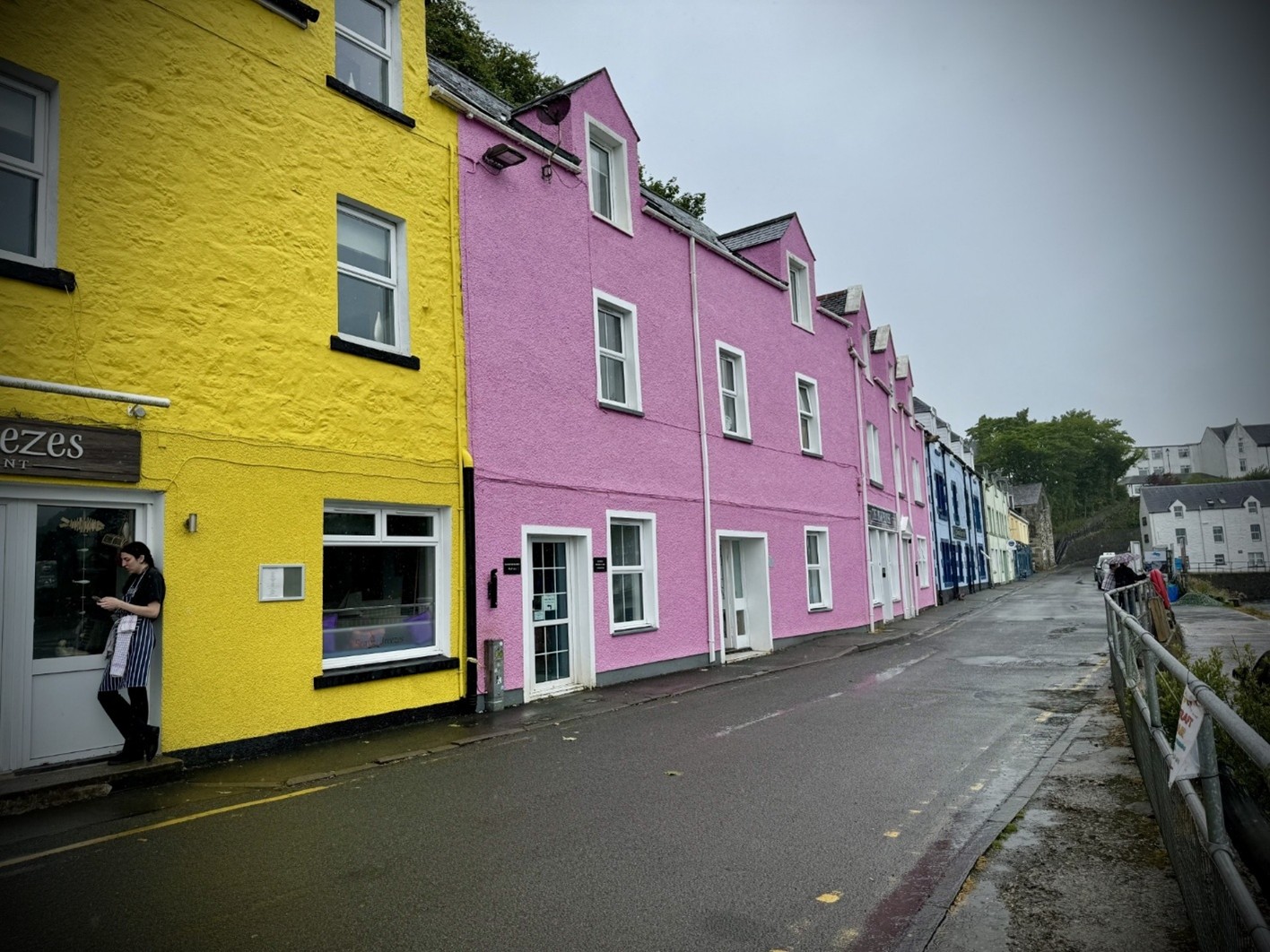
On both occasions our motel provided packed lunches.  We topped it up with snacks that we wanted and 2 litres of water.

On a clear day, the views are spectacular and well worth getting up early for!  You’ll struggle to find a better one day walk in the world, never mind New Zealand!

Helpful Hints

  1. Go out of main holiday periods (i.e. Christmas) if possible – The last time we went was just before New Year and it was very busy (albeit not enough to ruin your enjoyment).
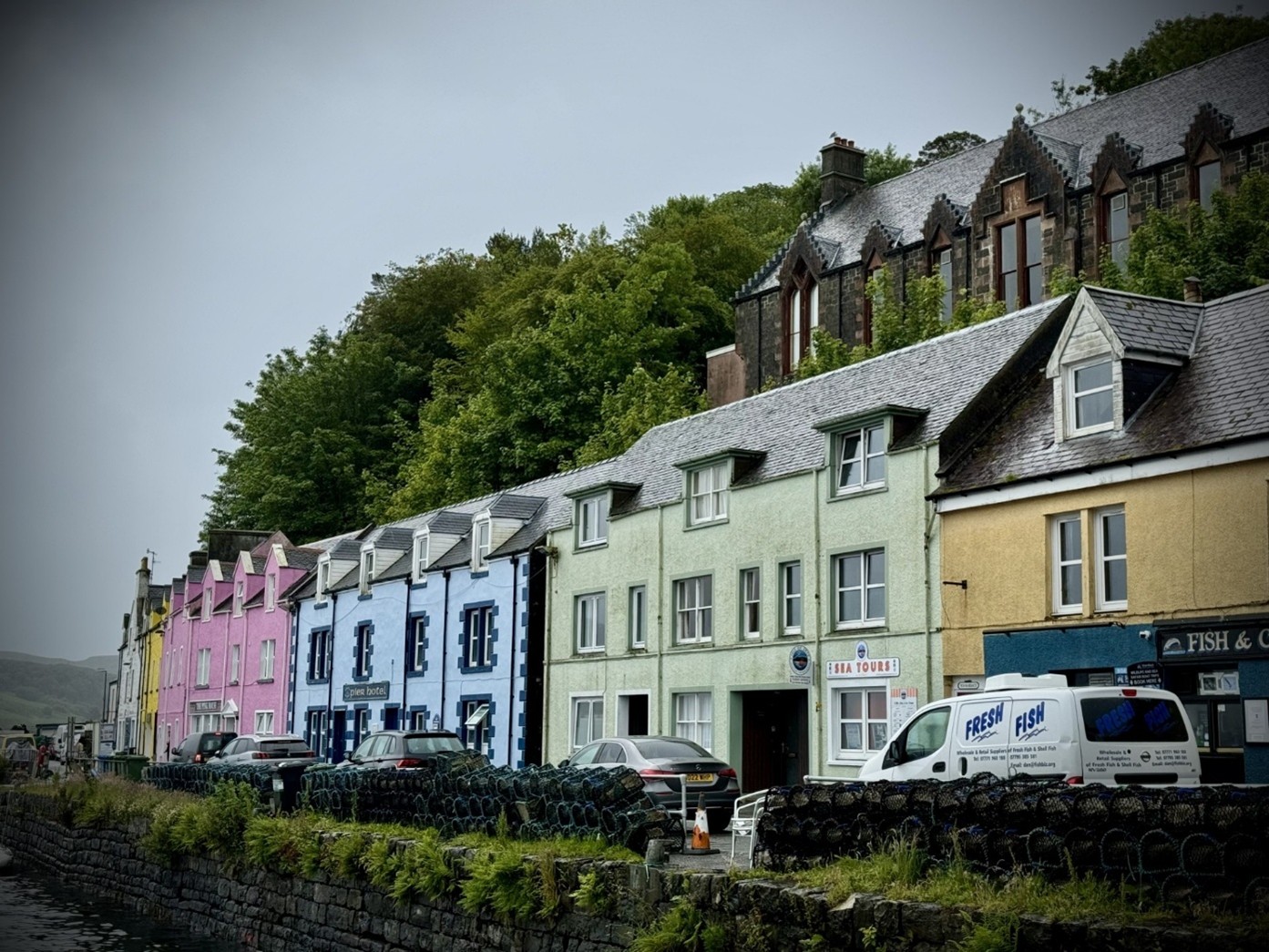
  2. Water. Take 2 litres. Don’t skimp on it or you will regret it.
  3. Food. Take a packed lunch.  You’ll be doing upwards of 30,000 steps so as well as keeping hydrated, keep yourself fuelled.  It’s great to have little snacks that you can have when you stop to enjoy the view.
  4. Altitude.  Although you only get up to 2,000m, it’s high enough to make you notice that the air is thinner (harder to get your breath) and it’s cooler than at sea level.  Make sure you take waterproofs and warm clothing.
  5. Feet. While I saw people doing this in trainers, I’d suggest strong walking shoes or walking boots.  It’s easy to go over on ankles in some places. I wouldn’t do it in trainers.
  6. Sunblock. Even if it’s not hot, apply plenty of sunblock.  The UV in New Zealand is lethal and there’s very little shade for you on this walk.

Quick video of my last Tongariro Crossing

The last time I did the Tongariro Crossing, I made a quick video (disclaimer – I’m never going to be in the film industry with my cinematic skills). It gives you an idea of some of the views you’ll get on this walk though. Click here if you’d like to see it.


Egypt – impressive land of contrasts

Egypt is a land of startling contrasts.  Isolated, arid deserts and fertile river floodplains.  Polluted, congested cities and unspoiled, desolate riverbanks.  Illegally constructed buildings, likely to topple at the first suspicion of an earthquake, and Pyramids and temples that have withstood all that nature has thrown at them for over 5,000 years.

Egypt continues to mesmerise travellers, hundreds of years after the first tourists turned up to inspect the centuries old legacy of the Pharaohs.

Our 10-day Egypt tour with Peregrine Adventures took us from Cairo to Aswan and back again, providing an insight into the ancient Egyptian psyche and unravelling the mysteries of this ancient civilisation.

egypt-map

For me, the trip had four highlights;

  • The Pyramids,
  • Karnak Temple, a cultic centre of worship of the God “Amun-Re” (built on 2 axes, covering over 100ha),
  • The Valley of the Kings, where many Pharaohs were buried, and
  • Abu Simbel, Ramesses II’s rock cut temples on the banks of Lake Nasser.

Arriving in Cairo, you know you’ve stepped into something special.  Never before have I experienced a rubbish dump in the middle of a city, surrounded by people’s homes, with pigs used as mobile mulchers.  Nor have I seen so many people living in a cemetery, in a suburb known as the City of the Dead.  Yet neither have I been in a city where I have felt entirely safe, where the locals are incredibly friendly (if slightly over curious!), where the roads are as busy at midnight as they are during the morning rush-hour, and where you are guaranteed an experience that you can only get rummaging about in the shadows of such an ancient civilisation.

Cairo’s roads cannot be judged by New Zealand norms.  One taxi driver took great delight telling us how safe he was and that he had never crashed his car.  The rolls of sellotape holding both of his wing mirrors together suggested that he was being at least slightly economical with the truth, but we jumped in anyway.  His taxi looked no worse than any other in the vicinity!

Cairo and Giza’s combined population of 22 million put Auckland’s traffic congestion into perspective.  They have minimised gridlock by having few lane markings and negligible numbers of traffic lights.  These omissions enable seven or eight cars abreast to fit in a space that, in New Zealand, would comfortably hold four.

Egyptians communicate energetically via their horns.  A single honk can mean anything from “get out the way” to “if you just squeeze slightly to the left, I can get my car between you and the pavement without having to mount it”.  Remarkably, Caireans have an innate understanding of what each honk means and whether or not it is directed at them – particularly impressive when you understand that most drivers are frantically honking most of the time.

Our official tour began with a visit to Memphis and Saqqara near Cairo.  Here you start learning the importance of ego to the ancient Pharaohs.  The enormous statue of Ramesses II is a great example of how these ancient kings viewed their importance and self-worth:

Memphis Open-Air Museum - 4/7/07
Statue of Rameses II at Memphis

Saqqara boasts Djozer’s Step Pyramid, a predecessor to its more famous neighbours at Giza.  Dating to around 2630 BC, it started as a single bench (or mastaba), but grew to a total of six mastabas placed on top of one another by the time he died.

Djoser's Step Pyramid Complex - 4/7/07
Djozer’s Step Pyramid (circa 2630 BC)

If the Pyramid’s size and surroundings are not sufficiently impressive, knowing that it has stood for almost 5,000 years certainly gives you a sense of how well things were built in those days!

Djoser's Step Pyramid Complex - 4/7/07
Entrance to Djozer’s Step Pyramid Complex (as seen from the inside).

Giza’s Plateau (home of the Pyramids and Sphinx) is equally impressive.  It is truly fascinating, and somewhat humbling, to examine the Pyramids and to consider the workers who toiled so hard to complete them.  It is even more fascinating and equally humbling to think that, had we been about in their heyday, we would never have been allowed in the inner sanctuaries that we were being guided through.  It is perhaps most fascinating, though not at all humbling, to walk around the corner from these structures and find a KFC, a Pizza Hut and a fake Hard Rock Café!  I guess that’s progress for you!

Khafre’s Pyramid is most impressive, with its limestone cap and Sphinx, although Khufu’s is the oldest of the three on the Plateau.  The splendour of the area is tempered by the litter left by tourists; sadly typical of many Egyptian tourist sites.

Giza Pyramids - 5/7/07
Khafre’s Pyramid, with its limestone cap intact.

Sphinx - 5/7/07
The Sphinx with Khafre’s Pyramid in the background.

Giza Pyramids - 5/7/07
The Pyramids of Khufu, Khafre and Mankaure (l to r).

Khufu’s Solar Boat museum was also worth a visit.  Not only was the air conditioning a welcome relief from the oppressive July heat, but the 3,000 year old boat, believed to have been used to take the dead Pharaoh to his Pyramid, was very impressive in its own right.

Solar Boat Museum - 5/7/07
Khufu’s impressive Solar Boat.

From Cairo, we headed south to Luxor by sleeper train; an experience I’d recommend trying no more than once, if you want a decent night’s sleep!

Once in Southern Egypt, you are coming forward in time and many temples in this area were still being added to in Roman times.

Approaching Karnak Temple by horse and cart at 7.30am, the increase in temperature compared to Cairo was immediately evident.  Indeed, it wasn’t unusual for temperatures to reach 48C.

So much is packed into the 3,500 year old sprawling temple complex, including the 134 columned Hypostyle hall.  Commenced in 1390BC, the hall was still being decorated some 177 years later.  Imagining such sustained construction nowadays is a real challenge.

Karnak Temple - 6/7/07

Western entrance to Karnak Temple through an avenue of ram-headed sphinxes.

Karnak Temple - 6/7/07
Karnak’s Hypostyle Hall.  The post and lintel hall was originally illuminated by high windows, as seen at the top of the photograph.

The Hypostyle hall’s 134 columns leave you with a sense of enduring admiration for their craftsmen.  The undersides of some lintels still retain much of their original colour; vivid hues of red, yellow and blue.

Karnak Temple - 6/7/07
The colour that remains on some of the lintels is very impressive!

The temple still retains two of its original six obelisks, one of which was built by Hatshepsut, the first female Pharaoh (who reigned as if she were a male). The other was built by Thutmose III, Hatshepsut’s stepson.

Karnak Temple - 6/7/07
Obelisk at Karnak Temple.

It was disappointing to leave Karnak Temple, as we could have spent several more hours exploring.  Our disappointment was soon forgotten on arriving at the Valley of the Kings, however.  A huge area on the West Bank of the Nile, this was the burial ground for Pharaohs, Queens and Nobles from around 1500BC.

Our day got underway with a dawn balloon trip, taking in the spectacular vista before the inevitable crowds descended.  The peacefulness of sun-rise at 1500ft in near total silence totally justified the US$95 per person cost.

Valley of the Kings (Hot Air Balloon) - 7/7/07
Sunrise from a hot air balloon over Luxor.

Valley of the Kings (Hot Air Balloon) - 7/7/07
The views were impressive….

Valley of the Kings (Hot Air Balloon) - 7/7/07
….and helped to understand the overall scale.

Following an inch-perfect landing, we were bussed to the Valley of the Kings, where our entry fee entitled us to explore the resting places of three Pharaohs.  Our guide showed us to those of Ramesses IV (a simple, early style tomb with vivid, colourful scenes on the ceiling) and Merneptah (a more intricate tomb with a much steeper entrance).  For our third, we walked to the far end of the Valley to the temple of Thutmosis III.  This was a fascinating, if somewhat claustrophobic, tomb with simple wall paintings depicting instructions for the Pharaoh’s progression to the afterlife.

Although this tomb did not boast the vivid colours of the other two we visited, it was certainly my favourite.  Unfortunately, no photography can be carried out within the tombs, as this can damage the paint.

Valley of the Kings (Sesostris III) - 7/7/07
The climb leading to the tomb of Thutmosis III

On the opposite side of the hill from the Valley of the Kings lies the Mortuary Temple of Hatshepsut.  Designed to legitimise her right to rule, much was made of her feats, including trading voyages that she oversaw to neighbouring countries.  Most of Hatshepsut’s images in this temple were destroyed by those who came after her.

Hatshepsut's Mortuary Temple - 7/7/07
Dug from the limestone cliffs, Hatchepsut’s Mortuary Temple is very impressive, although in its heyday, there would have been significantly more greenery around it.

Valley of the Kings (Hot Air Balloon) - 7/7/07
Seen from above, it is clearer to see how it was dug into the limestone.

Hatshepsut's Mortuary Temple - 7/7/07
Soldiers marching in honour of Hatchepsut at her mortuary temple.

Many Egyptian tours include a trip on the Nile.  Not wanting to “rough it” in a felucca (a small sail boat that has been in existence for centuries in Egypt), we opted for a cruise style ship, the Atun, instead.  There are many such ships, with varying degrees of luxury. Peregrine’s choice in ship (not to mention their outstanding guide Big Mo) was excellent and made for a very relaxing three day cruise, during which we took in temples at Edfu, Komombo and Philae.  The cruise provided an excellent opportunity for relaxing and watching life on the Nile.

Philae Temple was possibly one of the most impressive to approach.  Built for the God Isis, it was relocated following the building of the Aswan High Dam.  The island on which it was originally located is now underwater.

Philae Temple - 9/7/07
Approach to Philae Temple.

Philae Temple - 9/7/07
A closer view of the Temple.

The Romans continued to add to Philae Temple and Trajan’s kiosk, built to embellish existing features of the temple, is a great example of this.  It demonstrates that some of these Pagan temples were used until fairly recently.

Philae Temple - 9/7/07
Trajan’s Kiosk.  Built by the Romans at Philae Temple.

Our final destination prior to returning to Cairo was Abu Simbel.  Here we visited 2 temples; the larger one celebrating the great Pharaoh Ramesses II, the other celebrating his most famous wife, Nefertari.  Like Philae Temple, both of these were cut and moved to higher ground due to the Aswan High Dam.  Had they not been moved, they would currently be submerged.

Ramesses demonstrates the extent of his ego through his four seated statues (that are as tall as a five to six storey building) and through the depiction of him being an equal with the three Gods with whom he is seated in the inner sanctuary.

Abu Simbel - 10/7/07
Temple of Ramesses II at Abu Simbel. A long minibus ride to get here, but well worth the effort.

Abu Simbel - 10/7/07
Temple of Queen Nefertari at Abu Simbel.

Ramesses II had around 110 children and probably lived into his 90s.  Given that he spent the first 20 years of his Kingship at war building his empire; it seems surprising that he also had the time to be one of the most prolific builders of all the Pharaohs.

Having finished in Southern Egypt, it was time to return to Cairo for a final couple of days sight-seeing. It didn’t take long to get back into the clamour of Cairo life.  After the heat of Southern Egypt, the cool 38C of Cairo almost felt civilised!

As I said at the outset, Egypt is a land of startling contrasts.  It is precisely these contrasts that ignite your senses, guiding you back to early Dynastic times, immersing you in a history that is very hard to imagine without being there.  I suspect that Egypt will still be mesmerising travellers such as me in another 5 millennia, with the wondrous legacy of the Pharaohs.
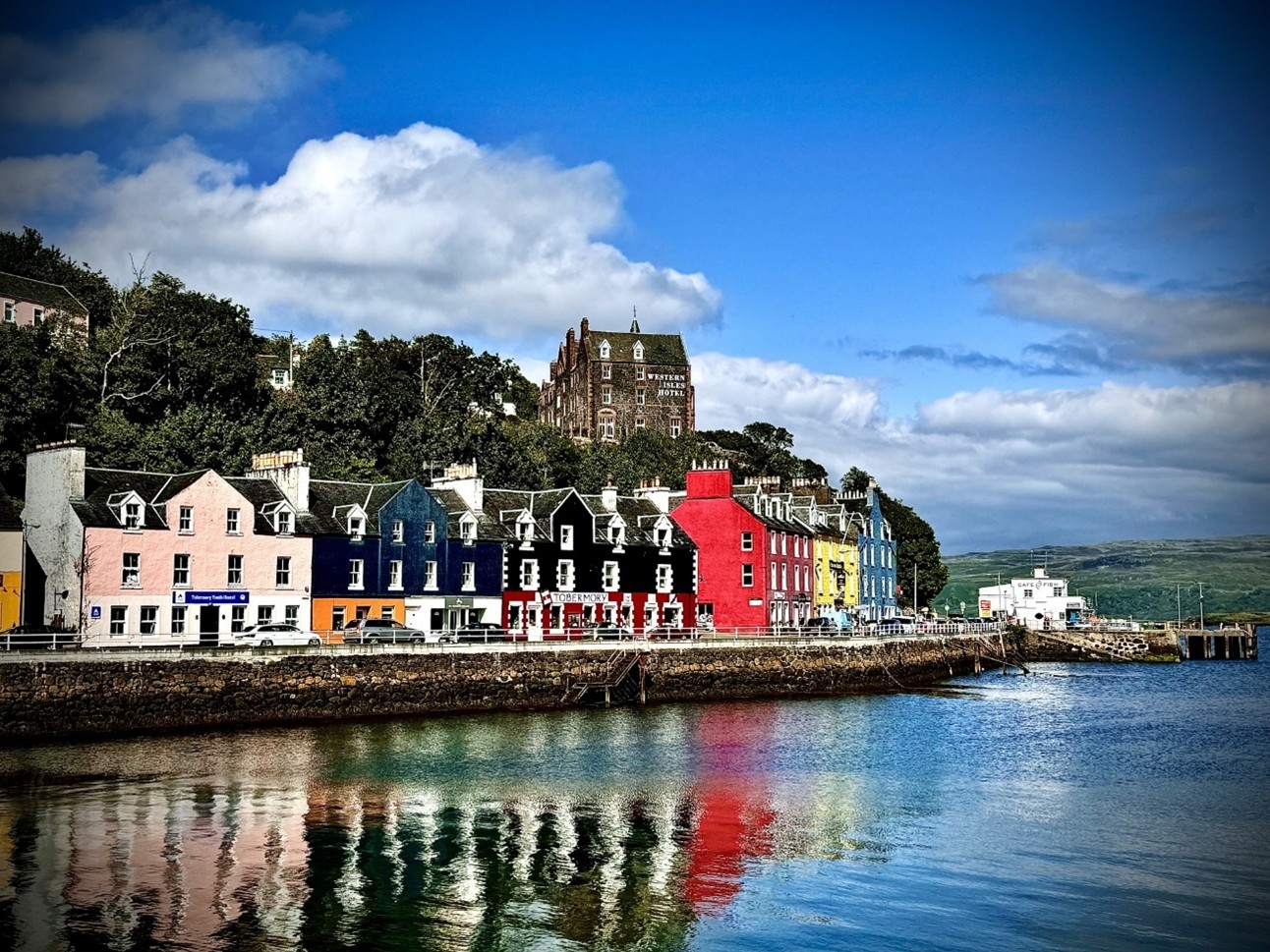
Tips.

  • Haggle for everything including taxi rides.  It’s fun, it’s expected, and you’ll get ripped off if you don’t!
  • Tipping (or “baksheesh”) is a way of life in Egypt.  You will be expected to tip everywhere you go.  Ensure you accumulate lots of small notes (i.e. EG£1, which is around 25c).
  • Be prepared for the heat if travelling in July / August.  This will result in some very early starts on your excursions.
  • Don’t eat fruit or salad if you have not washed them yourself with bottled water.  This should help you fend off a bad stomach.  Even use bottled water for brushing your teeth.
  • Take Imodium and electrolytes for replenishing your body if you get an upset stomach.  It’s better to be safe than sorry!

Reflections on War: Memories from Sarajevo

Disclaimer

I should probably start this blog with a disclaimer.  I have no doubts that those who served with me in Sarajevo will have a multitude of similar stories about their service. They served in and around what was once a beautiful, cosmopolitan city.  They will also have seen and experienced things over and above those that I’ll talk about.  I know for a fact that one of those in our team volunteered to ride as the top gunner. He was shelled frequently during the infantry’s regular trips over Mount Igman. They did this to bring supplies for the British Forces into the city.

Similarly, several others experienced the war firsthand. They were at our sub-units at Sarajevo airport. Some were at our frontline detachments like Sierra Oscar and the Old Fort. I’m fairly certain there is a whole book of witty anecdotes to share! This, though, is just an opportunity for me to tell my story, to share my music as it were.

I should also note that I can’t recall everything that took place (it was 29 years ago and although I started with every intention of keeping a diary, this was only partially successful and while I remember some things as clear as if it was yesterday, others are more, ahem, rusted with age!).  I will try to recount the main events as I recall them.

While 29 years ago doesn’t sound much, the Walkman I took to Sarajevo with me played cassettes. That puts time into perspective! I was only in Sarajevo for four months. I can’t claim to have seen the true horror of this war. The civilians who lived there had to endure it for far longer than I did. I’m sure that it was a living hell for them.

It was, though, four months that showed me that the inhumanity of mankind is often simmering just beneath the surface.  And religion is often used as an excuse to exercise that inhumanity.  It was also a time that showed how human kindness can shine through. Without doubt, humour is often the thing that sees people through such difficult times. In military circles that is certainly the case at any rate. I hope that this blog will bring out all three of those aspects.

During those four months from May to September 1995, some of the most intense fighting took place in and around Sarajevo.  It was a time of almost total inaction from the United Nations that led to NATO stepping in to prevent any further atrocities.  Several years too late for the inhabitants of the Former Yugoslavia, it at least brought open hostilities to an end.  I suspect the country’s inhabitants still wear the scars, nonetheless. Some of those who served there from a multitude of countries will likely feel the same.

Introduction

It is said that there is a story in all of us.  This is definitely the case for anyone who has ever served in the Armed Forces.  Benjamin Disraeli once said “Most people die with their music still locked inside them”.  These are sage words. They inspired me to start writing my own blog. I wanted to get the “music” out of my head so that it could be shared with others.  Whether they had the desire for it to be shared in the first place is another matter altogether. Once the music is out of my head, it’s a choice whether anyone wants to listen to it!  If you’ve made it this far, I guess you are at least partially interested.

I’d broadly decided (and apologies for the split infinitive, but it’s one of the things about the English language that really shouldn’t be wrong – how would Star Trek have sounded if Kirk wanted “to go boldly where no man has gone before”?) that I wanted to write about places I’d travelled to; things I’d seen and experienced. It was 29 years ago. Yet, much of the person I am today is attributable to that time in my life.

Getting there

I had been at my new unit, the British Army’s tactical electronic warfare unit for 5 months when a four month detachment to Sarajevo came up.  I wasn’t actually on the shortlist to go. It was a Staff Sergeant’s posting and I was only a Sergeant. Yet, the fact that I wanted to go meant that I turned it into a short-list of one!  You learn very quickly never to volunteer for anything in the Army – I was a slow learner!

Normally in the British Army, there is pre-deployment training. Nonetheless, due to the short notification period, none of this happened before my tour.  It was difficult enough to pick up all my kit and get all my vaccinations completed. I also had to complete medical requirements and fill out all the paperwork, like signing wills. Additionally, I needed to get my rifle ready for transportation, never mind do any additional training.

I’d recently been part of a Divisional Skill at Arms march and shoot competition. I was fit and up to date with most of my training. At any rate, I felt prepared.  Besides, I was getting out of “Sweaty Palm” an escape and evasion exercise that the Regiment carried out regularly, so that was an added bonus!

There were a total of 22 British Soldiers on this detachment, although not all came from the same parent unit. We were to be based in Sarajevo. This was in the French theatre of UN operations, though there were mainly French Foreign Legion Troops that we came across. However, our Electronic Warfare expertise was needed for the area. Sarajevo was one of the United Nations “Safe Areas”. Though as time would tell, a safe area didn’t really mean that much.

Before deploying, I met up with the Officer Commanding (OC) of the detachment. I’ll refer to him as “Captain A“. I also met with the Warrant Officer. I’ll refer to him as “Mac“. The three of us got to know each other over the course of the briefings. These included intelligence updates on warring faction activity. We also bonded over a few beers. We all got on well.

From the news, we observed that things were pretty active in Sarajevo. The intelligence updates we received confirmed this. Talking to the team who were currently in theatre further highlighted the activity level.   We knew that it wasn’t going to be an easy tour.  The guy I was replacing “Skelly” mentioned that they’d had a quiet start to their tour. However, things were becoming increasingly violent in and around the city. This violence was expected to continue.  They had once been capable of freely move around the area. Now, they were actively targeted by the Bosnian Serb Army (BSA).

The OC and I were going out with the main deployment. We had to make sure that everyone had all of their administration sorted out.  Mac would be following us out later, replacing Pat, who was presently the Warrant Officer in theatre.  Little did Pat and some of the others know it, but the increasing hostilities were about to extend their tour somewhat!

I’d decided that as I was off to Bosnia, I wanted a telescopic sight on my rifle. The normal steel sights are pretty crap (a military technical term, meaning “not that good”). I quite fancied hitting whomever or whatever I was shooting at.  The armourer happily provided me with one.  Once in theatre, having such a sight on my weapon led to lots of interest in me at checkpoints. ABiH soldiers (Armija Bosnia i Herzegovina – the Bosnian Muslim Army) would gather round, nudging each other and whispering “Ah, sniper” while pointing at me.  Little did they know that I was far from any such thing!

We had to get all the weapons packed and ready to go – even on military transports we weren’t allowed to carry our weapons with us.  They had to go in the hold.

Once all of this administration was sorted, I took a couple of days leave, to spend a bit of time with Josanne, my wife, before deploying.  I pulled together all the names and addresses of the folks I’d need to be writing to while I was out there (the more letters you write, the more you receive – and there’s nothing more demoralising to soldiers than not receiving mail while deployed.  I suspect that with modern technology that is no longer the case, as you can probably Skype daily nowadays instead of writing letters). I still have the small black notebook that I was taking these notes in, which changes from lists of things to collect and all the team’s personal weapon numbers, to notes around the various warring factions and what they were up to, as well as my “to do” list for my intelligence reports.  It seems strange to think how quickly my life changed based on the notes in this book.

And so it was that in the very early hours of 23 May 1995, I said farewell to Josanne as I left home for Sarajevo, via Brize Norton and Split, where I’d spent the next 4 months in a war zone that was totally surrounded by hostile forces with minimal to no support available if it was required. And I firmly believe that it’s that last point that made the tour such an interesting one, where resilience was critical to your wellbeing.

Background

Our unit was in Sarajevo to monitor what was taking place and to determine what was likely to happen next.  My role was to take the raw information they provided and to try to work out what was going on.

I was deployed as the detachment analyst and Troop Staff Sergeant (I mentioned earlier that it was supposed to be a tour for someone the rank above me). We had a number of troops deployed in and around Sarajevo with varying intelligence related skillsets.

It is very rare that the type of work we were carrying out was used as a primary source of intelligence.  More usually, it is used to back up existing information gained through other means, such as troops deployed on the ground.  By the time I arrived in theatre, the Bosnian Serb Army (BSA), backed by Serbia, had stopped permitting United Nations (UN) troops free movement through any of their areas, so the work we were doing was turning into one of the only sources of information available. This hadn’t always been the case, and Skelly, who I was replacing, had numerous stories of the things that used to go on at the BSA checkpoints in the days when they could move about more freely and relations were more “cordial“.

Split to Sarajevo via Kisiljak and Malo Polje

We arrived in Split on 24 May and had to do all the usual things such as clear customs, get our passports stamped etc. I vividly recall being asked “Do you have anything dangerous in your luggage?”  I’m still unsure whether or not he was being serious!

Both the current detachment commander (a captain) and Skelly were there to meet us.  We collected all our gear and weapons.  We also had to get across to the stores to pick up 120 rounds of ammunition and 2 ampules of morphine.  We had to sign for these and keep them with us at all times.  One of the things that is drummed into you in the army is that you never go anywhere without your rifle. On exercise, you even sleep with it in your sleeping bag, which is lovely in the middle of winter!  I suppose that it’s at times like this that the reason for all the training seems obvious though.


We then headed for the exit, where we’d catch transport to the holding barracks in Split where we were scheduled to spend one night.

It took a couple of trips to get all our gear and us to the barracks, but we got there OK in the end.  The OC was put up in the Officer’s Mess, and I opted to stay with the lads in what was termed “The Bubble”; a large plastic covered gym that got so hot during the mid-day sun that you could have turned it into a sauna.  We were only supposed to be there for a night, so it wasn’t really any great hardship and it made more sense for me to remain with the others who would be making their way in to Sarajevo.

I caught up again with Skelly, an ex infantry Corporal who had transferred to the Intelligence Corps and worked up to Staff Sergeant. He briefed me on what had been going on in the last few days, saying that things were getting worse by the day in Sarajevo and that they were expecting more serious trouble soon.  He had a few interesting stories to tell us about all the shelling that had taken place, including several aimed at the building we’d be living in.  It all sounded pretty hair-raising stuff, but we were all looking forward to it for some reason.

Sarajevo had been a cosmopolitan city, inhabited by all three ethnicities from the Former Yugoslavia.  Now, it was mainly Bosnian Muslim.  It was surrounded by the Serbs, who also inhabited some areas on the outskirts of the city.  We were in the same area as the Bosnian Muslims, although in places, the front line was very close indeed.

Skelly outlined that the Serbs had been firing more and more artillery into the city in the past few days, and that they’d had many near misses.  It sounded like they got shot at just about every time they went down Sniper Alley, the infamous thoroughfare in the city, and I could already tell that I wouldn’t be forgetting the next 4 months in a hurry!

We were due to return to the airport the next morning to catch a Hercules from Split into Sarajevo.  That was something I was particularly looking forward to.  We’d all seen the news footage of the Hercules C-130 aircraft diving hard and fast into Sarajevo Airport.  It looked great and I was looking forward to the thrill of riding that particular roller coaster.

Three days later though, the thrill still hadn’t eventuated.  The Serbs had forced the closure of Sarajevo Airport.  They had promised to shoot anything out of the sky that even attempted to fly close to the city, and the UN was taking them at their word.  I think a couple of planes had gone up and had promptly been shot at, so my exciting flight into the city was off before it had begun.

View from my window
View from my bedroom window

The result of all this was that we had another few tedious days whilst trying to sort out alternative transport into Sarajevo.  The heat of “The Bubble” caused me to regret not having chosen to sleep in the Sergeants’ Mess by now as we cooked by day and stayed almost as hot by night!

We eventually managed to hitch a ride with a Ghurkha transport convoy, which got us as far as the British Forces base at Kisiljak.  From here, we arranged to get to a French base at a place called Malo Polje, where they held the ski jumping (think Eddie the Eagle) at the 1984 Winter Olympics.

To get our transport to Kisiljak, we had to get across to the Ghurkha barracks and left very early the next morning.

One of our Lance Corporals, a likeable chap, very intelligent, but probably not quite cut out for a tactical Electronic Warfare unit, decided to leave some of his kit, including his 120 rounds of ammunition and morphine at the side of the road.  The first I knew of it was when he picked up my webbing and tried to put it on.  When I pointed out (politely of course!) that he’d picked up my kit, he looked perplexed and said “well, where’s mine then?”

Where did you have it last?” I asked him.

I dunno, it was at the side of the road when we loaded all our gear onto the trucks”.

After a few expletives, a Ghurkha Corporal turned up in a Landrover.  He’d followed us when he discovered the webbing lying at the side of the road.  It was a lucky escape for a certain Lance Corporal!

The journey to Sarajevo

We had an early night and set off the next day along the coast with the Ghurkhas.

We headed south for the first couple of hours, where you’d never even have known a war was on.  My wife’s family on her mother’s side originally came from the Makarska Riviera and some of them still lived there at the time. We actually drove past their village.  It was completely unscathed, although I never had the chance to stop and say hello.

The trip as far as Kisiljak and then onto Malo Polje was fairly uneventful.  As I mentioned, you wouldn’t have known a war was on most of the way.  As we approached Mostar however, the Ghurka drivers became more tense and vigilant.  At that point we put on our flak jackets and helmets and it was very noticeable that we had entered more hostile territory.

We spent, from memory, a couple of days in Kisiljak, which passed almost entirely uneventfully.  All I can recall was us all being squeezed into a room too small to comfortably accommodate us while we awaited transportation to Sarajevo via Malo Polje.

Olympic Ski Jumps on Bjelasnica
Bjelasnica detachment
Hotel Igman (with Bjelasnica in background)

The Infamous “Igman Run”

I’d been asked to pick up some beer at Kisiljak to take into the city as everyone was allowed a beer every now and then.  Being Scottish, I bought a couple of crates of Tennents.  Alas, we ended up drinking one of those with the French troops the night before heading in to Sarajevo.  They fed us and gave us some wine, so we thought it only reasonable to return their hospitality with beer.

Sarajevo from top of
Sarajevo from top of the”Igman Run”.
Igman Run
Igman Run
Destroyed vehice on Igman Run
Lots of Serb shelling coming down
The Serbs could shell at will from the area in front of you.
Bottom of Igman Run (and relative safety!)
Checkpoint at the bottom of the Igman Run 

We drove, in a Saxon armoured vehicle, to the top of  “the Igman Run”.  Before setting off, the captain in charge of the detachment who had met us in Split gave us a briefing that went something along the lines of the following:

“The drive to the Igman Run is bumpy but uneventful.  Just before we get to the top of the Run, we will stop.  At that point we will radio the checkpoint at the bottom of the Run to ensure that nothing is coming up.  This is a single-track dirt road, it is in full view of the Serbs and they will shell and mortar us on the way down.  We will be moving fast.  When we stop to do the radio check, you need to don your flak jackets and helmets.  You also need to do your lap belts up tightly at that point.

The Serbs will usually aim for the front vehicle, trying to take it out.  They do this because they can then hit everything behind it at their leisure.  We are the front vehicle   If we are hit, the vehicle behind us will not stop – it will push us out the way.  If we are hit, get out of the vehicle quickly and take cover.  Any questions?”

We had none – but I recall that it was a sobering briefing and announced our arrival proper into the war zone. I also don’t think the captain would have been much good at inspiring passenger confidence in an airline safety briefing!

The seats in a Saxon Armoured Personnel Carrier are set out as two benches on either side of the vehicle. I sat in the very back seat on the right hand side of the vehicle.  The first that I knew about us being on the actual Igman Run was when my head started bouncing on the roof!  On looking out of the rear window, I was now witnessing the shells / mortars / machine gun fire hitting the bank behind our vehicle.

It turns out that the captain had told an American officer at the front of the benches that we wouldn’t be stopping but that we’d done the radio check and were off.  He was supposed to tell us to put our helmets and lap belts on.  He didn’t.  If anyone is at all interested, I can confirm that it’s exceptionally difficult putting a lap belt on and then donning your helmet when you are bouncing all over the place!!

We careered down the track until we reached safety.  We got to the bottom and slowed down to go through the French checkpoint.  We were now in Sarajevo, our first introduction to the Igman Run successfully completed.

The Captain told us all that we were due the driver several beers each, as his skill had kept us on the road during some of the most intense shelling he’d encountered on this tour.

I learned, a while after, that some of the shelling and mortaring had been so close that the Sergeant in charge of the Cymbeline detachment (a radar used to spot mortars, which was used by the Royal Artillery) had actually declared that we’d taken a direct hit.

This was the opening account in what led to me being called a “shit magnet”, as everywhere I went I managed to attract shit – in the form of mortars, being shelled or being sniped at.  If I didn’t know better, I’d have taken it personally!

This was the one and only time I experienced shelling on the Igman Run, but Dave W, one of the Signals Sergeants experienced it several more times as he volunteered to provide top cover with the infantry to get supplies into the city.  The vehicle he was in was hit on at least one occasion.  I think he secretly enjoyed the thrill!

We also had to use the Igman Run each time we sent troops to and from our position on top of the mountain at Bjelasnica.

Bjelasnica detachment
Bjelasnica with
Bjelasnica with “Papa Oscar” on far right of first hill
Ski run - Bjelasnica
Ski run – Bjelasnica

Sarajevo

Having completed the Igman Run, the remainder of the drive into Sarajevo was far more sedate, although it did take us very close to the front line in and around the airport. 

When we got into our HQ in the TV2 building in Sarajevo, Captain A, who had been in the Saxon behind us, commented that he was very glad that they had focused all their fire on our vehicle as he’d discovered a couple of gas bottles in the vehicle he was in – one of which was leaking!  He said that the shelling and tracer fire had made it a very interesting trip down for him as he manned the top machine gun.

Sarajevo from top of
Sarajevo from top of “Igman Run”.

As a sidebar to the Igman Run stories, one of the tasks we carried out in our time in theatre was to monitor the radio frequencies of the convoys coming down the mountain.  On more than one occasion the Serbs succeeded in what they wanted to do – taking out convoys and preventing supplies from making it into the city.  That made for harrowing listening.  Interestingly, the Serbs didn’t usually fire at vehicles leaving the city via Mt Igman – even though they were going uphill and would have been much easier targets to hit due to their speed.  Anything with UN on the side was definitely fair game to them.  That much was evident even this early on.  They clearly held the UN in contempt.

From our position at “Sierra Oscar” you could actually see Mount Igman in the distance.  At night, they could even see the tracer fire and explosions:

“Sierra Oscar” – very active area of frontline, with Mount Igman in the background

When we’d left UK, Captain A had brought a hip flask with him.  He had some port in it and had said “KB, this is for any of those “thank god for that moments” while we are in theatreHopefully we don’t have to drink it!”  Having survived Day 1 in theatre, he promptly pulled it out and we both had a swig. I don’t think he’d intended needing it quite so soon!  I also think that he could have done with a few bottles, never mind a hip flask! My love of port remains to this day, though thankfully it’s drunk purely for pleasure nowadays.

So having arrived in Sarajevo safely, we all set about getting our bearings.  As we were moving into the building where those we replaced were still staying, there were no beds available for us.  Once they moved on, we’d take their bed spaces.

I recall that either on the first night or one fairly early in our tour, we were all in the TV / Operations room one evening.  Although there was only rarely electricity in Sarajevo, we had our own generator.  We had Sky TV, a table football game and a bunch of paraphernalia “appropriated” from various places around Sarajevo (including a blow-up doll (named Doreen) hanging from the ceiling).  Doreen was stolen from one of the Danish checkpoints.  Soldiers tend to have kleptomaniac tendencies – and our predecessors in Sarajevo had clearly lived up to expectations.

TV room, comlpete with Doreen the blow-up doll

Anyway, I digress. We were all stood around talking and some of the lads were playing table football. A firefight had broken out and we could also hear shelling and mortaring going on.  It was initially in the distance, but was getting closer.  Suddenly there was an almighty explosion that hit the back of the building (or the bank outside the building at any rate).  The whole building shook.  Everyone hit the deck apart from us newbies, who just stood there.  Pat yelled at us to get down, and I think we got better at doing this without instruction as time went on!

My absolutely vivid memory of the first night in the city was of being the only person in the transit room.  As the shelling went on, I tried to curl up behind my helmet and flak jacket to get to sleep.  I had the worst night’s sleep ever.  It didn’t take long to get used to it mind you, and I used to head off to sleep most nights listening to Bruce Springsteen at full volume on my Walkman.

Once PatSkelly and the others managed to get out of the city, I got to have a proper bed in the sergeant’s room.  I was lucky enough to get the bedspace by the window, as at least you got fresh air that way.  I did have some lovely sandbags next to me, not that they’d have done much good if we took a direct hit. Newbies started in this space and then worked up towards the door, however, being a lover of fresh air I stayed there for the duration.

My bed!
My bed!

UN Headquarters and my first experience of being mortared

The next night Tony McGarry and I took the Landrover down to the UN HQ. We were able to get a 10 minute call back to our family once a week.  Some of the lads from the airport detachment had come in for the night and had been dropped off to make their calls.  Tony and I went down to pick them up.

While we were sat outside in our white UN Landrover, the Serbs up on the hill started firing mortars.  The first one landed fairly close and the second one closer still.  They were clearly getting their aim in!  I don’t know why but I picked up my rifle and ran towards the second explosion as soon as it happened.  Tony was yelling “where the hell are you going“, at which point I turned back and got sheepishly into the vehicle. I have no idea to this day where I was going!

The Danish troops wouldn’t let us in the UN compound with our vehicle and clearly  we couldn’t just leave it outside (I find it hard to imagine that although we were being actively targeted in the open, they did this.  And worse still – being a Glasgow Rangers supporter, I was very fond of one of their nationals – Brian Laudrup – who played for us!  But even my “Brian Laudrup‘ and thumbs-up signs were getting us nowhere!  Due to this, I stayed with the vehicle and Tony went in to get the rest of the lads out, so that we could get back up to our building. In the same location a few days later, the Serbs were firing heavy machine guns up the street and Skelly had to get the vehicle off the road and wait for it to die down.

As things became more tense inside Sarajevo, the shelling was becoming more frequent.  We were in the TV2 building and the TV1 building (in front of ours) housed some ABiH soldiers.  For this reason, it regularly came under attack. I recall one direct hit that caused an almighty explosion that shook our building to the core.  There were people killed in that, but fortunately none of them were British soldiers.

“Home Sweet Home” (TV2 Building, Sarajevo).  Our Ops room was at the top right hand side of this building.

This explosion did make the news back home though, noting that the TV building had been hit and that people had been killed, so our families were all worried.  We were told that they had all been told that we were all OK; however, when I spoke to Josanne a few days later, it transpired that this wasn’t the case.  They all knew the building had been hit, but no one had been told that we were OK.

I suspect that this was one of the most worrying things for families.  They could see what was going on in Sarajevo daily on the news, but the army wasn’t always very good at telling them how we were.  I suspect that these days, Skype and the like would have removed a bunch of the problems that we encountered.  Although it could also have caused additional ones.  I had to explain away firefights a couple of times while I was on the phone, but with Skype, this could have happened far more frequently.

Sniper Alley

My role involved daily visits to the communications centre in the UN HQ.  To do this I had to use Sniper Alley.  Sniper Alley was a fairly long stretch of road where the Serbs held the ground to the right.

They were close enough to be able to fire at vehicles and people who used the street.  Much of the war footage from the time shows areas of Sniper Alley, and it could vary from being fairly quiet to very active.  We always had to go out with at least two people in each vehicle – equipped with rations etc, just in case we couldn’t get back.

Start of Sniper Alley (Serbs dug in around 50m on right)
Half way down Sniper Alley
Sniper Alley
Sniper Alley – probably the most photographed buildings in Sarajevo during the war.
Nearing end of Sniper Alley
Last section of Sniper Alley (need to zig-zag up here)
Last section of Sniper Alley (you generally had to to zig-zag up here, as the Serbs had machine guns directly behind you at this point.  Once through the containers, you were out of sight

There were French troops at the most active areas in armoured vehicles with 50 Calibre machine guns, but this didn’t seem to act as any sort of deterrent.

Most active area of Sniper Alley (outside Holiday Inn)
Most active area of Sniper Alley (outside Holiday Inn – note the French APC on the far left with a 50 cal machine gun).

British troops have a tendency to wear berets rather than helmets where they can (this wasn’t the case with the French, who wore their helmets most of the time).  Being less formal puts the locals at ease and seems less intimidating.  We knew that the Sarajevans noticed this, because if we were ever wearing our helmets, they would ask us what was going on.

One day I was driving down Sniper Alley with Dave Rome in the passenger seat.  We got part way down when we started getting shot at (loud ear-splitting cracks as the rounds passed over our vehicle).  There was a very funny moment where we both reached for our helmets, laughing, at the same time and slipped them on!  It wouldn’t have made any difference whatsoever, but I guess we seek security in the strangest ways.

We often played a trick on new people into the city.  We had soft-skinned (i.e. not armoured) Landrovers and we’d have a bungee on the roof.  Someone would be giving a run-down that we were now in Sniper Alley and to be alert for being sniped at.  At that moment, someone in the back would pull the bungee down and release it so that it hit the roof.  This would frighten the living daylights out of any of the new people, but was always good for a laugh.  That was until someone got such a fright that they kicked the radio-set, short-circuiting it and filling the vehicle with smoke.  Thankfully I wasn’t there for that one.

I did once complain to a REME Warrant Officer that the Landrover I drove pulled very hard to the right under hard breaking.  I told him that this was especially so at high speeds.  He asked what I meant by high speed.  I told him that anything over 60mph was much worse.  He asked what I was doing driving at that speed and I politely replied that he could do whatever speed he wanted down Sniper Alley, but I tended to do it with my foot to the floor.

Keeping Fit

Keeping fit is always topmost in soldiers’ minds.  Even though we were in a war zone, we tried to stay fit.  We had some weights that had been cobbled together with steel bars and concrete – fairly primitive but they worked. We also went out running in the local area quite a bit (although within our actual building compound).

Proving that once I was under-fed!
Proving that as a 26 year old, I wasn’t too short for my weight!

This was stopped as the area became more and more active and I recall the OC calling Tony McGarry and me in as mortars started falling in the direct area one afternoon.  I’ve no idea why he called us in –there was no way we were going to stay out there in that!  I think it was the first time I was close to keeping up with Tony in a sprint to be honest!  That day, you could actually see the mortars whistling over, they were so close to us.

Take a 500lb aircraft bomb and attach it to rockets…..

Army chefs are always at their best in the field.  The food we ate in Sarajevo was outstanding and everyone always looked forward to mealtime.  We’d just had lunch one day when Dave Rome and I were walking back up to our end of the building (where the TV and operations rooms were).  Just as we got to the operations room, there was a whoosh overhead, followed by a crash, glass going everywhere and a loud thud (but no explosion).

We looked at each other and shrugged our shoulders in a “wonder what that was” sort of way.  We went over to the window to have a look and at that very moment there was a huge explosion with shrapnel, smoke and debris going everywhere.  It was a race between the OC (who had also gone to see what the noise was), Dave and me to see who could hit the deck first (I did mention that we got better at this over time didn’t I?).

I can clearly recall an old lady carrying two bags and wearing a bright red cardigan and a headscarf just as we’d looked out the window.  She had been incredibly close to the explosion as we dived for cover.  On getting up and looking out of the window, we saw her get up, dust herself down, pick up her bags and scurry off down the street.

Outside our building

Outside our building where the aircraft bomb hit

500lb aircraft bomb explosion site (outside TV2 building)
Closer view of the explosion area.

As the photo of that explosion demonstrates, it was a big one and if Bosnia had a National Lottery around that time, I’d have recommended that she bought a ticket.  She has to be one of the luckiest people of all time. Look at how it threw the large metal wheelie bins aside.

The curious case of the defective mosquito net…

While I’ve already noted that I was really happy to have a bed by the window, it did have its disadvantages.  These “disadvantages” were largely caused by Dave W and Mick B (one of the REME technicians with us).  I used to work pretty late, pulling the final intelligence reports together once we’d finished the analysis of what had taken place during that day.

Being by the window, I’d very quickly decided that I needed a mosquito net.  Fortunately, it was one of the things that I’d brought with me.

My bed (having discovered the numboer of mozzies!)
My bed (having discovered the number of mozzies!)

I used to vehemently complain and curse about how terrible my mosquito net was, much to the amusement of everyone else in the room.  I used to have more mosquitos inside than there were outside.  Dave later confessed that my cursing was so amusing that he would put the hand-held light over my bed and pull the mosquito net up for 15 minutes before they knew I was coming in.  They’d then all laugh hysterically at my complaints about the aforementioned useless net!  I was the only person with a mozzie net who had to liberally smear myself with the world’s smelliest repellent to sleep in it!

Humanity in adversity

In our compound we had some old Muslim ladies who were employed as cleaners and another Muslim man who pumped the fuel for our vehicles.  This enabled the British Army to provide some of the locals with work.  The bloke who pumped the fuel had a son who we called Sinbad (not sure what his name actually was, but it sounded similar to that, so it’s what we called him).  Sinbad had been born in the war and knew nothing other than war.  Unlike children from the West, he didn’t have a comfortable living and had few possessions and fewer home comforts.

Mass grave in Sarajevo
Huge cemetery close to the UN HQ in Sarajevo.

We all used to get our wives and families to send gifts and sweets across that we could give to the local kids and Sinbad, as a result, was fairly spoilt.  His eyes would light up when you gave him a packet of sweets and we’d always give him cans of Coke and Fanta if we could get hold of any.  I remember giving him a couple of packs of sweets that Josanne had just sent across for him.  He ran off with them and his dad tried giving me some carrots that he had been growing in his garden.  I politely declined, but it was heartening to see someone who had nothing, trying to share with us what he had.  It was nice to be able to help his family.  I sincerely hope that they all live much happier lives now.

My driving skills prove to be not that good! (I definitely think that this should be said in a Jeremy Clarkson voice).

One of our positions very close to the front line was known as Sierra Oscar.  It had been coming under increased attack from Serb artillery and mortars.  The team at the detachment (at that time I think it was Dusty, Kenny S and some Canadians) had had a few close calls.

In one of these, the building and vehicles had taken a few direct hits (from which Dusty managed to get some shrapnel in his butt, of all places) and we made the decision to pull them out of that location until things calmed down again.

It was rather annoying that the team knew exactly who was shelling them (shown in the red arrow below) and we could even pinpoint their position.  Captain A even went up the chain of command to the UN asking for air or artillery strikes to be called in on the Serbs, as they were clearly deliberately targeting UN elements.  Not surprisingly, they said “no”, so our only option was to temporarily withdraw.

slide29-copy
The red arrow denotes where the Serbs used to fire artillery and mortars from, much of which was targeting our position.
“Sierra Oscar” – very active area of frontline
slide33-copy
This shows the amount of shrapnel and general fire that the building we had came under here on the front line.
slide36-copy
Dusty smiling by the step that took a direct mortar hit.  He ended up with some shrapnel in his butt for his efforts!

We took Ketts, as he was a tracked vehicle driver and we wanted to ensure that we could pull everyone out quickly.  Alas, we didn’t even make it to the detachment!

slide30-copy
Ketts with one of the vehicles at Sierra Oscar.  Before having his hand jammed in the Rover door!

On getting close to our position, the ABiH deliberately held us (in our white Landrover) on a hilltop in full view of the Serbs.  We’d been there a while when the Serbs started to launch mortars at us.  Rather like the time outside the UN HQ, they were getting their range in and they started getting closer (although I’d got out of the habit of running towards the explosions by this time!).

As it became clear that we were going to be hit fairly soon, the OC said “suggest you get us out of here pronto KB”.  Ketts had been hanging out of the back door of the vehicle, keeping an eye on what was going on. I turned the vehicle around and started heading down the hill at a fair old pace.  I’d just said to the OC that I’d slow down once we were around the corner and out of sight, when I swerved to miss a shell hole on the road and promptly careered into some poor Muslim’s vegetable patch at 60mph. It turns out that Landrovers do a decent job of ploughing!

In the melee, Ketts had caught his hand in the door and there was blood everywhere, not to mention a very bent looking finger!  He still has the bent finger and now also lives in New Zealand.  He reminds me every time I see him that I’m responsible for his deformity!  I think that he has partially forgiven my not very good driving skills!

The incident led to me taking up smoking again – something that I’d given up years before.  It was also very apparent that I truly was a shit magnet by this time!

UN Press Briefings

Dave W and I used to attend the UN television briefings each day.  To do that, we had to go up to the main Post Office building.  It was always useful to keep up to date with what the UN said was going on and to compare that with the work that we were doing.  Our briefings to them provided them with a fair amount of intelligence, but they obviously had people on the ground too by now, speaking to soldiers of both sides and trying to calm things down.

UN Press Centre in Sarajevo
UN Press Centre in Sarajevo.  This is the actual table where all the media briefings took place.

The UN briefing was just finishing and Dave and I were about to head outside.  Dave pulled out his cigarettes and passed me one as we left.  We hadn’t even lit them (and weren’t about to until we got outside), but a UN official came up to us and said “I hope you’re not going to light them – I don’t want to get cancer from breathing in that shit“.  Quick as a flash, Dave looked at him and said “Mate, you’re in Sarajevo and you’re worried about dying of cancer? Seriously?“, as we walked off shaking our heads.

Smoking did turn out to be a bit of a blessing in a strange way.  One of the roles I had to fulfil was working with the ABiH liaison officer, a Major, to ensure safe passage for our vehicles whenever we wanted to move them in and around Sarajevo (while under the auspices of the UN, we pretty much had to ask for permission to do most things.  The process changed under NATO when we were back to doing what we wanted, when we wanted to, without asking for permission).  However, the discussions at that time were always done cordially over a cigarette.  I always had to ensure that I got my cigarettes out before the ABiH Major however – I’m not sure what they smoked in Bosnia, but boy, they were strong, smelly and tasted awful!

Getting caught on TV

Wherever you go in the world with the Army, there will be rules and regulations made up – usually for drinking games to catch people out.  For example, it may be that you are only allowed to drink with your left hand at certain times, or else have a forfeit if you mess up.  In Sarajevo, we had a rule that if you were caught on TV, you had to buy a slab of beer for the rest of the team.

This was taken so seriously that at one time, our vehicle mechanic, a guy named Billy, was caught on TV running for cover as our building came under fire.  His life literally depended on it, but he was still fined a slab for getting caught on the telly!

Sarajevo Airport

Sometimes the people out at the airport detachment would stay there overnight.  If we thought things were too active, we’d pull them in each night.  This meant that they were at least in the same location as us if anything went wrong.

Destroyed Illyushin at Sarajevo Airport
Tony McGarry - Sarajevo Airport
Tony McGarry – Sarajevo Airport
Dave Rome - Sarajevo Airport
Dave Rome – Sarajevo Airport

We’d often take the team out in a soft-skinned Landrover, but this became too dangerous, as not only were you too soft a target, but the local teenagers used to throw rocks at the vehicle all the time.  I recall one occasion when we were having rocks thrown at us and Tony McGarry physically had to put his head down and just to continue driving to get us through.

Airport - houses have Serb snipers

Airport – houses had Serb snipers

When things were more active, we started to get people in and out of the airport using our 432 armoured vehicles.  It was on just such an occasion that I was coming back from the airport.  Dusty was driving and I was up top with the General Purpose Machine Gun (GPMG).   There was a TV crew at the side of the road, no doubt looking for some extra footage to put into a news story.

Sarajevo Airport detachment
Sarajevo Airport detachment – Byron M fast asleep, I mean, hard at work, in the background!

No sooner had Dusty seen the crew there than he put the 432 into a big slide, causing them to scarper.  I asked Dusty what he was doing and he pointed out that we’d be on the hook for a slab of beer and that was not about to happen!

I think that the team at the airport used to quite enjoy being there.  The vehicle was situated behind a berm, providing a semblance of cover.  There were snipers going in and out of the area where our detachment was however, and the teams knew which areas to avoid and you didn’t hang about when getting into the berm.  It was also very noisy at night when the ABiH and BSA would take pot shots at one another.

Muslim buildings on front line at Airport
On way to Sarajevo Airport
On the way to Sarajevo Airport

If the team stayed at the airport overnight, it usually turned into an opportunity for them to go exploring later on.  For example, there was a crashed Ilyushin aircraft on the runway and they used to regularly visit this to see what they could pilfer.  Not that Ilyushin aircraft parts were of much use to us mind you!  They were just collectable. In the same way that magpies are attracted to shiny things!

Entrance / exit to Sarajevo airport
Entrance / exit to Sarajevo airport.  Slightly different to most international airports for that era!

French Observation Post

While I spent most of my time in the TV2 building, a bunch of the lads spent time in various locations around it.  These teams were very self-sufficient and were even closer to some of the fighting than I usually was.  I recall Dags coming in one day telling me that one of the French Observation Posts that he’d been at by the front line had come under fire from a sniper.  The sniper had been pretty good, as he had actually managed to shoot the binocular lens of one of the French soldiers.  Another of those “buy a lottery ticket” moments.

Muslims attempt to break out of Sarajevo

We’d been seeing large troop movements of both Bosnians and Serbs on the lead-up to 16 June, an example of which was a large Serbian artillery unit had moved from Trnovo to the South of Sarajevo but by 16 June was in the city.  We also knew that General Ratko Mladic was in and around Sarajevo far more frequently, so it was expected that Sarajevo was about to be the next supposedly UN protected enclave to be targeted by the Serbs (following the atrocities that had taken place in Zepa and Srebrenica).

The incessant crump, crump, crump of heavy artillery, the unremitting scream of the shells as they passed overhead, tank shells, mortars and staccato automatic gunfire was what awoke the city of Sarajevo at 3am on the morning of Friday 16 June. The enormity of this particular bombardment would have ensured that even the deaf would have struggled not to notice that something was going on, and I’d imagine that there would have been very few who slept through such a cacophony.

Sarajevo had become sadly used to mornings such as these, but this particular one was a step up from the norm. It was as surreal an experience as I’ve ever known.  Both frightening and exhilarating at the same time, I almost had to pinch myself to determine that I hadn’t been transported to the scene of an epic Hollywood war movie.  Sarajevo, the once beautiful city that had hosted the Winter Olympics in 1984, was kicking off yet again.

If you’ve read this blog from the start, you’ll know it wasn’t my first experience of being under fire in Bosnia and it wouldn’t be my last either. It was, however, sufficiently memorable that the feelings associated with that day have remained with me still.  If I stop and think about that day, about all that went on, I can almost feel and smell myself back in Sarajevo.  It’s a reminder of how a destructive war tore a country apart, pitting those who were once friends and neighbours against one another.

The level and intensity of the activity suggested that something out of the ordinary was taking place.  And we were smack, bang in the middle of it.

The events of that morning had been brought about by the Bosnians trying to create a corridor to break out of Sarajevo.  The Serbs had decided that this was not in their interest and set about stopping it. The shelling – some of the most intense noted around Sarajevo throughout the Bosnian war – kicked off at 3am and lasted until almost midnight that day.  By that time, the Bosnian Army, realising it had failed in its attempt, fell back to their earlier positions and awaited the next opportunity to try to free their starved and beleaguered city.

Shelled building outside Sarajevo Airport
Shelled buildings close to the frontline near Sarajevo Airport

The BSA was numerically inferior to the ABiH, but what they lacked in personnel, they more than made up for in equipment.  With around 96,000 troops, their presence was felt through the artillery, tanks and other heavy equipment that the ABiH would have given their right arms for.  For their part, the ABiH had around 188,000 troops, but they were an out and out infantry army with few heavy weapons. On the outskirts of Sarajevo, the Muslims were still operating in trenches – a real kickback to the First World War.  The composition of these opposing sides led to many stalemates, interspersed with copious shelling, mortaring and small arms fire.  Things were never quite as they appeared and the situation changed quickly, frequently and without warning.

It was thought, at the time, that the Serbian forces had around 800 artillery pieces in and around Sarajevo.  On that fateful morning, it was easy to believe that they had pointed most of these into the city, had stood back and had lit the blue touch paper.  They were mainly dug-in, giving them a greater degree of protection, but the downside of this for the Serbs was that they could not quickly change targets.  This didn’t really matter, as their target, Sarajevo, wasn’t moving anywhere.  The Serbs did have self-propelled artillery (such as the Russian 122mm “2S1” howitzer), and much of this had been operating to the south of the city for a period of time.
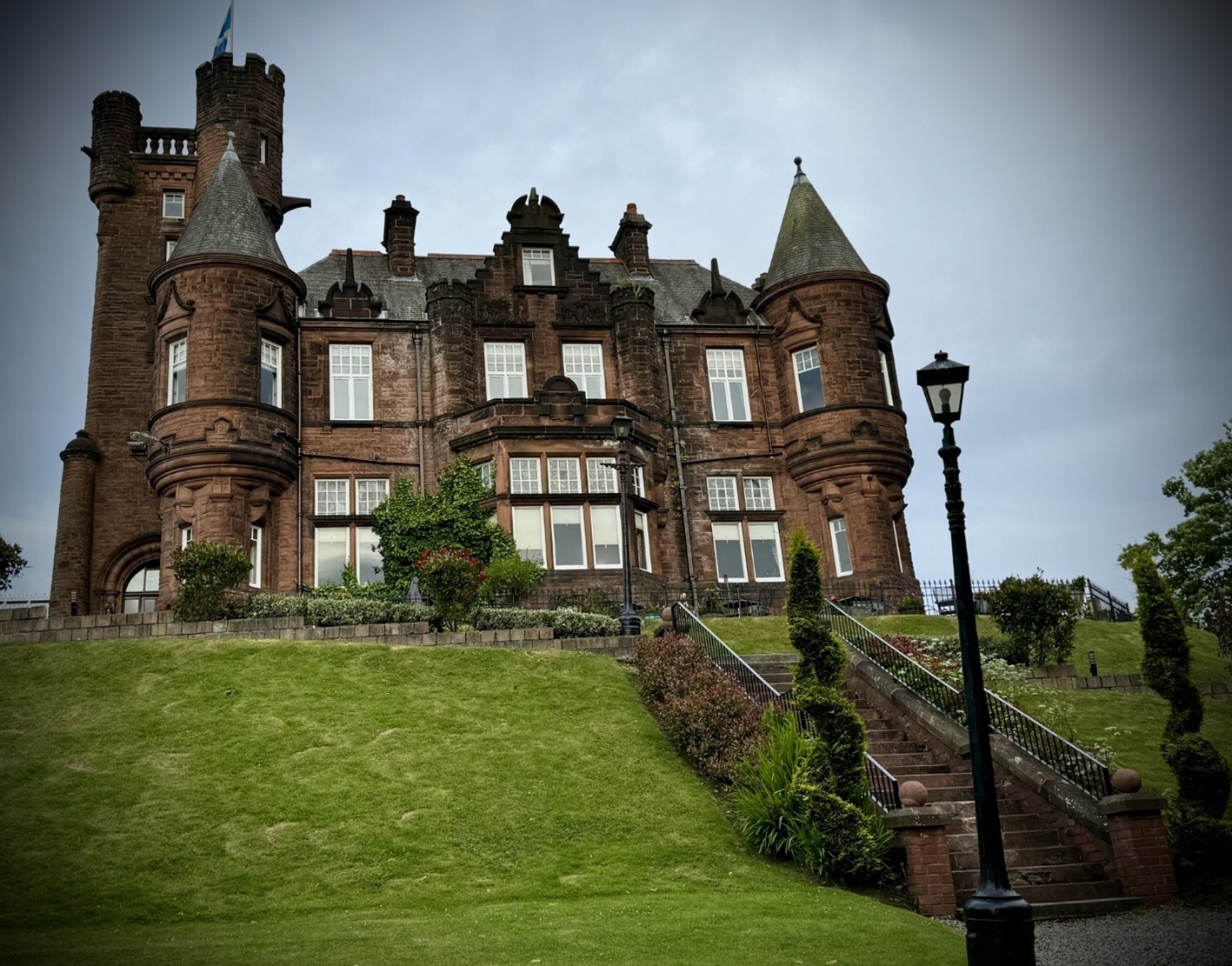
The shells rained down like a squally and brutal summer downpour for most of the day (I hate to think how much all that ordnance would have cost – certainly enough to feed all of Sarajevo’s starving inhabitants!) and the noise and explosions were something the likes of which I’d never experienced before. It may have seemed like overkill, but it was a typical Serbian response to a numerically superior enemy force trying to break out of the city.  The Muslims in Sarajevo had been under siege for months with only two ways into and out of the city. One was the perilous route over Mount Igman, with the other route being via a tunnel created close to Sarajevo airport.

As I mentioned earlier, the ABiH had been building up to this offensive for weeks, pulling in troops from other areas around the city, seeking a way out of their current predicament of enforced incarceration.

Correspondingly, the Serbs had also been gathering their forces and more importantly, their hardware, around the city.  While they had insufficient troop numbers to take the city using their infantry (far greater numbers would be required to clear the city in the street to street fighting that would ensue under such a strategy), I suspect that they wanted to ensure that a breakout was impossible.  It was clear at the time that Sarajevo, like previous UN safe areas such as Srebrenica, was a target for Milosovic and his troops.

As the day’s shelling continued, myself and the OC had been working out of our Ops room on the second floor of the TV2 building, however, we’d ensured that those not required were down in the cellar. If the building took a direct hit, we would minimise casualties in this way.

For me, and I’m sure for the OC, as well as the troops out in the detachments, it was an utterly exhausting day as we went through the huge amount of warring faction activity. There were several times during that day when you could hear artillery barrages coming closer and closer, yet we both knew that there was absolutely nothing we could do about it.  I’ve never been so busy in all my life and could see the situation changing by the minute as each side took the ascendency across various locations.

Several of the buildings in our area took direct hits that day.  I can still recall my amazement at discovering that shells and mortars actually did sound, in real life, as they sounded in the movies!  The high-pitched scream was exactly the noise that you heard as the shells roared in from what could have been almost any area surrounding the city.

At the end of the day, once the shelling started to subside, I think we were all utterly exhausted.  I know I felt like I’d been up for days and would have killed for a hot shower, a beer and an early night.  Alas, all three were in incredibly short supply in Sarajevo!

Incident at the Old Fort

There is another incident that is lodged firmly in my memory.  We had a couple of our team in a detachment up at an area in Sarajevo called the Old Fort.  This was in a Muslim area and was generally safe, but it had been coming under a bit of artillery and small arms fire.  We decided we should relocate them to another area of the city for a while and myself and the OC went up to resupply their rations and to tell them that we were planning moving them out, for a few days at least.  It had never been problematic for us to get into this location before.

Sarajevo from the Old Fort

On this day, we headed up to the Old Fort, but one of the Bosnian soldiers in the area was adamant that we couldn’t get in to the detachment.  The OC was as adamant that the ABiH were in no position to stop us and got out of the vehicle to go and speak to the ABiH officer.  Around 30 seconds later, Captain A came back around the corner, hands above his head, with the same ABiH soldier pointing his rifle directly at him.  As I was driving the vehicle (I’m amazed anyone let me following my earlier driving incident!), my rifle was stowed next to me in a rack.  As I reached towards it to unclip it, the guy swung his rifle directly towards me.  I swear that it’s the closest I’ve ever been to involuntarily emptying my bladder! I don’t doubt for a moment that he would have fired.  The OC got back in the vehicle and said “KB, I suggest we get out of here“.  And we did.  Some high-level negotiations took place after that, enabling us to get back in to remove our people from that location.

The beginning of the end

On 28 August, the Serbs sent mortars into the old market in Sarajevo, killing 43 and injuring over 70 civilians.  This was not the first of these events, as in February 1994, a similar occurrence killed 68 and injured 144.  This one act signified the beginning of the end, as NATO, having had enough of the inactivity of the UN, decided that they would take control of the war and put pressure on the Serbs in order to obtain a ceasefire.

A NATO multi-national Brigade (MNB), also referred to as the Rapid Reaction Force (RRF) that included French and British Troops started gathering on Mount Igman and NATO aircraft (most of which were US) were sent closer to the area.  It was rumoured that the MNB was going to fight its way into the city, up a route controlled entirely by the Serbs.  To do this, it was going to have artillery and air support.  We were in close liaison with the MNB (and I was sending them daily situation reports (Sitreps)), keeping them up to date with the warring faction activity in the area.

It was around this time that Fiona F, another analyst sergeant came into Sarajevo, doubling our analytical capability.  This was very handy, given that there was so much going on at the time that there was too much work for just one person.

There had been numerous atrocities committed, not least of which was the massacre of Muslim males in Srebrenica.  I suspect that NATO was losing whatever faith they’d had in the UN long before the mortaring, but it seemed that this solitary act of terror forced their hand.  Furthermore, we knew that there had been additional movement of Serb troops heading towards the city.

One of my Sitreps to the MNB accidentally caused a bit of panic.  I’d pointed out that the MNB was now within range of self-proppelled artillery elements that were around Sarajevo.  I think this was read as they were about to come under attack.  I had to reassure them that they had actually been within range for quite some time, but that they seemed to have other things on their mind at the moment!

The night before the NATO operation began we were obviously on a high state of alert and were aware of where certain elements were located and what they appeared to be doing.  Our work became more important after the air strikes and artillery barrages, as we could help ascertain the effectiveness of NATO’s strikes, along with any observations on what we believed had been successful and what hadn’t.

There were multiple waves of attacks from French and British artillery on Mt Igman, followed by air strikes from various NATO forces.  The following report by Martin Bell gives a decent overview of how the NATO operation began, and it’s worth watching the first few minutes:

Martin Bell news item from when NATO took over

While the Serbs initial response was to continue firing shells and mortars into Sarajevo, further NATO action meant that this soon ceased.  It started to have a significant impact on their troops and the people of Sarajevo seemed to give an audible sigh of relief.

The NATO operation started paying dividends fairly quickly and shelling in and around the city diminished.  This enabled more visitors to get into the City to see first-hand what was going on and the impacts of the war.  We had a Brigadier coming in for a briefing and he was escorted by a Lt Colonel who used to be my Officer Commanding at a previous Regiment (Colonel N).  I went through my briefing, outlined what had been going on etc and when I was finished I asked if there were any questions. The Brigadier had a few which I answered.  Colonel N then turned to me and said “Thanks Sgt Blyth, no questions, but I’d like to point out that I think that’s the first time I’ve seen you sober“.
The aftermath

Things in the city quietened down considerably after the NATO intervention and at the end of September, we all managed to leave Sarajevo and return to our families on time, being replaced by those on the next tour.  While our tour had been frantic and at times manic, the focus of theirs would be slightly different but just as important.  Having spent summer in our building with no electricity, I’m also fairly certain that it would have been exceptionally cold in the winter. I didn’t envy them that!

My last real memory of the detachment was of getting a flight in a Russian Antonov from Sarajevo to Split (the airport was open and there was free movement in the sky and on the ground again). It felt like it took forever to get off the ground and I seriously wondered if it was going to run out of runway.  It took off and our short flight to Split was entirely uneventful.  On getting off the aircraft however, a Russian airman was pouring bottles of cold water all over the wheels and there was steam everywhere.  The flight was going on elsewhere having dropped us off.  I was glad that I wasn’t going to be on it!

Coming home

Kev Blyth - Sarajevo Airport
Me at our detachment at Sarajevo Airport.

Coming home from this detachment was actually difficult.  To come from a theatre of war and get back to normality took quite a bit of getting used to and winding down took some time.  I could hear the eerie wail of the sirens that went off regularly in Sarajevo just before bombardments began, could see the people scurrying for cover and relived some of the incidents over and over again.

Bjelasnica in background

At the start, I didn’t speak about it much.  It was always there in the back of my mind and it probably took me quite a while before I started getting a good night’s sleep.  I didn’t have nightmares or anything – I just couldn’t get off to sleep very easily.  Then one day I decided to open up and talk to Josanne about what had happened.  She had seen the news, saw what was going on and there were even a couple of times when I was on the phone to her when we started getting shelled, or people opened up with machine guns, so I couldn’t very well pretend that nothing had happened.  There was also the incident when our building was hit and no-one was told that we were all OK.  Josanne understood and provided her ear.  I genuinely think that it was opening up and talking about it that then made it easier to move on.

We were offered counselling when we came back.  I have no idea if anyone took the offer up or not.  I didn’t.  I didn’t think I needed to and as I mentioned, once I spoke to Josanne about it, it seemed to clear it out of my mind and I could get on with my life as normal again.  If there is one piece of advice I can give to anyone who has returned from an event such as this, it would be to make sure that you talk about it and don’t bottle it up – there is nothing wrong with reaching out for help; nothing to be ashamed of.

Reflections 22 years on

slide02-copy

I maintain to this day, that most people who join the Army want to see active service.  I also believe that I served in one of the best trained (if not best equipped) armies of the world (although I’m also certain that most people will say that of whatever army they served in). It’s only natural that young males, oozing testosterone want to pit themselves against foes to see how they compare.  We all think we’re the best.  We all think we’re invincible. Most even think God is on their side. I think that the God on our side bit is the absolute folly that results in religion causing so many wars.

I know that since getting out, a number of my friends have seen several campaigns and it seems almost that as soon as one ends, another one blows up somewhere else in the world. People these days do several tours of Bosnia, Iraq, and Afghanistan – the list goes on. I don’t envy them and am thankful that none of my close friends have been killed.  A number of people from the Electronic Warfare unit where I served have been less fortunate over the years and I dare say that they and their families would gladly have foregone the active service with hindsight.  My thoughts go out to those families.

There is undoubtedly a close bond among military people that remains long after they have served together.  Those days I spent in the Army created some life-long friends and although I now live on the other side of the world, I still regularly keep in touch with a group of those I served with.

Although I was never your army-barmy type of guy I’m not too different to everyone else.  The lure of the Army was the opportunity to get away from home, to see different places, to have fun, to earn money and to buy myself some thinking time around what I wanted to do with myself.  Oh yes, and I think there may have been a bit of drinking in there – that usually got me into trouble in some form!

The war in Bosnia seems to have been like so many before it. Unnecessary.  It was a war over religion, land, perceived differences and way too much focus on those perceived differences.  Thousands died as a result – some in horrific war crimes, others in fighting, still others innocently while trying to eke out an existence in their war-torn country.  But it was all unnecessary.  The action of NATO put a stop to the war continuing, but things will never be like they were before.  And there are many who aren’t around to appreciate it.

I like to think that the role I played, that my comrades played and that the British Army played helped people to eventually live better lives.  I know that there are those who think that we should stay out of the fights of others.  I dare say that the inhabitants of places such as Sarajevo, Pale, or Srebrenica would have been far happier not to have been left at the behest of Karadzic, Mladic or any of the other power brokers of this war.  And from that perspective, I believe that you can’t turn a blind eye to the plight of others.

Benjamin Disraeli once said, “Most people die with their music still locked inside them”.  There were many in Bosnia who died long before they had the chance to unlock theirs.   I feel all the better for getting mine out there – so thanks for taking the time to “listen”.  I hope it’s been worth it.