
Introduction
There’s something about Scotland that grabs you by the soul. It’s a country where every turn reveals another dramatic vista, where history seeps from ancient stones, and where the landscape whispers tales of the past.
While I’m Scottish, my wife Josanne is a New Zealander who’d seen relatively little of my homeland beyond Edinburgh, Glasgow and Aberdeen. After work in Paris and trips to Rome and Venice, we were heading back to take the high road home in June 2024. It’s taken me ages to write this up, but I’ve finally done it!
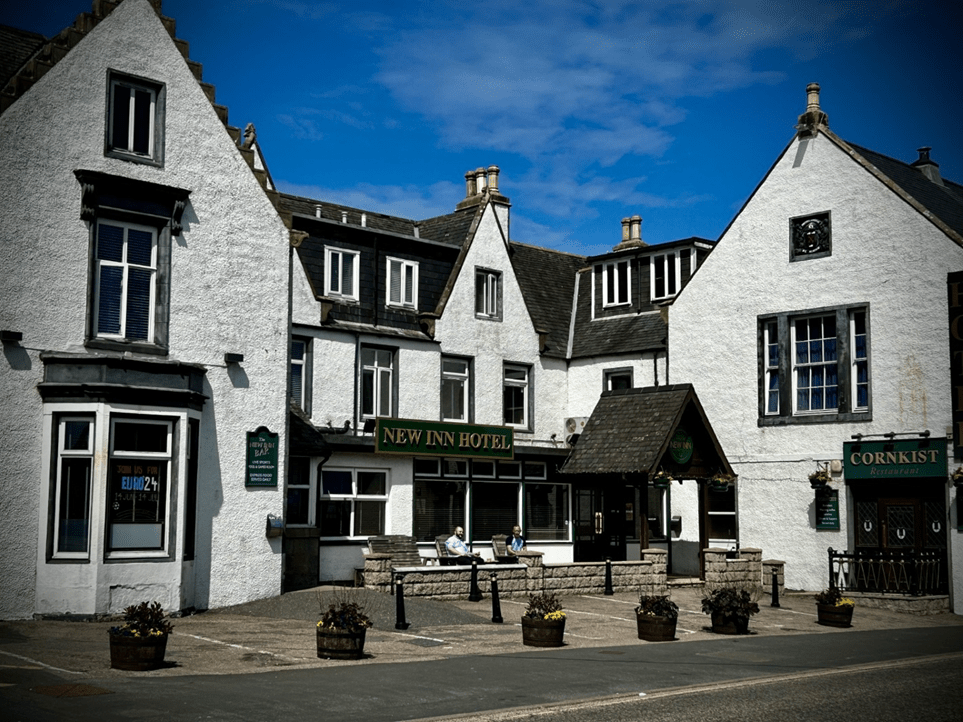
We started our 11-day journey in Ellon, Aberdeenshire, where I lived from 1978-1985 when my dad worked on the oil rigs. Josanne and I returned there to marry in 1992 at St Mary’s on the Rock Church, with our reception at the New Inn Hotel.
Having visited Edinburgh several times before, we deliberately bypassed Scotland’s capital.
We’d brought warm, wet weather clothing. Even in summer, we expected rain. I didn’t reckon on buying a beanie on Skye because the wind was so cold on my ears though!
DAY 1-2: ELLON, ABERDEENSHIRE (22-23 JUNE)
Our stay here was mainly catching up with old friends (including the odd beer at the Brew Dog pub). Despite having lived here, I was still surprised at how long it remains light in Scotland. We left the pub after 11pm and it still wasn’t dark. I’m not difficult to keep amused!
St Mary-on-the-Rock was designed by George Edmund Street and built in 1871, based on the medieval parish church destroyed in 1776. It’s a Grade A listed building with floor tiles by Minton and excellent stained glass.


The New Inn Hotel is a historic coaching inn built in 1704, overlooking the River Ythan. It was a changeover point for horses between Aberdeen and Peterhead. It has been part of the Ellon history for over 320 years.
DAY 3: BALLATER (24 JUNE)
We set off early for Ballater, working out travel times and what we wanted to see along the way, our modus operandi throughout Scotland. We said goodbye to my best man Kevin and his wife Wendy, hoping to return their hospitality when they visit New Zealand.
Ballater is “The Royal Village” in Royal Deeside, about 40 miles from Aberdeen, most famous for Balmoral Castle. Many shops display “By Royal Appointment” warrants, I suspect an advantage of having the Royals as neighbours!
Our reason for starting here was to visit Balmoral Castle. While I’d never been, it was what I expected, though Josanne said it was smaller than she thought. Prince Albert purchased it for Queen Victoria in 1852. She called it “my dear paradise in the Highlands.”
It has extensive, tidy gardens, including vegetable gardens to feed the Royal Family when in residence (we were there before they arrived, so no chance of bumping into a King, Queen, Prince or Princess)!
This was probably the last day of good weather until we had another sunny day in Mull. Thankfully, having been brought up in Scotland, I wasn’t expecting days of warm sunshine like a New Zealand summer.


We also stopped at Crathie Kirk, where the Royal Family worships when at Balmoral. Unfortunately closed to visitors while we were there, we could only walk around outside. While built in 1895 during Queen Victoria’s reign, there had been previous churches dating back to the 9th century.

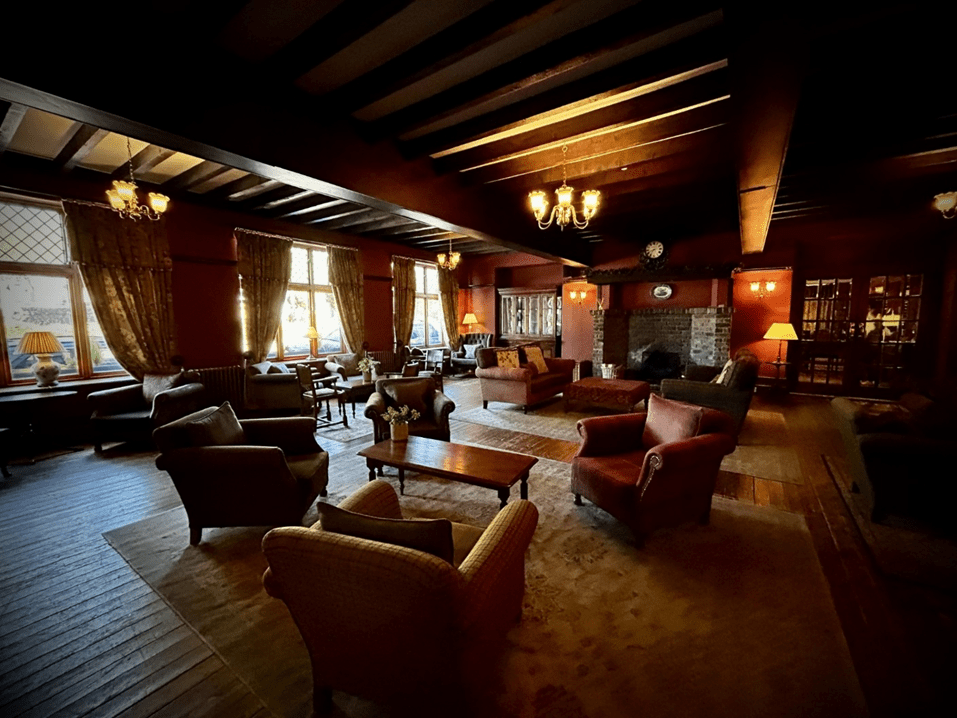
We stayed at the Balmoral Arms, a traditional Scottish hotel in the heart of Ballater, built in the Victorian era. They did a lovely breakfast where Josanne experienced haggis as part of a traditional Scottish breakfast for the first time! She enjoyed it, though unlike me, her breakfasts tended to be healthier.

DAY 4: INVERNESS (25 JUNE)
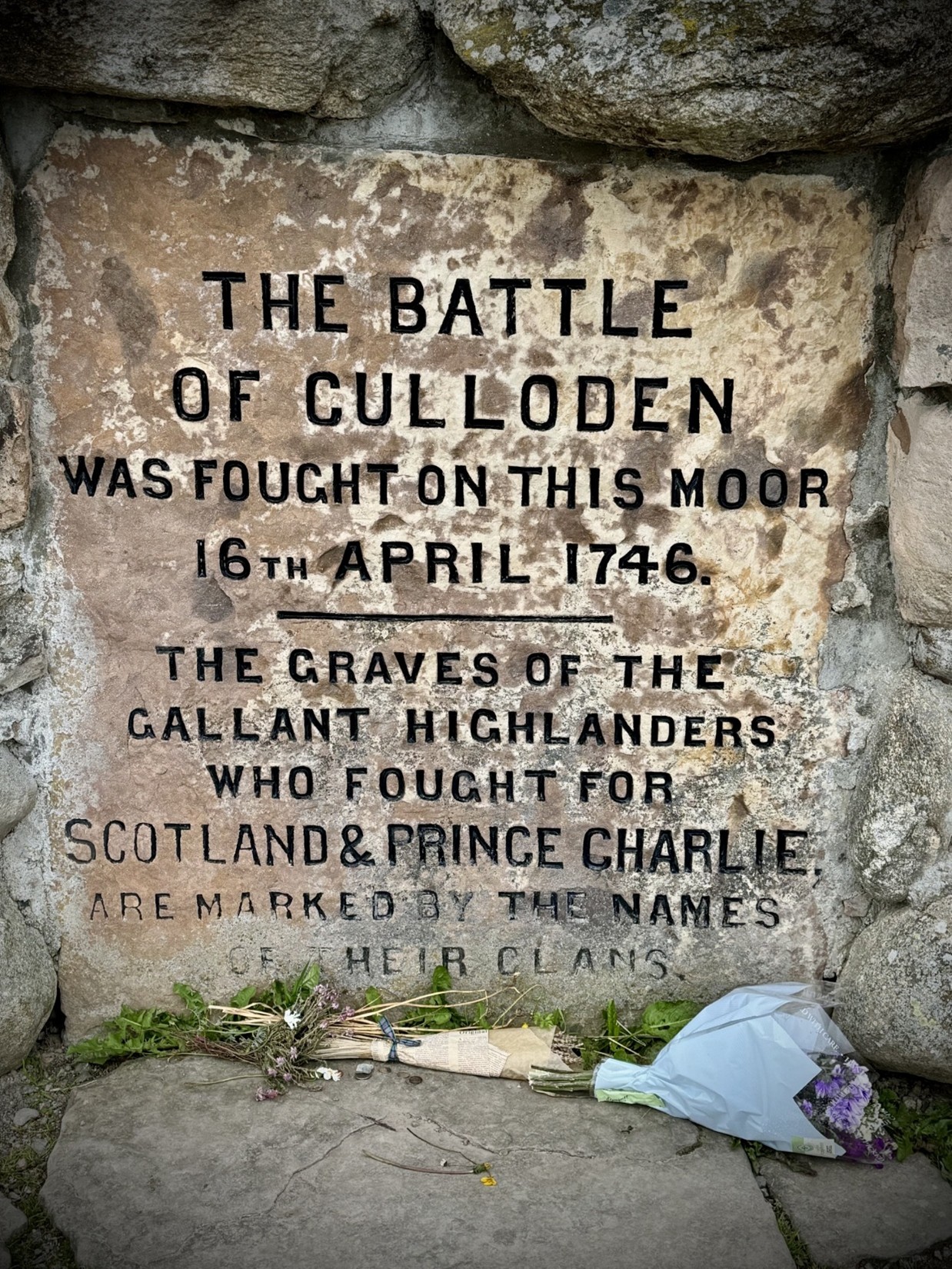
We headed to Inverness to see the Battle of Culloden site, the famous 1745 battle from the Jacobite Rising. At a very high level, the battle lasted less than an hour but around 1,500-2,000 Jacobites were killed versus approximately 50 government troops. It marked the end of the Jacobite uprising and the Highland clan system.
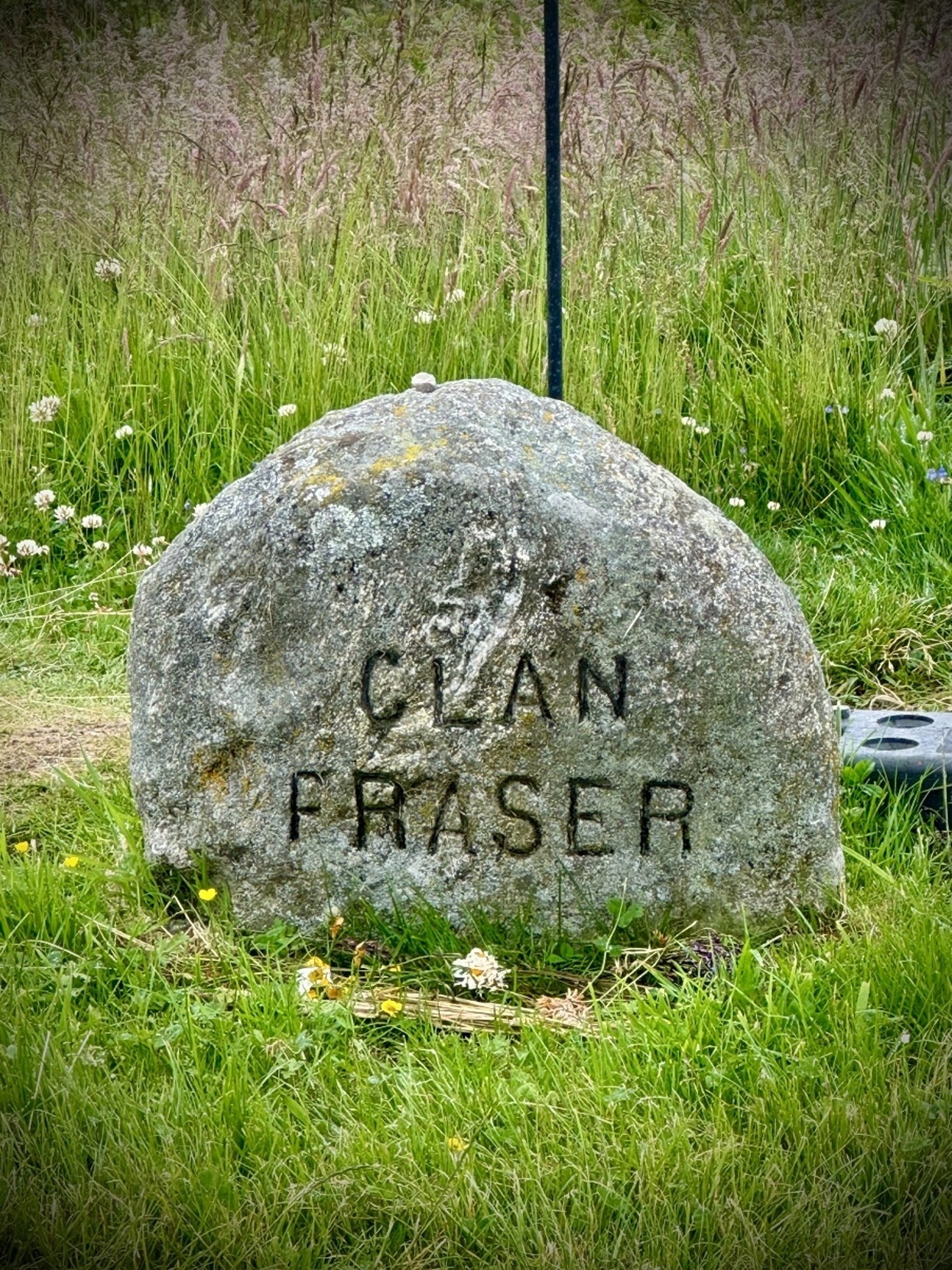
The battlefield is well-preserved and you can walk the actual ground where clansmen charged. Seeing the undulating and stony ground and understanding their weapons versus government troops, you can only tip your hat at the bravery of those men. The visitor centre excellently explains what took place with lots of clan markers to show who was located where at the time the battle commenced. It was moving, and everyone seemed sombre and respectful.

By the time we left Culloden, that most famous of Scottish weathers (drizzle) had kicked off! From here, we headed to Cawdor Castle, which I recall from studying Macbeth at high school!
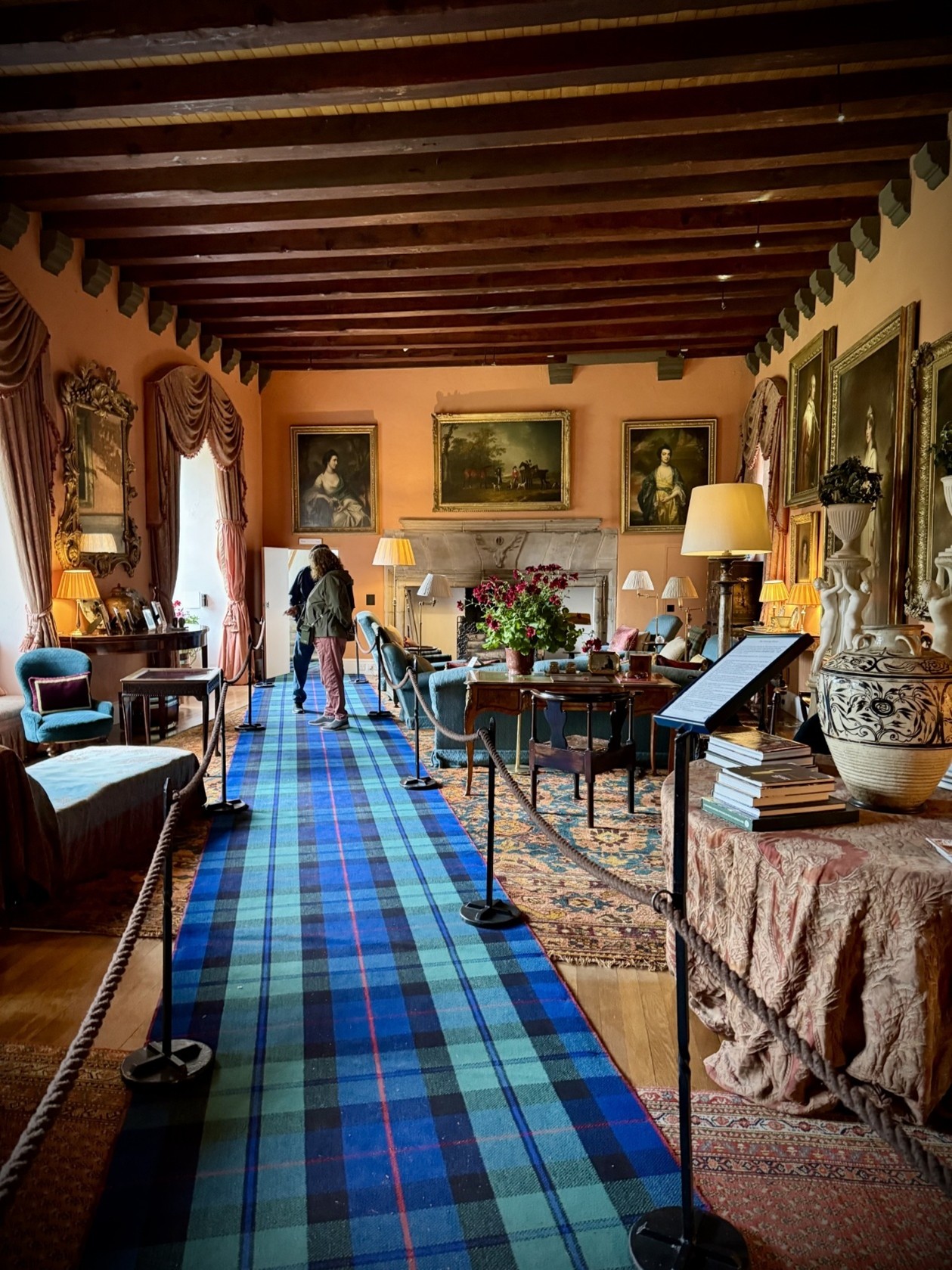
Cawdor Castle is still a family home, built in the 14th Century, most famous for its Shakespearean connection where Macbeth, the Thane of Cawdor, allegedly lived. The castle is built around an ancient holly tree still visible in the basement. Legend says the original Thane was told in a dream to build where a donkey rested.
It’s very well-preserved with beautifully kept gardens.



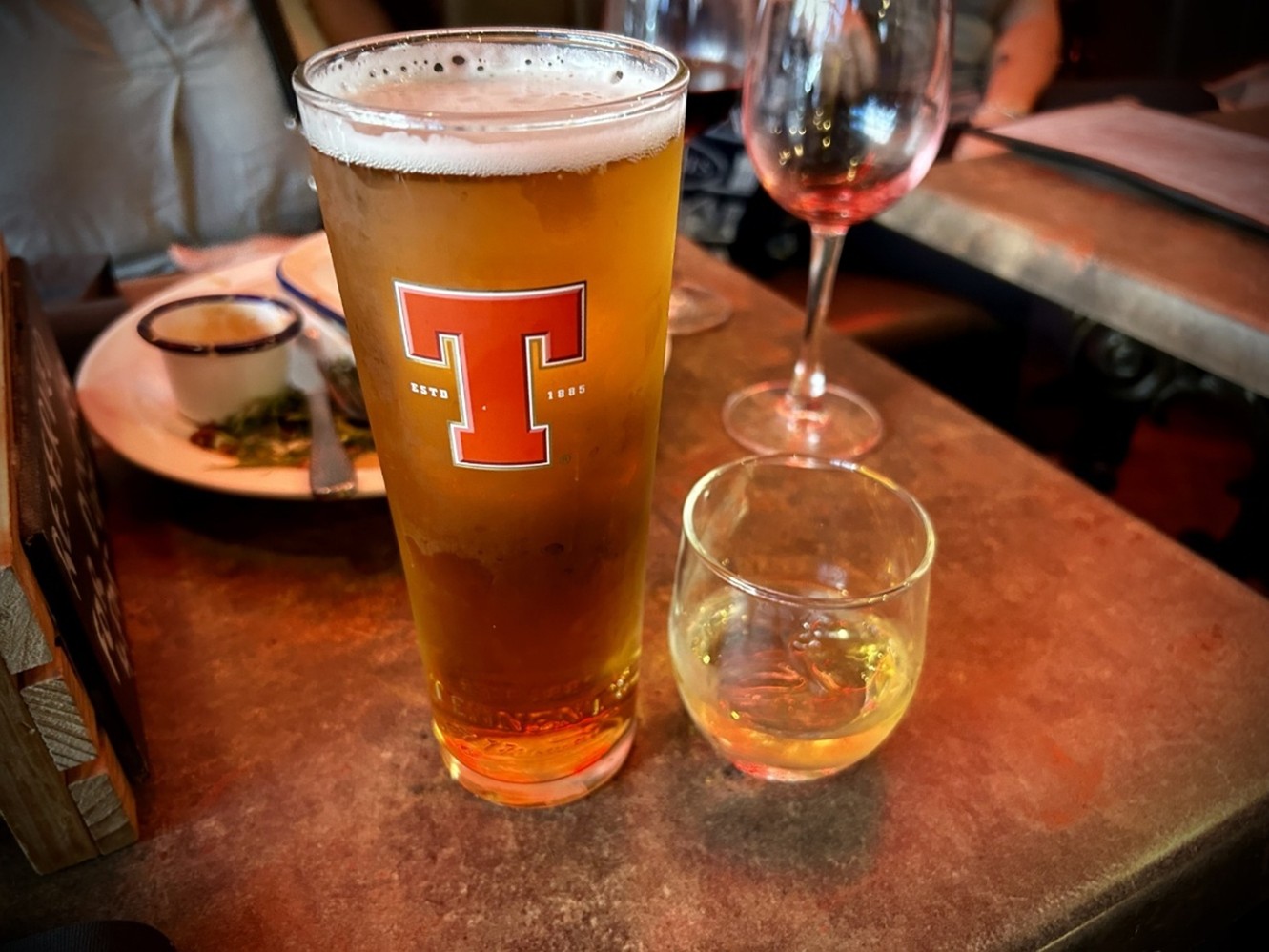
We spent that night in Inverness at the Ballifeary Guest House with traditional Highland hospitality in a handy location. We went into town for dinner, came across a pipe band playing in the city centre, and I went traditional with a pint of Tennents and a whisky chaser!

The next day before setting off, I made time for a quick Scotch pie. It was delicious and took me straight back to my youth where school lunch was invariably a Scotch pie and a custard slice
DAY 5: INVERNESS TO BROADFORD, ISLE OF SKYE (26 JUNE)
From Inverness, we headed to Skye, something that Josanne had been most excited about (though it was also where we had the worst weather).
First stop was Urquhart Castle. We arrived so early it wasn’t open yet, so had to wait around 30 minutes. We could have carried on, but it seemed a shame to waste the opportunity, and while Josanne said it was fine to carry on, I knew there was a hidden subtext that said “don’t even think about it“!
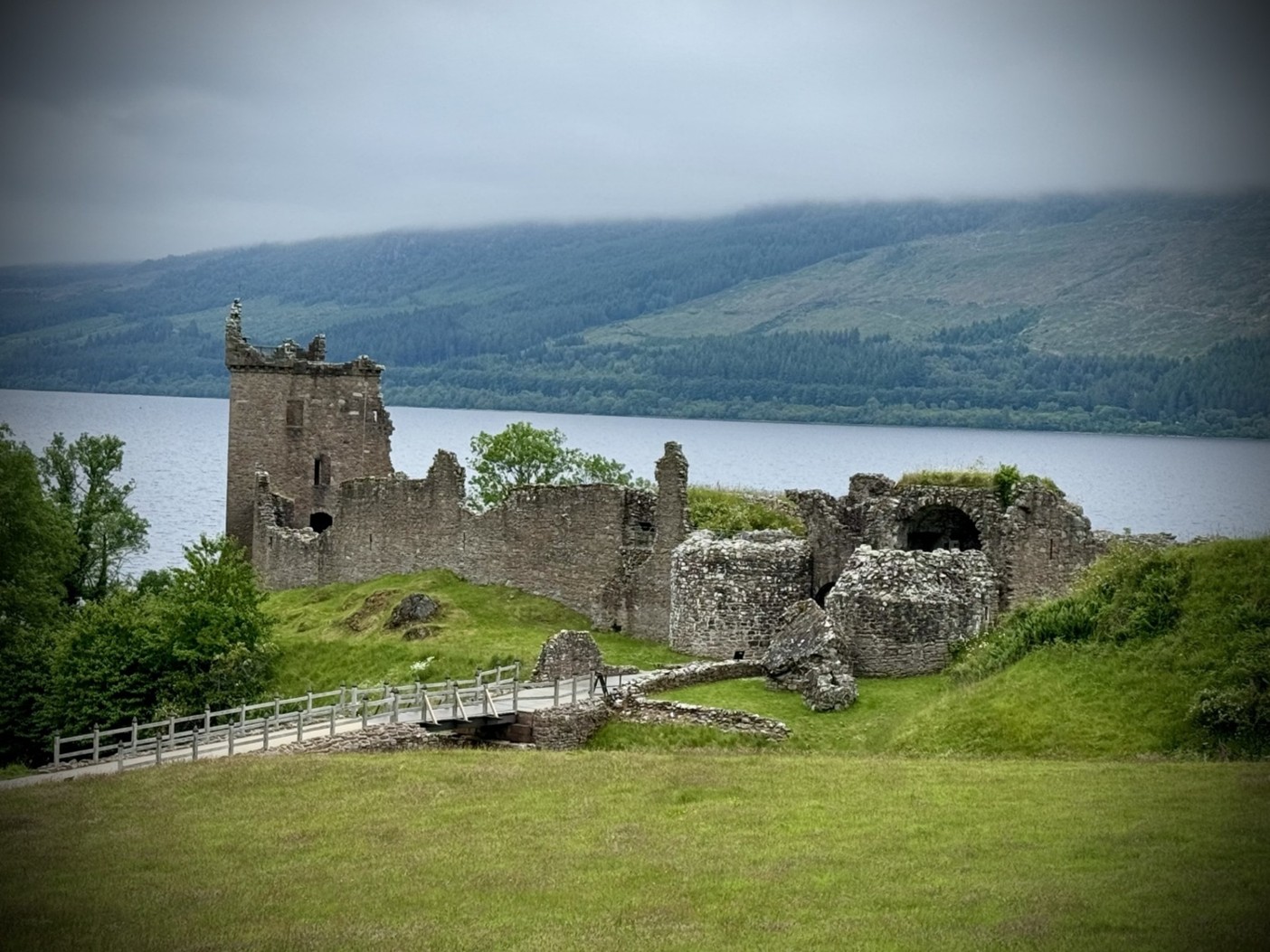
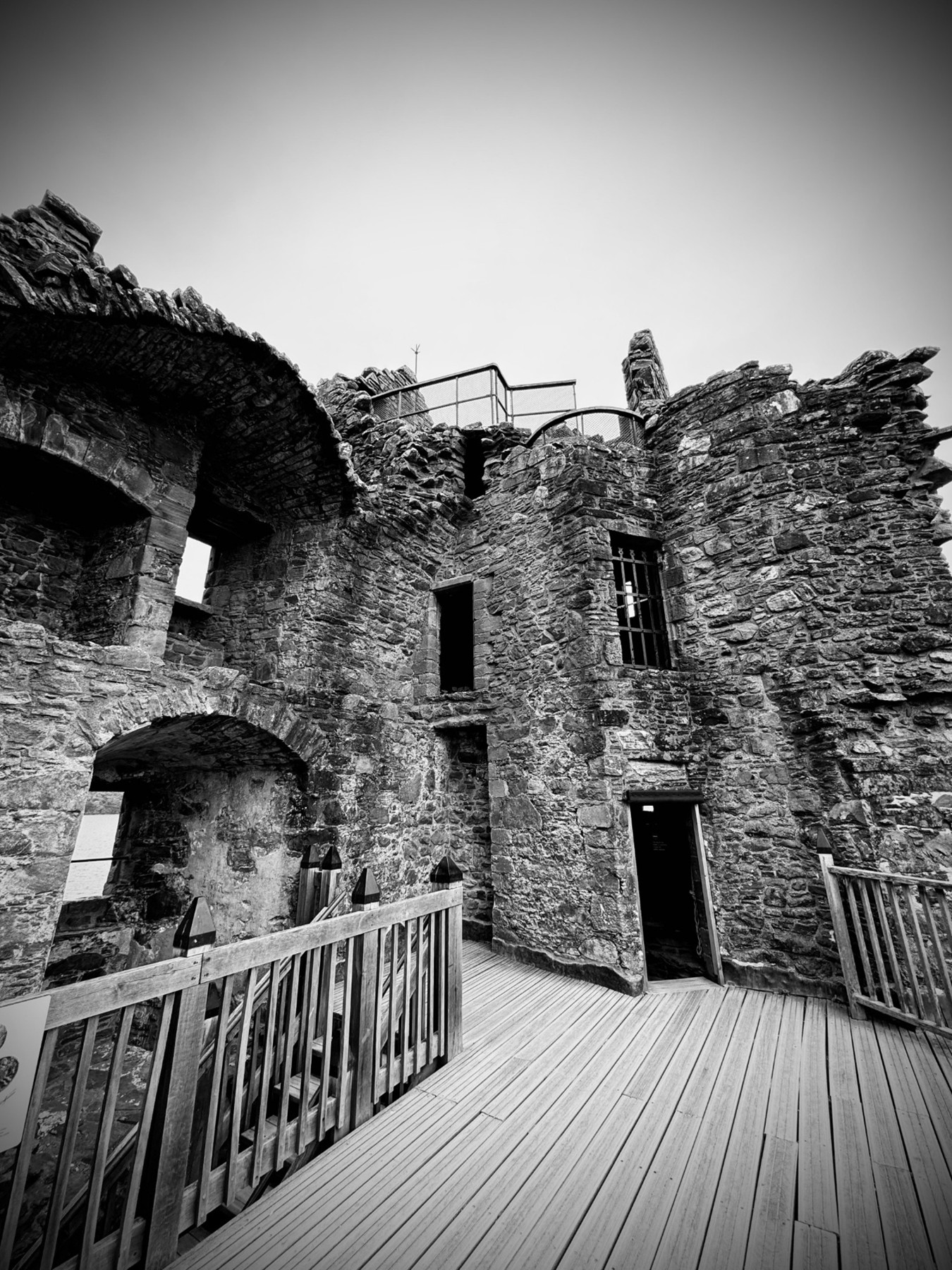
Urquhart Castle is about 20 miles from Inverness on the banks of Loch Ness. Once one of Scotland’s largest castles, it was destroyed in 1692 to prevent Jacobites from occupying it. It has over 1,000 years of history, occupied since the 6th century. You can see the impressive Grant Tower, offering stunning views across Loch Ness.
Most Nessie sightings are allegedly near this location. I can’t profess to having seen even a ripple. Maybe Nessie doesn’t like tourists. Or maybe it was too early.
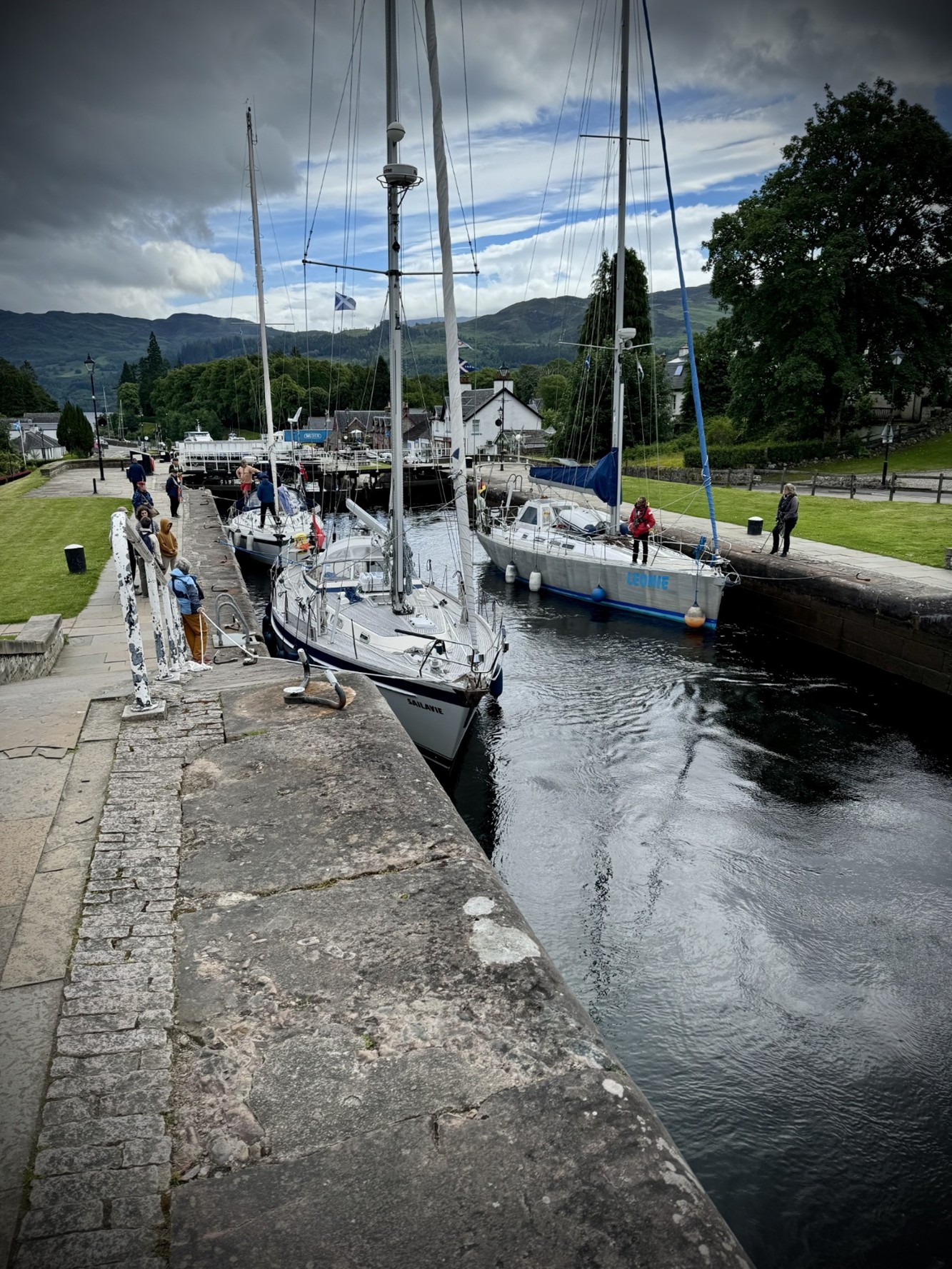
Being chilly, we grabbed tea and cake in the café before heading towards the Caledonian Canal at Fort Augustus.

The Caledonian Canal is a 60-mile engineering marvel connecting Scotland’s east and west coasts. Designed by Thomas Telford and opened in 1822, it links four lochs, Ness, Oich, Lochy, and Linnhe.
There are 29 locks, including Neptune’s Staircase (8 locks) at Banavie—the longest staircase lock in Britain. The Fort Augustus section features 5 locks descending into Loch Ness.

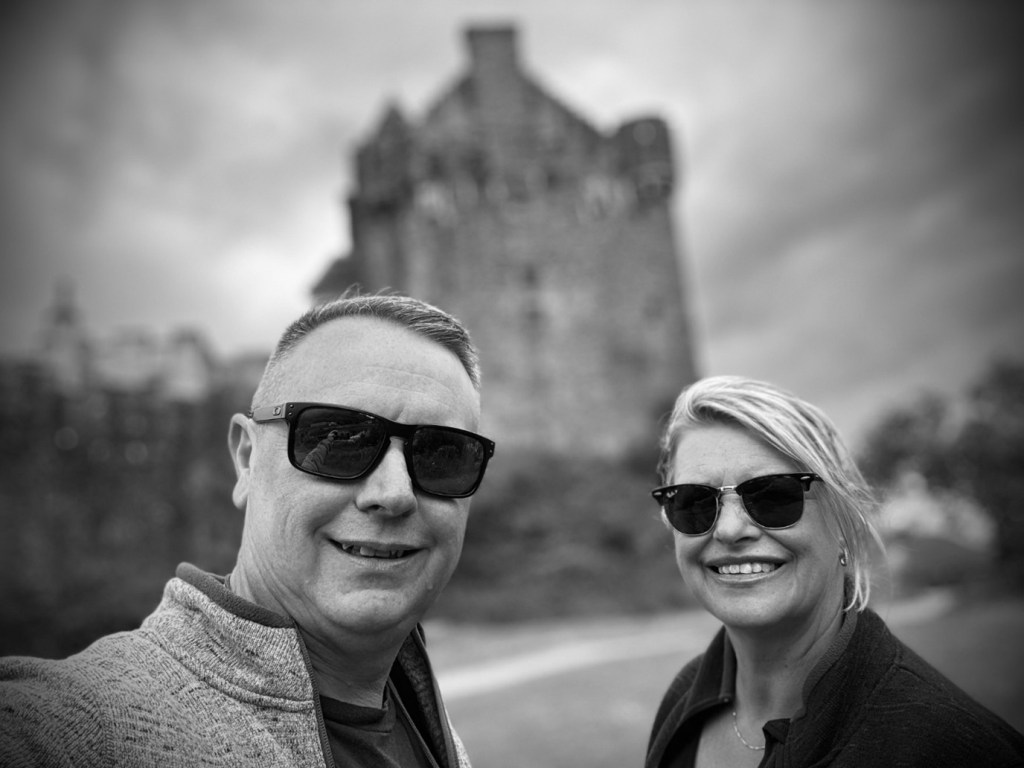
Next was Eilean Donan Castle, which was a highlight for me. Supposedly Scotland’s most iconic castle, it is situated on a small island where three lochs meet. Originally dating from the 13th century as defence against Viking raids, it was destroyed in 1719 by government ships during the Jacobite uprisings.
The castle lay in ruins until restored between 1919-1932. It’s featured in numerous films including “Highlander” and James Bond’s “The World Is Not Enough“. It is named after Saint Donan who came to Scotland in the 7th century.
It is spectacular inside with rooms furnished to show castle life. It’s one of those castles you can quite happily just sit and look at, especially on the outside. Enchanting, enigmatic, evocative. Don’t miss this if travelling near Skye!

Eilean Donan Castle, a stunning historic landmark in Scotland 


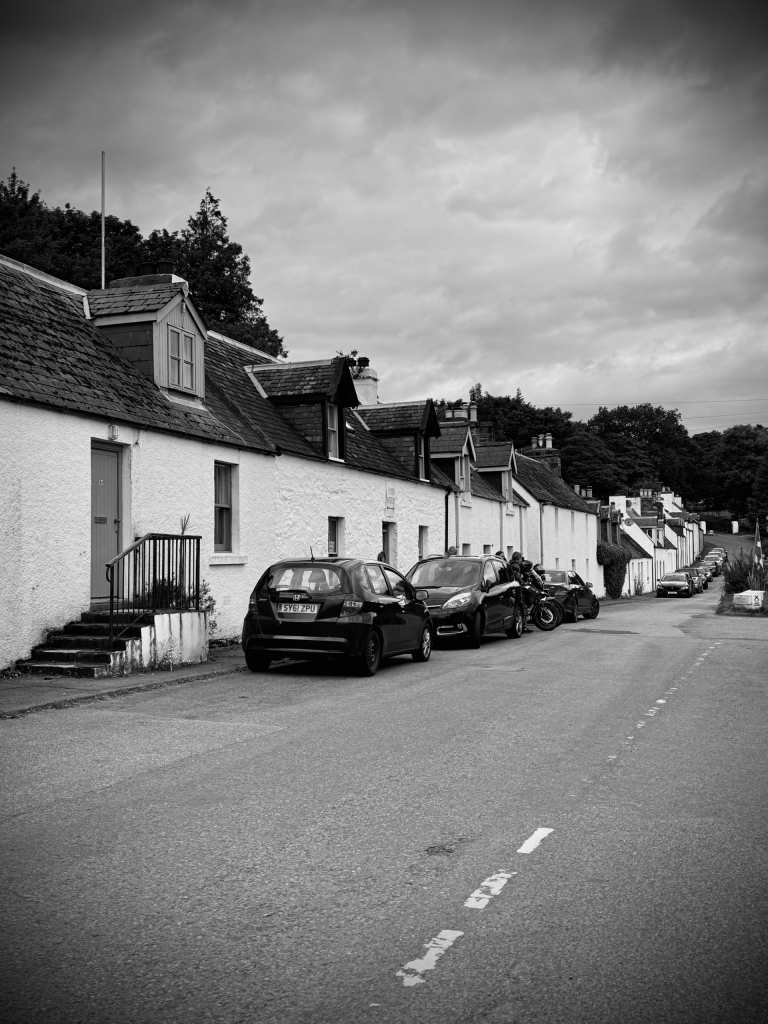
Someone told us the drive to Plockton was very picturesque. This small village on the shores of Loch Carron was only about 6 miles from Kyle of Lochalsh (where the Skye Bridge connects). Due to the Gulf Stream, it actually has Cabbage Trees which are common in New Zealand. It’s most famous as the filming location for Hamish McBeth (the fictitious town of “Lochdubh“). We visited a small gin distillery, though as I was driving, Josanne did the tasting. We grabbed a couple of small bottles for our travels. The locals here were incredibly friendly.

By the time we’d reached Skye, the weather had turned very Scottish—cold, windy and rainy. Our first night was at the Broadford House, very basic but with friendly, helpful staff. We grabbed fish and chips and sat at the water’s edge eating them during a brief respite from the rain.
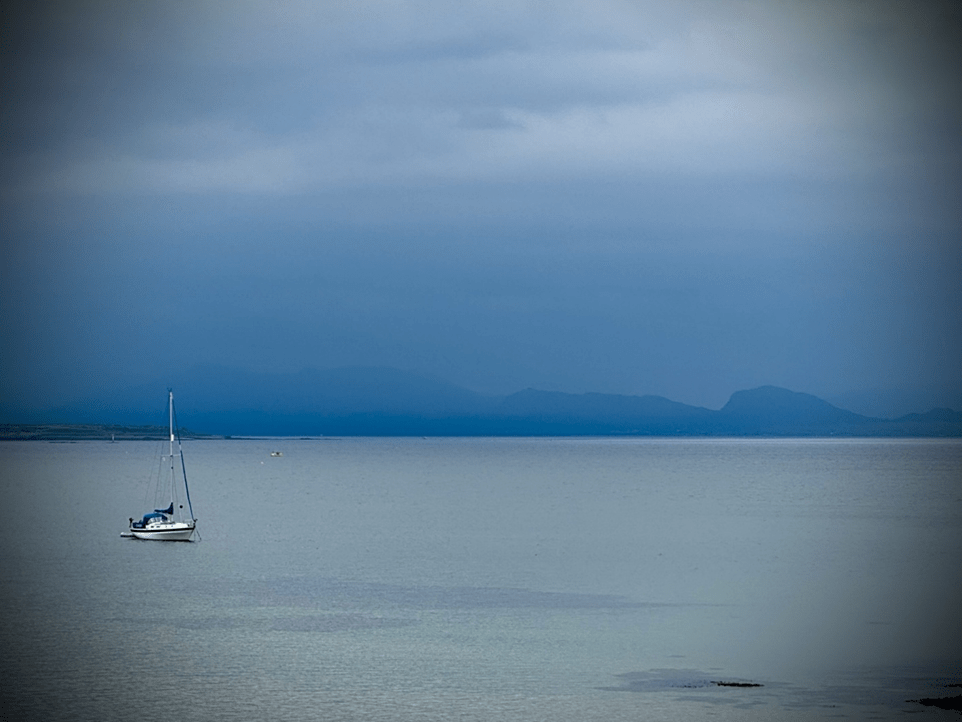
On awakening next morning, it was as if we’d stepped back into winter, howling wind, horizontal rain and definitely not summer temperatures. On the bonus scale though, at least there were still no midges!
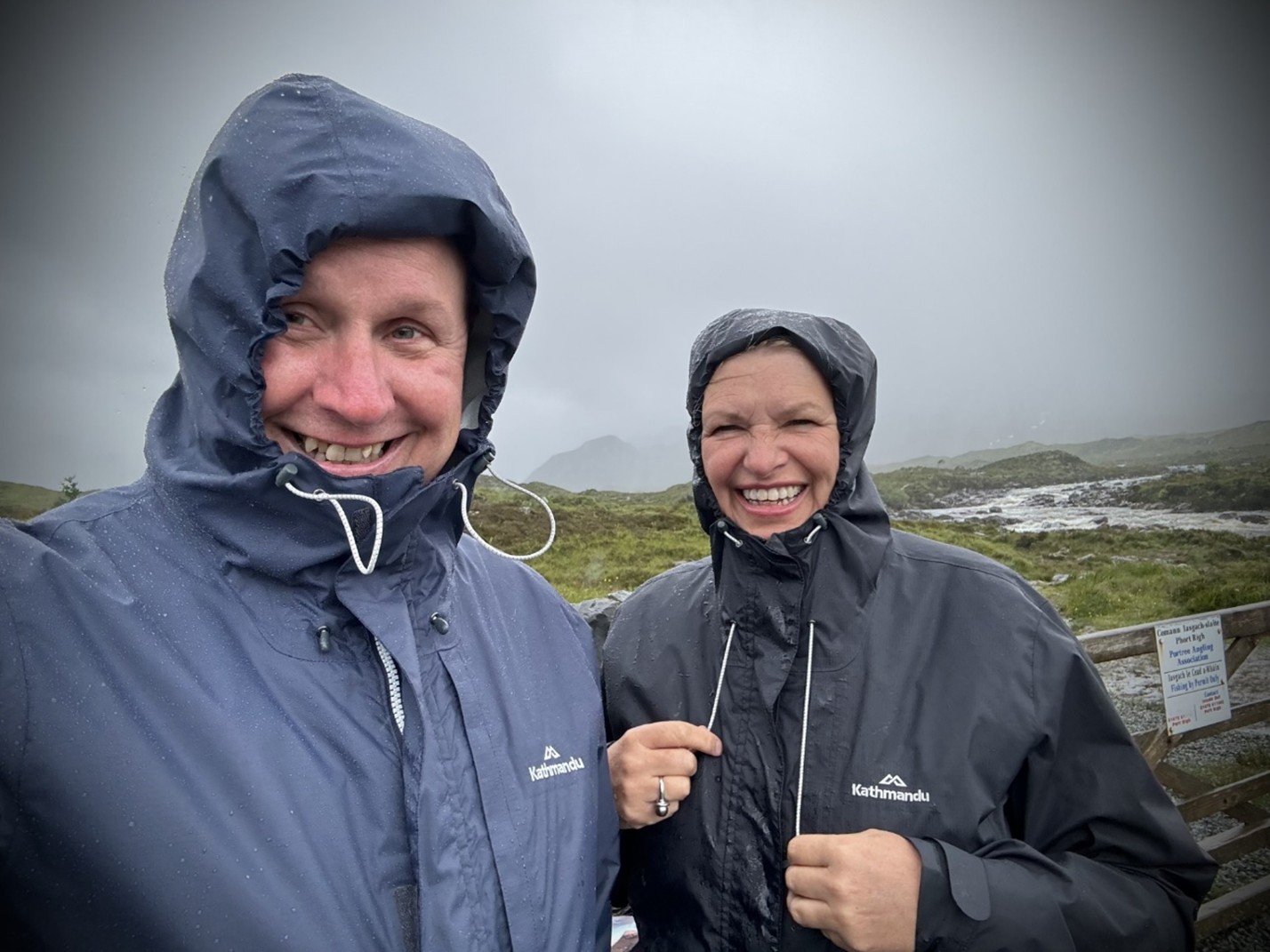
Not letting weather put us off, we jumped in the car with wet weather kit and headed for Sligachan Bridge. Built in the early 1800s by Thomas Telford, we definitely got to see it at its wettest! You normally have good views of the Cuillin mountains in the background.
Legend says if you dip your face in the pools beneath the bridge, you’ll receive eternal beauty. I’d challenge that by suggesting if we’d dipped our faces in the pools, we’d have caught hypothermia!

DAY 6-7: PORTREE, ISLE OF SKYE (27-28 JUNE)
Next stop was Portree, where we’d spend a couple of nights to tour around.
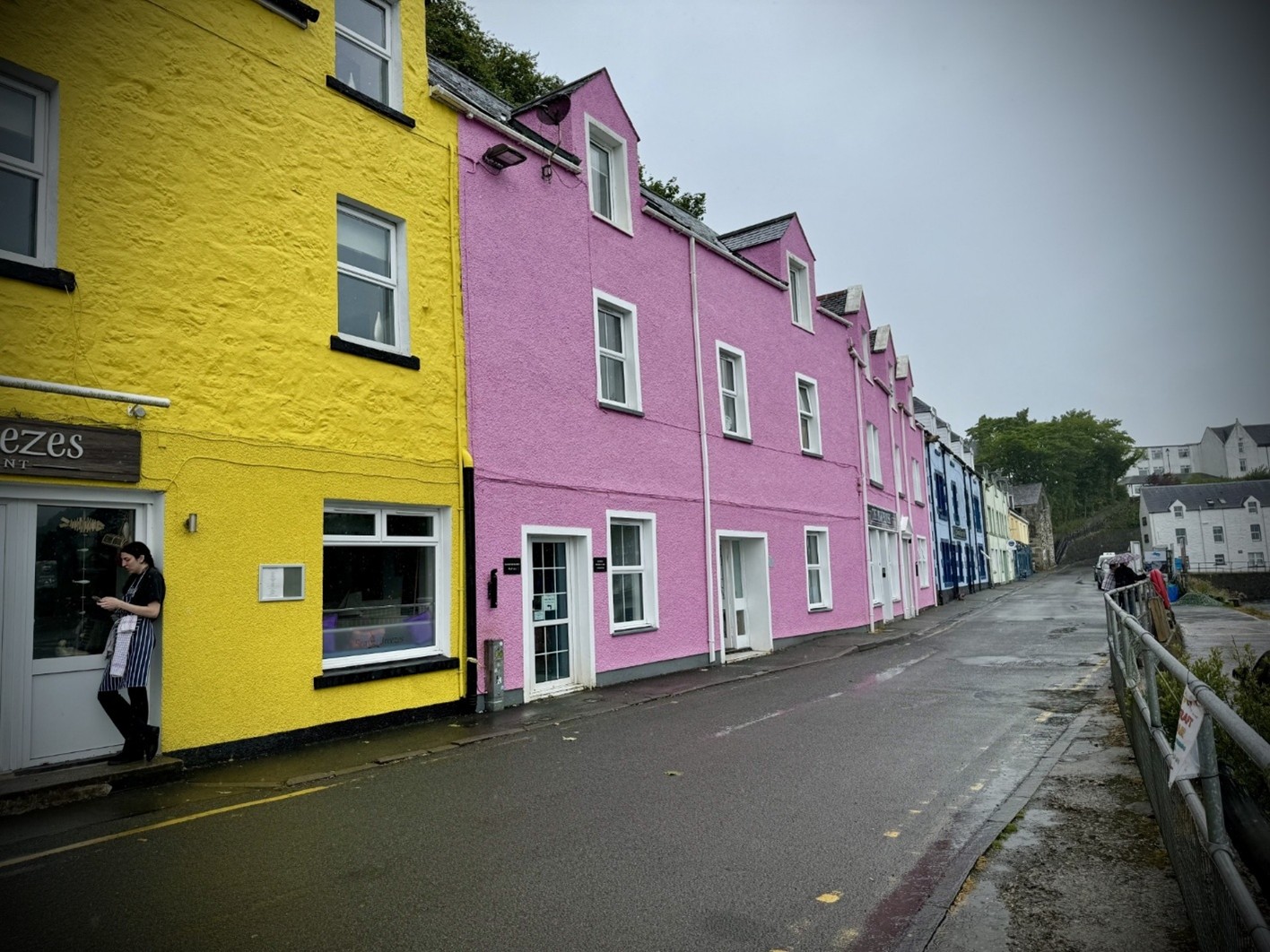
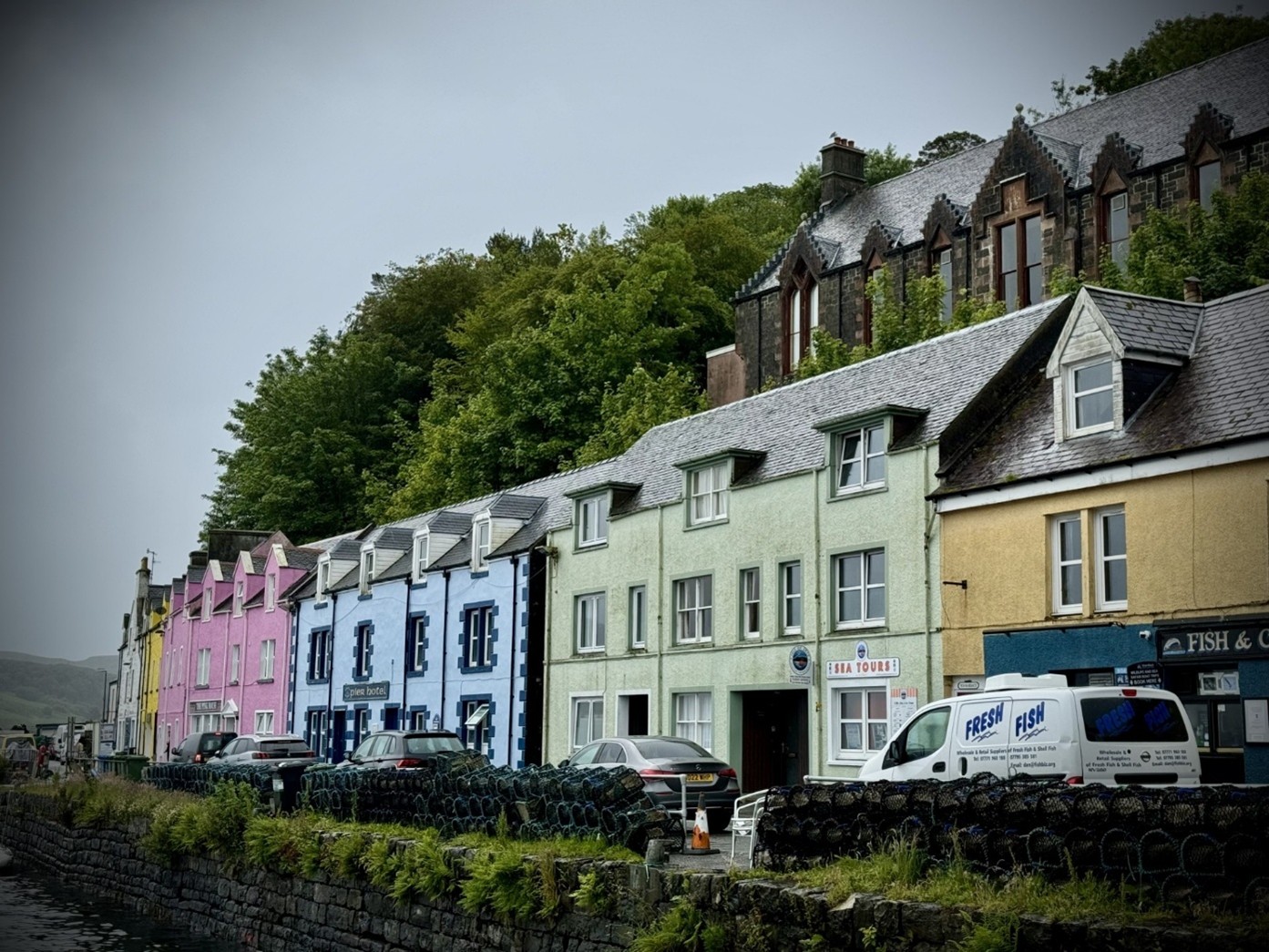
Portree is Skye’s capital and largest town. The name means “King’s Port” in Gaelic, received following James V’s 1540 visit. It’s famous for its colourful harbour houses and is the main hub for exploring Skye’s attractions.
The rain hadn’t stopped, so we looked around shops. There were lovely colourful houses on the waterfront, so we walked up the hill to see them before returning to the car.

Things weren’t drying out, so we thought visiting Talisker Whisky Distillery would be excellent. Alas, the wet weather meant we weren’t the only ones with this idea and it was packed with no tour places available all day.
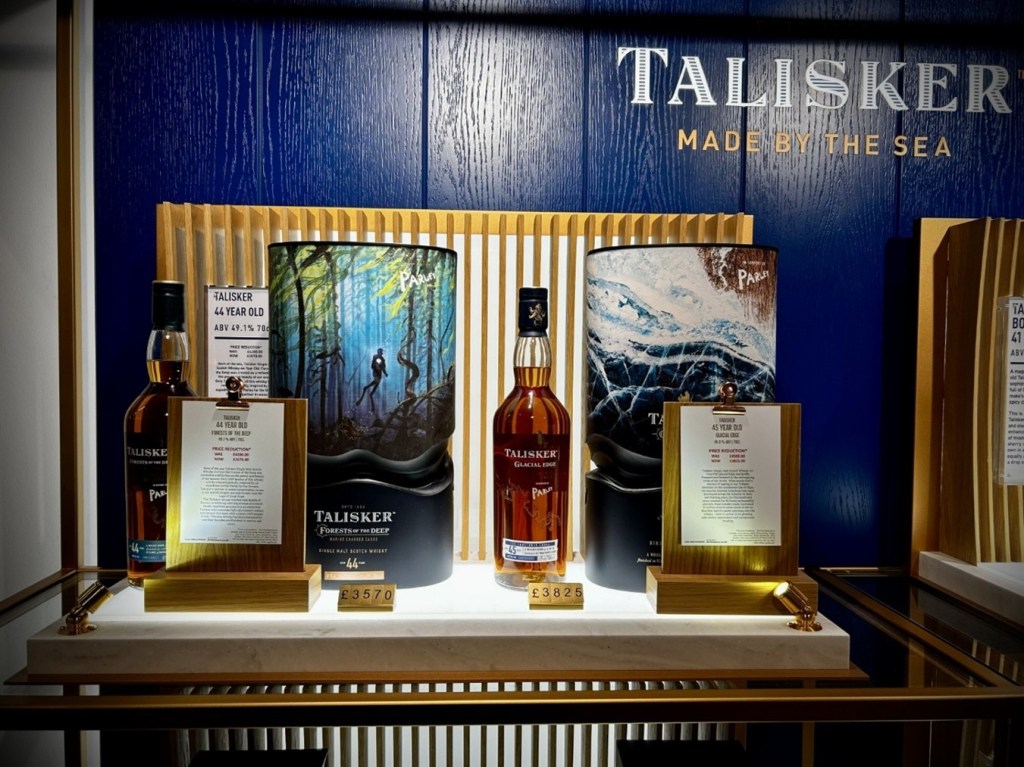
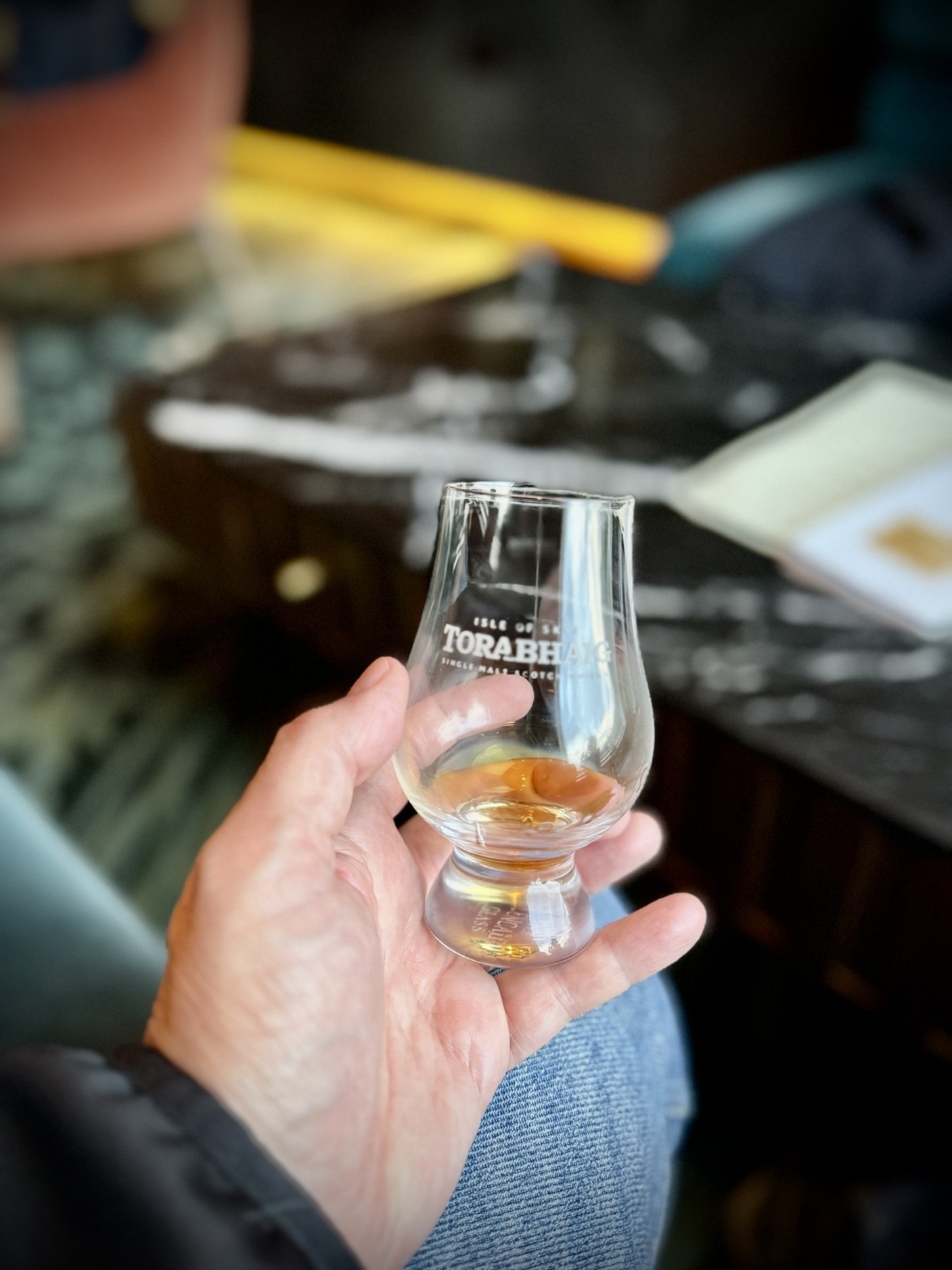
We tried a couple of whiskies and were given the great advice of purchasing some Talisker Dark Storm at duty free. You can only buy it there (it’s not even available at the distillery) and it’s now one of my firm favourites!
There were lots of bottles to choose from, including a 45-year-old finished in the arctic circle. At £3,825, it was an absolute snip, reduced from £4,500!

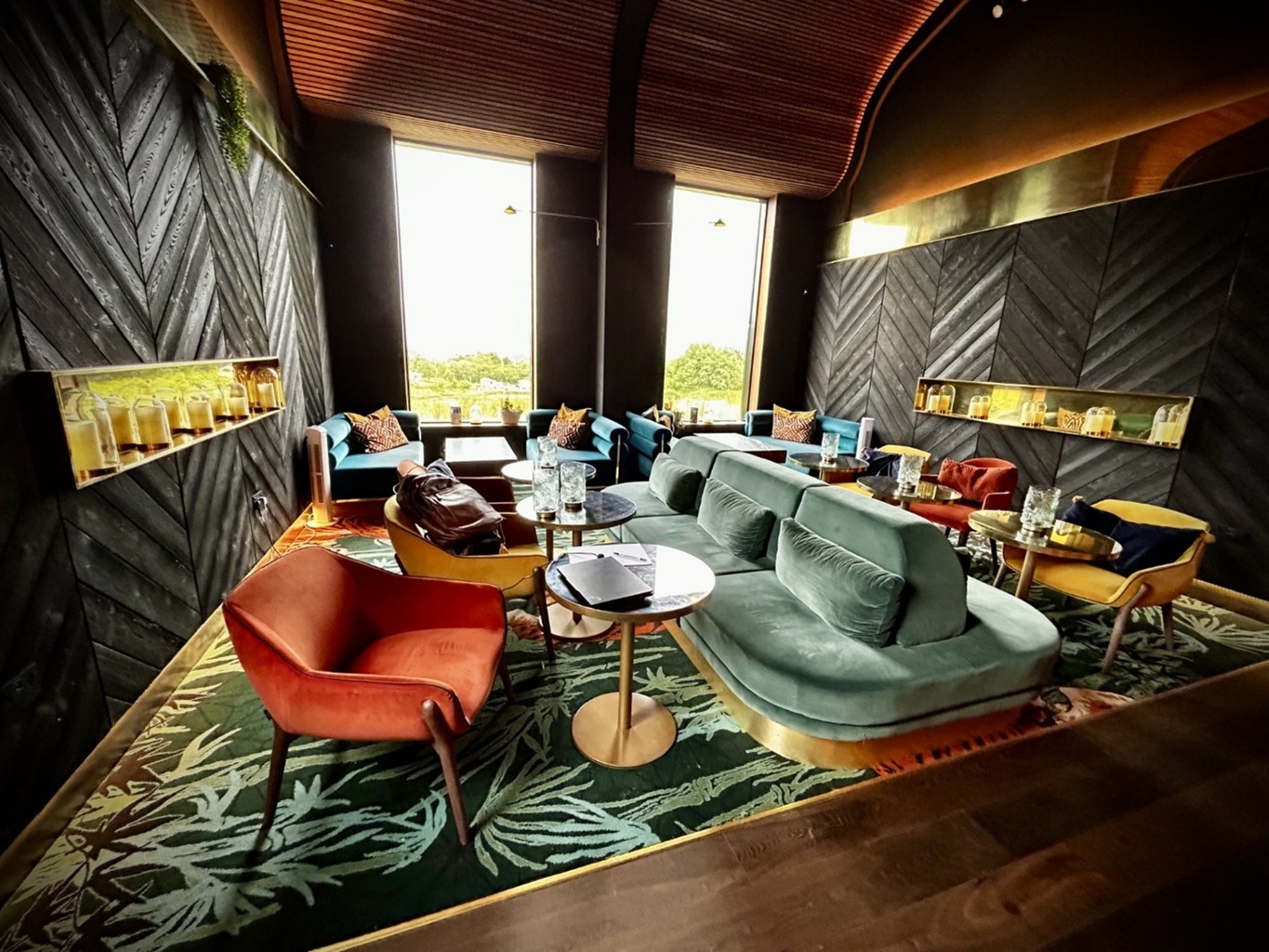
We stayed at the Bracken Hide hotel in self-contained Nissan style huts, with the restaurant and bar a short walk away in the main building. The first night we heard about a man in a van making pizzas (I drove down and waited in the car as it was still raining). The second night we ate in the restaurant which was excellent. We had the best breakfasts of the whole week here. They had an incredibly well-stocked bar with just about every whisky you could think of.


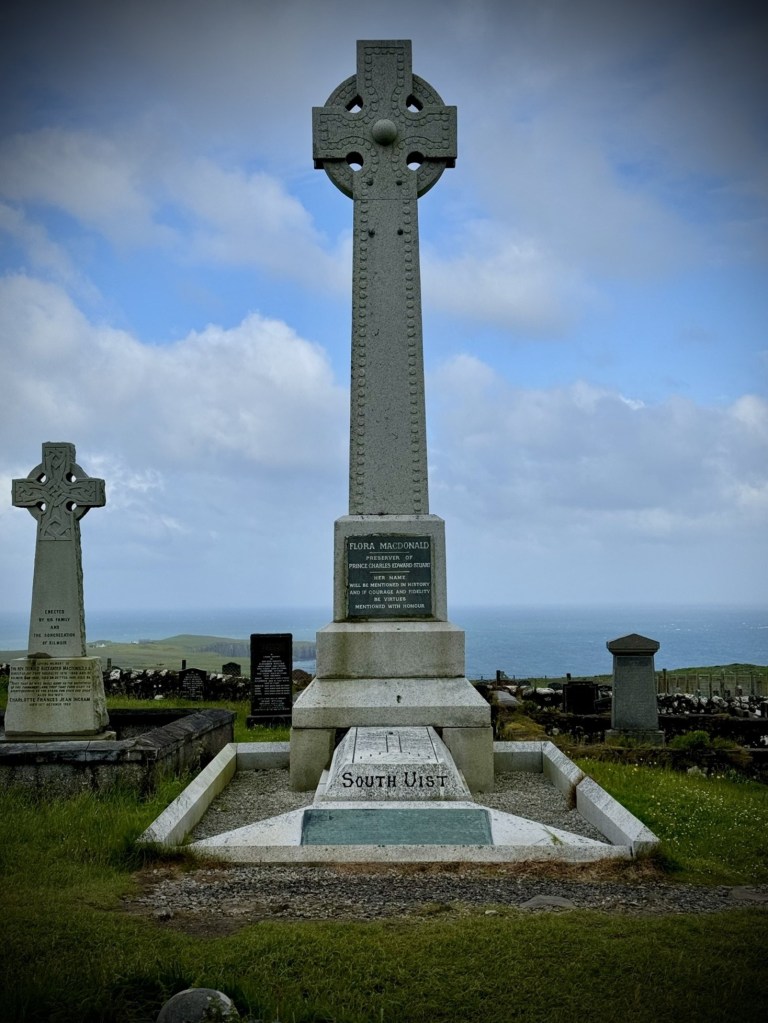
On the 28th, we did quite a bit of driving. We drove from Portree to Uig and onto Kilmuir to see Flora MacDonald’s resting place. My mum’s side are MacDonalds, so we wanted to visit Flora’s grave. Flora is renowned in Scottish history for helping Bonnie Prince Charlie escape after losing at Culloden. She smuggled him from South Uist to Skye. This story is immortalised in the Skye Boat Song.
Flora MacDonald died on 5th March 1790 and is buried at Kilmuir Cemetery. Her body was allegedly wrapped in a sheet in which Bonnie Prince Charlie had slept. The words engraved on her memorial come from Samuel Johnson.
Flora isn’t the only famous person buried here. There’s a magnificent grave marker with a carved effigy of a knight in armour marking Angus Martin’s grave (Aonghas na Geoithe, or “Angus of the Wind”).
Local legend claims Angus stole this tomb slab from an early Scottish king’s grave on Iona and carried it here himself. Though historians doubt this, it’s a great story!

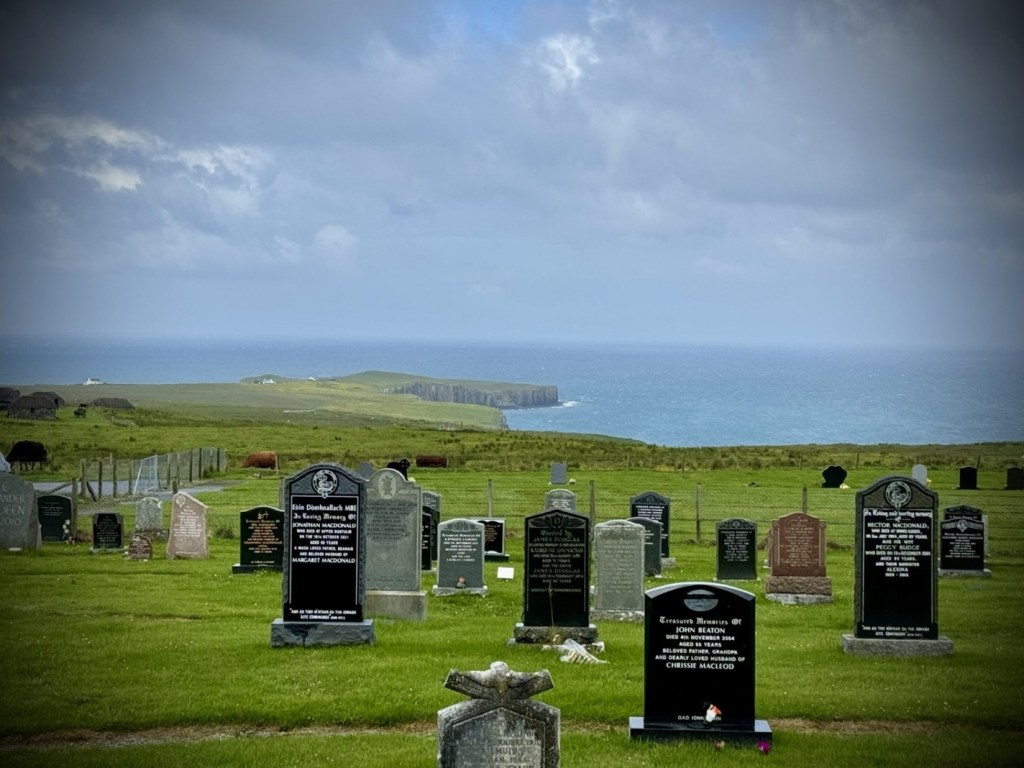


Up at the graveyard was stark and open landscape—beautiful yet basic. The wind was howling in from the sea with no warmth in it at all. It was at the gift shop where I succumbed and bought a woollen beanie! Josanne did likewise.
There was also a small museum showing how people lived in years gone by. They were far hardier than me!


From here we headed to the Trotternish Peninsula, the northernmost stretch of Skye, its name and landscape both shaped by Viking times. Formed by a massive ancient landslip, the area is known for its dramatic cliffs and surreal rock formations, none more striking than the Quiraing, which means “round fold” in Old Norse and is said to still be slowly shifting.
We’d planned a longer walk, but the cold and relentless wind had other ideas. Even so, we managed a one-hour trip and made it back to the car just before the heavens opened. The beauty of the Quiraing was unbelievable—raw, sculptural, and enthralling. Had the weather been kinder, we’d have walked further, but it was enough to stand and take in the majesty.
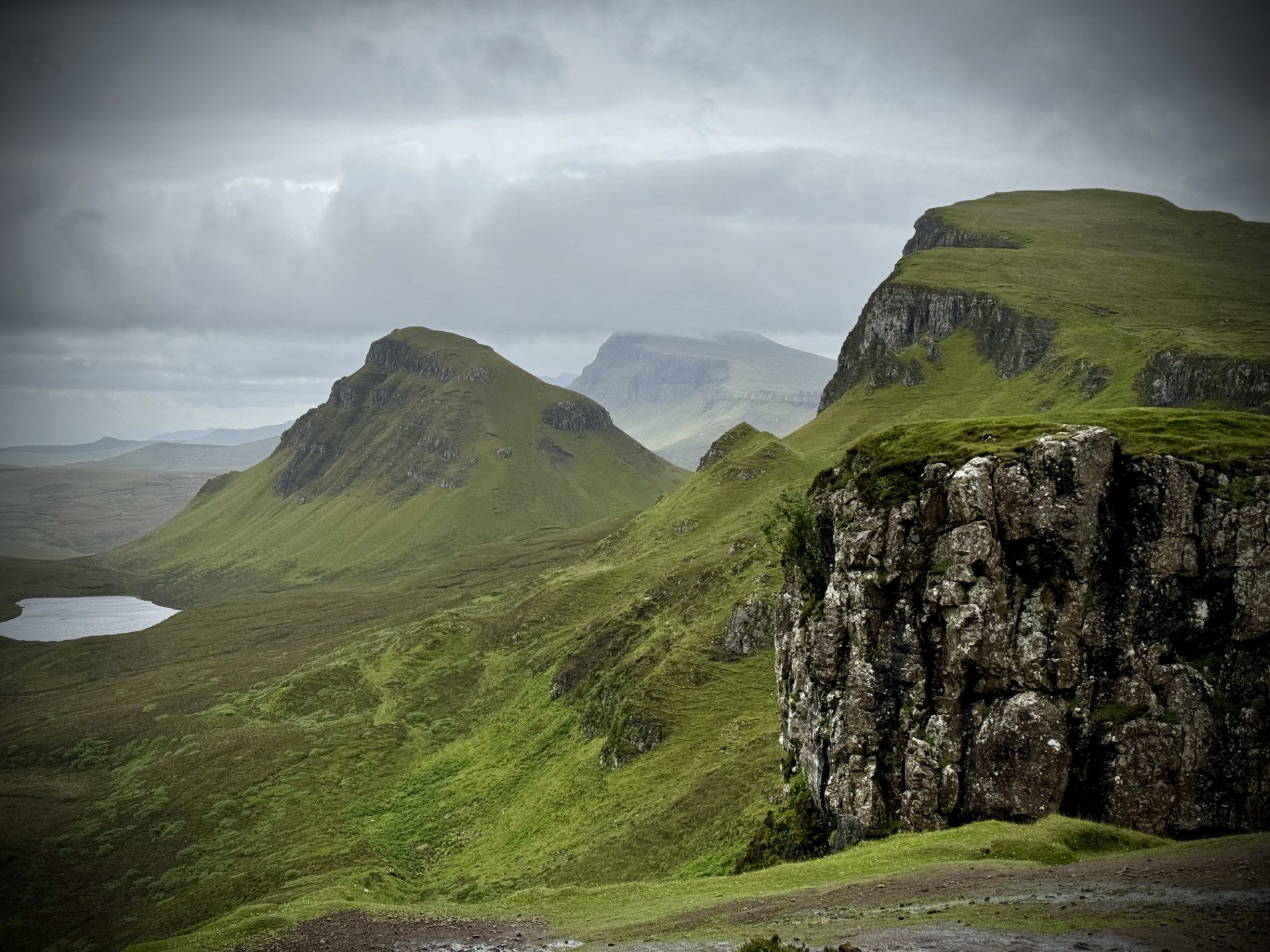

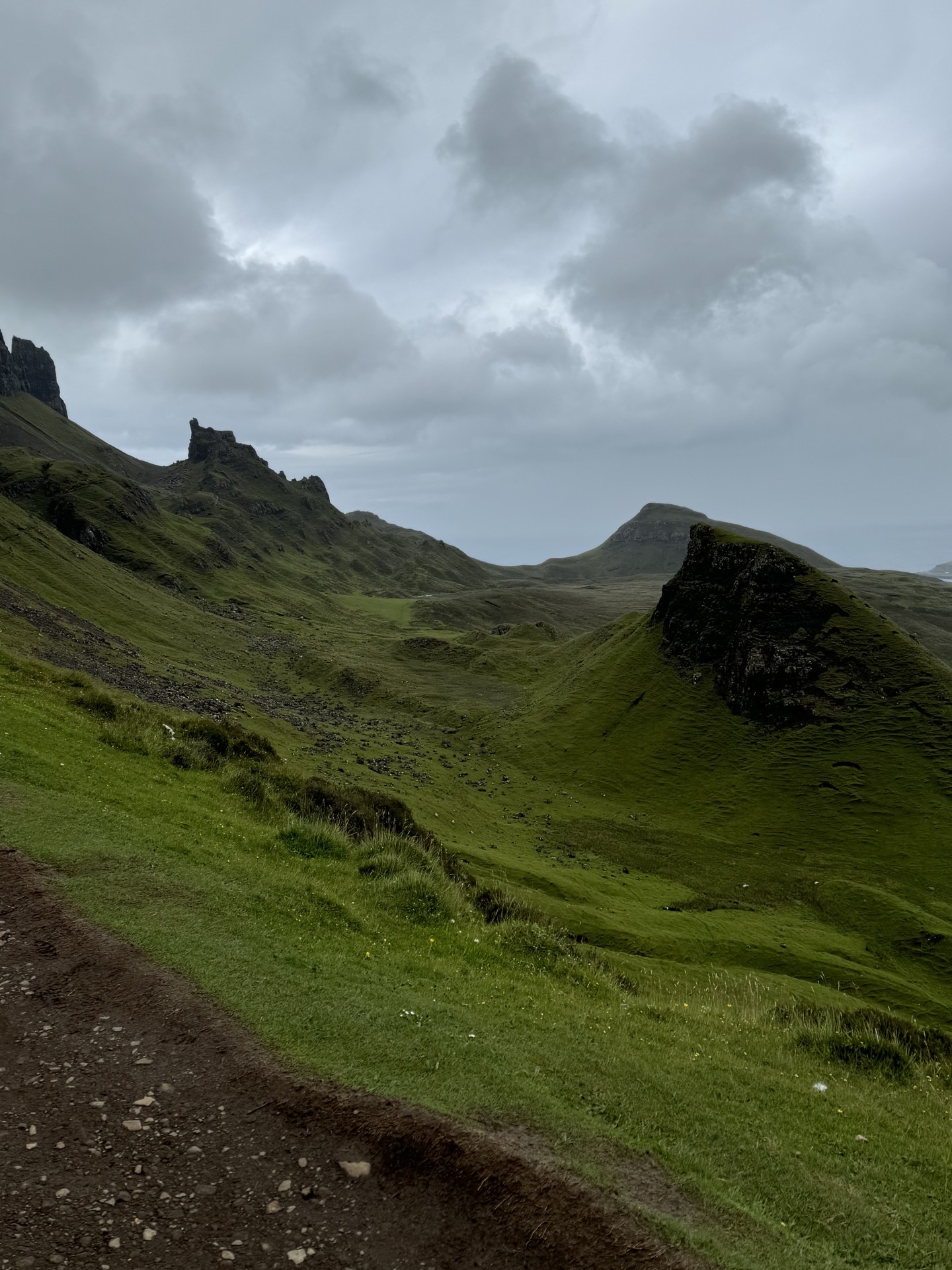
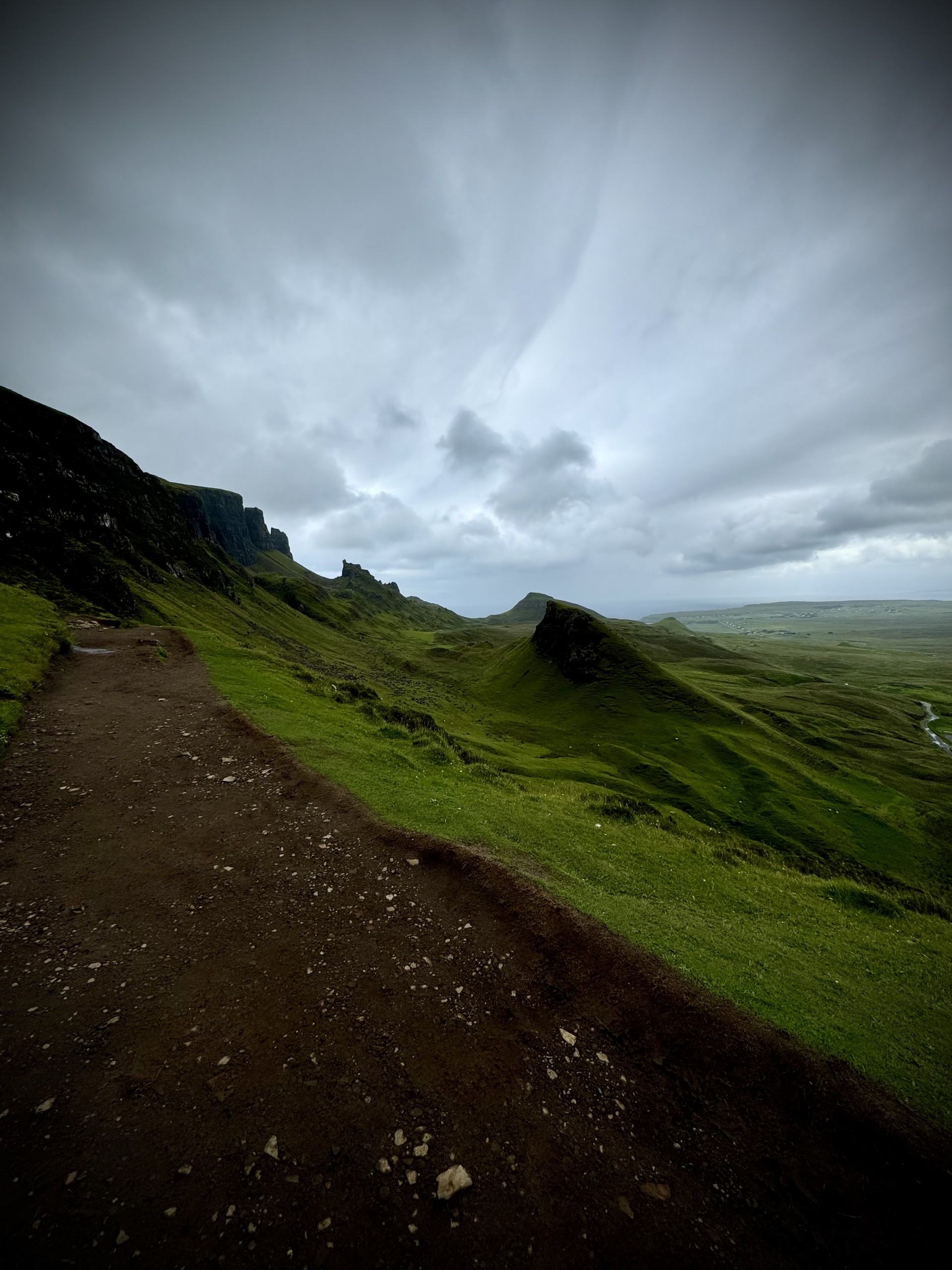
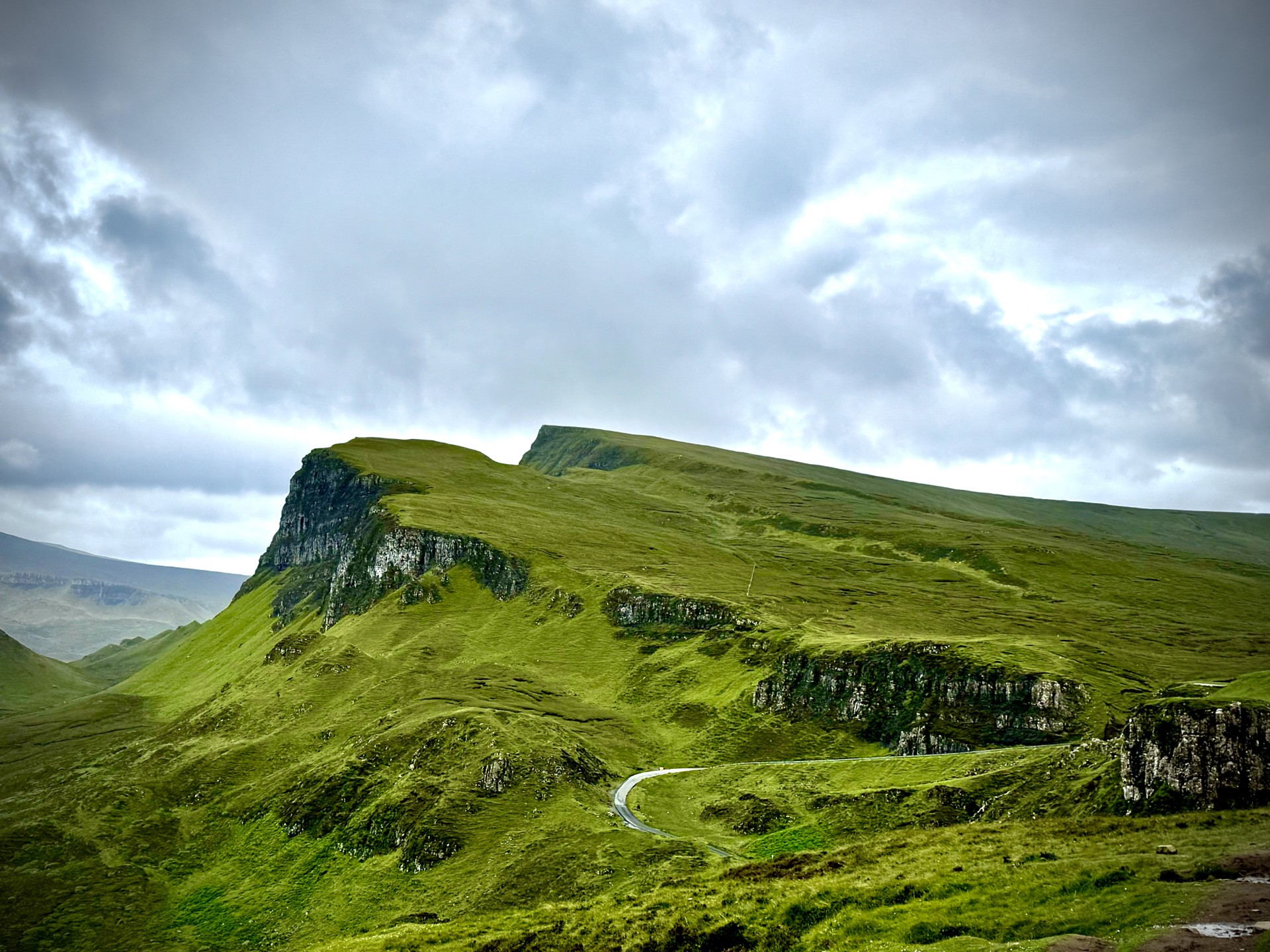


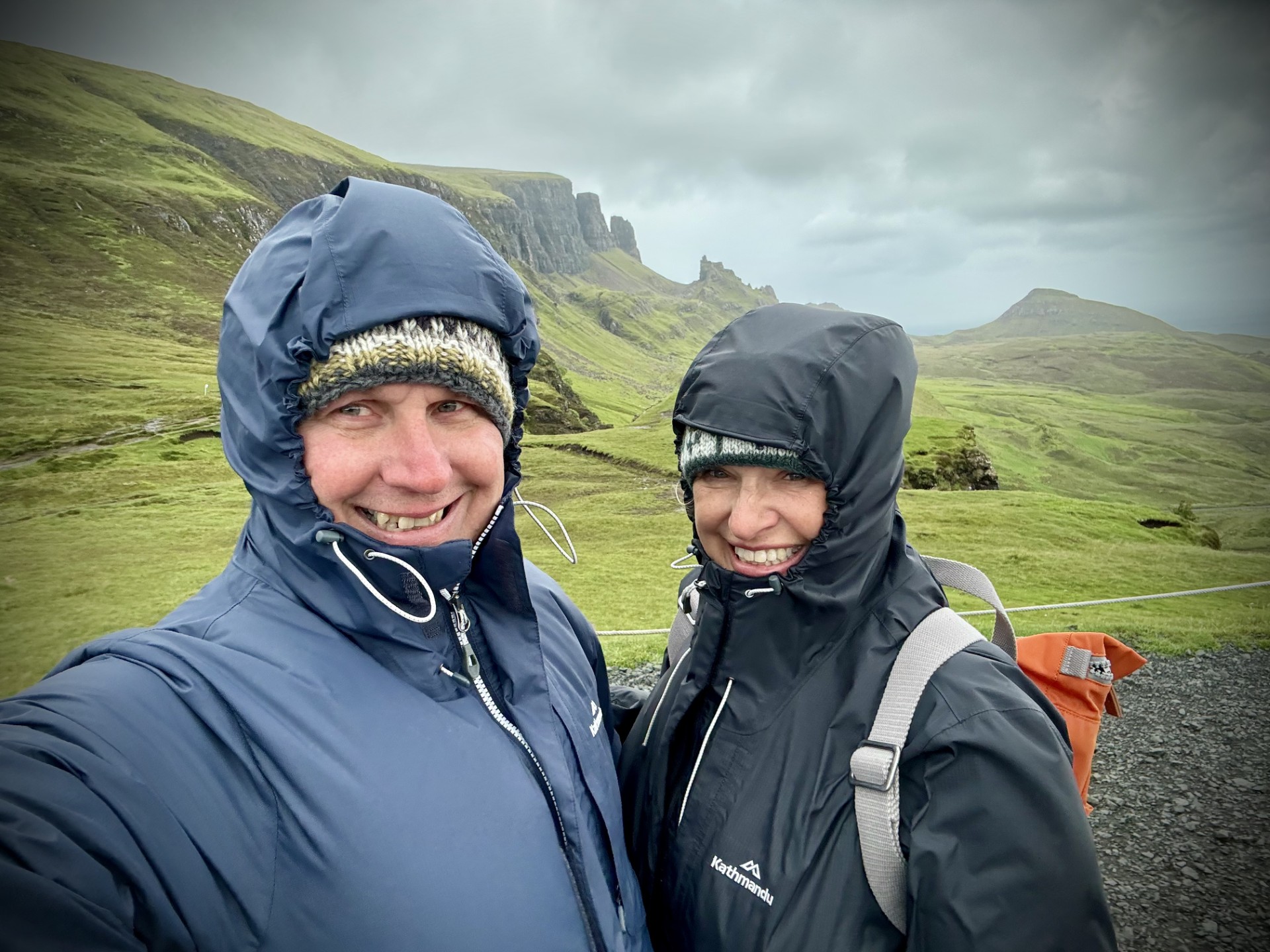
There’s a nice view of the Quiraing that you can see here. It shows how windy it was that day, as does the short clip here. You couldn’t hear me speaking, it was so windy!
Getting out of the wind seemed like a good idea, so we headed down to the waterfront to see both the Kilt Rocks and Mealt Falls as well as dinosaur footprints on the beach.
Mealt Falls is a magnificent waterfall cascading down cliffs and plunging into the sea at the Sound of Raasay, coming directly from Loch Mealt. Kilt Rock gets its name from steep basalt columns resembling kilt pleats. There’s a carpark with good views.
You can see a short video of it here.
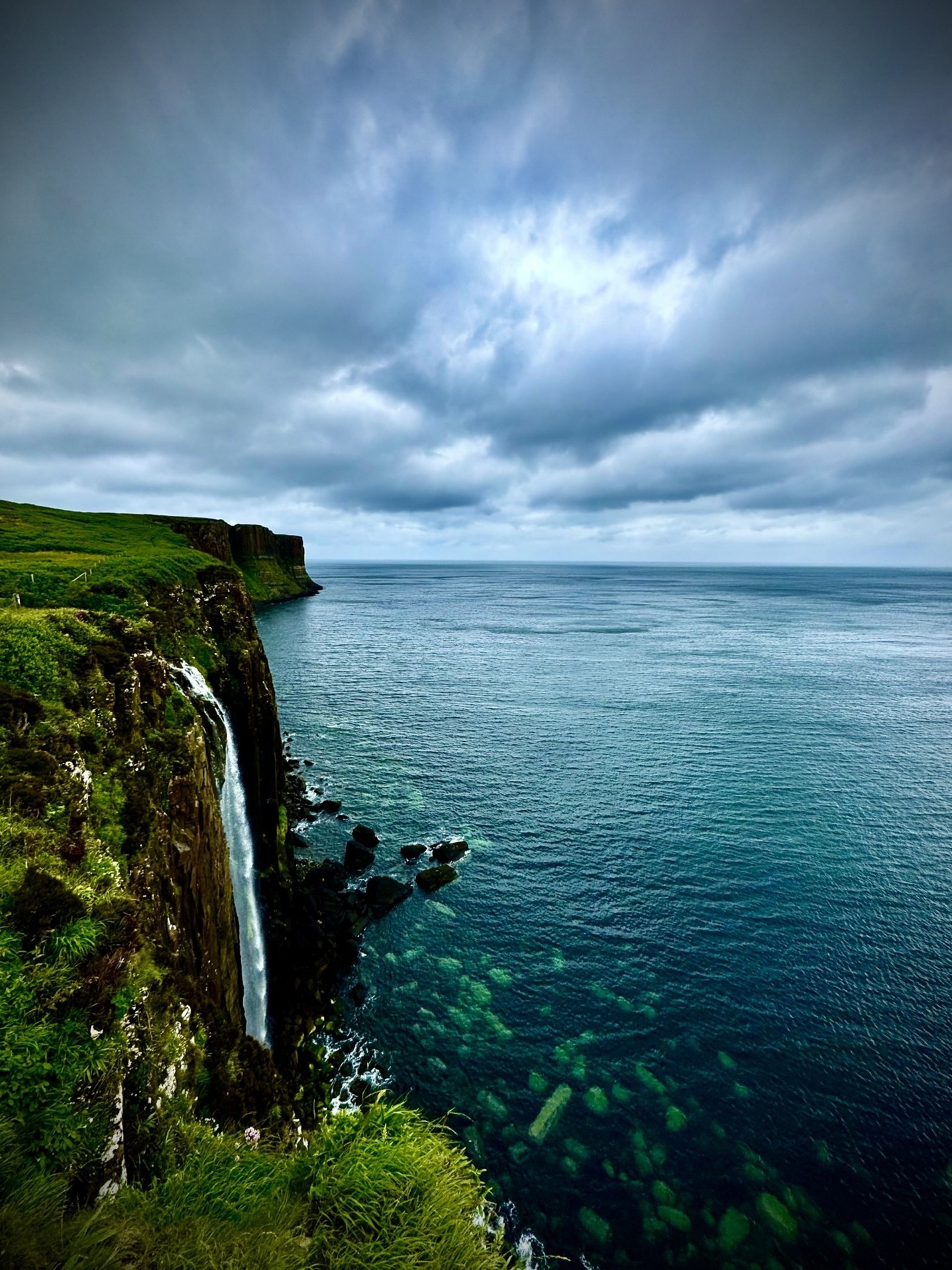
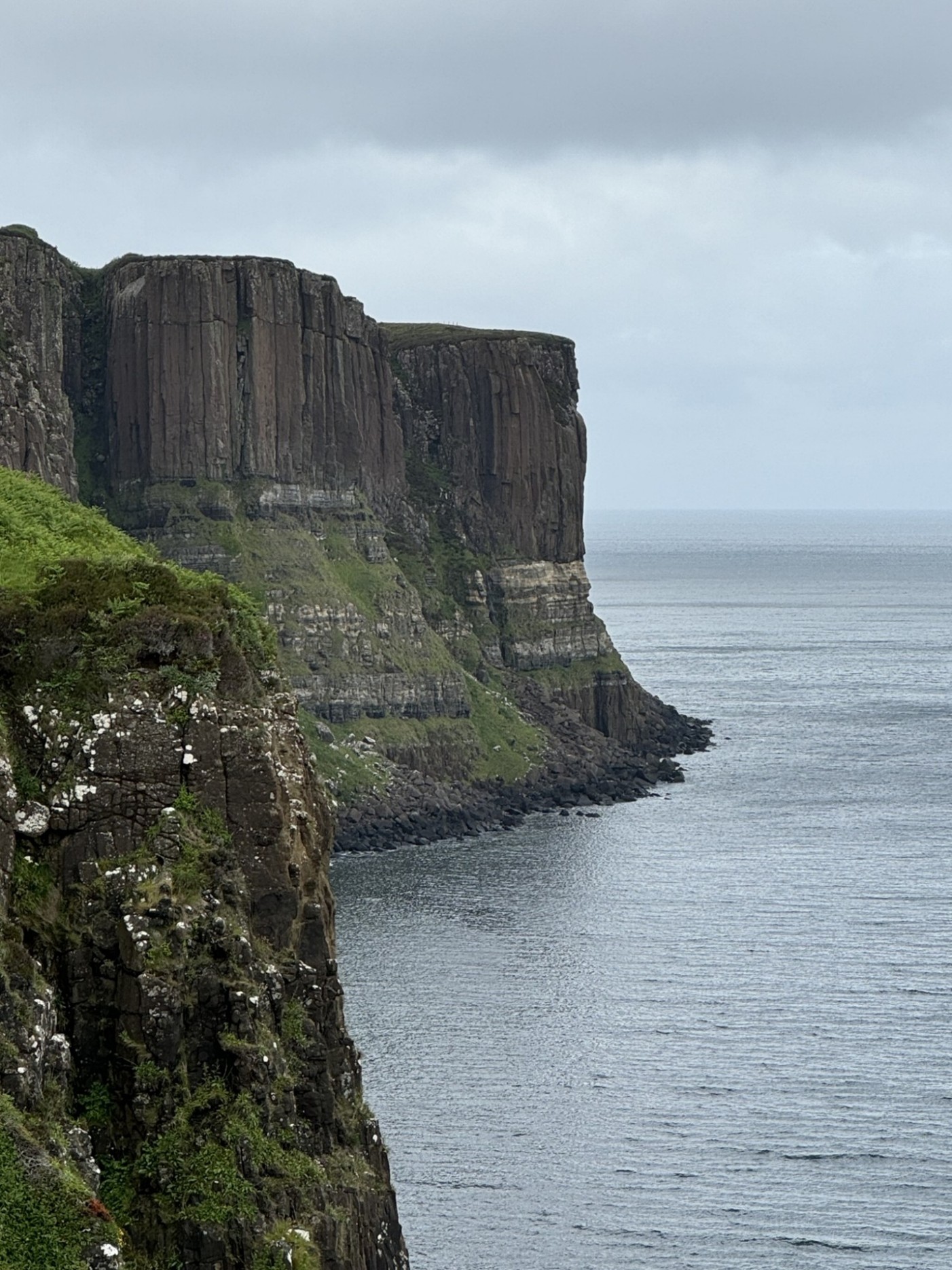
We were getting cocky with the weather and decided to chance our luck looking for dinosaur footprints at Staffin Beach. The footprints date back approximately 170 million years to the Middle Jurassic period, made by long-necked sauropods and three-toed theropods. We managed to see at least one print, however, the skies then opened and climbing back over rocks to the car took an eternity. We were absolutely soaked! I must admit, it’s hard to imagine Skye being subtropical though.

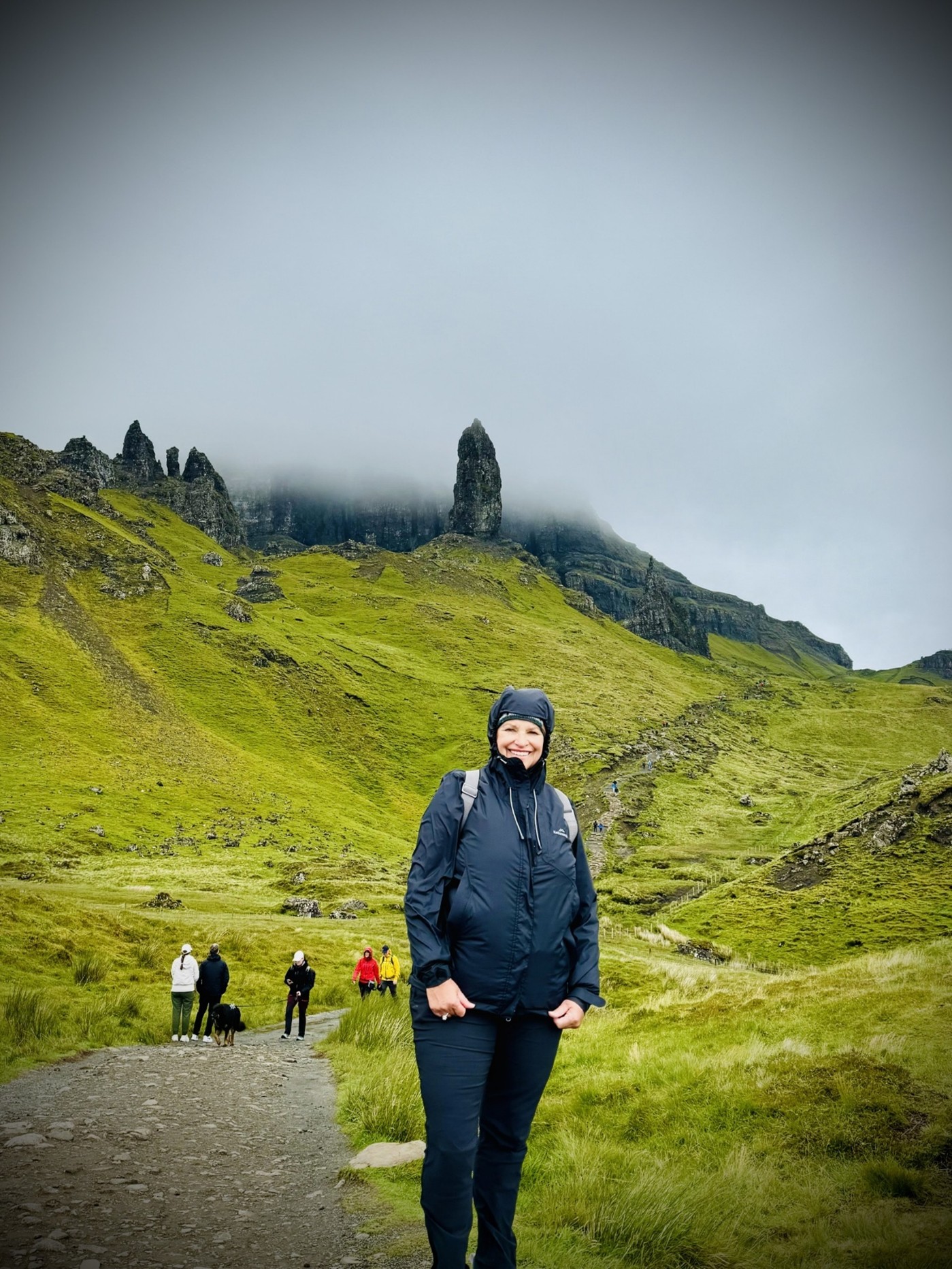
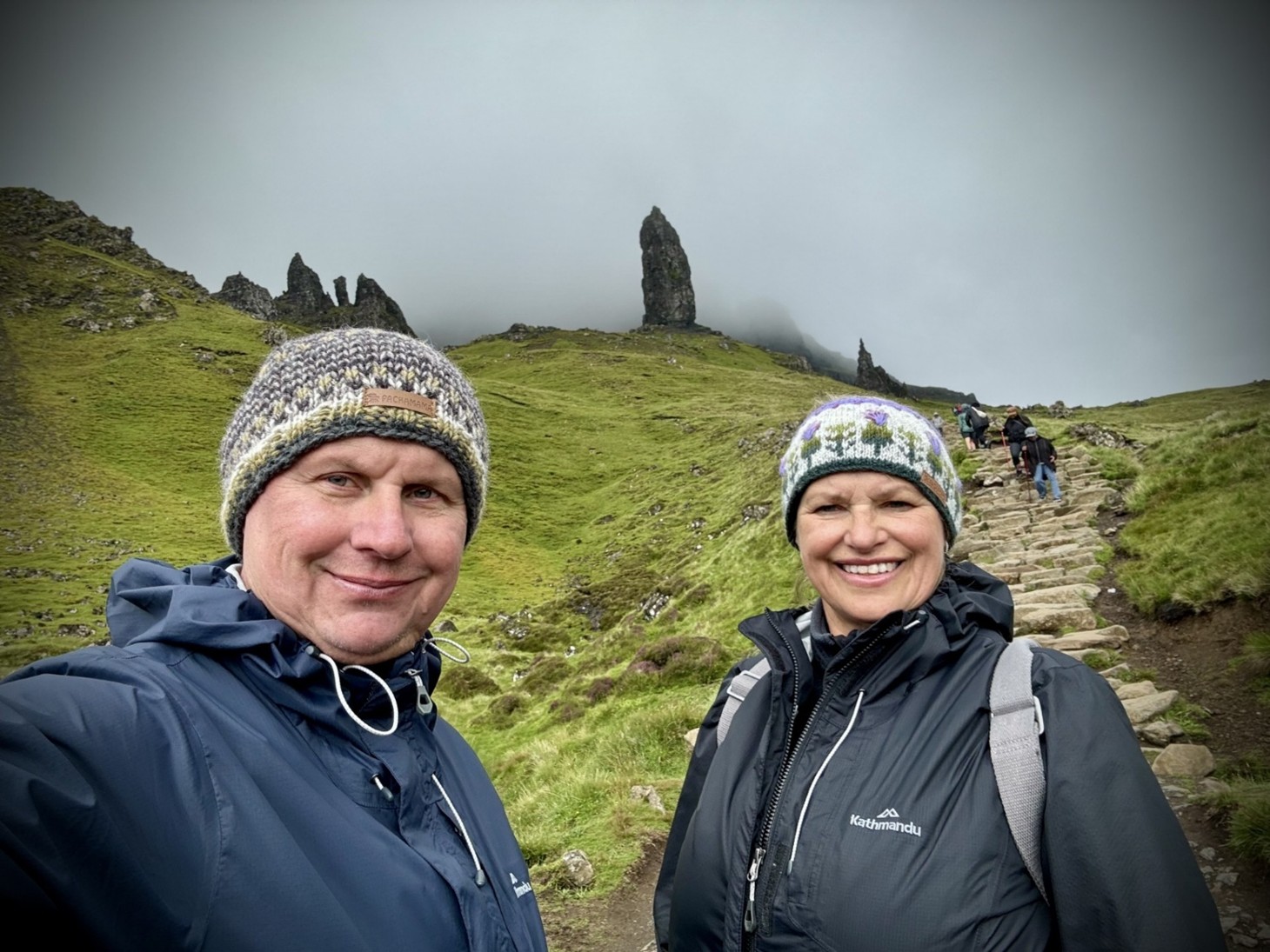
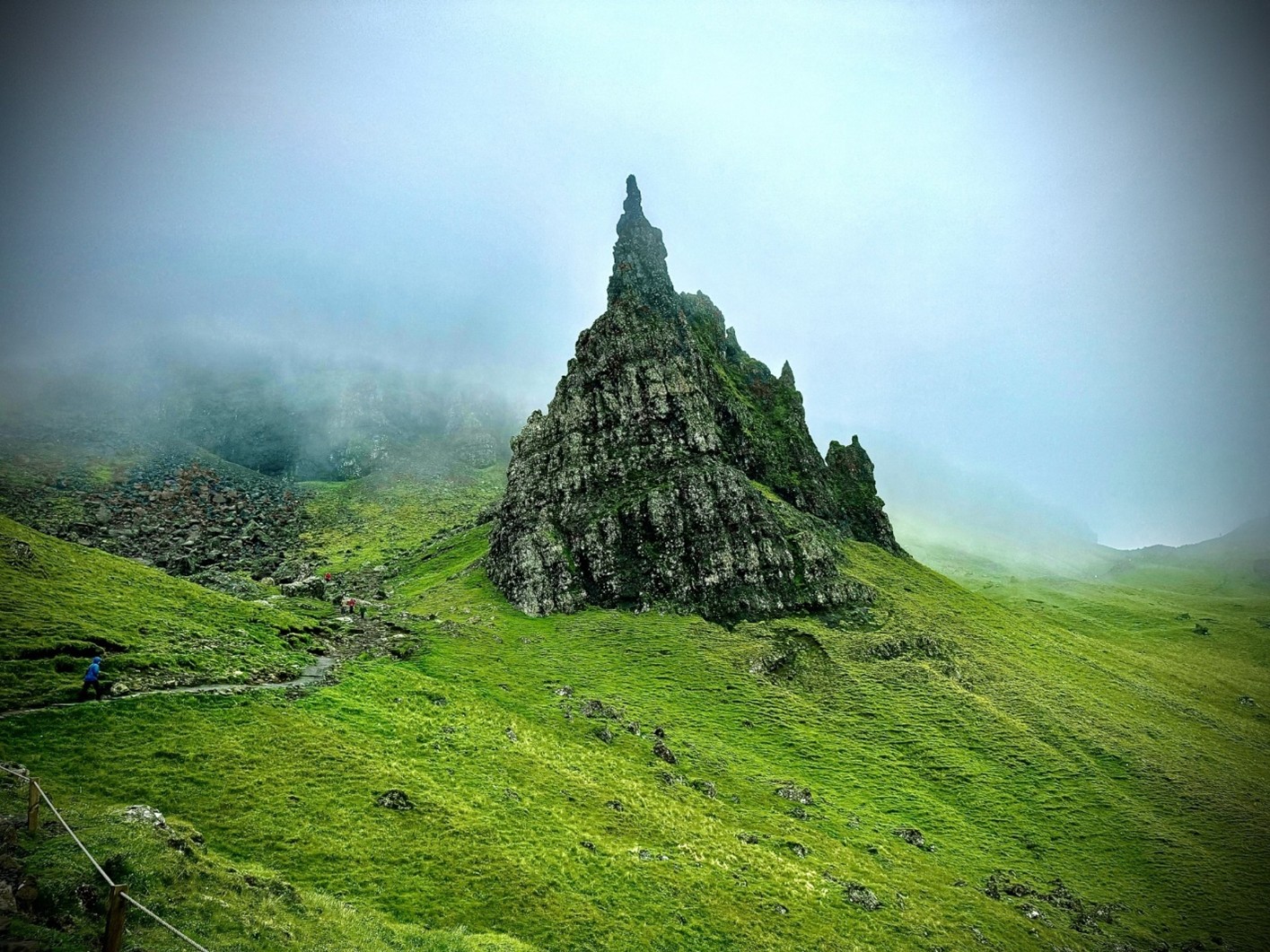
We hadn’t finished for the day as we were determined to walk up to the Old Man of Storr, a 50m tall rock pinnacle. Local legends claim it’s a giant’s grave, but I suspect it’s really part of the land slip (though the giant story is far more interesting!).
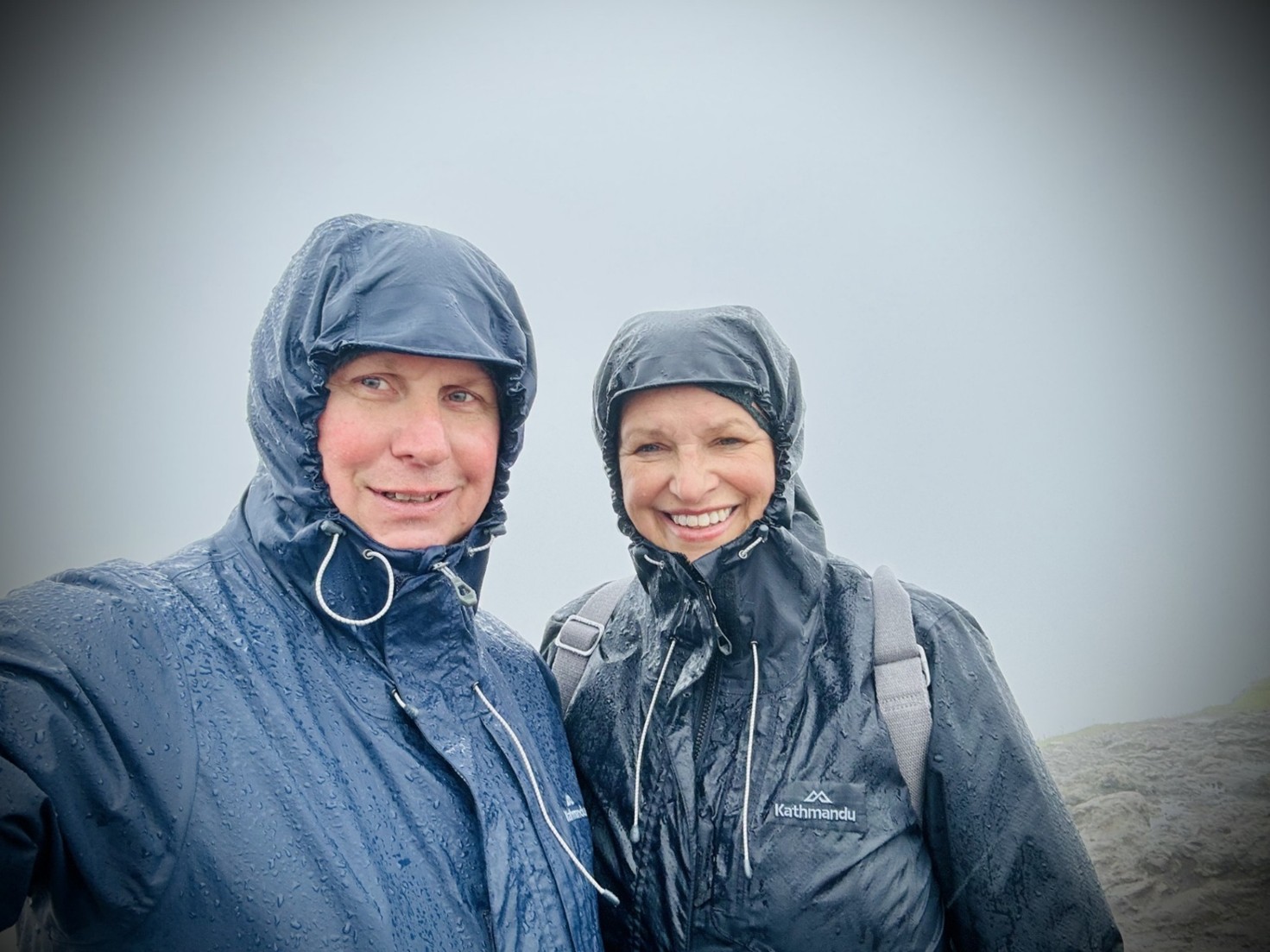
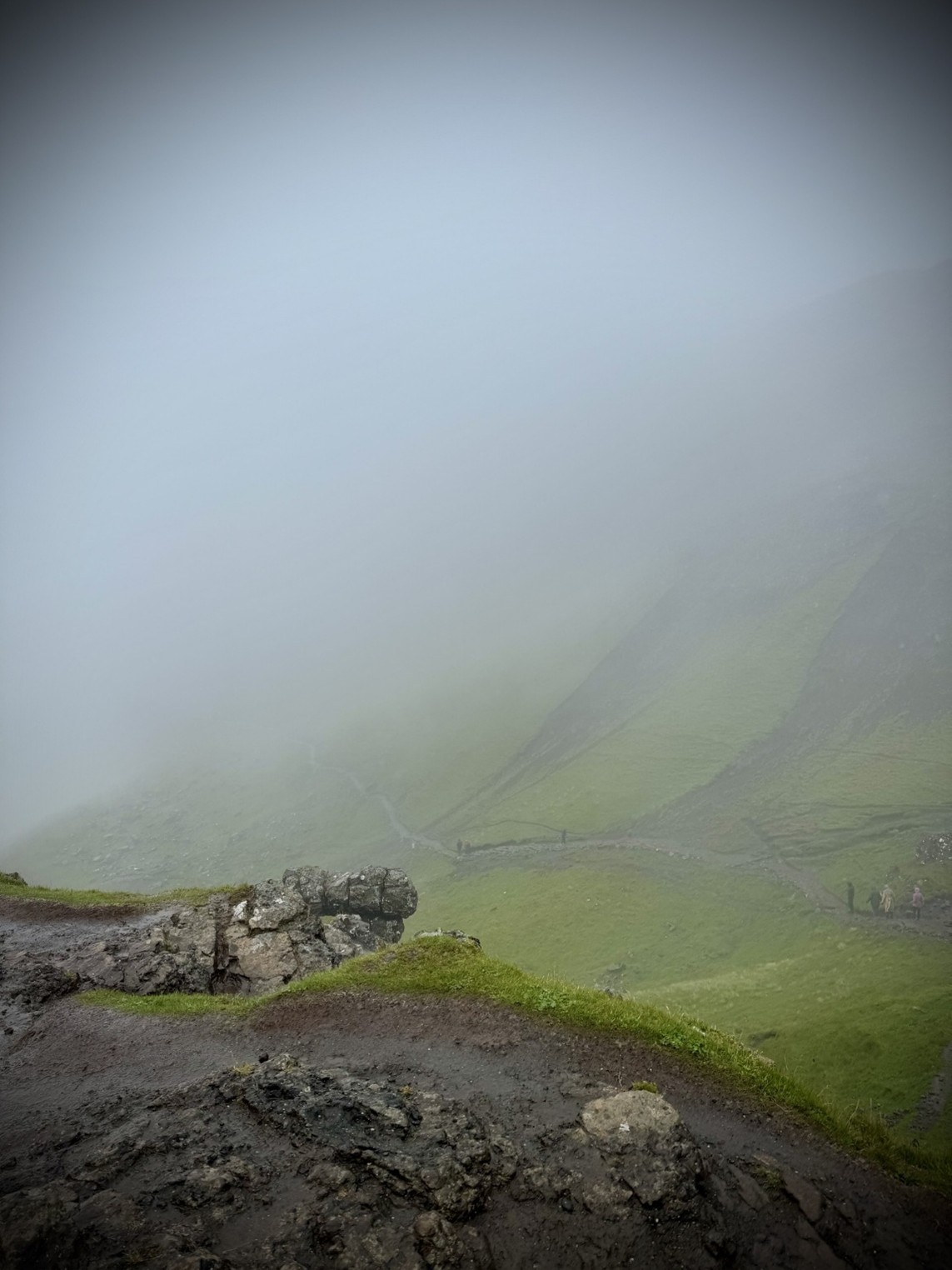
It’s only a 3.8km round trip and while there are slippy areas over rocks in the wet, we were soaked anyway so decided we may as well do it. We started walking and while the cloud was low, it wasn’t too bad. Part-way up, however, the rain started again and visibility dropped significantly. We made it to the top, but by then we were in the clouds with heavy rain. My weather app suggested it would clear in around 20 minutes, and I was keen to stay for photos. Josanne sensibly said we should head back down as it wasn’t going to clear (for once, my weather app was right, but we were halfway down by the time it cleared).
The photos were still stunning—I’d love to have gone up when the weather and views were better! By the time we got to the top, views were non-existent and we were soaked. Again. But still smiling!

Back at the car, we got most of the wet clothes off and headed back to the hotel for dinner and a well-earned dram for me and a G&T for Josanne. Our clothes hadn’t dried out by next morning when we checked out and headed to Armadale Bay.
With so many happy memories (most of them wet) from Skye, early on 29 June, we headed for the ferry back to Mallaig for the next part of the adventure. Although I’d never been to Mallaig, I’ve always been aware of it due to it being the title in one of my favourite bagpipe pieces, Steam Train to Mallaig.
DAY 8: ARMADALE TO MALLAIG, GLENFINNAN, AND GLENCOE (29 JUNE)
Ferry trips between the Islands were always quick and efficient. We set off early to drive from Portree to Armadale for the ferry to Mallaig. We chose this option as it’s only a short crossing and got us much closer for the next stint.
First stop was Glenfinnan. While there are two things of significance there, one is more famous to most of the world, though perhaps not to native Scots.
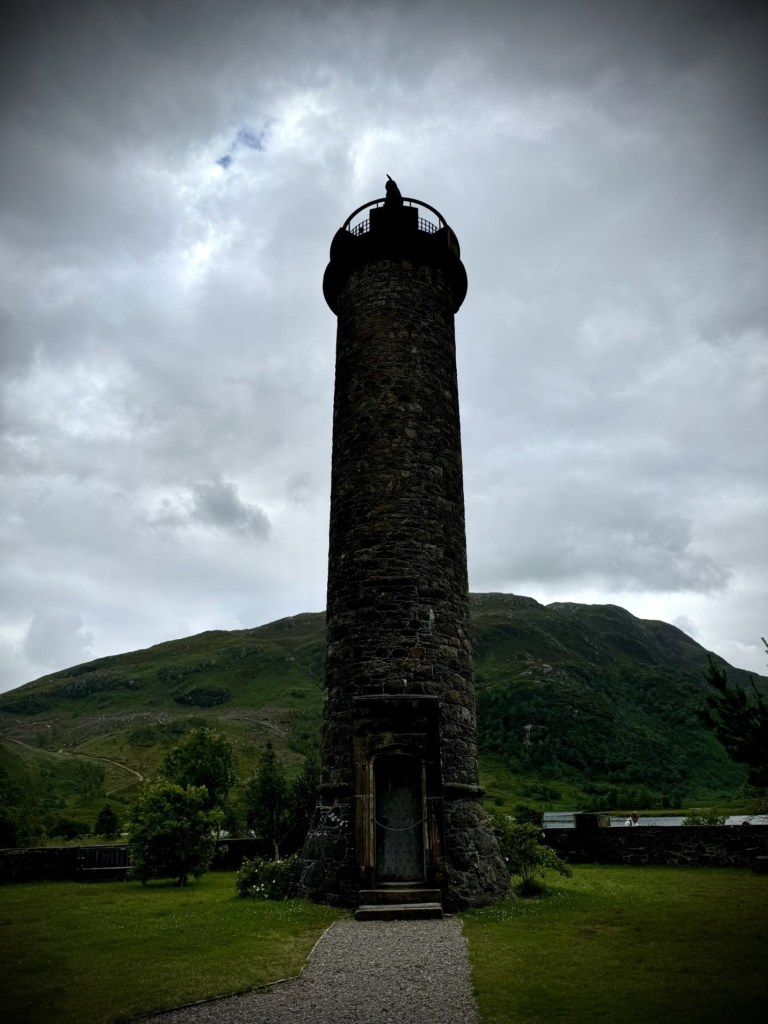
Glenfinnan was where Bonnie Prince Charlie raised his standard in August 1745, marking the start of the final Jacobite Rebellion (leading to Culloden in April the following year). On the banks of Loch Shiel, there’s a 60-foot monument commemorating the clansmen who fought and died. We first headed to the Glenfinnan Monument before the second attraction.

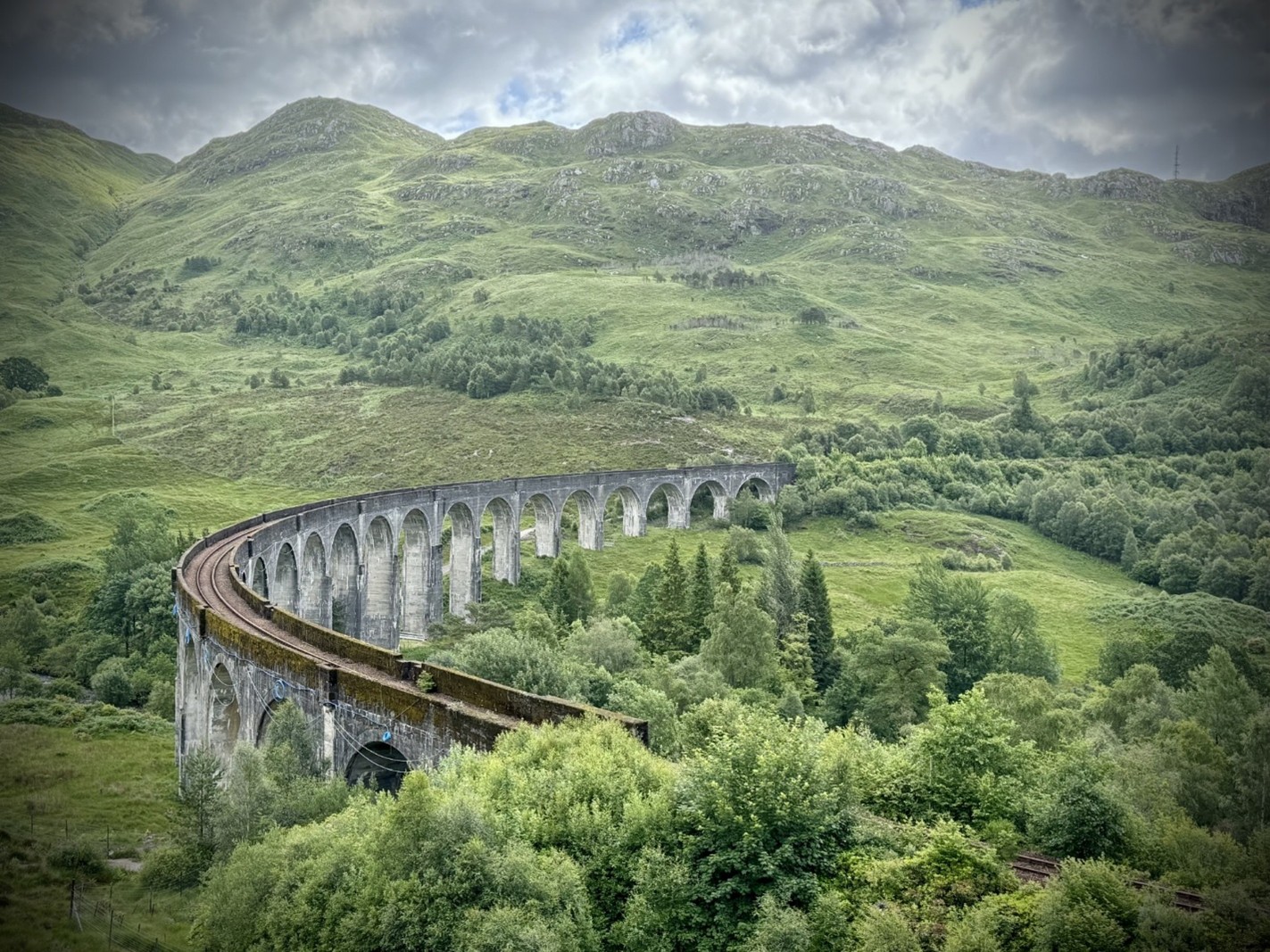
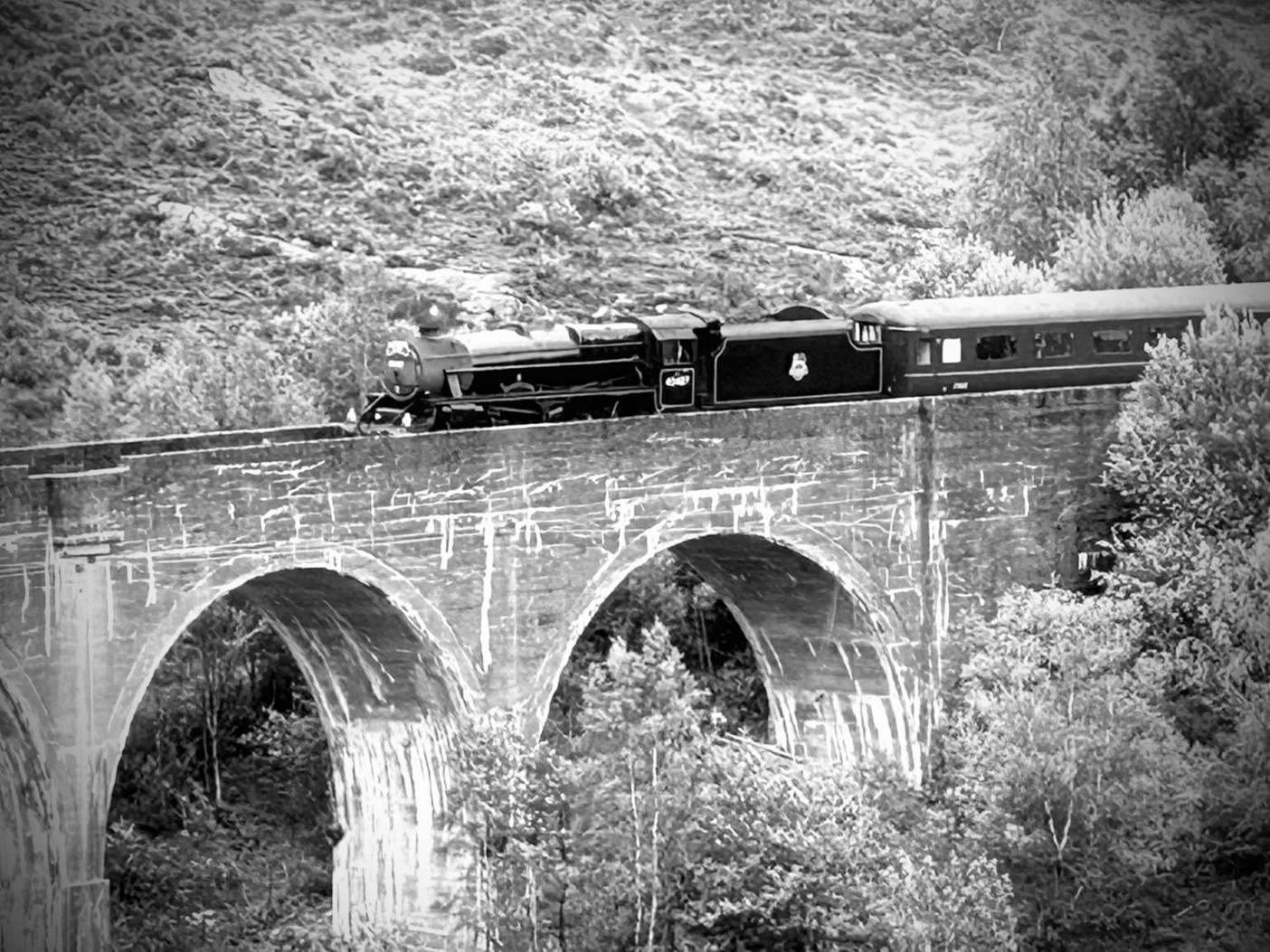
Glenfinnan is also home to the Glenfinnan Railway Viaduct. Completed in 1901 and built entirely of concrete, the 21-arched railway viaduct is undoubtedly one of Scotland’s most iconic railway structures. It’s where you can see the Jacobite Steam Train making its twice daily crossings between Fort William and Mallaig.
We got to our vantage point and waited with around 300 others for the train. It stopped as it got to the far side of the viaduct, gave a long, mournful steam whistle and started forward across the single-track viaduct, gaining speed. While we were there to see the Jacobite Steam Train, I think we may have been outnumbered by those coming to see the Hogwarts Express!
You can see the video that I took of it here.

As we headed back to the car, the grey skies turned rainy, but we’d ticked another thing off the list, so we didn’t really care.
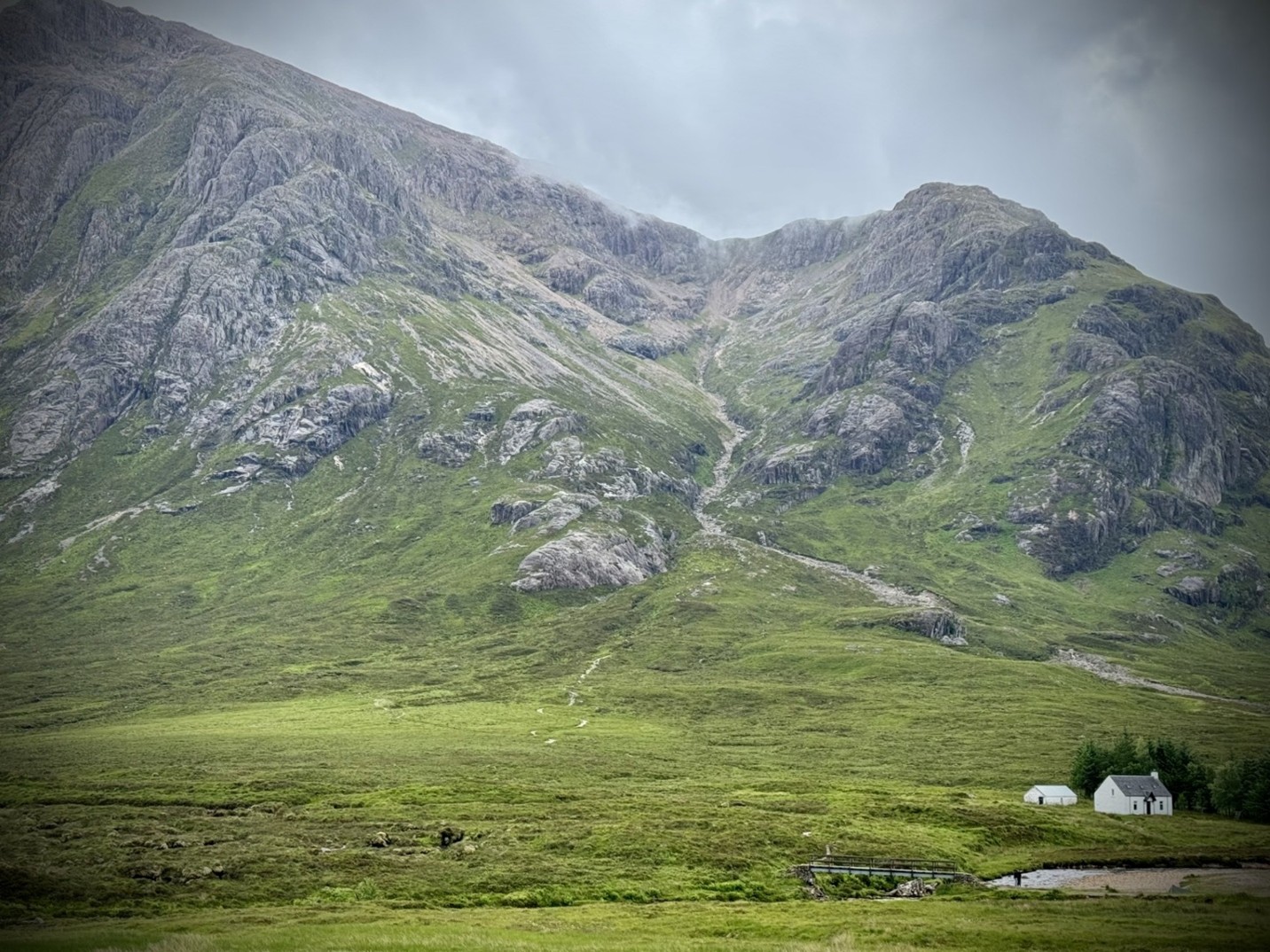
The next activity required a detour as Josanne really wanted to see Glencoe. It is, without doubt, both a famous and a dramatic glen. Moreover, it’s the site of the 1692 Massacre of Glencoe where 38 MacDonalds were murdered by Campbells.
The glen was once an ancient super volcano, but Ice Age glaciers and millennia of weather have reshaped it. The A82 road takes you right through the middle with a few places to stop for photos.
Josanne was mesmerised by Glencoe’s beauty, and we spent an hour chatting and taking photos. It being Scotland, in the short time we were there it was both sunny and misty and atmospheric. It did not disappoint.


We stopped briefly in the Glencoe Museum where you see traditional thatched houses and learn about farming. The story of the 1692 massacre was shared in detail.
From here, it was off to Oban where we’d spend one night.
DAY 9: OBAN (30 JUNE)
Oban is known as the “Gateway to the Isles” as you can get ferries to both the Inner and Outer Hebrides. It has a working fishing port and draws tourists from all around Scotland and beyond. Our primary reason was catching a ferry to the Isle of Mull, but we both wanted to explore the town.
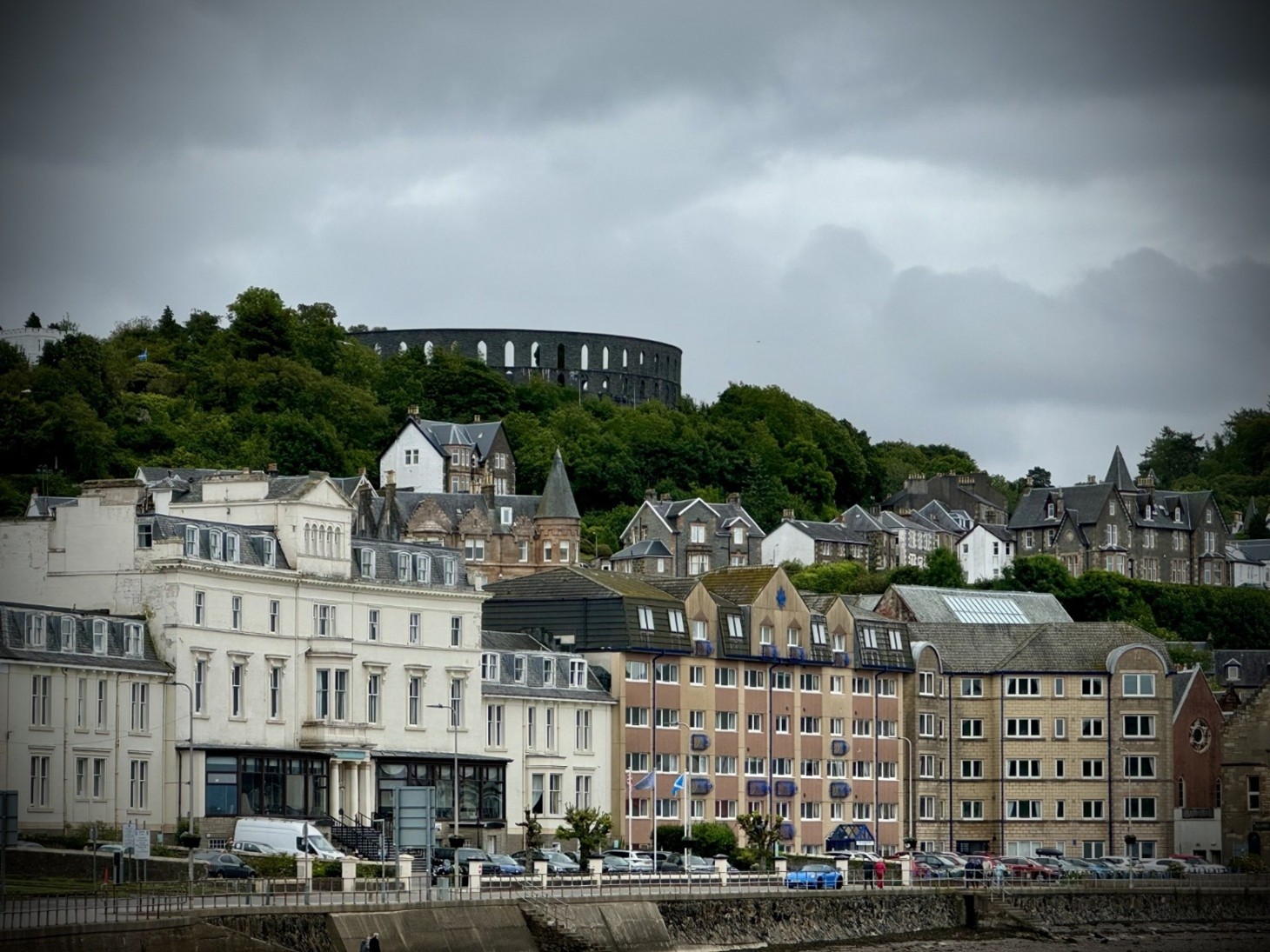
Having been in Rome two weeks prior, it was interesting to see Oban had its very own Coliseum (though slightly less spectacular than Rome’s version)! McCaig’s Tower dominates the skyline, built between 1897-1900 to provide work for locals and as a family memorial. It was never finished.
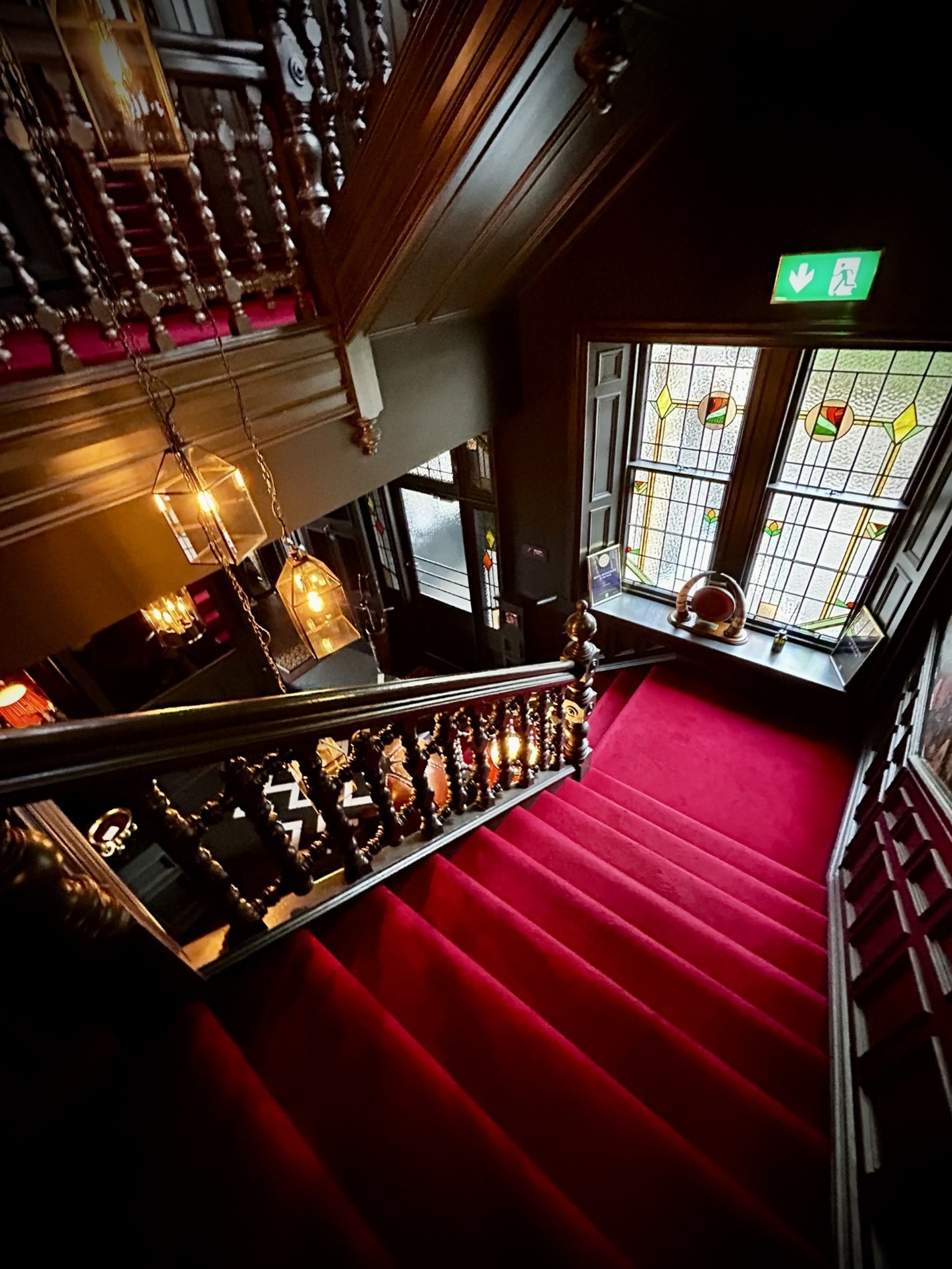
Oban is home to one of Scotland’s oldest distilleries (founded in 1794) and, perhaps not surprisingly, some excellent seafood thanks to the local fishing fleet. We spent the day exploring the town and decided to eat in the hotel restaurant that evening as we were quite tired. It was a beautifully restored Victorian era hotel (No 17 The Promenade), sitting on the waterfront. The owners had done a great job blending historic charm with modern luxury, with lovely views over the Sound of Mull.

DAY 10: ISLE OF MULL (1 JULY)
The Isle of Mull hadn’t initially been on Josanne’s “must do” list, but I wanted to see more than one Island and had heard lots of positives about Mull. We caught the 9.30am ferry for the 45-minute crossing from Oban to Craignure. The journey takes in views of many other islands like Kerrera, Lismore, and Jura.
We left early to use most of this day exploring on the way to Tobermory, knowing we’d have to drive straight back down next day. It was a good call and the sun was out. I was very pleased we’d chosen to visit Mull as it truly is diverse by terrain, history and sights.
We’d earmarked two “must do” items, to visit Duart Castle and the Distillery in Tobermory. As it was such a beautiful day and the driving (most on single track roads with passing bays) was a joy, we took yet another detour to visit the Standing Stones at Kinlochspelve.
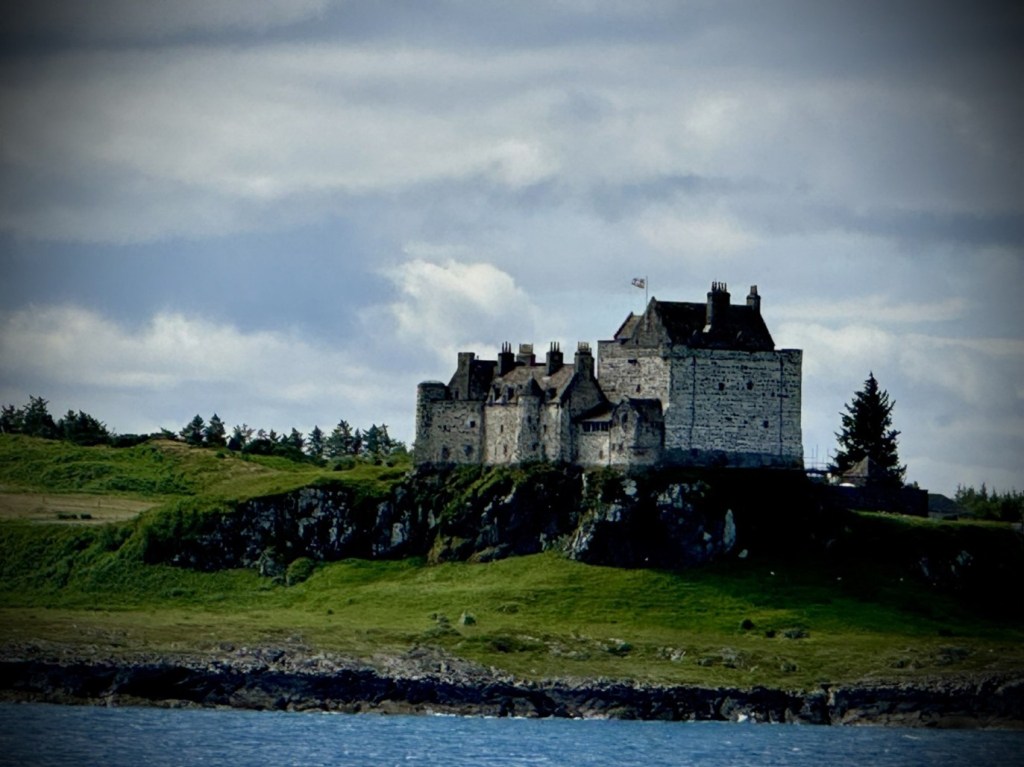
We’d sailed past Duart Castle on the CalMac ferry so that cemented our decision to head there first.
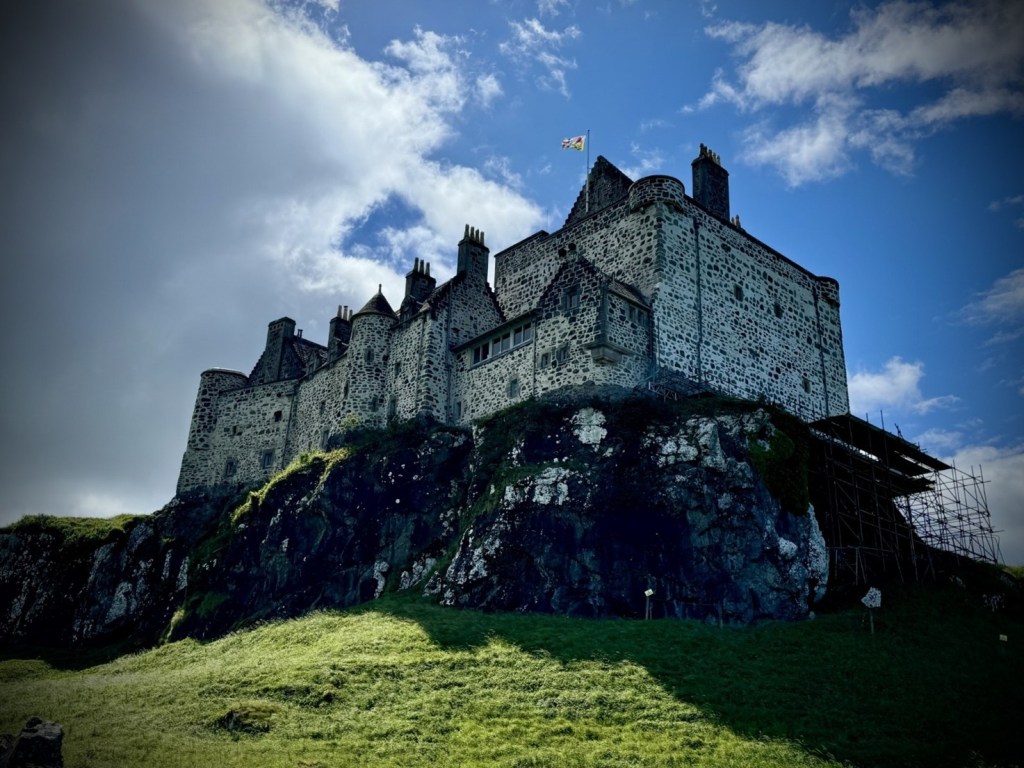
The castle has been the ancestral seat of Clan Maclean since the 1200s. It looks very dramatic, sitting on a hill overlooking the Sound of Mull. While abandoned for a long time, Sir Fitzroy Maclean refurbished it in 1911, and the Maclean family still owns and lives in it now.



Those who’ve watched Outlander will know all about Standing Stones. I made Josanne hand me the car keys before she touched one. Just in case!
It was only around 12 minutes from Duart Castle to Kinlochspelve, a small settlement at the head of Loch Spelve. The ancient standing stones allegedly date back to the Bronze Age (approximately 3,000-4,000 years old). Their purpose remains contentious—they could have been astronomical, ceremonial, or territorial markers. We’ll never know for sure! To reach them, there’s a small parking area (only accommodating three or four cars) and then you walk across farmland.


It’s a very atmospheric setting. I found myself quietly contemplating what it could have been like here 3 or 4 thousand years ago. How did the people live? What did they do here? I did have the eerie feeling we were being watched…

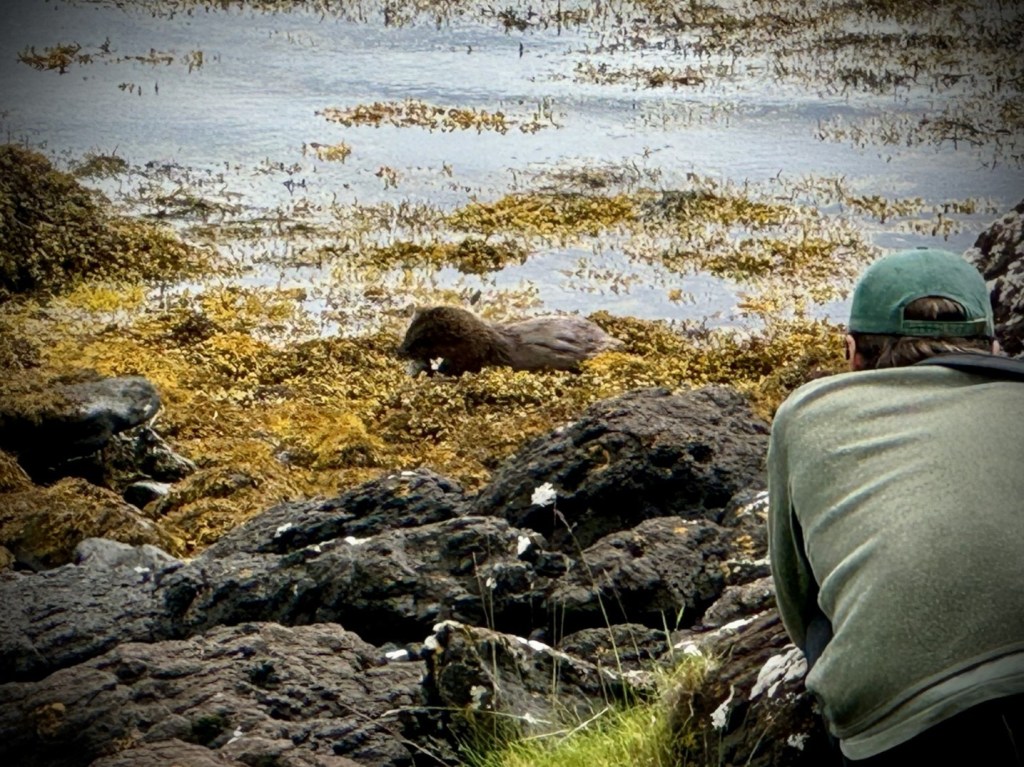
The drive from Kinlochspelve to Tobermory was another you couldn’t get bored of. So much to see, from mountains (where we did see soaring eagles, though I didn’t get a photo). The route we took let us explore some of Mull’s most evocative landscapes—a fantastic blend of coastal views, forested glens, and open moorland. We even came around one corner to find 4 or 5 cars stopped with their inhabitants watching a sea otter eating an eel. If we’d been 5 minutes earlier, we’d have seen the fight for survival the eel eventually lost.
As I only had my iPhone, these photos were as good as I could get. You can see a brief video of it here.
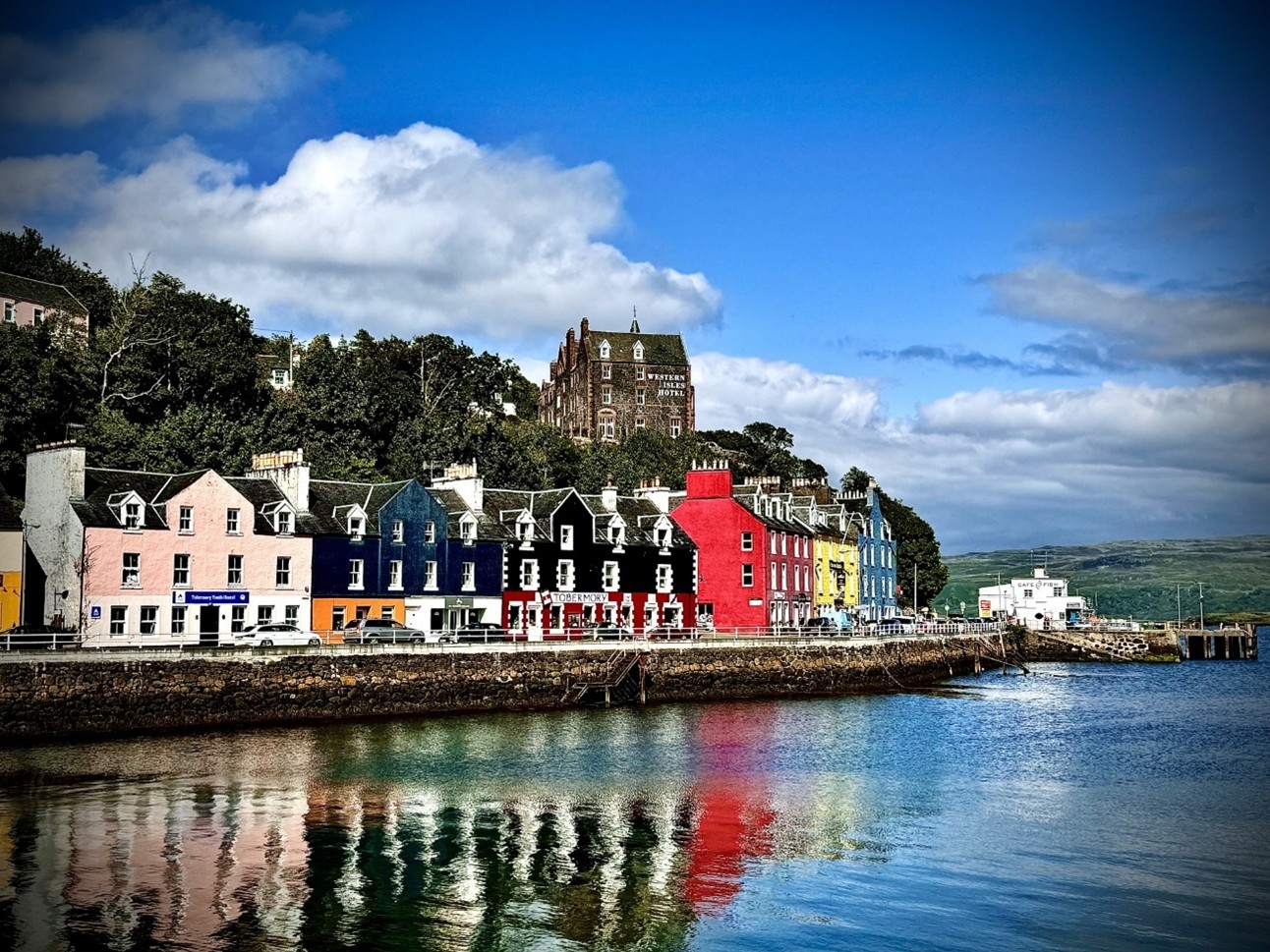
Tobermory is the main town on Mull, most famous for its brightly coloured buildings. It’s allegedly one of Scotland’s most photographed harbours and I can see why. Although only a small town, it has shops, galleries, restaurants, pubs and even a distillery established in 1798. It’s also a working fishing port with plenty of good seafood.
We got lucky with the weather as the sun shining certainly added to the feel-good factor. The colours brightened under the sun’s gaze, as if Tobermory had dressed for the occasion. There’s allegedly a sunken Spanish galleon from the Armada that sank in the bay in 1588. More importantly, the gold supposedly on board has never been found. Maybe next trip…
We again ate in the hotel this evening as they had a nice menu and it meant we could both have a drink with dinner.


DAY 11: MULL TO GLASGOW VIA LOCH LOMOND (1 JULY)
Next morning it was raining, but we’d explored all we needed on the way up to Tobermory. All we had to do was head back to Craignure for the 9.55am sailing back to Oban, arriving around 11am.
The plan was heading to Glasgow via Loch Lomond. I may have taken a slightly more circuitous route than planned, but we eventually got back on track without too much shouting!
While you drive along the length of the Loch, there isn’t necessarily that much to see other than water. We’d decided to stop at Luss for late lunch and a look around.
Loch Lomond is obviously well known for the song “The Bonnie Banks o’ Loch Lomond.” In the song, widely associated with the Jacobite rebellion, the “High Road” is interpreted as the physical route taken by the living successfully returning to Scotland after battle. The “Low Road” refers to the spiritual path of the dead. It was believed a deceased person’s soul could return to Scotland quicker than the living, hence the singer being in Scotland via the Low Road before his companion taking the High Road. Hence the song is about someone not returning home, having died. Runrig (a band from Skye) have a fantastic live version of this song that you can watch here.
We stopped at Luss for a look around and lunch. For some reason, I didn’t take any pictures of Loch Lomond. It was a typically grey day, so maybe it wasn’t looking its best! From there, we were in Glasgow in under an hour. I’d chosen the Sherbrooke Hotel for this overnighter.
The hotel (as it is now) was built in 1896 of red sandstone as a private residence during the industrial boom. During World War 2, it was used as a radar training centre for naval officers and is now a Grade B listed, 14-room luxury hotel.
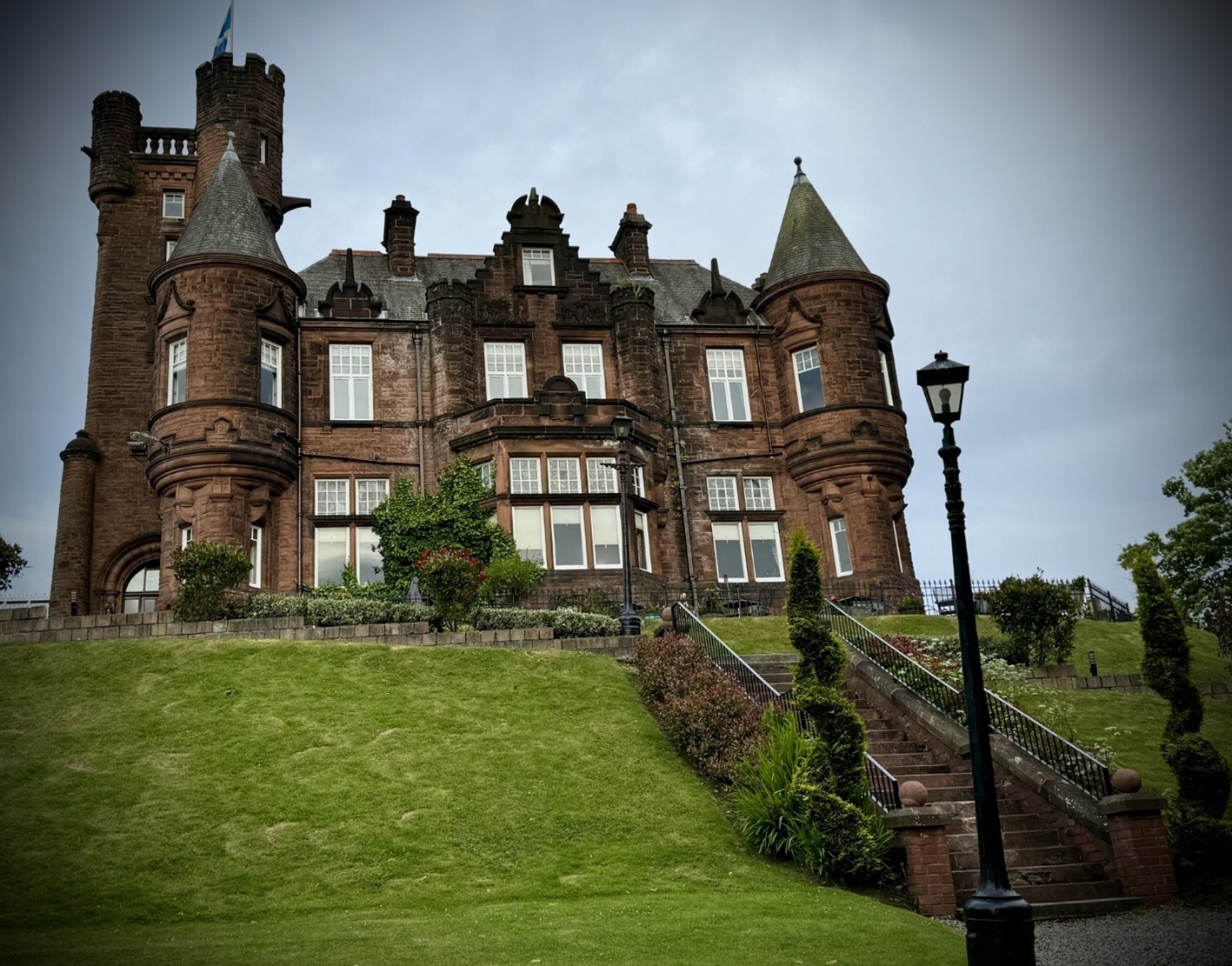

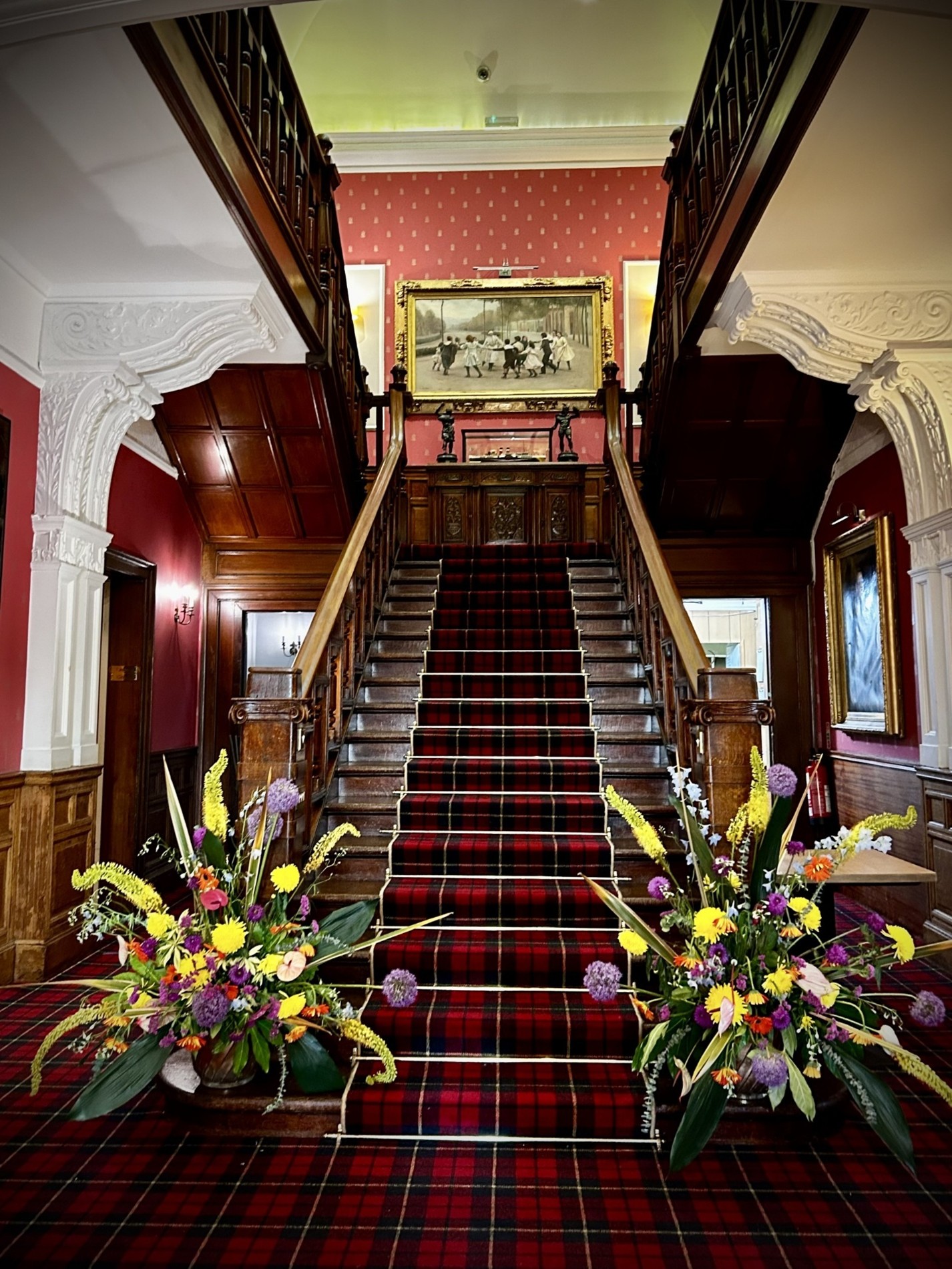
However, none of those was the reason I booked it. It was primarily booked as it was close to Ibrox, where my beloved Rangers play, and I was booked in for a Stadium Tour the next day! That, however, is another story for another day!
POST TRIP REFLECTIONS
As I drove south from Glasgow toward Newcastle, leaving behind the mountains, lochs, and islands that had shaped the past nine days, I felt a quiet, contemplative smile settle in. Josanne had been eager to see more of Scotland, but I enjoyed it just as much as she had.
This journey connected deeply with both of us. We travelled from the granite respectability of Aberdeenshire to the otherworldly beauty of Skye and Mull, from battlefields where history was created and changed, to remote beaches where dinosaurs once walked. We took ferries, navigated single-track roads, and stood before castles that have witnessed centuries of often bloody Scottish history.
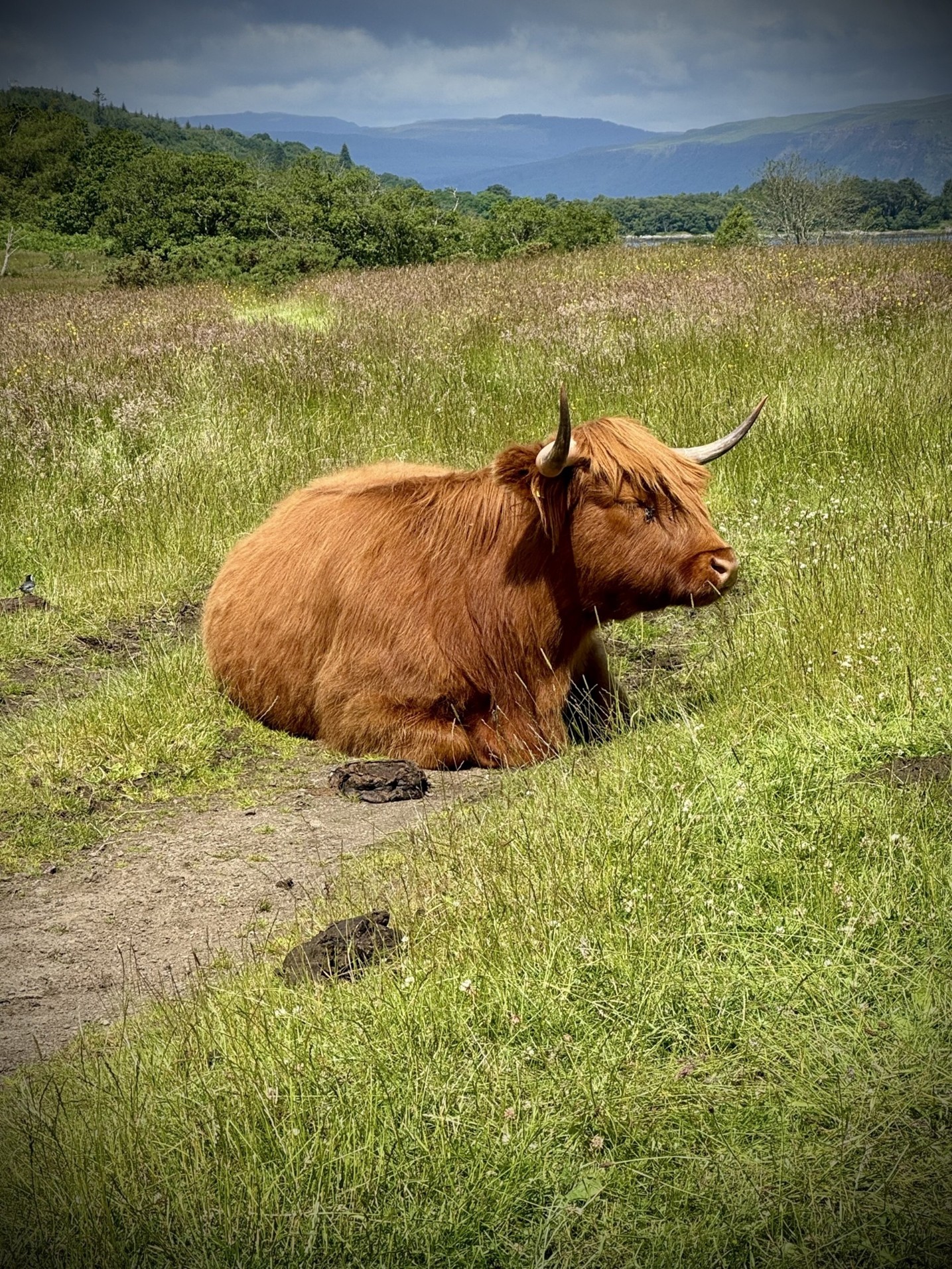
As I smiled, I reminded myself why we travel in the first place. It’s not to tick boxes on an itinerary (though ironically, I’d certainly created a spreadsheet to do just that), but to embrace the possibility of wonder. To stand before the Old Man of Storr as mist swirls around ancient rock. To watch Highland cattle amble across the road as if they own it (which, in a sense, they do). To trace the footsteps of Jacobites and clan chiefs, Vikings and alleged prehistoric giants created memories for both of us that hopefully stay with us forever.
Scotland is a land where every mile reveals another breathtaking view, where history isn’t confined to museums but lives in every ruin, ridge and castle. The landscape tells stories of prehistoric volcanic fury, glacial carving, and human endurance, sometimes against all odds. While New Zealand offers its own raw beauty, it doesn’t carry the ancient weight Scotland does.
Scotland is redolent of ancient ballads and battlefield winds, where standing stones whisper of forgotten rites, harbour towns glow brighter under the sun’s gaze, and every glen carries the scent of memory, rebellion, and belonging. I’d forgotten how much I missed her!
PRACTICAL INFORMATION FOR TRAVELERS
Best Time to Visit:
- June offers long daylight hours (sunset after 10pm) and relatively mild weather. Don’t expect too much of Scottish weather though—it can disappoint!
- Midges (tiny biting insects) are less prevalent in June than July-August. That was a godsend for us as insects love biting me.
- Summer is peak season. Book accommodation well in advance as if you just turn up, you may not get in.
- Weather is changeable year-round, so always pack layers and waterproofs (and if you have a beanie, take it. Just in case!)
Driving in the Highlands and Islands:
- Many roads are single-track with passing places. Pull over to let faster traffic pass. Be nice; it doesn’t cost anything.
- Watch for sheep, Highland cattle, and deer on roads and be ready to stop for photos if the opportunity arises.
What to Pack:
- Waterproof jacket and trousers (essential)
- Layers for changeable weather
- Good walking boots or shoes
- Midge repellent (in summer at least)
- Camera with good zoom for wildlife (though all my photos were from an iPhone 15 Pro)
- Binoculars for wildlife spotting if you plan on doing any of that
Costs:
- Scotland can be expensive, especially in peak season
- Ferry bookings should be made in advance (CalMac). These are, surprisingly, not expensive.
- Many castles and attractions have entry fees
- Accommodation varies widely. We found many expensive on the Kiwi Dollar
































 Kevin Blyth